

Memecoins are a curious phenomenon in the cryptocurrency world – digital tokens born out of internet culture and viral hype. At first glance, investing in something with no inherent value seems illogical. Yet, these tokens have repeatedly attracted millions of dollars, driven entirely by collective excitement and the willingness of communities to pool resources.
Cryptocurrency launchpad Pump.fun, built on Solana, supercharged the memecoin boom by letting anyone create and trade tokens instantly. This near-frictionless system triggered a surge of hyper-fast launches, with some coins briefly hitting multi-million-dollar valuations. Quickly, the platform became the busiest hub for ‘pumping’ memecoins, becoming a symbol of the 2024 and 2025 memecoin boom, particularly on crypto Twitter, Telegram, and Discord.
To track how that cycle has played out, the team at BestBrokers analysed platform data from Pump.fun alongside broader market figures from CoinMarketCap, covering the period from June 2025 to June 2026. What the data shows is not just a cooling of sentiment for memecoins, but a market that has shed the vast majority of its value, its participants, and its momentum in the span of a single year.
Key findings from the report:
- Memecoins collectively shed 74% of their value since their 1-year peak at $85.08 billion in July 2025, down to just $22.14B as of 29 June 2026, and nearly 84% from their all-time high at $137.19 billion on December 8th, 2024.
- 18 out of 20 of the most valuable Memecoins saw a substantial drop in value in the past year, with the largest decrease coming from Fartcoin which at its height reached a market cap of $2 billion, now down to $122.2 million, a 93% decrease in value.
- Cryptocurrency launchpad and one of the key platforms for memecoin launches over the past years Pump.fun has seen a substantial decline in new users, dropping from a 1-year high of 174,000 in January 2026 to under 20,000 as of June 23, despite a relatively stable concurrent userbase on the platform.
Market Caps Collapse as Liquidity Dries Up
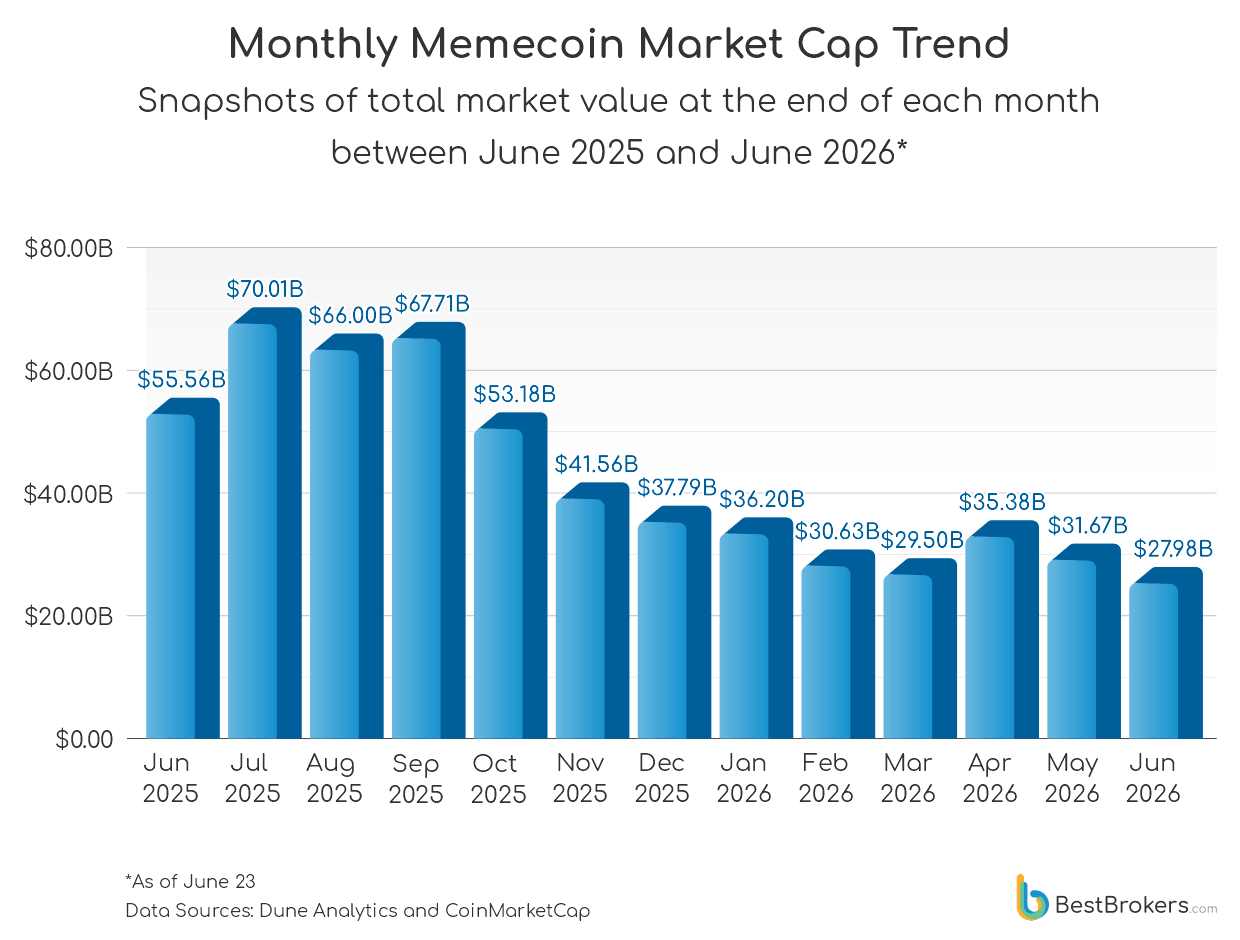
The memecoin market peaked in December 2024, when the sector’s total capitalisation reached roughly $137.2 billion, driven by a broader crypto bull run, the post-election surge in risk appetite following Donald Trump’s return to the White House, and the explosive growth of token launchpads such as Pump.fun. By July 2025, that figure had already fallen to $85.08 billion as early speculative enthusiasm gave way to oversaturation and declining retail interest. By June 29, 2026, total memecoin market capitalisation stood at just $22.14 billion, a 74% decline from the July 2025 level, and nearly 84% below the sector’s all-time high reached just 18 months earlier.
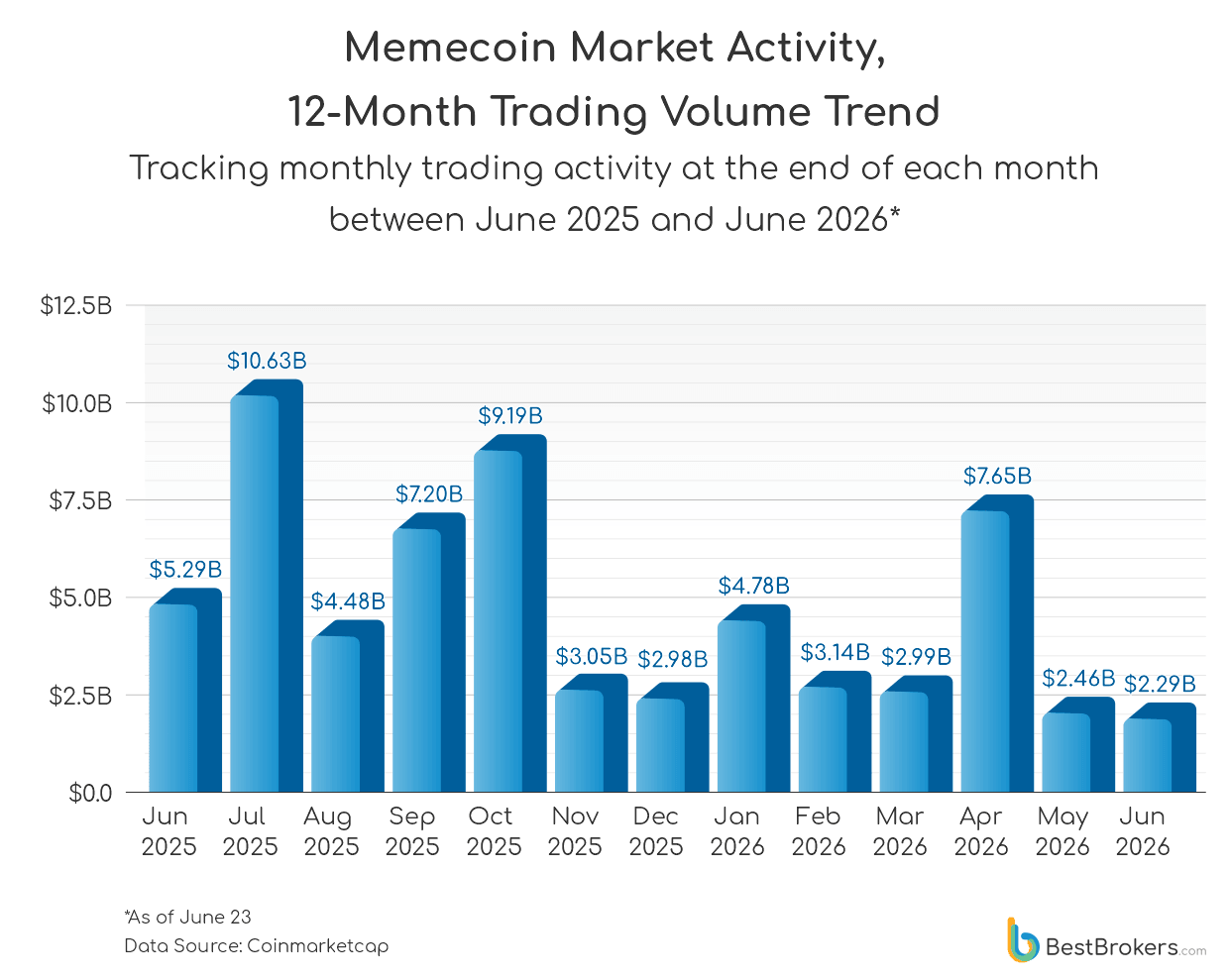
Monthly trading volume followed a similarly steep trajectory, peaking at $10.63 billion in July 2025 before declining sharply through the remainder of the year. The descent was not linear, brief volume spikes in October 2025 and April 2026 briefly interrupted the downtrend, but neither reflected genuine recovery. In memecoin markets, a spike in trading volume does not necessarily mean new money is entering, it can just as easily reflect existing holders selling, rotating between tokens, or taking profits before the next leg down. Each time, volume surged briefly, prices failed to hold, and participation thinned further once the momentum faded. By June 2026, monthly trading volume had fallen to just $2.29 billion, a drop of nearly 79% from the July 2025 peak.
Loss of Momentum
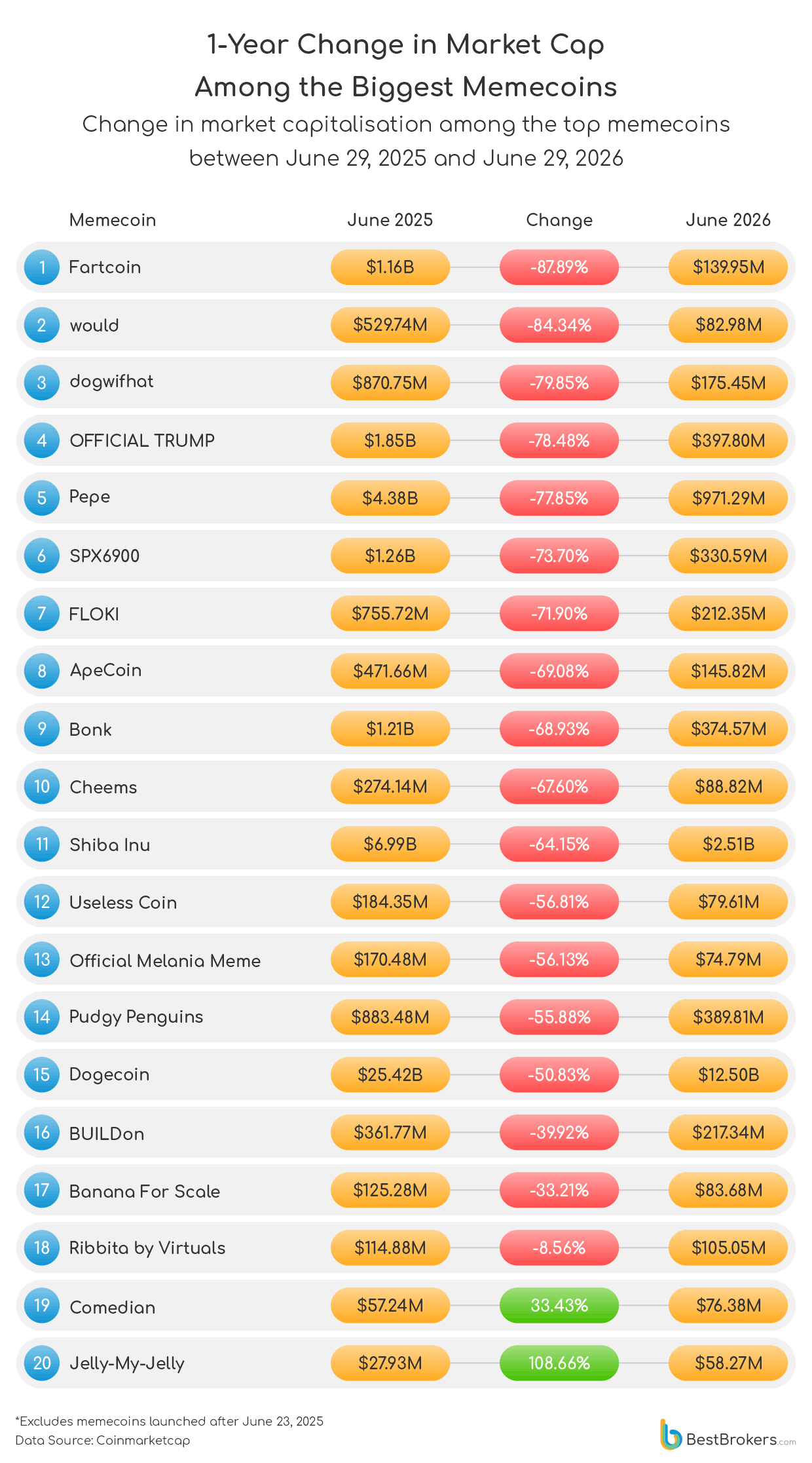
The decline of memecoins is even more striking at the individual token level. Fartcoin, one of the most prominent viral success stories in recent years, has seen its market capitalisation collapse by 87.9%, falling from $1.16 billion to just $139.95 million. Similar declines were recorded by Would (-84.34%) and dogwifhat (-79.85%), suggesting that many of the sector’s fastest-rising stars proved unable to sustain investor interest once market sentiment turned. Unlike established cryptocurrencies with broader ecosystems or utility, these tokens rely heavily on social media momentum and speculative trading, making them especially vulnerable as liquidity dries up.
Larger and celebrity-themed memecoins have fared no better. OFFICIAL TRUMP, the token launched by U.S. President Donald Trump ahead of his January 2025 inauguration, has fallen more than 95% from its peak market cap of $9 billion in January 2025. Over the past year alone, it shed a further 78.48%, dropping from $1.85 billion to just $397.8 million. Shiba Inu fell 64.15%, from $6.99 billion to $2.51 billion, while Dogecoin shed more than half its market cap, declining 50.83%% from $25.42B billion to $12.5 billion.
Although the longer-lived and more established memecoins saw less severe declines than the smaller speculative tokens, the pattern still points to a sector-wide contraction rather than a rotation between individual assets. When even the largest and most established memecoins are losing billions in value, the entire asset class is contracting, not just its weakest links.
The Crowd Thins Out
Daily Pump.fun Platform Users Over the Past Year
Tracking new and recurring users on Pump.fun from June 2025 to June 2026*
Pump.fun is arguably the platform that played the biggest role in the ascension of memecoins to global sensation. Allowing anyone to launch a memecoin in under a minute for less than $2, it became the primary gateway for retail traders during the boom, and its sign-up numbers tracked the hype cycle almost perfectly. Daily new-wallet creation peaked in late January 2025 at over 183,000 in a single day, fuelled by a wave of viral token launches and the kind of overnight success stories that were still credible enough to draw in newcomers. By early August 2025, daily traders on the platform had dropped 62% from their July peak as the market became saturated with near-identical tokens, early participants cashed out, and the broader Solana ecosystem saw overall activity hit a 12-month low. New wallet registrations briefly fell below 14,000 per day, a fraction of what they had been six months earlier.
In January 2026 , a second wave of interest occurred on the platform, when daily active addresses on Pump.fun reached 300,000 on January 27, the highest figure since early 2025, with over half being newly created wallets. The surge was driven by a broader memecoin rally as traders rotated into high-volatility assets following a period of post-holiday pessimism, with tokens like PEPE and Bonk posting sharp gains and briefly reviving retail enthusiasm. New user sign-ups hit 174,250 in a single day, close to the all-time peak. But the recovery proved short-lived.
By June 2026, daily new-user registrations had fallen back to around 20,000, roughly the same floor as the post-crash lows of late 2025. Recurring users, the active and loyal traders, have held comparatively steady at 60,000-100,000 per day throughout the same period. The gap between the two tells the clearest story: the people who were always going to leave have left, and what remains is a smaller, more experienced core that generates activity without generating growth. For most other platforms, a loyal and dedicated userbase is often enough, but for one that runs on fresh capital and new participants, a stable core is not a foundation, it’s what’s left after the foundation is gone.
Fewer Users, Less Revenue
Pump.fun Daily Revenue 1-Year Decline
Tracking Pump.fun daily revenue between June 2025 and June 2026*
Pump.fun’s revenue trajectory closely mirrors the broader unwinding of memecoin speculation. The launchpad takes a percentage cut of every trade executed through its bonding curve system, the mechanism that automatically prices tokens higher as more people buy in. The more tokens launching and trading hands, the more Pump.fun earns. When the market is active and traders are cycling rapidly through new launches, those fees accumulate fast. At the peak of the cycle in mid-September 2025, Pump.fun was generating up to $2.45 million in a single day, making it one of the most profitable platforms in the entire Solana ecosystem.
The decline since then has been steady and structural. Through late 2025, daily revenues settled into a $700,000-$1 million range as the pace of new token launches slowed and speculative cycles shortened. Fewer tokens were managing to hold attention long enough to generate sustained trading volume, and the bursts of high activity that had previously kept revenues elevated became progressively less frequent. The platform was still generating meaningful income, but the conditions that had produced its peak earnings, relentless retail enthusiasm, constant token rotation, and a seemingly endless supply of new participants, were slowly fading.
The structural break arrived in 2026. As new user inflows dried up, platform economics followed directly. By May, daily revenues had compressed to $300,000-$500,000, and by June 2026 they had fallen further to between $169,000 and $367,000 per day, a decline of more than 85% from the September 2025 peak, and the lowest sustained revenue levels the platform has recorded since the early days of the memecoin boom. Pump.fun has not changed its product. What it cannot replace is the crowd that made that product profitable.
Methodology
This report analyses the performance and market dynamics of memecoins over the past 12 months, focusing on user growth, daily token generation, trading volume, and market capitalisation. Daily and monthly data were used to track trends in new-user adoption, token issuance, and liquidity across top memecoins, providing insight into speculative activity and market health. Figures were sourced from Dune Analytics, CoinMarketCap, and CoinGecko, using data between June 2025 and June 2026. The analysis highlights correlations between user activity, token generation, and market metrics to identify the post-hype contraction phase of the memecoin market.