

Global financial institutions manage trillions of dollars in assets, facilitate international trade, and influence capital markets worldwide. But for job seekers, the first hurdle is often not market volatility or regulatory complexity – it is the interview process.
While firms such as JPMorgan, Goldman Sachs, and Visa are widely regarded as elite employers, little publicly available analysis exists on how difficult it is to secure a position at these institutions. To address this gap, the team at BestBrokers examined interview data from Glassdoor for the largest publicly traded financial companies globally, measuring average interview difficulty, candidate sentiment, and overall satisfaction.
The findings reveal notable contrasts between traditional banks, asset managers, insurance firms, and exchange operators, challenging common assumptions about which financial employers are the hardest to break into.
Key Takeaways:
- US auto and home insurer Progressive has the highest interview difficulty at 3.2/5, reflecting a selection process that many candidates report as challenging, even though overall employee satisfaction remains relatively strong (3.9/5).
- Global investment banks Goldman Sachs and Morgan Stanley, along with alternative asset manager Blackstone Group, also rank among the hardest to interview at with an average difficulty score of 3.1/5, reinforcing the ‘high finance = higher difficulty’ narrative.
- Among mega-cap firms, US multinational conglomerate Berkshire Hathaway stands out for the easiest interviews, with a difficulty score of 2.3/5, markedly lower than its closest peers, Hong Kong insurer AIA and Chinese Ping An Insurance, which register 2.6/5.
- Brazil’s main stock exchange operator B3 and French asset manager Amundi record the highest interview satisfaction (73% and 69%), while US-based exchanges Intercontinental Exchange and Coinbase show the lowest satisfaction (17% and 6%) and are also among the most difficult to enter (3.0/5)
From Banks to Insurers: The Financial Firms with the Toughest Hiring Processes
In 2026’s competitive financial labour market, interviews at leading institutions have become more demanding due to intense competition for specialised talent, complex role requirements, and rigorous evaluation standards. Financial firms frequently invest significant time and multiple assessment stages to differentiate between highly qualified candidates, particularly when skills in areas such as risk management, analytics, and compliance are in short supply and in high demand across the sector.
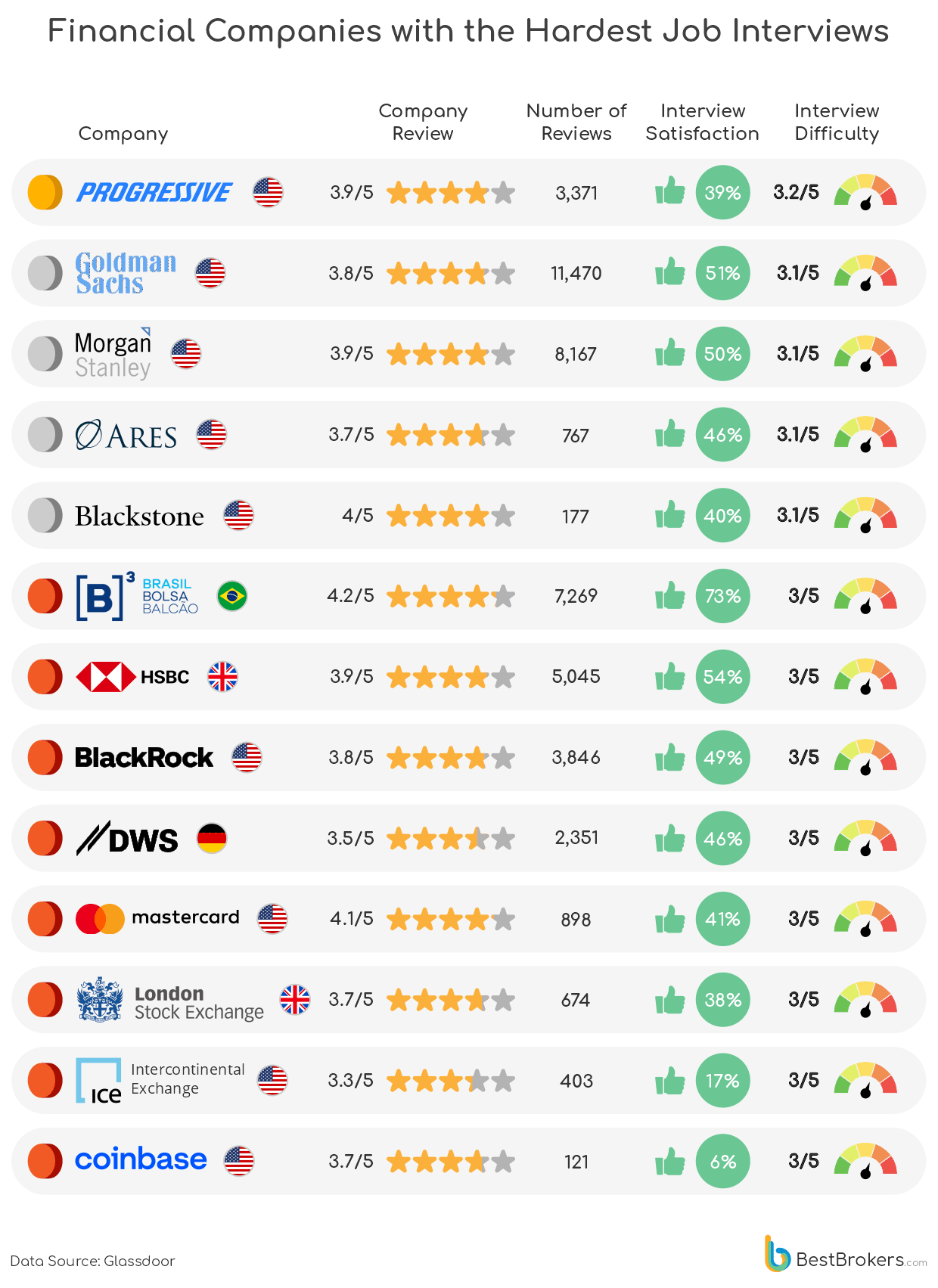
Interview processes vary sharply across financial firms, reflecting the unique demands of each organisation. American auto and home insurance company Progressive leads with a 3.2/5 difficulty score, suggesting candidates face a combination of technical assessments and cultural fit evaluations, likely tied to its data-driven underwriting and risk models. Investment banks and asset managers such as Goldman Sachs, Morgan Stanley, Blackstone Group, and Ares Management also rank highly in difficulty, driven by intense emphasis on analytical skills, market insight, and case-based problem solving, even for support or non-front-office roles. Glassdoor reviews highlight the intensity of these assessments and the professionalism of the process.
Yet difficulty alone does not dictate candidate perception. Brazil’s main stock exchange, B3 (Bolsa de Valores de São Paulo), achieves strong satisfaction ratings (73%) despite challenging assessments, indicating that well-structured interviews and clear communication can buffer the stress of a demanding process. The UK-based universal bank HSBC ranks second in satisfaction among difficult firms to get into (54%), with reviews noting coordinated HR and technical stages that leave candidates informed.
Global payment networks Mastercard and Visa illustrate how difficulty and candidate perception can diverge. Mastercard enters the hardest financial interviews with a score of 3.0/5, reflecting demanding assessments of analytical and problem-solving skills. Slightly less challenging at 2.9/5, Visa registers one of the poorest candidate experience scores in the dataset (26%), with comments citing ‘unclear feedback and unpredictable rounds’. This contrast shows that the intensity of an interview does not automatically translate into a positive experience – clarity, structure, and communication remain key to shaping candidate perceptions.
US-based cryptocurrency exchange Coinbase not only ranks among the hardest financial firms to interview for, with a 3.0/5 difficulty score, but also records the lowest candidate satisfaction in the dataset at just 6%, with feedback frequently referencing intensive multi-stage assessments, alongside concerns about communication gaps and limited feedback throughout the process.
The Surprising Leaders in Candidate-Friendly Recruitment Among Financial Titans
Across 2025-2026, many financial institutions have leveraged AI and data‑driven tools to reduce time‑to‑hire and improve candidate engagement, creating pathways for quicker decision‑making and more transparent evaluation metrics. At the same time, broader trends in the financial industry, including shifts toward flexible staffing models and the prioritisation of real‑world competencies over credentials, have influenced how certain firms structure their interviews, resulting in noticeably lower difficulty scores for some of the largest global organisations.
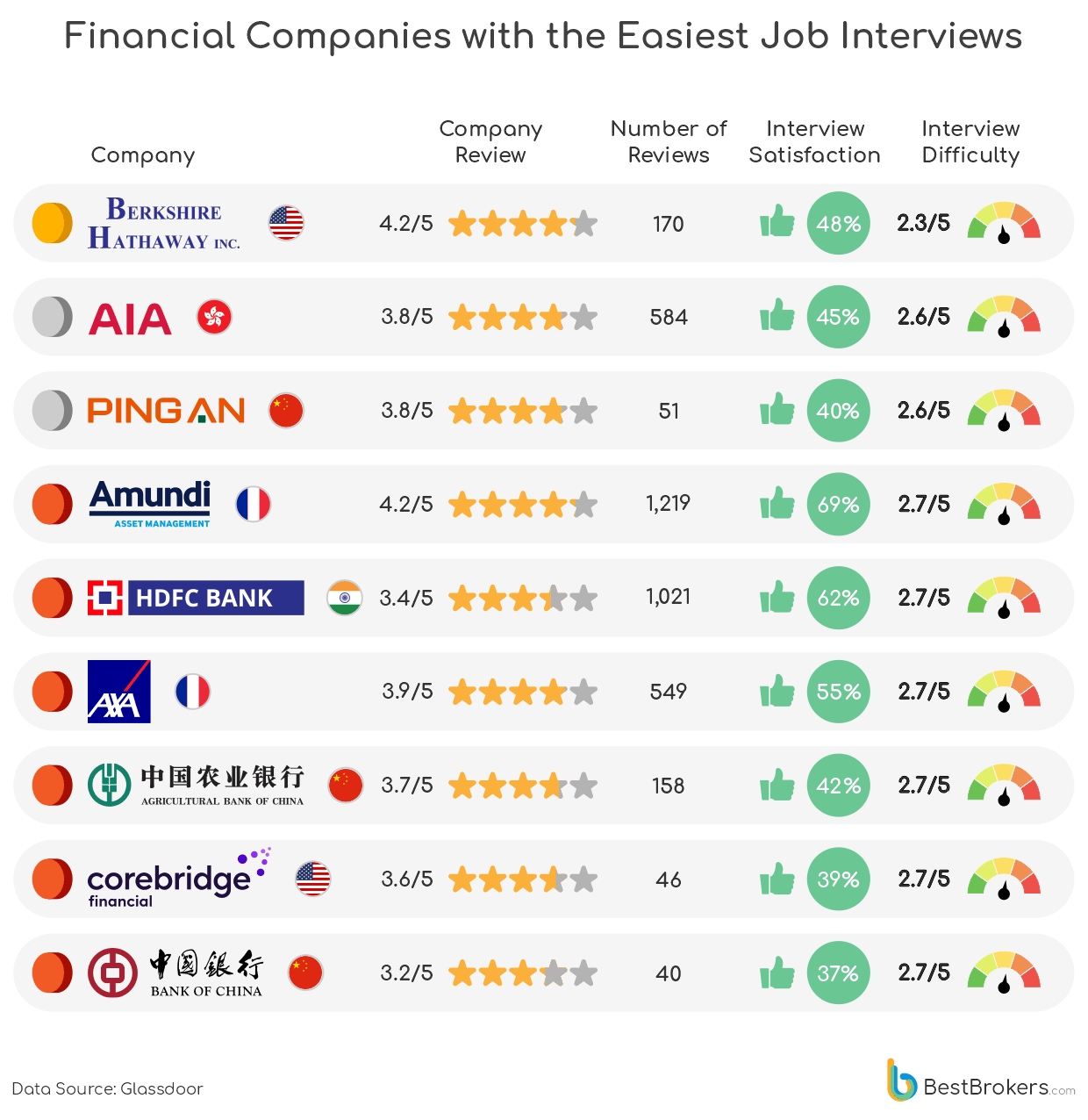
Berkshire Hathaway clearly leads among mega-cap firms with a remarkably low difficulty score of 2.3/5, creating a notable gap with its nearest peers, Hong Kong insurer AIA and Chinese financial services group Ping An Insurance, both at 2.6/5. Glassdoor interview reports on Berkshire Hathaway suggest candidate encounters often involve ‘conversational evaluations of experience and fit’ rather than extended technical gauntlets. Reviews of AIA and Ping An similarly indicate a stronger emphasis on core competencies and interpersonal skills over deep technical assessments, which may make their hiring processes more accessible to a broader range of applicants.
Interestingly, French investment and asset management firm Amundi achieves both moderate interview difficulty (2.7/5) and exceptionally high candidate satisfaction (69%), indicating that clear communication and well‑organised recruitment stages can enhance candidate perception even when assessment is moderately demanding. At India’s leading private-sector bank, HDFC Bank, headquartered in Mumbai, reviewers often describe a structured but efficient process with a mix of campus recruiting, HR screens, and role‑specific interviews, which may explain its high satisfaction rating (62%), despite moderate difficulty.
By contrast, two of China’s largest state-owned banks – Bank of China and Agricultural Bank of China – also register moderate difficulty ratings (2.7/5) but much lower satisfaction (37-42%), implying that ease of assessment alone does not guarantee a positive candidate experience. Regional differences, expectations, and the clarity of feedback appear to play a decisive role in shaping perceptions of the interview process.
High Standards, Happy Candidates: Which Employers in the Finance Sector Get It Right
Candidate satisfaction at certain financial firms illustrates that a selective process does not have to feel daunting. Brazil’s B3 achieves a remarkable 73% interview satisfaction, reflecting structured assessments and transparent communication despite moderate difficulty (3.0/5). Interviews are reported as ‘professional yet approachable’, with clear guidance on expectations, which appears to buffer candidate stress.
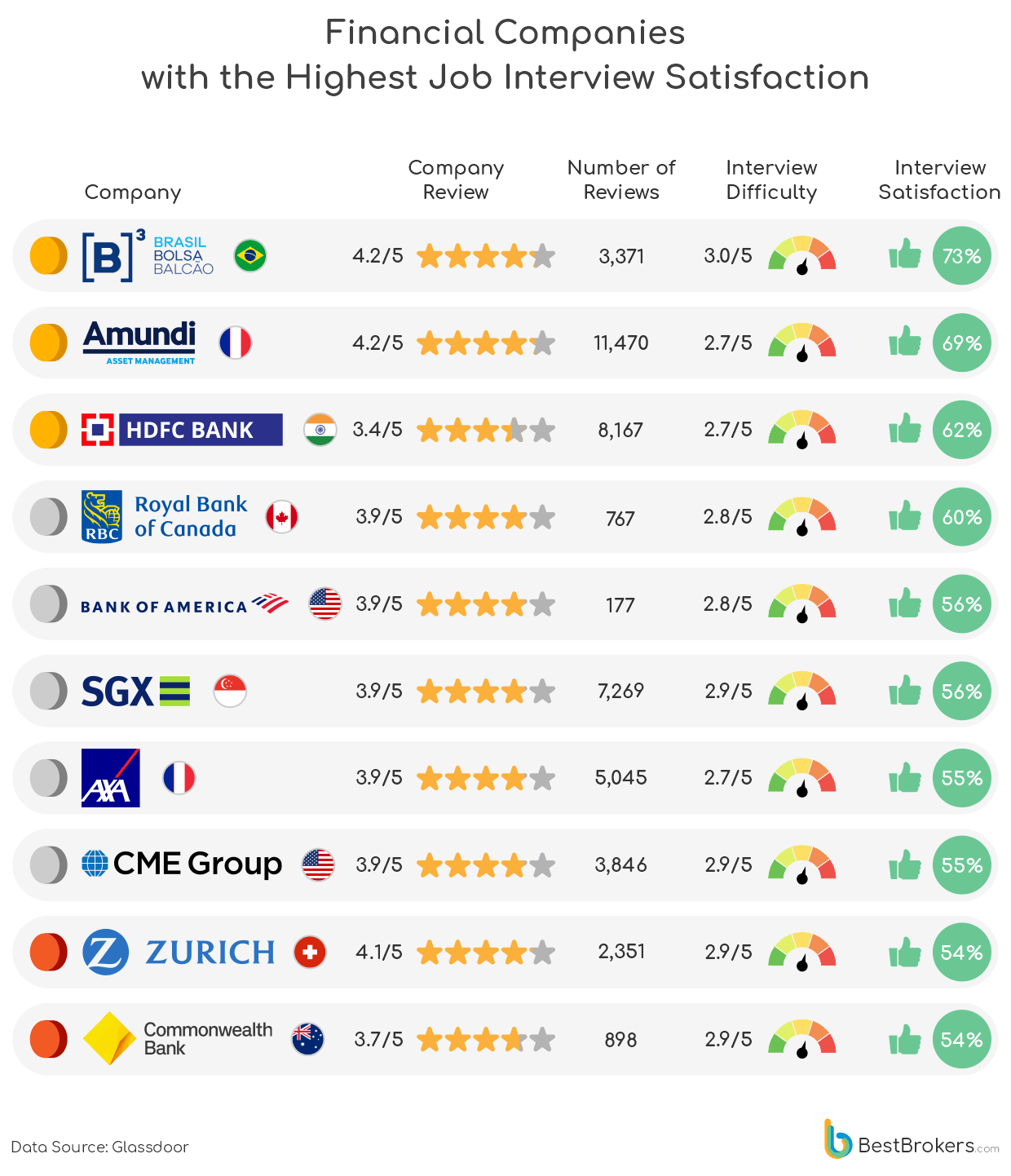
Amundi similarly combines a moderately selective process (2.7/5) with exceptionally high satisfaction (69%). Glassdoor reviewers note a ‘pleasant and structured’ experience, where HR discussions are followed by targeted role-specific conversations, balancing technical assessment with behavioural evaluation. This clarity and organisation are credited for the firm’s strong candidate perception.
Canada’s largest bank by market capitalisation, Royal Bank of Canada, maintains 60% satisfaction with interviews described as ‘smooth, transparent, and professional’, emphasising teamwork and real-world scenarios that make even selective hiring stages feel fair. Bank of America (56%) and Zurich Insurance Group (54%) show that structured rounds, clear role framing, and supportive interviewers are key drivers of positive perception, even when assessment stages involve technical or competency-based questions.
Other firms, including French multinational insurance and financial services company AXA, headquartered in Paris, and Singapore Exchange (SGX), the country’s primary stock and derivatives exchange, echo this pattern: moderately selective interviews paired with well-communicated expectations lead to high satisfaction scores, underscoring that the combination of transparency, structure, and interpersonal engagement can outweigh difficulty in shaping candidate experience.
Methodology
This report examines interview difficulty and candidate satisfaction across the world’s largest publicly traded financial firms. Companies were selected from CompaniesMarketCap based on market capitalisation, focusing on the largest firms within financial services, banks, investment, insurance, stock and crypto exchanges, and traditional stock exchanges. Only firms with over 30 Glassdoor interview reviews were included to ensure a reliable sample size.
Interview difficulty is reported directly by Glassdoor on a scale from 1 to 5, while interview satisfaction is calculated as the difference between positive and negative experiences reported in the reviews, providing a net measure of candidate perception. Additional metrics such as overall Glassdoor review, number of reviews, and the percentage of employees who would recommend the company were also considered to provide context.
By combining quantitative scores with qualitative insights from Glassdoor comments, this methodology allows for a nuanced understanding of how selective hiring processes relate to candidate experience across sectors and regions. All data is as of 24 February, 2025.