

The term ‘unicorn’ was introduced in 2013 by venture capitalist Aileen Lee to describe privately held startups valued at over $1 billion, companies so uncommon they seemed almost mythical. At the time, there were only a few dozen worldwide, making the label a true badge of exceptional success. A little more than a decade later, the landscape looks very different. Fueled by an unprecedented surge in venture capital and rapid growth in the global tech ecosystem, the number of unicorns has ballooned into the thousands.
As of March 2026, a total of 1,705 startup companies have reached valuations of US$1 billion or more, earning unicorn status. This prompted the team at BestBrokers to analyse the latest data from Crunchbase, TechCrunch, and PitchBook to identify which industries are producing the most new unicorns, which regions have the most billion-dollar private startups, and which private companies are attracting the most investor attention in today’s volatile market.
Which countries are home to the most Unicorns in 2026?
Unicorn startups around the globe are heavily concentrated in a handful of countries, with the United States in the lead, as the country is home to 881 privately held companies valued at over $1 billion, more than half of the world’s 1,705 total unicorns. The U.S. also hosts many of the most valuable private startups globally, including SpaceX, the world’s most valuable unicorn with a valuation of $1.25 trillion, as well as OpenAI ($840B), Anthropic ($380B), Stripe ($159B), Databricks ($134B), and Waymo ($126B). The country’s dominance reflects its deep venture capital ecosystem, world-leading research universities, and major technology hubs such as Silicon Valley that consistently produce high-growth startups.
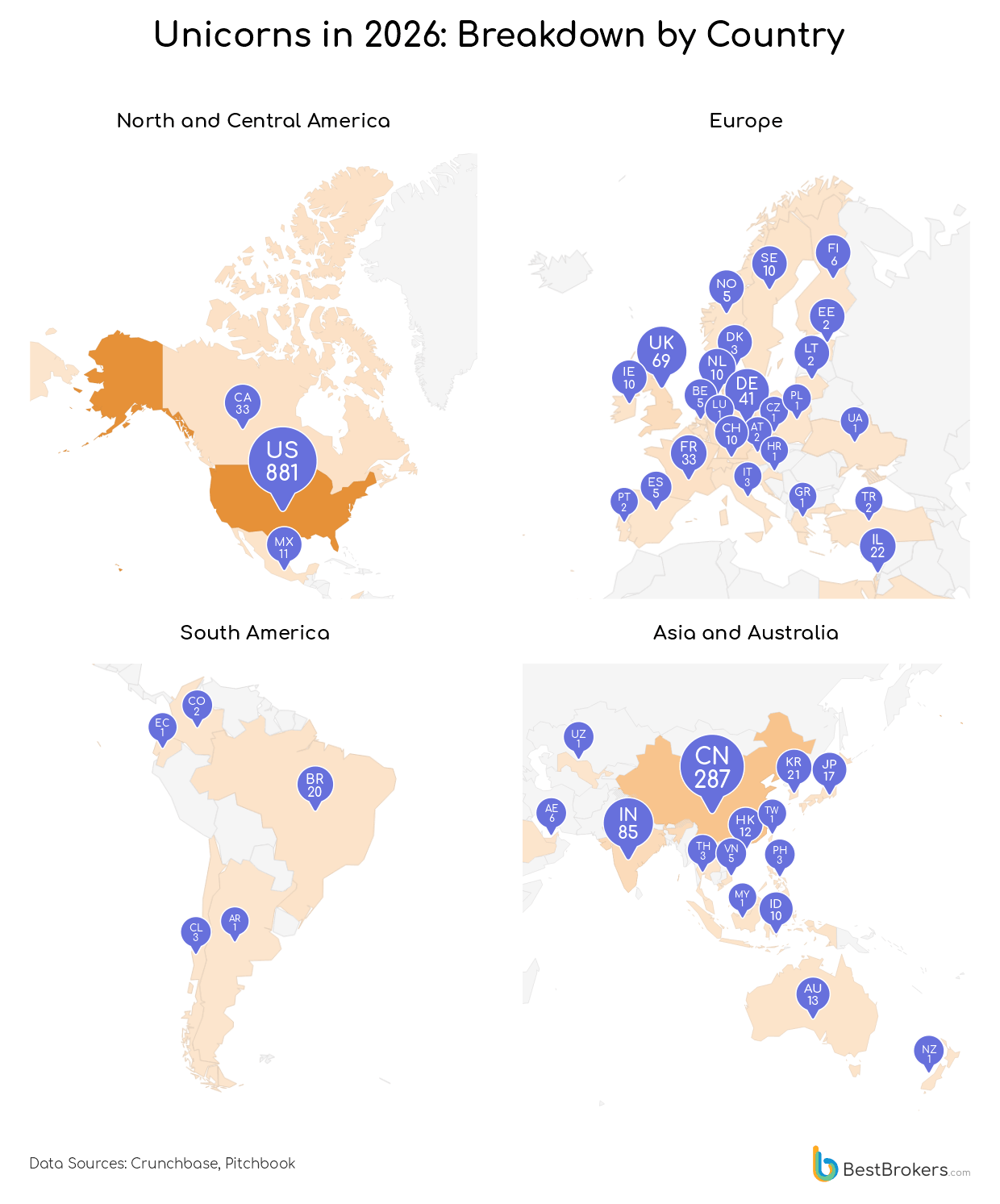
In Asia, China ranks second with 287 unicorn companies, driven largely by its massive domestic market and strong technology sector. Among its most valuable private startups are ByteDance, the parent company of short-form video app TikTok, and its Chinese counterpart, Douyin, valued at $480B, and fintech giant and Alibaba affiliate Ant Group, worth about $150B. India has emerged as another major unicorn hub with 85 companies, supported by rapid digital adoption and a huge consumer base. Two of its biggest startups include Reliance Retail ($101B) and Reliance Jio ($58B), both part of the broader digital expansion of the Indian economy. Another Asian nation with a dense concentration of unicorn startups is Singapore, home of global E-commerce platform Shein, placing 10th worldwide with 22 unicorn startups.
In Europe and other regions, unicorn numbers are smaller but still notable. The United Kingdom leads Europe with 69 unicorns, many of which are in the finance sector, including fintech leader Revolut ($75B) and payments firm Checkout.com ($40B). South and Central America host roughly 38 unicorn companies spread across countries like Brazil (20), Mexico (11), Chile (3), and smaller counts in Colombia and Argentina. The most valuable unicorns in the region include Brazil’s QuintoAndar, iFood, and C6 Bank, all valued at $5 billion, Mexico’s financial platform Plata ($3B), and Argentina’s fintech company Ualá, also valued at $3 billion.
The largest unicorn companies in the world in 2026
In 2026, a handful of extraordinary private companies have achieved valuations that dwarf most public corporations. At the very top sits Elon Musk’s SpaceX, which has become the first private company ever to exceed a $1 trillion valuation after its merger with xAI, creating a combined entity valued around $1.25 trillion ahead of a planned IPO, a record in private market history. Close behind in second place is ChatGPT’s OpenAI, also nearing the $1 trillion mark with a current valuation of $840 billion following a massive $110 billion investment (the biggest investment in a private company to date) by technology giants Amazon, Nvidia, and SoftBank. Another key company in AI with a massive valuation is Anthropic, which recently secured $30 billion in Series G funding led by GIC and Coatue, boosting its valuation to a whopping $380 billion.
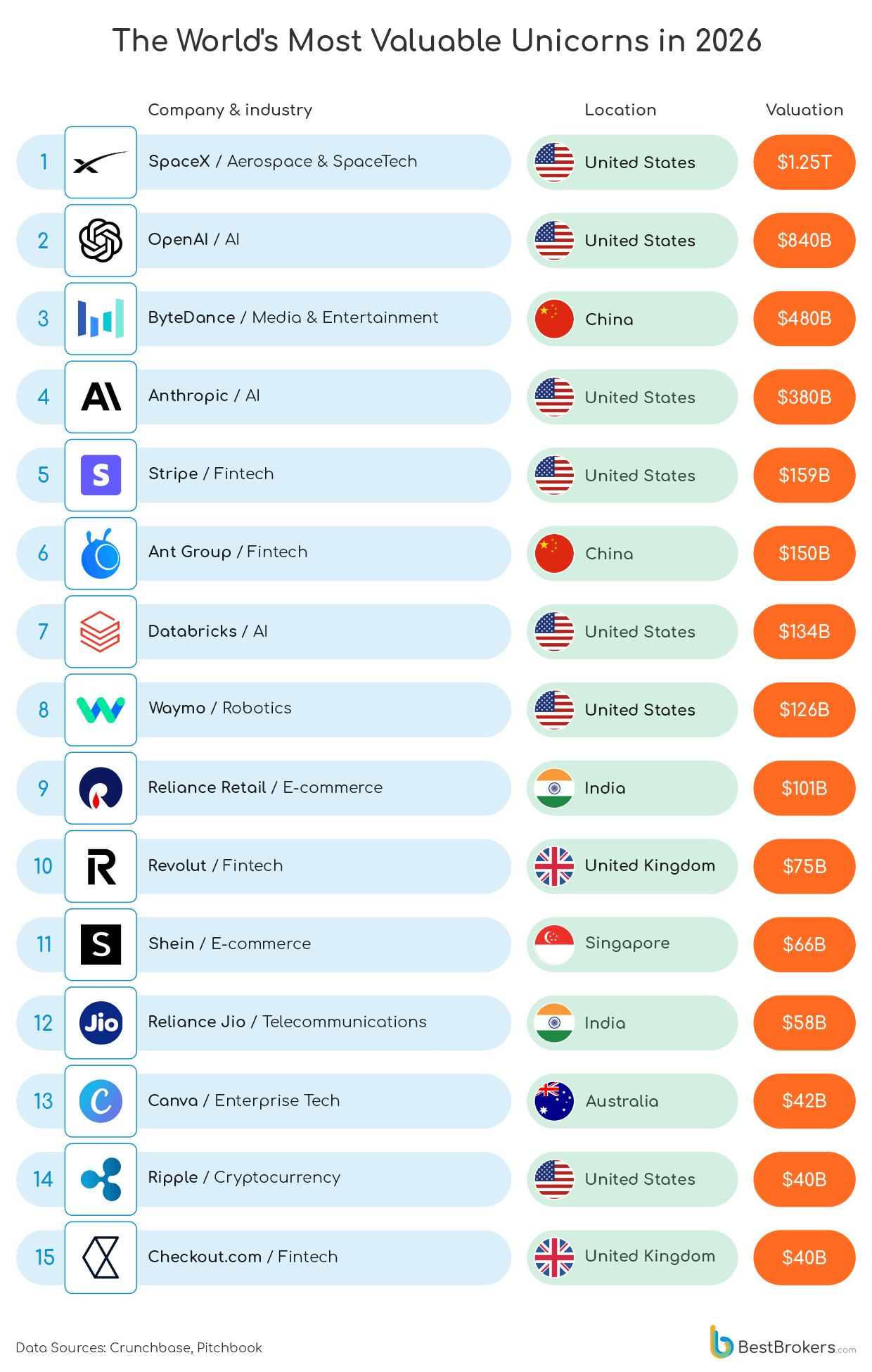
China’s ByteDance maintains its status as one of the world’s most valuable private companies with a valuation of $480 billion, sustained by global adoption of its media services, TikTok, and Douyin. Fintech startups with massive valuations like Stripe ($159B) and Revolut ($75B) highlight the enduring strength of digital payments and financial services platforms. Beyond these, companies such as India’s Reliance Retail and Singapore’s Shein illustrate how diversified sectors like e‑commerce and telecommunications have produced some of the largest private enterprises outside the U.S. and China.
9 AI Startups Became Unicorns in 2026 So Far, The Most Out Of Any Sector
Artificial intelligence companies account for the largest share of startups that reached a $1 billion valuation in 2026. Of the 39 companies that achieved unicorn status this year, 9 operate in the AI sector, representing 23.1% of the total. These businesses focus on building AI infrastructure and specialised tools built on large language models, reflecting how deeply artificial intelligence has become integrated into the broader technology ecosystem.
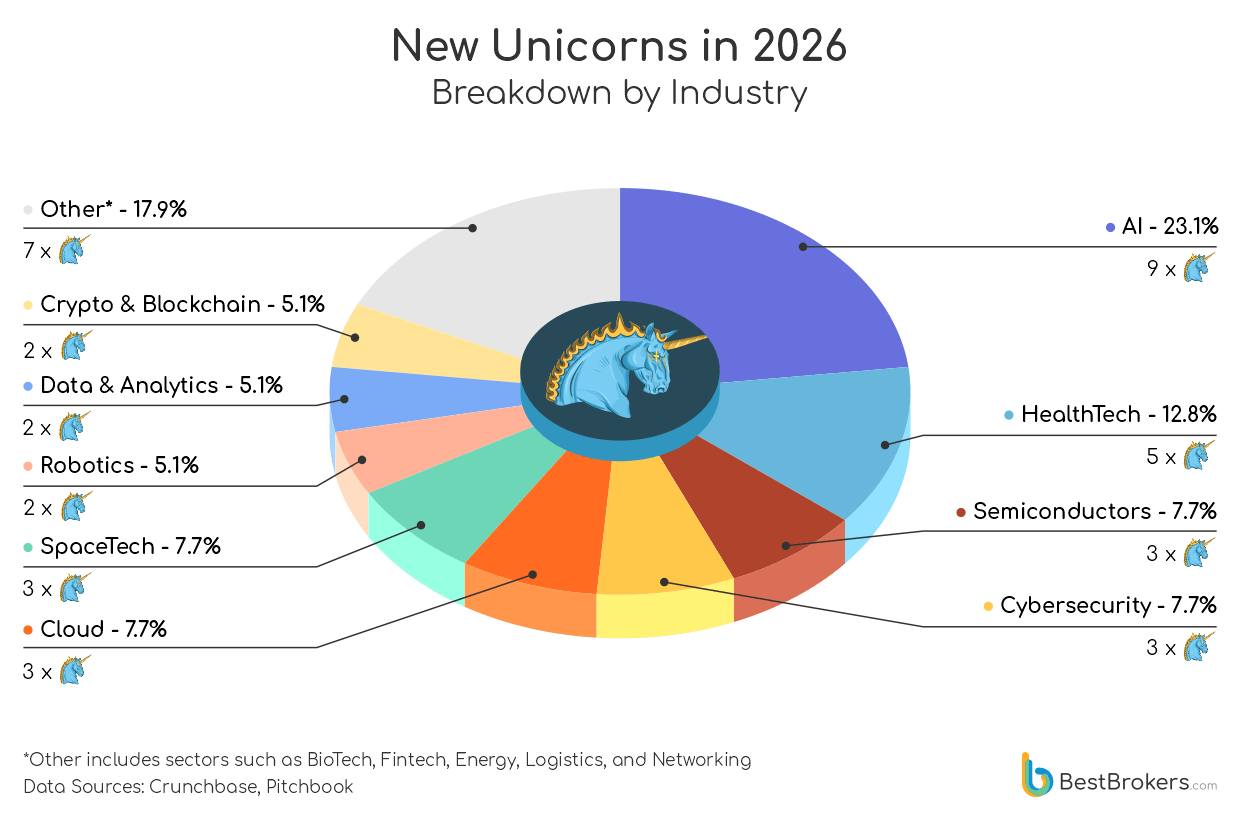
HealthTech ranks as the second-largest category, with 5 companies (12.8%) reaching unicorn status. These firms span digital health platforms, AI-assisted diagnostics, and data-driven healthcare services, illustrating how venture capital continues to flow into technologies aimed at improving healthcare delivery and patient outcomes.
Semiconductors, Cybersecurity, Cloud & Infrastructure, and the SpaceTech industries each produced 3 new unicorns so far this year. These sectors form much of the underlying infrastructure of the modern digital economy, from advanced chip design and secure digital systems to cloud computing platforms and the growing commercial space industry. Robotics, Data & Analytics, and Cryptocurrency & Blockchain each added 2 companies (5.1%) to the unicorn ranks of 2026, showing continued investor interest in automation, large-scale data processing, and digital asset technologies.
The remaining seven companies, or 17.9% of the total, fall across a range of other sectors, including areas such as biotech, enterprise software, and specialised technology niches. While artificial intelligence accounts for the largest single share of new unicorns in 2026, the broader distribution across industries indicates that high-growth startups are still emerging across a wide range of technological and commercial fields.
Ricursive Intelligence Takes The Crown As The Most Valuable New Unicorn Startup in 2026
Among the startups that first crossed the $1 billion valuation threshold in 2026, Ricursive Intelligence stands out as the most highly valued. The U.S.-based artificial intelligence company reached a $4 billion valuation in January after raising $300 million in a Series A round led by Lightspeed Venture Partners, just weeks after launching publicly. The company was founded by former Google DeepMind researchers Anna Goldie and Azalia Mirhoseini, whose earlier work on the AlphaChip system helped automate chip design for Google’s TPU processors.
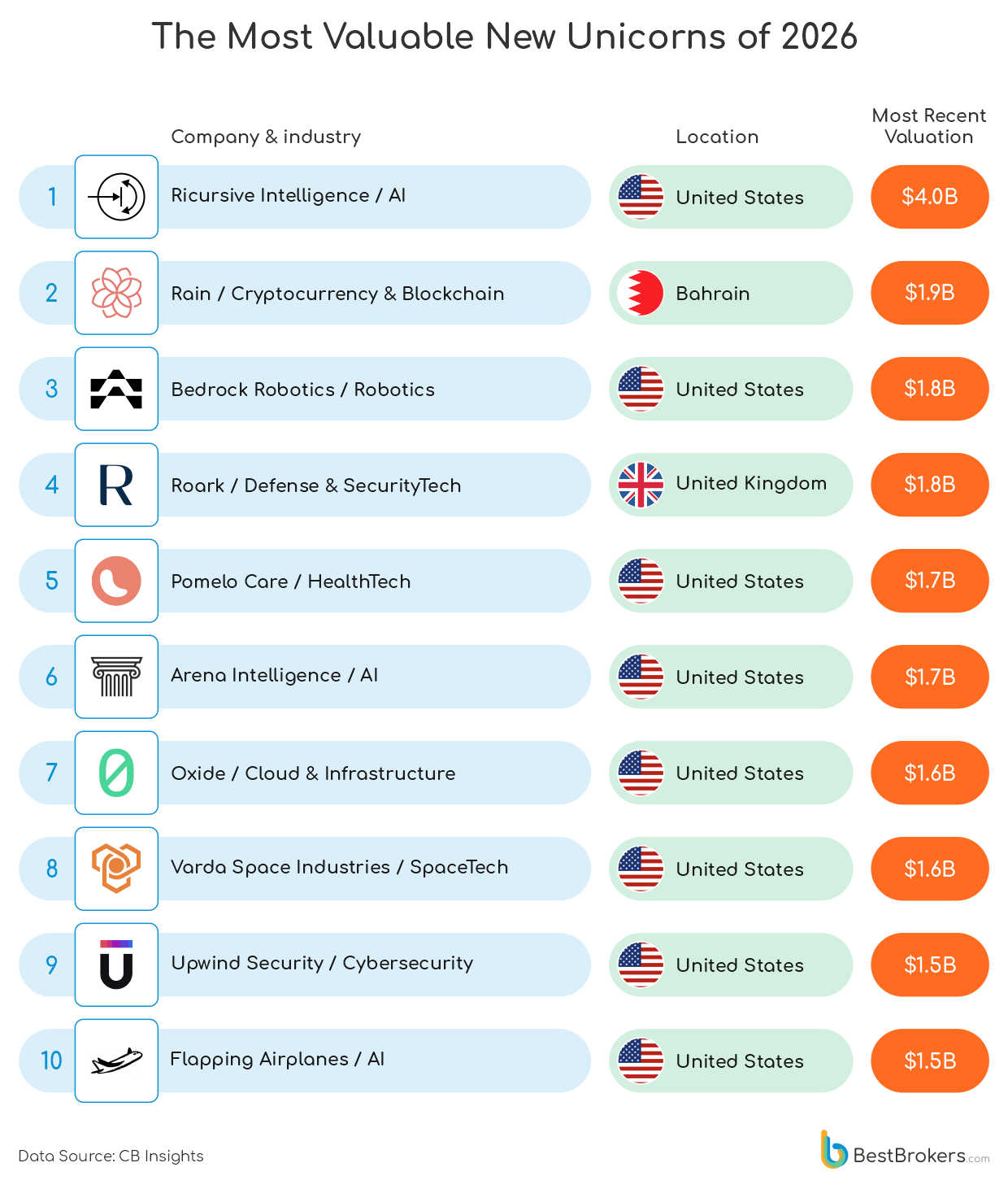
Several other companies that reached unicorn status this year are building technologies in fields such as robotics, healthcare, and digital infrastructure. Rain, a Bahrain-based cryptocurrency platform valued at $1.9 billion, is now the most valuable crypto & blockchain startup among all startups that reached unicorn status in 2026. In the United States, Bedrock Robotics reached a $1.8 billion valuation, reflecting continued investment in automation and robotics technologies designed for industrial and logistics applications. Another notable entrant is Pomelo Care, a digital healthcare company valued at $1.7 billion, which focuses on maternal and newborn care services delivered through a technology-enabled care platform.
A number of the year’s unicorns are also building core infrastructure for emerging technologies. Varda Space Industries, valued at $1.6 billion, is developing spacecraft designed to manufacture high-value materials in orbit before returning them to Earth, part of a growing commercial space economy. In cloud and cybersecurity infrastructure, companies such as Oxide and Upwind Security have also joined the unicorn ranks, with Upwind reaching a $1.5 billion valuation following a $250 million Series B funding round led by Bessemer Venture Partners. The company’s platform focuses on “runtime-first” cloud security, monitoring live cloud environments to detect vulnerabilities and attacks in real time.
Methodology
To illustrate the current state of unicorn startups, the team at BestBrokers analysed company data from The Crunchbase Unicorn Board, which tracks privately held companies valued at $1 billion or more. Additional information on company valuations, funding rounds, and newly created unicorns was gathered from platforms such as PitchBook, as well as industry coverage from TechCrunch and other publicly available sources.
Using these datasets, we identified current unicorn companies and grouped them by country, industry, and valuation to show their distribution across the global tech ecosystem. We also compiled a separate list of startups that first crossed the $1 billion valuation threshold in 2026 based on the most recent funding announcements and reported valuations.
All figures reflect the most recent data available at the time of writing. Because startup valuations and funding rounds change frequently, the total number of unicorn companies and their valuations may evolve over time.