
For millions of people, side hustles are no longer just about extra spending money. Rising living costs, economic uncertainty, and concerns about job security have pushed many workers to look for additional income streams outside their primary jobs. At the same time, they have evolved into one of the Internet’s biggest financial obsessions. Videos promising passive income, remote gigs, or ‘$1,000-a-week side hustles’ regularly attract millions of views, while finance-focused communities such as ‘FinTok’ continue to grow among younger users.
This inspired the team at BestBrokers to examine some of the most viral and widely discussed side hustles in 2026 and evaluate them across a range of metrics, including average earnings, income ceiling, stability, scalability, platform fees, startup costs, and burnout risk. Using data from official platform reports, freelancer marketplaces, worker surveys, and industry research, this report explores which side hustles are actually worth trying, and which are oversaturated, unstable, or far less profitable than social media trends often suggest.
Because side hustles differ widely in structure, earning potential, and accessibility, creating one standardised ranking across all of them proved impractical. Instead, we divided them into four categories – gig work, freelancing, e-commerce (inventory-based and non-inventory-based), and content creation – and compared opportunities within each category rather than across the entire market. As an additional metric, we also identified the 10 most viral side hustles in 2026 based on the number of posts tied to their three most popular related hashtags on TikTok.
Key Takeaways:
- Uber drivers earn the highest average hourly income among app-based gig jobs at $22.20 per hour, while DoorDash couriers make half that amount, averaging just $11.36 per hour.
- Among freelancing side hustles, life coaches command the highest average rates, earning around $150 per hour on Upwork, more than three times the average earnings of content creators and affiliate marketers, and roughly five times higher than tutors and Canva designers.
- Within e-commerce, selling digital products offers the best overall balance of low costs, high margins, scalability, and long-term stability, while Shopify stores and Amazon FBA provide higher revenue potential but come with greater risk, costs, and operational complexity.
- Among content platforms, YouTube performs best overall because it offers scalable reach, multiple income streams, and long-term passive earnings, while others rely more on constant activity or trends.
- The most viral side hustles on TikTok are e-commerce freelancing, digital art, and dropshipping, with their leading hashtags collectively accumulating between 2.3 and 3.6 million posts.
Gig Work: Freedom or Being a Slave to the App
When many people think about the gig economy, they picture a broad mix of flexible online and freelance work. However, this section focuses on a more specific and comparable segment: on-demand app-based jobs such as ride-hailing and delivery. These roles were selected because they operate under similar task-based pay structures and represent some of the most accessible entry points into gig work, making them useful for comparing income, stability, and earning potential across platforms.
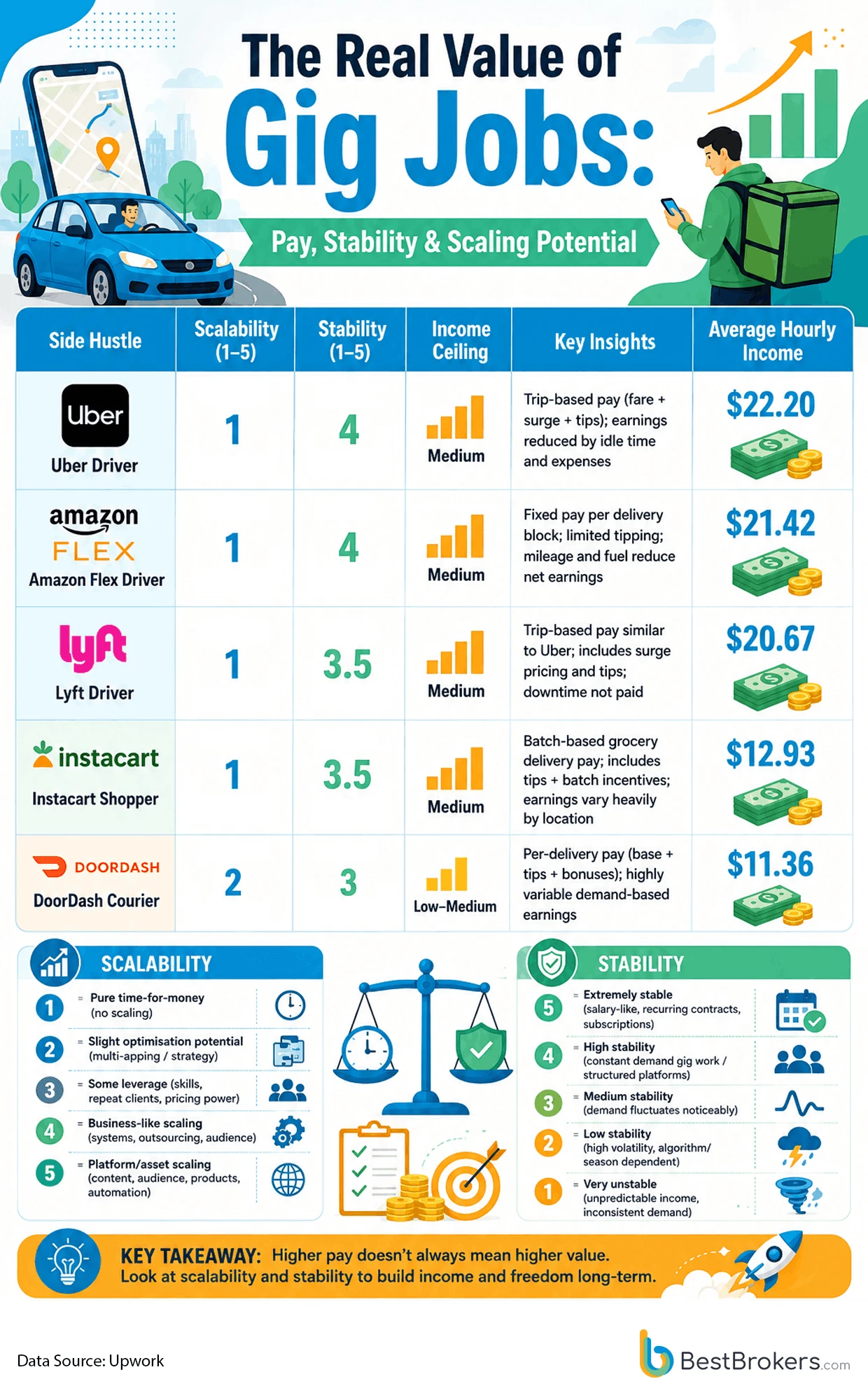
While the hourly earnings figures are drawn from Gridwise Analytics, which compiles real-world income data from gig workers tracking their trips and work activity across multiple platforms, the broader evaluation of scalability, stability, and income potential is based on analytical scoring to compare how these roles function beyond just pay levels.
Across these on-demand gig roles, the overall pattern is consistent: income is relatively accessible but structurally constrained. Most platforms, such as Uber, Lyft, Amazon Flex, Instacart, and DoorDash, sit at the very low end of scalability (1-2/5), meaning earnings scale almost entirely with hours worked rather than systems, assets, or audience building. In practical terms, there is little long-term leverage – drivers and couriers can optimise routes or multi-app, but income remains fundamentally tied to active time on the platform.
@the.rebrandugc Another day another flex 💪🏾 #amazonflex #amazon #sidehustle #fypppp ♬ original sound – CYE
Stability, however, varies more meaningfully between roles. Uber and Amazon Flex score highest due to more consistent demand patterns and structured trip or delivery block systems, making income slightly more predictable. Lyft follows closely but with slightly more volatility, while Instacart and DoorDash tend to be the least stable, as earnings fluctuate heavily based on order volume, location density, and tipping behaviour. This creates a clear separation between ‘more predictable gig work’ (ride-hailing and structured delivery blocks) and ‘highly variable gig work’ (food and grocery delivery).
@mrmentorrr £21 per hour! Is it worth it? A cheeky 8 hour Friday shift, Definitely a lot busier than January الحمدلله #sidehustle #uberdriver #hardworking #earnings ♬ Deen Over Dunya (Vocals only) – Halal Beats
Overall, Uber Driver emerges as the strongest all-round option in this group, combining the highest average hourly income with relatively higher stability compared to most alternatives. Amazon Flex is a close second due to similar earnings and structured scheduling, while Lyft performs slightly lower but remains in the same tier. Instacart and DoorDash rank lower overall due to weaker hourly earnings and higher variability, even if they offer flexibility and easy entry. However, the more stable and higher-paying roles still remain fundamentally low in scalability, meaning none of these jobs breaks out of the time-for-money constraint that defines on-demand gig work.
Mapping Freelance Work: Income, Stability, and Leverage
Unlike app-based gig work, freelance careers vary far more in how income is generated, scaled, and sustained over time. Some roles rely almost entirely on direct client work and hourly billing, while others can evolve into audience-driven businesses, recurring retainers, or automated income systems. This creates a much wider gap between stable but limited service roles and high-upside freelance careers with strong long-term leverage potential.
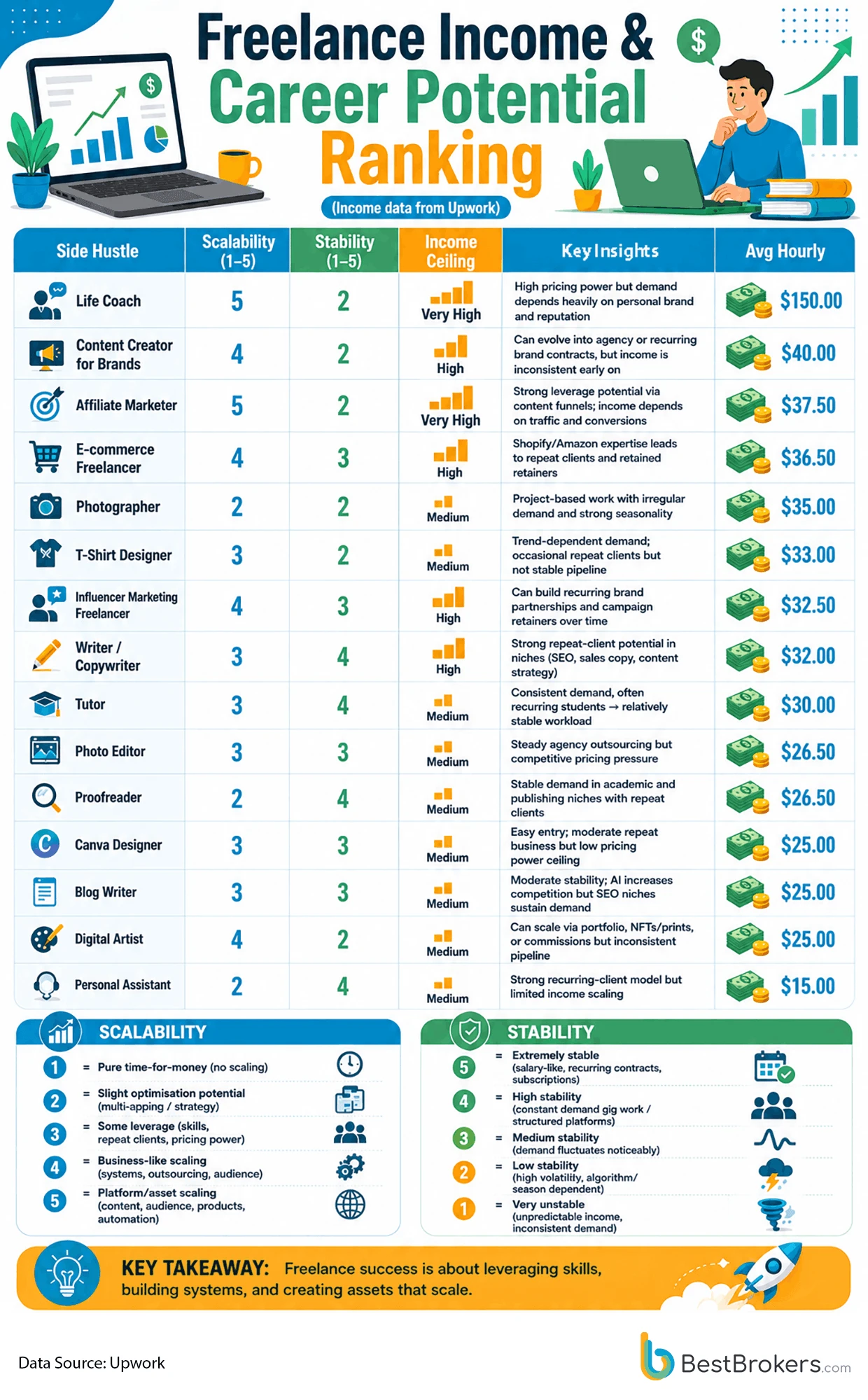
The highest-paying role in the ranking is life coach, averaging around $150 per hour, largely due to high pricing power and premium positioning. However, despite its enormous income ceiling, coaching also scores relatively low on stability because earnings depend heavily on personal branding, reputation, and client acquisition. At the other end of the spectrum, roles such as personal assistant, proofreader, and tutor tend to offer lower hourly earnings but stronger stability due to repeat-client relationships and more predictable demand.
@daniellelowy Let me know what else I can breakdown for you 👇
Roles such as affiliate marketer, content creator for brands, e-commerce freelancer, and digital artist score highly on scalability because they can turn into systems-based businesses, recurring retainers, audience-driven brands, or productised services. By contrast, photography, proofreading, and assistant work remain more constrained by direct labor hours. Among the strongest all-round performers in the ranking is the e-commerce freelancer, which combines relatively high hourly income with stronger stability than many creator-focused roles, largely because businesses increasingly rely on Shopify, Amazon, and digital storefront expertise.
@digital.priestess POV: you accidentally built a six-figure business on Pinterest, so you’re starting a fresh affiliate marketing account from zero – and bringing the newbie Pinterest girlies along for the ride 📌 If you’ve been wanting to know how to start affiliate marketing Pinterest account – stick around 😍 #pinterestmarketing #affiliatemarketing #softgirlmarketing #pinteresttips #pintereststrategist ♬ original sound – Hannah | Pinterest Queen 👑
The broader freelance market in 2026 is also being reshaped by AI and automation. According to Upwork’s latest skills report, demand for AI-related freelance skills grew by more than 100% year over year, with AI video editing, AI integrations, and chatbot-related work seeing particularly rapid growth. At the same time, the rise of generative AI is increasing pressure on lower-barrier freelance categories such as generic content writing and basic design work, where competition and automation are pushing rates downward. However, demand for highly human, strategic, or creative work remains resilient, with businesses still prioritising originality, niche expertise, and client-specific problem solving over fully automated output.
The Business Models Behind Modern E-commerce
E-commerce businesses are built around products, systems, and customer acquisition rather than direct hourly labor. This creates a much wider range of scalability outcomes, with some models remaining highly operational and inventory-dependent, while others can scale through automation, digital distribution, or recurring revenue. Our ranking compares both inventory-based models, such as Amazon FBA, Shopify stores, Etsy, and eBay selling, and no-inventory approaches like dropshipping, print-on-demand, subscription boxes, and digital products.
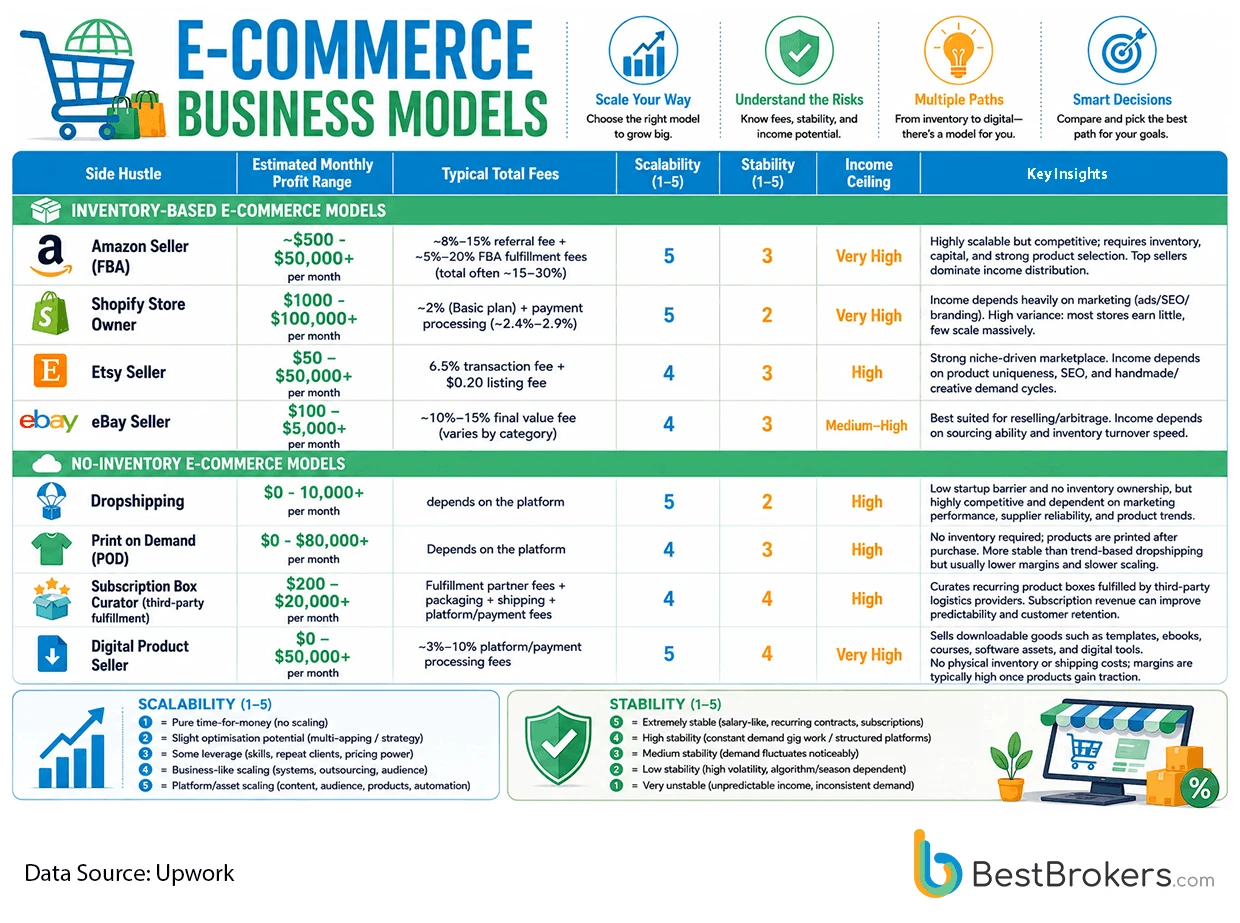
Among the strongest overall performers is the digital product seller model, which combines very high scalability with relatively strong long-term stability. Unlike physical-product businesses, digital products such as templates, courses, software assets, and downloadable tools can be sold repeatedly without inventory, shipping, or fulfillment costs, allowing margins to remain significantly higher once products gain traction. At the same time, AI-generated content and design tools have dramatically lowered entry barriers in 2026, leading to rapid growth in digital product marketplaces but also increasing saturation and competition.
@beverlytemplates Here’s exactly how to make a Shopify website if you're a beginner! Save hours from doing your entire website from scratch, done-for-you Shopify website templates are available on my website. #shopifywebsitedesign #shopifytips #shopifystore #shopifysmallbusiness #startabusinessonline ♬ original sound – McKenna Beverly
Shopify store owners and Amazon FBA sellers also rank at the top for scalability and income ceiling, with some stores generating six- or even seven-figure annual revenues, though rising advertising costs and stronger marketplace competition have made profitability increasingly dependent on branding, niche selection, and customer retention rather than simply launching products.
@wordyandwild Start the thing! ✨ #booktok #smallbusiness #smallbiz #bookish #booksubscription ♬ original sound – certainlybee
Lower-barrier models such as dropshipping and print-on-demand remain widely popular because they require little upfront capital and no inventory ownership, but both tend to show weaker long-term stability due to dependence on trends, paid advertising performance, and algorithm-driven discovery. Meanwhile, subscription box businesses stand out for a different reason: recurring monthly revenue. In recent years, subscription-based commerce has continued expanding across categories such as wellness, pet products, gaming, and specialty foods, largely because recurring customers improve predictability and long-term retention compared to one-off purchases.
How Online Creators Turn Attention Into Income
The creator economy has transformed online attention into one of the Internet’s largest new income streams. This creates some of the highest scalability potential in the digital economy, as successful creators can monetise the same content repeatedly through advertising, sponsorships, memberships, affiliate sales, and platform rewards. However, income stability varies significantly between platforms, largely depending on how discoverability algorithms, audience loyalty, and monetisation systems operate.
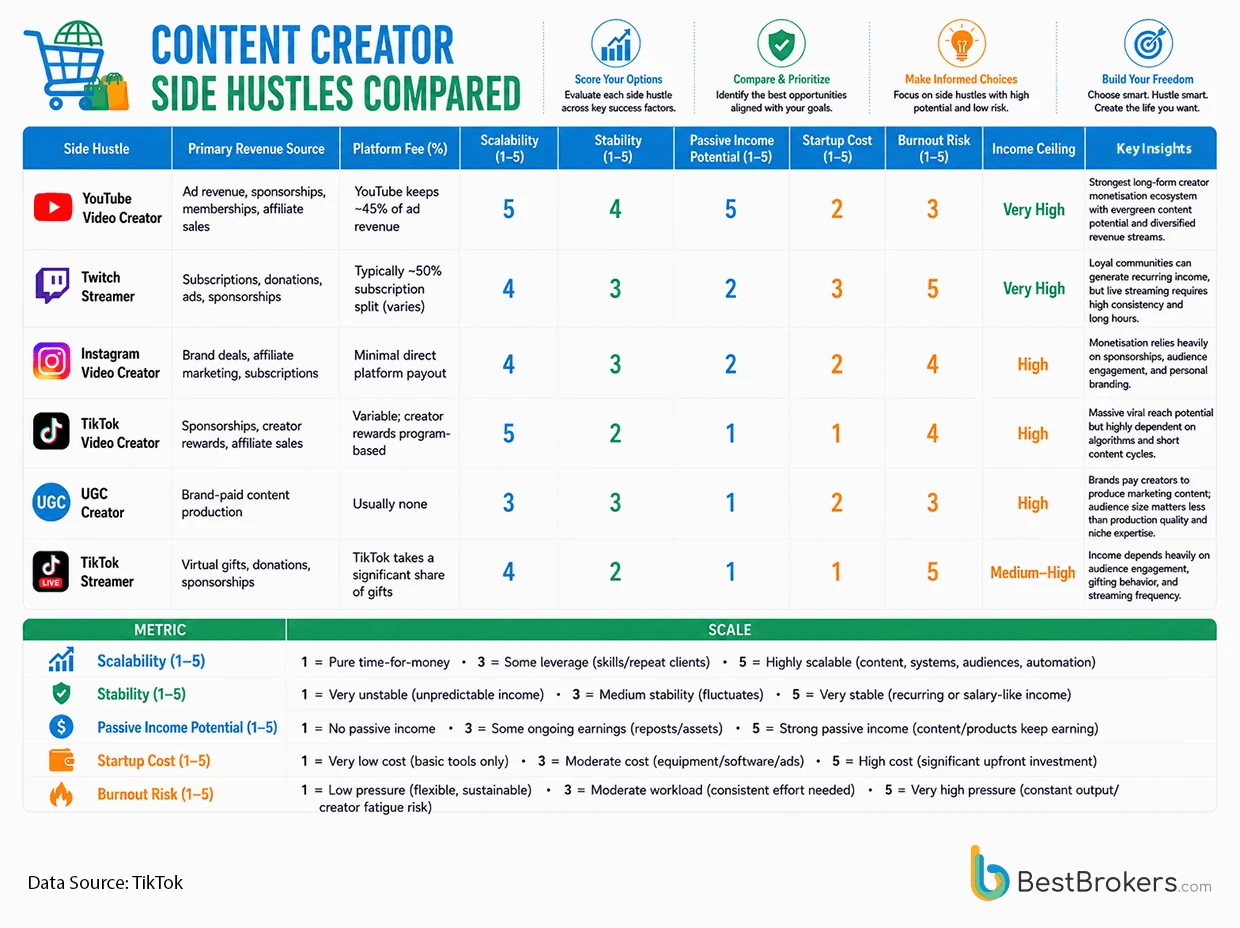
Among all creator side hustles, YouTube appears to be the strongest platform overall, combining high scalability, relatively strong stability, and the highest passive income potential in the category. Unlike short-form platforms where content visibility often disappears quickly, YouTube’s search and recommendation system allows videos to continue generating ad revenue months or even years after publication. This evergreen structure has become even more important in 2026 as creators increasingly diversify income through courses, memberships, affiliate marketing, and brand partnerships rather than relying purely on platform payouts.
Meanwhile, TikTok remains one of the fastest-growing discovery platforms on the Internet, but creator income is still highly dependent on algorithms, trends, and constant posting frequency, making it one of the least stable ecosystems despite its enormous viral reach potential.
@personalbrandlaunch0 TikTok vs. Instagram vs. Youtube Follow for more social media marketing education.
Livestream-based models such as Twitch, TikTok and YouTube streaming show a different trade-off entirely: stronger community engagement but significantly higher burnout risk. Twitch streamers, in particular, often rely on long daily streaming hours to maintain subscriptions and viewer retention, contributing to one of the highest creator-fatigue risks in the ranking.
The rapid rise of UGC (user-generated content) creators has reshaped brand marketing in 2025 and 2026, with companies increasingly paying creators for authentic short-form advertising content even when those creators have relatively small audiences. Across the broader creator economy, AI editing tools, automated captions, and generative content systems are lowering production barriers, but they are also increasing platform competition and content saturation, making audience trust and consistency more valuable than ever.
The Side Hustles Driving the Most TikTok Attention
TikTok has become one of the most influential platforms shaping how people discover and evaluate side hustles. Unlike traditional search engines, it does not just present information, it amplifies visibility through short-form storytelling, where business models are often simplified into quick success narratives, earnings screenshots, and ‘step-by-step’ tutorials. This makes it one of the main entry points into modern online work, especially for younger audiences, but it also means that popularity on the platform does not always reflect real-world success rates or income reliability.
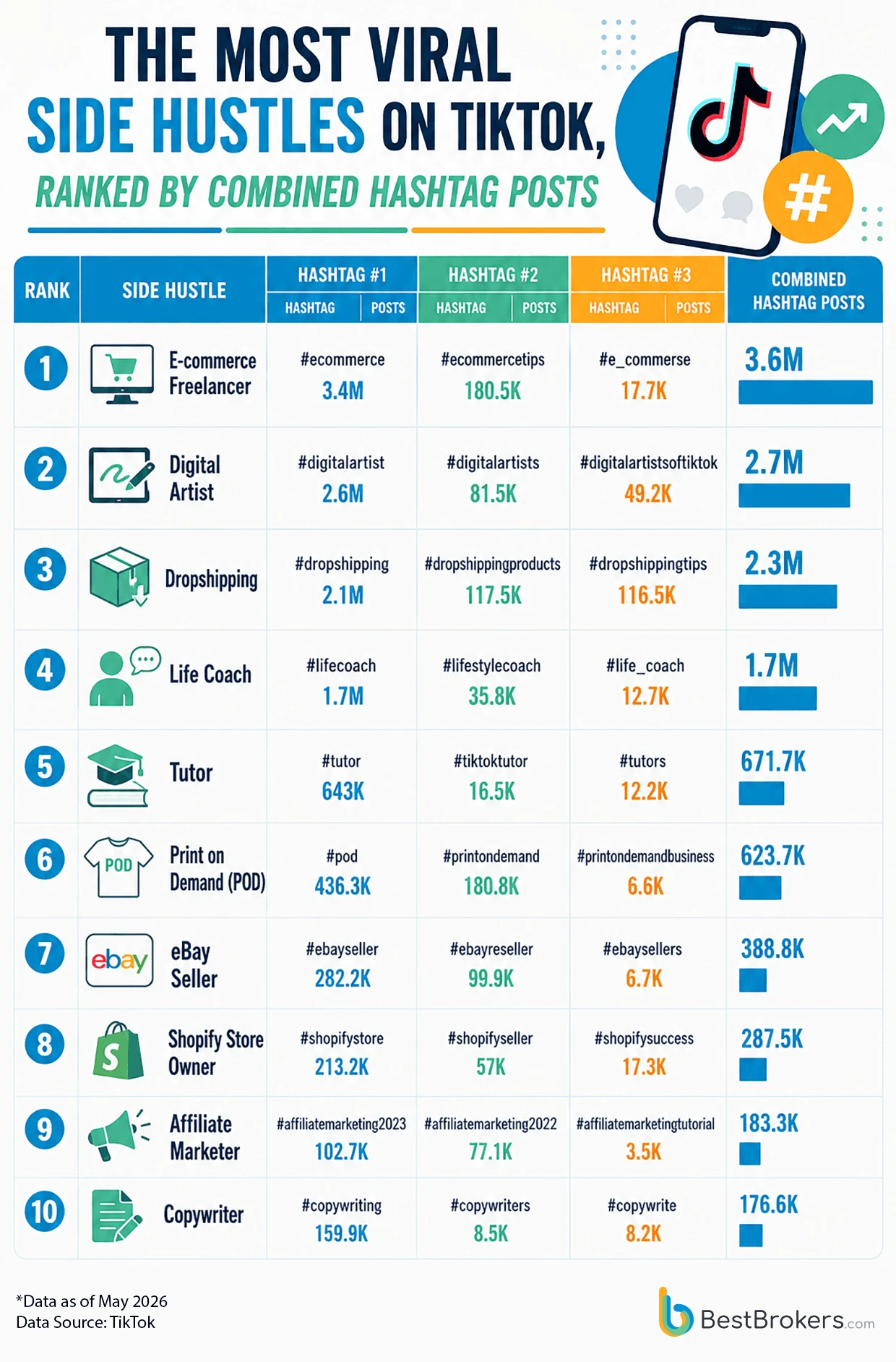
The ranking shows that the most visible side hustles are overwhelmingly digital and entrepreneurial in nature. E-commerce freelancing leads with 3.6 million combined posts across its three most popular hashtags, followed by digital artists (2.7M) and dropshipping (2.3M), all of which are highly ‘content-friendly’ business models that can be visually demonstrated and framed as transformation stories. These types of side hustles tend to dominate TikTok not necessarily because they are the most profitable in practice, but because they are easy to package into engaging narratives such as ‘I started with $0’ or ‘how I made my first online sale’. In contrast, more service-based or less visually dramatic work such as copywriting or affiliate marketing appears significantly less frequently despite often having more stable or structured earning potential in real markets.
@thekamiylahmonroe study this blueprint and you will be printing in no time. #dropshipping #wealthbuilding ♬ original sound – KAMIYLAH
At the same time, TikTok’s side hustle ecosystem has increasingly been linked to misleading or fraudulent content patterns, particularly as AI tools make it easier to generate convincing promotional material at scale. In 2025, cybersecurity reporting highlighted large-scale fraud operations on TikTok Shop involving fake listings, AI-generated product pages, and impersonation tactics designed to trick users into purchases or off-platform payments, with millions of fake listings being blocked by the platform itself. Broader investigations have also shown that scammers increasingly use AI-generated videos and deepfake-style content to impersonate creators and promote fake products or income schemes, often blurring the line between authentic creator content and paid deception.
@laraecomwolf AI is the ticket to getting rich #ecommerce #business #dropshipping #makemoneyonline ♬ original sound – Lara Rahib
This creates a structural issue where TikTok simultaneously acts as both a discovery engine and a marketing channel for side hustles, while also being a high-risk environment for exaggerated claims and misleading monetisation narratives. As a result, virality becomes a weak proxy for economic validity: the most frequently seen side hustles are often those that are easiest to package into viral content, not necessarily those with the highest success rates or most stable income outcomes in the real economy.
Methodology
This report compares a wide range of modern side hustles across four major segments of the digital economy: on-demand gig work, freelancing, e-commerce, and content creation. The analysis combines platform-reported income data, publicly available fee structures, hashtag visibility metrics, and qualitative scoring models to evaluate how different side hustles perform beyond simple earnings alone.
Hourly income figures for gig work and freelancing were sourced from publicly available platform and marketplace data, including Gridwise and Upwork. E-commerce fee structures, monetisation systems, and seller economics were gathered from official platform resources and pricing documentation from companies including Shopify, Amazon, Etsy, eBay, and Printify. TikTok hashtag visibility rankings were compiled using publicly visible hashtag post counts collected directly from the platform during the research period.
To compare fundamentally different side hustles on a consistent basis, the report developed several scoring categories:
- Scalability measured how easily a side hustle could grow beyond direct time-for-money work through systems, automation, audiences, recurring revenue, outsourcing, or digital assets.
- Stability evaluated the predictability and consistency of income, considering factors such as recurring demand, algorithm dependence, seasonality, and client retention.
- Passive Income Potential assessed the extent to which earnings could continue with limited ongoing active labor.
- Startup Cost estimated the relative financial barrier to entry, including equipment, software, inventory, advertising, or platform-related costs.
- Burnout Risk examined how dependent each side hustle is on continuous output, long hours, or high engagement intensity.
The rankings do not represent guaranteed earnings or success rates. Many side hustles, particularly in e-commerce and content creation, show highly uneven income distributions, where a small percentage of participants generate a disproportionate share of total revenue. The report therefore focuses on structural characteristics, scalability dynamics, and business-model economics rather than promising typical outcomes for all participants.
Additional contextual analysis and trend observations were informed by recent reporting, platform announcements, cybersecurity investigations, creator economy research, and broader developments in AI, social media, and online labor markets throughout 2025 and 2026.