
The term ‘unicorn’ was introduced in 2013 by venture capitalist Aileen Lee to describe privately held startups valued at over $1 billion, companies so uncommon they seemed almost mythical. At the time, there were only a few dozen worldwide, making the label a true badge of exceptional success. A little more than a decade later, the landscape looks very different. Fueled by an unprecedented surge in venture capital and rapid growth in the global tech ecosystem, the number of unicorns has ballooned into the thousands.
As of October 2026, there are 1,879 startup companies with a valuation of US$1 billion or more, the so-called unicorns. This prompted the team at BestBrokers to analyse the latest data from Crunchbase, TechCrunch, and PitchBook to identify which industries are producing the most new unicorns, which regions have the most billion-dollar private startups, and which private companies are attracting the most investor attention in today’s volatile market.
Which Countries are Home to the Most Unicorns in 2026?
Unicorn startups are heavily concentrated in a handful of countries, with more than half based in the United States, home to 971 privately held companies valued at over $1 billion. The U.S. also hosts many of the world’s most valuable private startups, including Anthropic, now the world’s most valuable unicorn at $965 billion after the previous champion, SpaceX ($1.25 trillion), went public. Other high-profile American unicorns valued in the hundreds of billions include OpenAI ($852 billion), Databricks ($190 billion), Stripe ($159 billion), and Waymo ($126 billion).
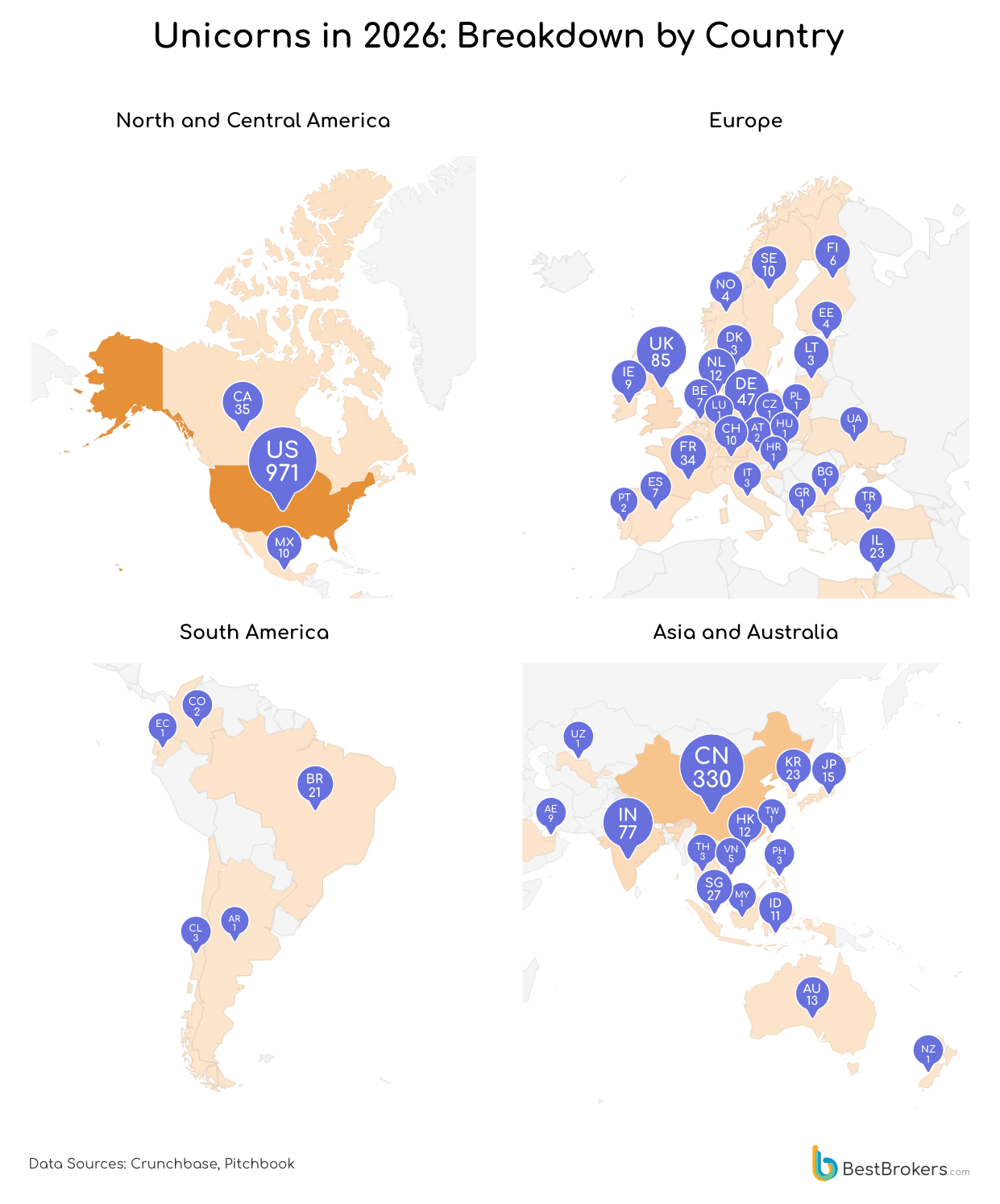
China ranks second with 330 unicorn companies, driven largely by its massive domestic market and strong technology sector. Its most valuable startup is ByteDance, the parent company of TikTok and its Chinese counterpart Douyin, which is valued at $550 billion based on a stake sale by early investor General Atlantic. That’s up from $480 billion in a November 2025 share sale, helped by strong revenue growth and the January 2026 deal that settled TikTok’s U.S. operations.
India has emerged as another major unicorn hub with 77 companies, supported by rapid digital adoption and a huge consumer base. Its most valuable startup is Walmart-backed payments platform PhonePe, valued at $14.5 billion. Another Asian nation with a dense concentration of unicorn startups is Singapore, which ranks 8th worldwide with 27 unicorns, led by data centre operator DayOne, which has filed for a U.S. listing.
The United Kingdom leads Europe with 85 unicorns, many of which are in the finance sector, including fintech leader Revolut ($115 billion) and payments firm Checkout.com ($12 billion). Latin America hosts 38 unicorn companies spread across Brazil (21), Mexico (10), Chile (3), Colombia (2), Argentina (1) and Ecuador (1). The region’s most valuable startups include Brazil’s QuintoAndar ($5.1 billion), iFood ($5 billion) and C6 Bank ($5 billion), Colombia’s delivery app Rappi ($5 billion) and Mexico’s financial platform Plata ($5 billion). Argentina’s fintech Ualá is valued at $3.2 billion after raising $195 million in an equity round led by Allianz X earlier this year.
The Largest Unicorn Companies in the World in 2026
Following Elon Musk’s space-tech company SpaceX’s historic IPO, which raised more than $86 billion, the title of the world’s most valuable unicorn passed to another U.S. company: Anthropic. Chatbot Claude’s parent company is now valued at a staggering $965 billion following a series of rapid valuation increases fuelled by booming demand for generative AI, major investments from technology giants, and strong revenue growth from its enterprise AI products.
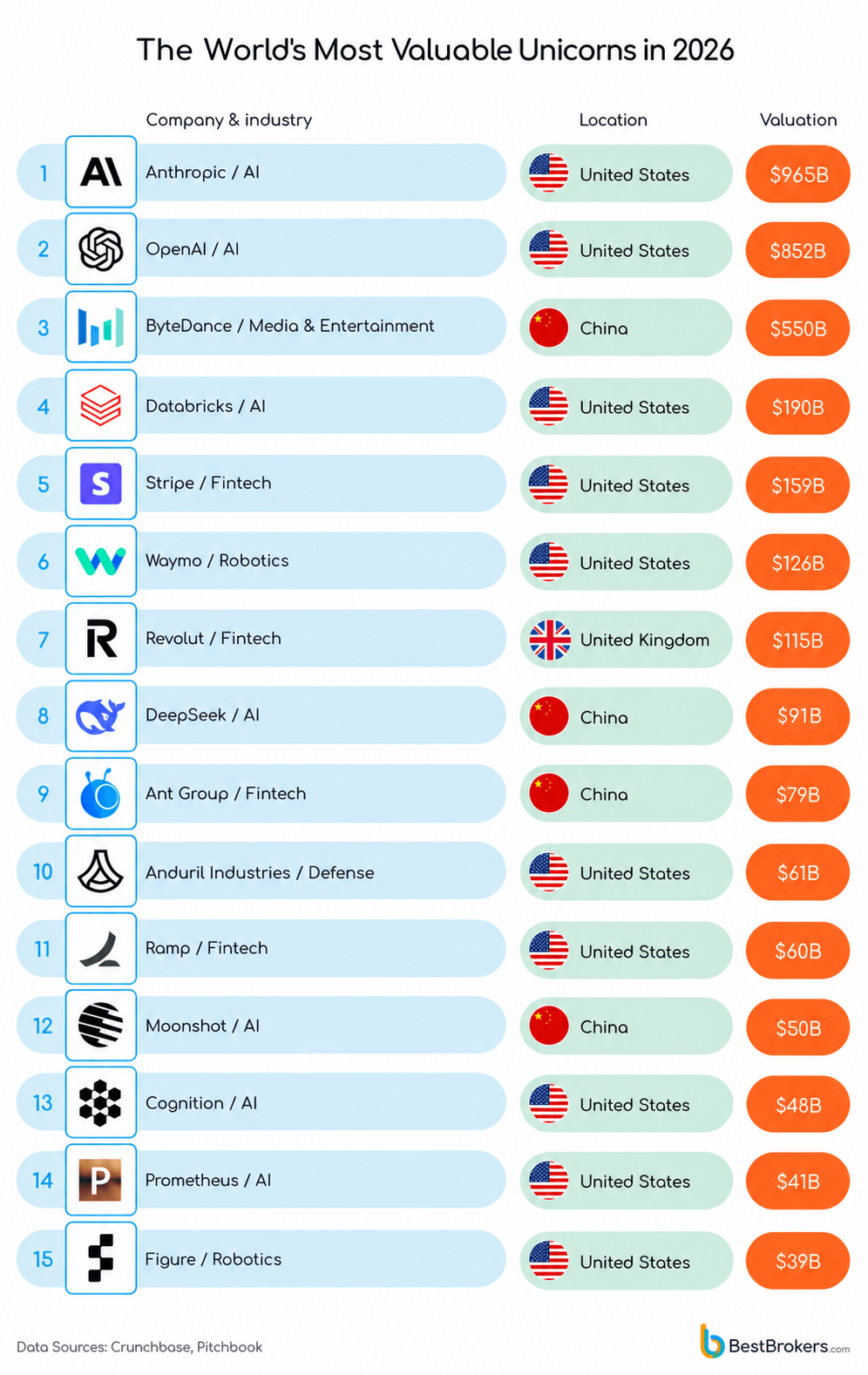
Just behind in second place is ChatGPT’s parent company and Anthropic rival OpenAI, currently valued at $852 billion following a record-setting $122 billion funding round led by Amazon, Nvidia and SoftBank. The company remains one of the central players in the global AI ecosystem, as investor capital continues to concentrate heavily within a small number of leading foundation model developers.
China’s ByteDance continues to stand among the world’s most valuable private companies, with a valuation of $550 billion. Its dominance is fuelled by the explosive global popularity of TikTok, which has reshaped entertainment and short-form video for billions of users, alongside Douyin’s commanding position in the Chinese market.
Data and AI platform Databricks takes fourth place with a private valuation of $190 billion after raising $5 billion in August. The company has passed $7 billion in annualised revenue, growing more than 80% year on year, and is cash-flow positive.
In fintech, Stripe holds a $159 billion valuation, and Revolut currently sits at $115 billion following a secondary share sale in July 2026. Both companies have established strong positions in digital payments and banking services.
1 in 4 Startups To Reach Unicorn Status in 2026 Are AI Companies
Artificial intelligence companies account for the largest share of startups that reached a $1 billion valuation in 2026. Of the 233 companies that achieved unicorn status this year, 56 (24%) operate in the AI sector, meaning nearly 1 in 4 newly minted unicorns in 2026 is an AI company. These companies range from frontier model labs like China’s DeepSeek to startups selling AI coding agents (Factory), customer-service agents (Wonderful) and video generators (PixVerse).
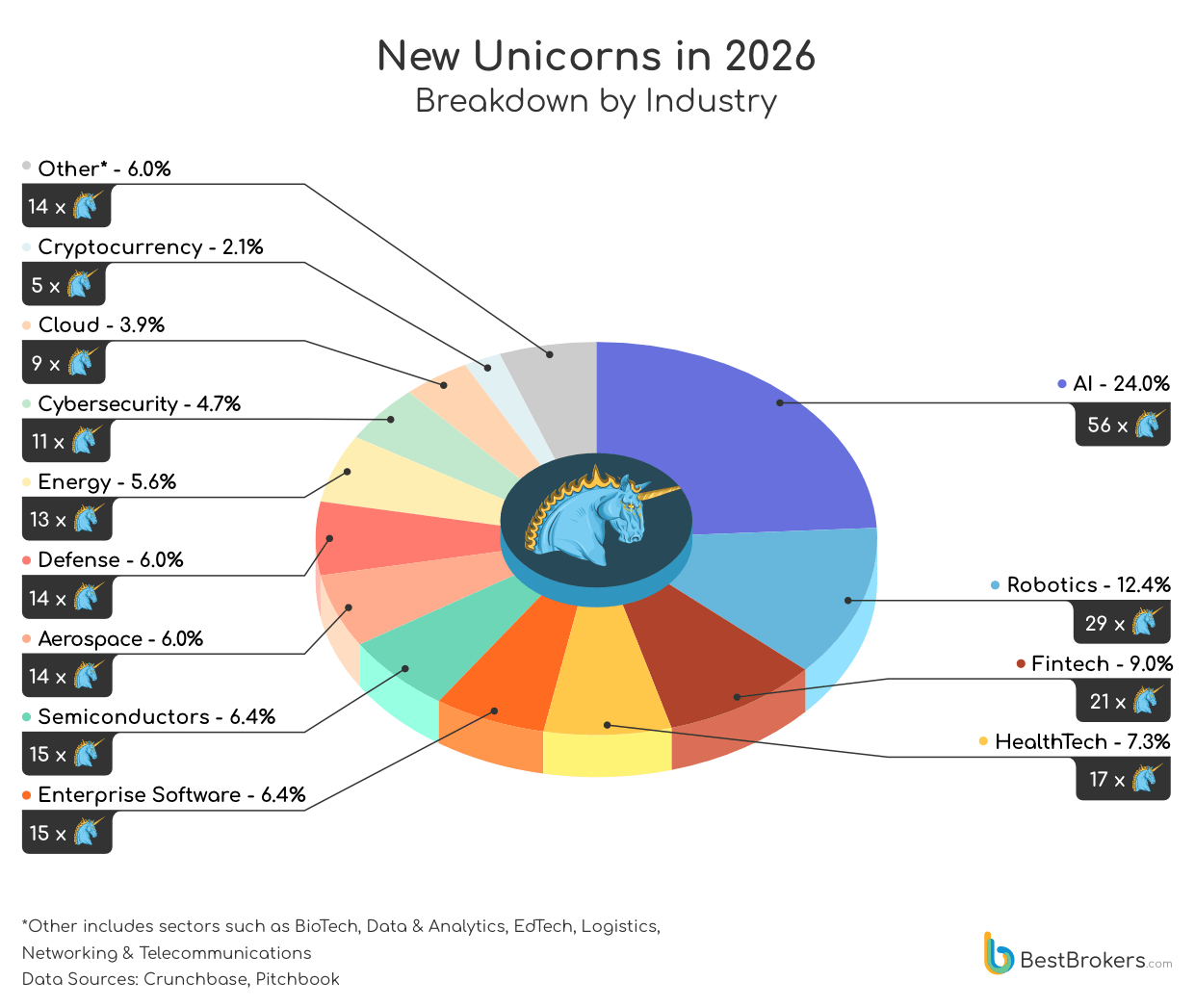
Robotics companies are attracting increasing investment in 2026 as advances in humanoid systems and embodied AI accelerate. As of October, robotics is the second-largest sector for newly minted unicorns, with 29 companies accounting for 12.4% of the total. China leads with 17 new robotics unicorns, including XPENG Robotics, valued at $6.3 billion, and AI2 Robotics and X Square Robot, both valued at $3 billion. The U.S. has produced 7 new robotics unicorns so far this year, led by Mind Robotics valued at $3.4 billion.
This year, 21 fintech startups have crossed the billion-dollar mark to become unicorns, accounting for 9.0% of all newly minted unicorns in 2026. Investor interest has remained strong across digital payments, lending, financial infrastructure and AI-assisted financial services. Corgi Insurance leads this year’s cohort, achieving a $4 billion valuation.
The healthtech sector has produced 17 new unicorns so far in 2026, making it the fourth most active sector after AI, robotics and fintech. The most valuable new healthtech startup is U.S. medical device maker MiRus, which attained a $4.4 billion valuation following Boston Scientific’s $1.5 billion investment. Other notable additions include Forus ($3 billion), Garner Health ($2.7 billion) and Pomelo Care ($1.7 billion).
The defence sector has seen plentiful investor interest in 2026, fuelled by geopolitical tensions and advances in defence and dual-use technology. So far this year, 14 defence startups have crossed the $1 billion threshold. Germany’s STARK leads the group with a $4 billion valuation, having gained prominence for its autonomous strike drones and secured a €300 million contract to supply the German armed forces. Nine of the 14 new defence startups are headquartered in the U.S., led by Mach Industries, which more than doubled its valuation to $3.7 billion in just three months after a $600 million Series C extension, followed by Neros Technologies ($2.5 billion) and Allen Control Systems ($2.2 billion). In Europe, France’s Harmattan AI became the country’s first defence unicorn after a $200 million funding round led by Dassault Aviation, while UK defence startups Roark Aerospace, UFORCE and Kraken Technology have also crossed the billion-dollar threshold.
Chinese AI startup DeepSeek is the Most Valuable New Unicorn Startup in 2026
By far the most valuable startup to become a unicorn in 2026 is China’s DeepSeek, valued at $91 billion after reportedly raising around $15 billion in its second-ever funding round, more than 14 times the valuation of the second most valuable new unicorn. The Hangzhou-based AI lab, founded in 2023 by Liang Wenfeng, made headlines after its low-cost R1 and V3 models challenged leading Western AI systems while using significantly fewer computing resources, with investors piling in as DeepSeek emerged as one of China’s strongest challengers in the global AI race.
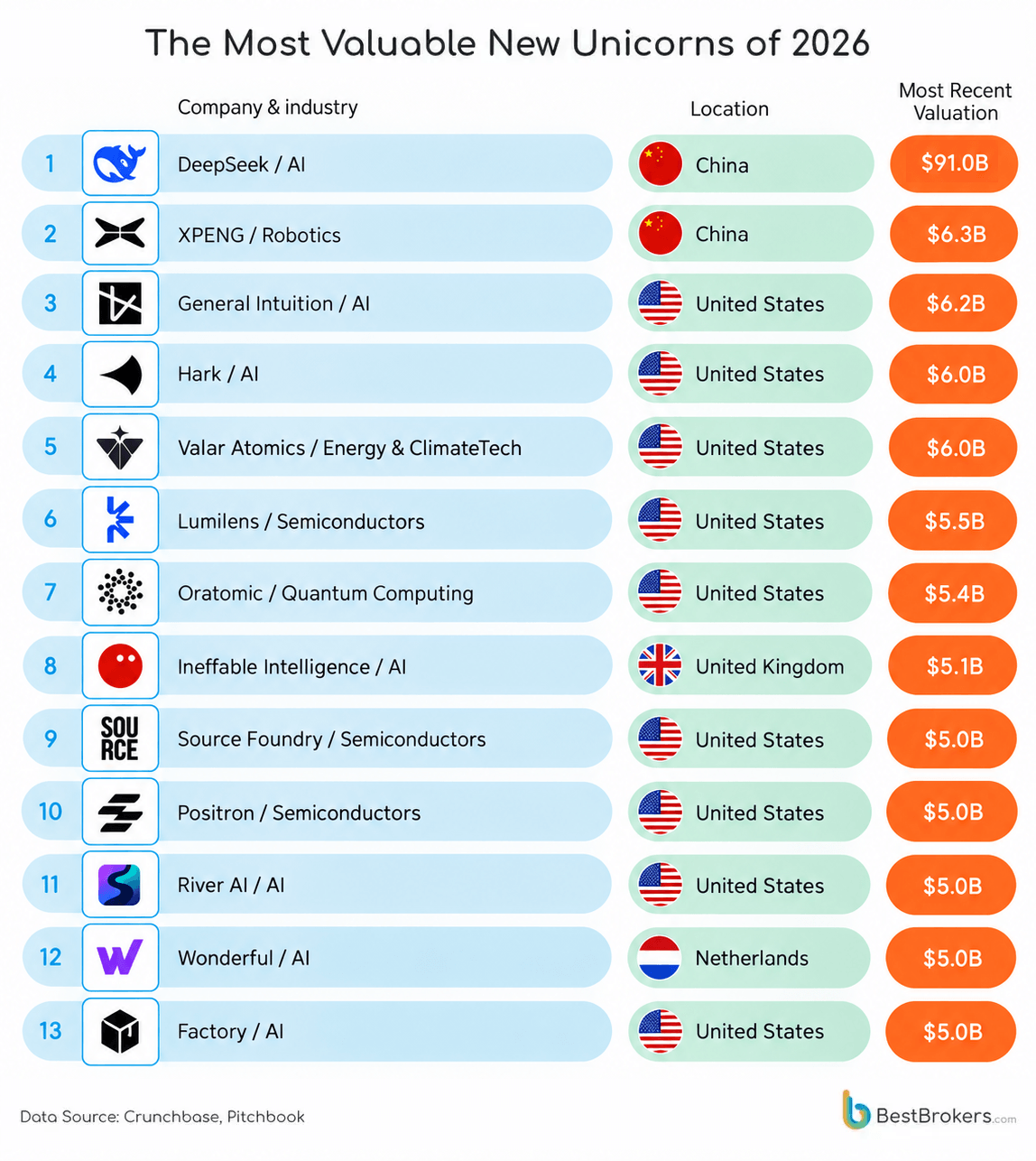
U.S.-based AI lab Hark, founded by Figure AI CEO Brett Adcock, reached an impressive $6 billion valuation after raising more than $700 million in its Series A funding round. Hark is part of a cohort of AI companies, which make up 7 of the 13 most valuable new unicorns this year. Among them are world model developer General Intuition, valued at $6.2 billion, and UK-based Ineffable Intelligence at $5.1 billion after the largest seed round in European history. Three more AI startups are each valued at $5 billion: xAI co-founder Igor Babuschkin’s River AI, enterprise AI agent platform Wonderful, and AI coding agent developer Factory.
Outside AI, the most valuable newly minted unicorn is China’s XPENG Robotics, valued at $6.3 billion, followed by nuclear energy startup Valar Atomics at $6 billion. Two semiconductor unicorns appear on the list, led by San Jose-based Lumilens, valued at $5.5 billion after a $700 million Series C in August. California’s Source Foundry, which is developing alternatives to ASML’s chipmaking machines, and inference chipmaker Positron are both valued at $5 billion. Meanwhile, quantum computing startup Oratomic achieved a $5.4 billion valuation following a $475 million Series B in October, just three months after its Series A round.
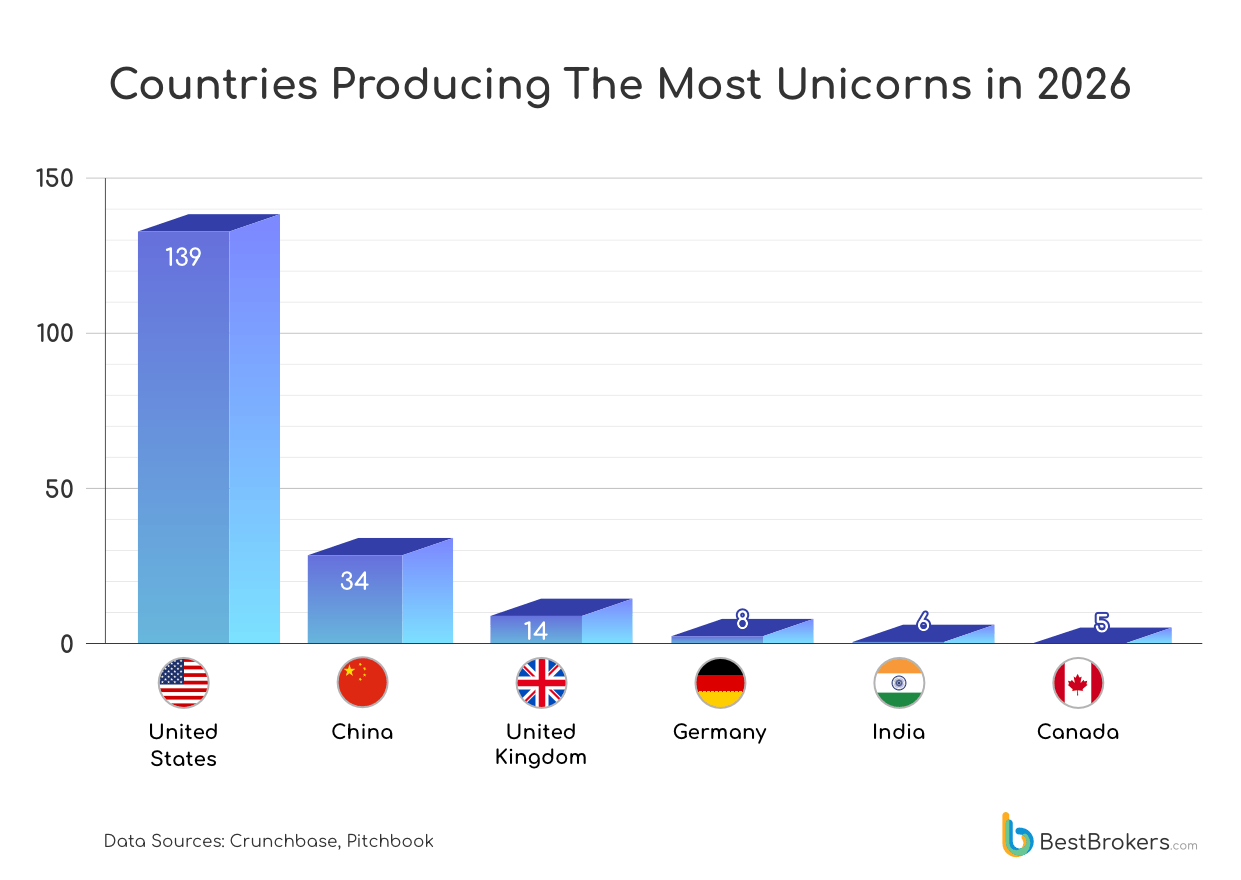
The United States overwhelmingly dominates the global unicorn landscape in 2026, accounting for 139 of the 233 newly minted billion-dollar startups. This reflects the country’s deep venture capital ecosystem, strong talent pool, and continued leadership in high-growth sectors such as artificial intelligence and advanced technologies.
Outside the United States, China ranks second with 34 new unicorns, followed by the United Kingdom with 14, and Germany with 8 new billion-dollar startups. The UK’s most valuable newly minted unicorn is Ineffable Intelligence at $5.1 billion, while China’s cohort heavily leans towards AI and robotics startups, led by DeepSeek at $91 billion and XPENG Robotics at $6.3 billion, alongside AI2 Robotics and X Square Robot, both valued at $3 billion. India has seen momentum accelerate in recent months, adding 6 new unicorns since the beginning of 2026. Among India’s 2026 unicorn class, fintech lender KreditBee and AI startup Sarvam AI are currently the most valuable, with both startups achieving a valuation of $1.5 billion.
Canada’s 5 new unicorns are in the artificial intelligence, semiconductors, fintech and biotech sectors. Autonomous driving AI company Waabi is the country’s most valuable new unicorn, reaching a $4 billion valuation, followed by quantum computing and semiconductor company Photonic at $2 billion. Fintech startups Super.com and Nesto, valued at $1.2 billion and $1.1 billion respectively, and biotech company Biossil at $1 billion round out Canada’s 2026 unicorn cohort.
Methodology
To illustrate the current state of unicorn startups, the team at BestBrokers analysed company data from The Crunchbase Unicorn Board, which tracks privately held companies valued at $1 billion or more. Additional information on company valuations, funding rounds, and newly created unicorns was gathered from platforms such as PitchBook, as well as industry coverage from TechCrunch and other publicly available sources.
Using these datasets, we identified current unicorn companies and grouped them by country, industry, and valuation to show their distribution across the global tech ecosystem. We also compiled a separate list of startups that first crossed the $1 billion valuation threshold in 2026 based on the most recent funding announcements and reported valuations.
All figures reflect the most recent data available at the time of writing. Because startup valuations and funding rounds change frequently, the total number of unicorn companies and their valuations may evolve over time.