

The world’s billionaires continue to accumulate wealth on an extraordinary scale, with many of the world’s richest individuals seeing their fortunes grow by hundreds of billions of dollars in a single year. Others were not so lucky, shedding significant chunks of their net worth over the past twelve months. While the rapid expansion of artificial intelligence and technology has created striking gains for some of the world’s most prominent entrepreneurs, billionaire wealth creation extends far beyond tech, spanning industries from finance and manufacturing to retail, energy, and real estate.
This is what inspired the team at BestBrokers to analyse the Forbes Real-Time Billionaire List as of 27 July 2026. To establish an accurate year-on-year comparison, we used the Wayback Machine to retrieve an archived version of the Forbes list dated 27 July 2025 and recorded each billionaire’s real-time net worth. We tracked how each individual’s fortune changed over the year to identify the biggest increases and declines in wealth, while also examining how billionaire wealth is currently distributed across countries and industries.
Where the World’s Billionaires Live
There are currently 3,356 billionaires in the world, with a disproportionate share concentrated in just a handful of countries. The world’s most populous nations are, perhaps unsurprisingly, also home to some of the largest billionaire populations. The United States leads by a considerable margin, with 990 billionaires, accounting for 29.5% of the global total. The country is also home to nine of the world’s ten richest people, including Elon Musk, Larry Page and Michael Dell. Collectively, U.S. billionaires are worth a staggering $8.43 trillion. Canada ranks second in North America with 78 billionaires worth $449.5 billion, with cryptocurrency entrepreneur Changpeng Zhao standing out as the country’s richest billionaire with a net worth of $107.6 billion. Mexico is home to 24 billionaires with a combined fortune of $258.6 billion, led by business oligarch and investor Carlos Slim Helú, whose $125.4 billion fortune makes him the richest person in Latin America.
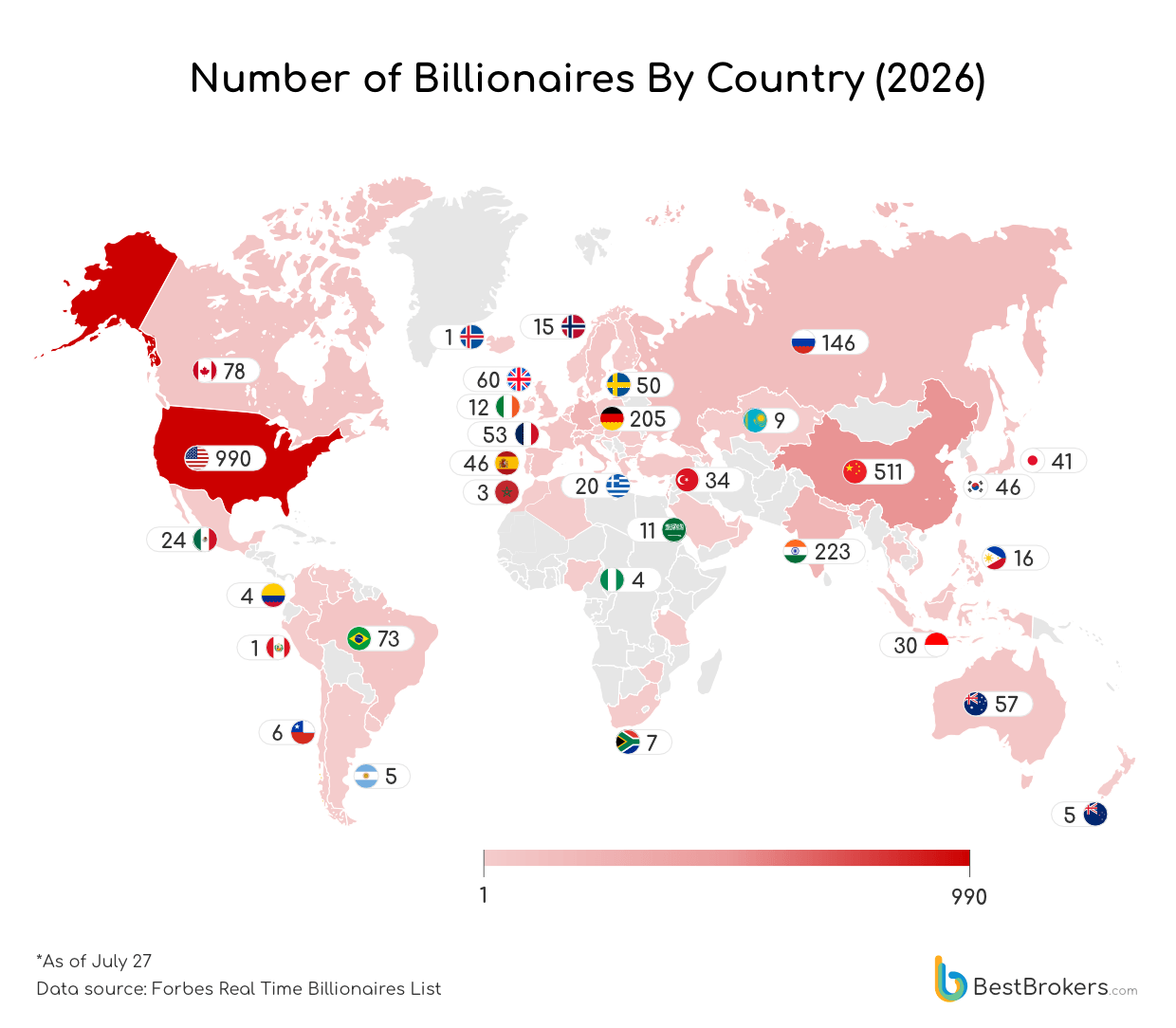
China is Asia’s largest billionaire hub and the country with the second-most billionaires globally, with 511 billionaires collectively worth an estimated $2.06 trillion. Much like the U.S., China’s wealthiest billionaires are heavily concentrated in the technology sector, led by ByteDance founder Zhang Yiming, the country’s richest person with a net worth of $69.3 billion. Hong Kong is home to a further 69 billionaires, whose combined wealth stands at $410.4 billion. India’s billionaire wealth is spread across a much wider range of industries, from conglomerates and infrastructure to pharmaceuticals, manufacturing, retail and telecoms, with Mukesh Ambani ($86.8 billion) and Gautam Adani ($85.2 billion) leading the country’s wealth rankings. Other major billionaire hubs in Asia include Taiwan, which is home to 63 billionaires worth $272.2 billion, led by art collector and businessman Pierre Chen ($17.6 billion), and Singapore, with 57 billionaires worth a combined $155.4 billion, led by businessman Jason Chang with a net worth of $20.3 billion.
Germany has Europe’s largest billionaire population, with 205 billionaires whose combined fortunes total $944.8 billion. The country’s richest is Lidl chairman Dieter Schwarz, worth $59.1 billion. Italy is next with 80 billionaires worth $465.0 billion, with cryptocurrency entrepreneur Giancarlo Devasin in the lead, whose $89.3 billion fortune makes him Italy’s richest person. The UK has 60 billionaires worth a combined $278.6 billion, led by hedge fund manager Michael Platt with $20.9 billion. France, despite having fewer billionaires than the UK with 53, has more than twice its combined billionaire wealth at $574.6 billion. The difference is largely driven by the country’s concentration of major fashion and luxury fortunes, with just four billionaires: Bernard Arnault (LVMH), Françoise Bettencourt Meyers (L’Oréal), Alain and Gérard Wertheimer (Chanel) holding a combined net worth of $311.7 billion, or 54.2% of France’s total billionaire wealth.
South America’s billionaire population is overwhelmingly concentrated in Brazil, which is home to 73 billionaires worth a combined $269.3 billion. The country’s richest is Facebook co-founder Eduardo Saverin, worth $33.1 billion, followed by banking heiress Vicky Safra at $25.3 billion and investment veteran Jorge Paulo Lemann at $19.8 billion. Colombia has six billionaires worth $63.8 billion, led by banking and infrastructure tycoon Jaime Gilinski Bacal with $16.9 billion, while Argentina’s five billionaires are worth $20.7 billion, led by Mercado Libre founder Marcos Galperin with $7.4 billion.
Australia is home to 57 billionaires worth a combined $242.8 billion, led by mining magnate Gina Rinehart with a fortune of $25 billion, followed by property developer Harry Triguboff and mining billionaire Andrew Forrest. Africa is home to 29 billionaires across eight countries, with a combined fortune of $143.2 billion. Nigeria leads the continent with four billionaires worth $53 billion, and it is also home to Africa’s richest person, businessman Aliko Dangote, whose $31.2 billion fortune accounts for more than half of the country’s billionaire wealth. South Africa follows with seven billionaires worth $42.7 billion, led by luxury goods magnate Johann Rupert at $17.6 billion. Egypt has six billionaires worth $23.9 billion, while Morocco has three worth $4.7 billion.
Billionaires Who Gained the Most Wealth in One Year
Elon Musk, the world’s richest person, also recorded the largest increase in net worth between 2025 and 2026. After briefly becoming the world’s first trillionaire following the initial public offering of SpaceX, his net worth stood at $725.1 billion on 27 July 2026, up from $405.6 billion a year earlier. This means that his net worth increased by $319.5 billion over the past year, equivalent to roughly $875 million in additional wealth every day since last year.
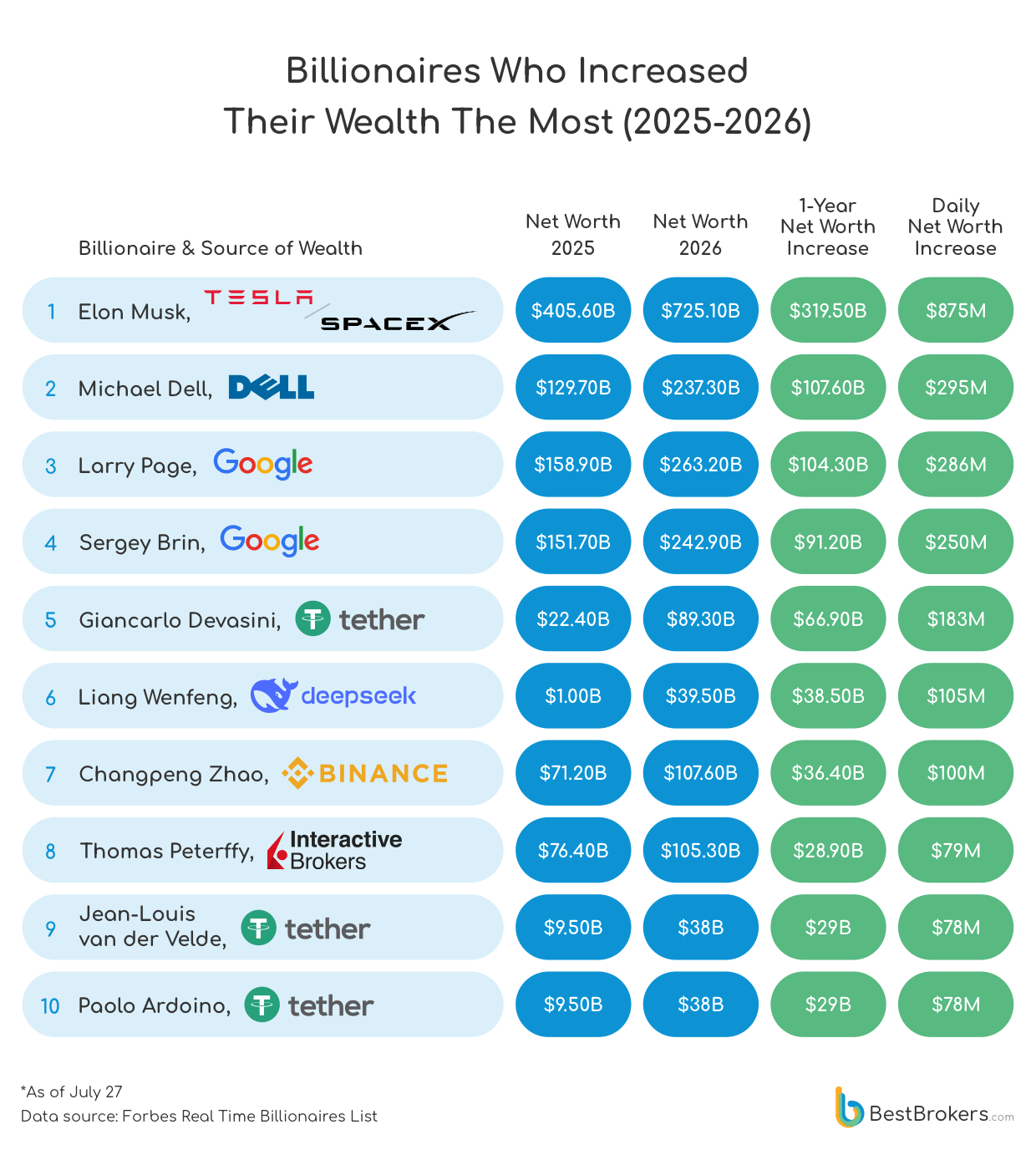
Dell Technologies founder and CEO Michael Dell recorded the second-largest increase, adding $107.6 billion to his fortune over the same period. Google co-founders Larry Page and Sergey Brin ranked third and fourth, increasing their net worths by $104.3 billion and $91.2 billion, respectively. The scale of these gains highlights just how strongly the world’s largest technology companies have contributed to billionaire wealth creation over the past year, with soaring valuations and investor enthusiasm translating into enormous increases in the fortunes of their founders and major shareholders.
Crypto also produced some of the year’s biggest individual wealth gains. Italian businessman Giancarlo Devasini, whose fortune is closely tied to stablecoin giant Tether, saw his net worth rise from $22.4 billion in 2025 to $89.3 billion in 2026, an increase of $66.9 billion. Other major cryptocurrency billionaires also recorded substantial gains, including Binance founder Changpeng Zhao and Tether executives Jean-Louis van der Velde and Paolo Ardoino, who added $36.4 billion and $29 billion to their net worths over the course of a year, respectively.
DeepSeek Founder Is the Person With the Fastest Growing Fortune
It is one thing to have billions of dollars at your disposal and steadily grow that fortune through smart investments, business expansion and rising asset values. It is another thing entirely to build a multibillion-dollar fortune in the space of just one year. Yet some of the world’s billionaires have seen their net worth increase at extraordinary rates between 2025 and 2026, with the fastest-growing fortunes expanding ten-fold or even more.
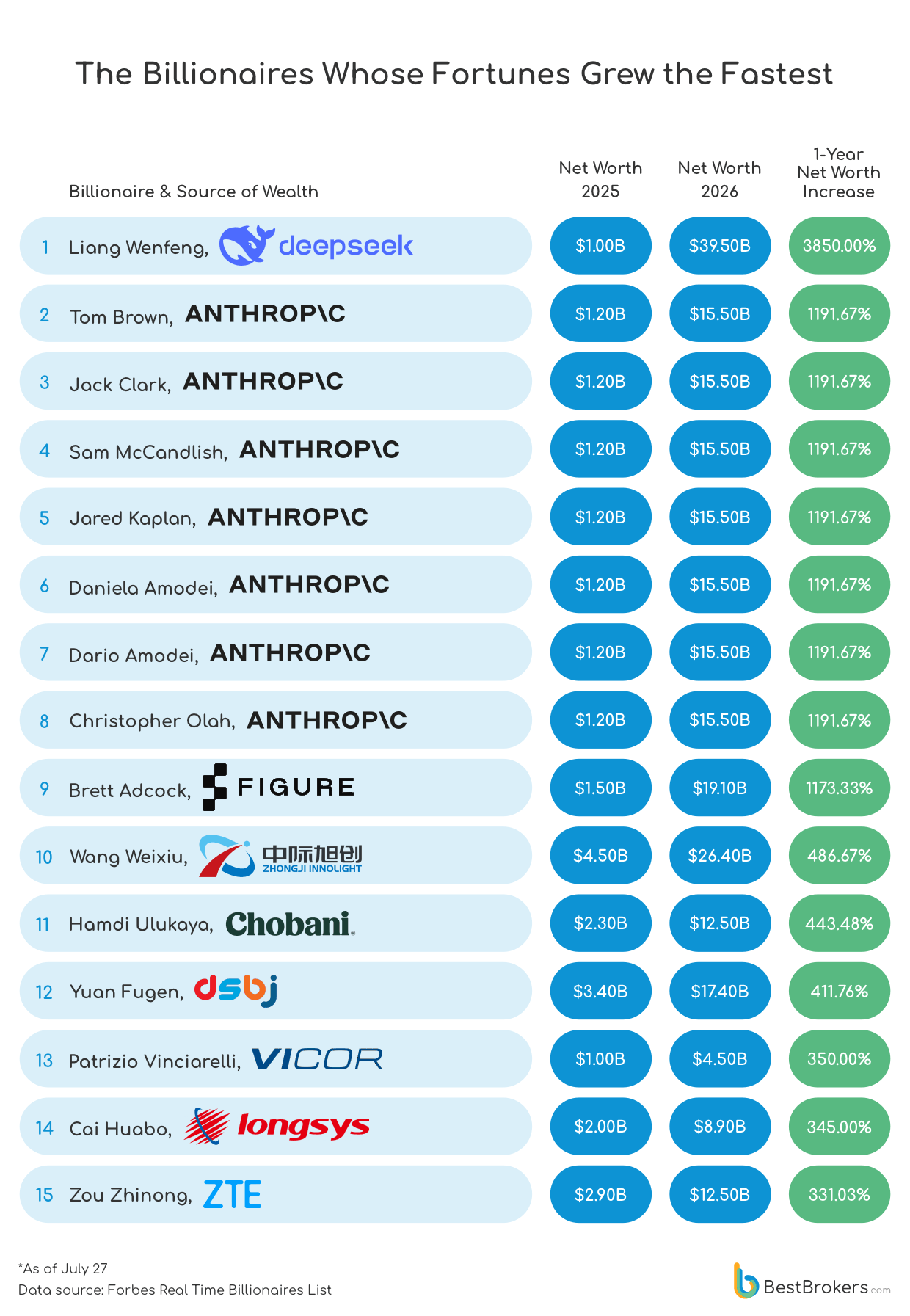
Artificial intelligence is at the centre of some of the most dramatic increases. As investment and demand continue to pour into AI models, infrastructure, and applications, the founders and early backers of some of the sector’s most closely watched companies have seen their fortunes surge. Chinese AI entrepreneur Liang Wenfeng is perhaps the clearest example. The founder of DeepSeek, the high-performance AI chatbot that reached impressive compute power at a fraction of the price of leading U.S. large-language models last year, saw his estimated net worth skyrocket from just $1 billion in 2025 to $39.5 billion in 2026 – representing an extraordinary 3,850% increase in a single year, placing him in the top 50 richest people in the world.
The founders of Claude maker Anthropic have experienced a similarly dramatic revaluation. Tom Brown, Jack Clark, Sam McCandlish, Jared Kaplan, Daniela Amodei, Dario Amodei, and Christopher Olah all saw their estimated fortunes rise from $1.2 billion to $15.5 billion, an increase of 1,191.67%. The surge reflects the extraordinary rise in the valuation of the AI company, as investors have poured billions of dollars into the race to develop increasingly capable foundation models and AI applications.
Brett Adcock, founder and CEO of robotics company Figure AI, saw his fortune climb from $1.5 billion to $19.1 billion, an increase of more than 1,170%. Figure AI’s focus on humanoid robots places Adcock at the intersection of two of the fastest-growing areas of technology, as investors increasingly bet on the convergence of artificial intelligence and physical automation.
The gains are also spreading further down the AI supply chain. Chinese telecom and optical component manufacturers have become increasingly important to the infrastructure supporting the AI boom, helping provide the high-speed networking and connectivity required by increasingly powerful data centres. Wang Weixiu, whose fortune is tied to Zhongji Innolight, saw his net worth increase from $4.5 billion to $26.4 billion, a 486.67% increase. Meanwhile, Zou Zhinong of ZTE had his fortune rise from $2.9 billion to $12.5 billion, a 331.03% increase.
But the fastest-growing billionaire fortunes were not exclusively linked to artificial intelligence or technology. Hamdi Ulukaya, founder and CEO of Greek yoghurt brand Chobani, reached $12.5 billion in estimated net worth (up 443.48% from 2.3 billion in 2025), while metal-processing entrepreneur Yuan Fugen saw his fortune rise from $3.4 billion to $17.4 billion, up 411.76% in one year. Patrizio Vinciarelli, whose wealth comes from power electronics manufacturer Vicor, more than tripled his fortune, from $1 billion to $4.5 billion (up 350%).
Larry Ellison’s Wealth Was Cut Nearly in Half in a Single Year
On the other end of the scale, Larry Ellison, CEO of U.S. cloud company and tech conglomerate Oracle, recorded the largest one-year decline. His net worth fell from $290.60 billion to $151.90 billion, a drop of $138.7 billion, equivalent to roughly $380 million wiped from his fortune every day over the past year. The decline reflects growing scepticism on Wall Street over Oracle’s aggressive AI spending plans and mounting debt load, with investors increasingly questioning whether the company’s cloud infrastructure growth can justify the scale of its investment.
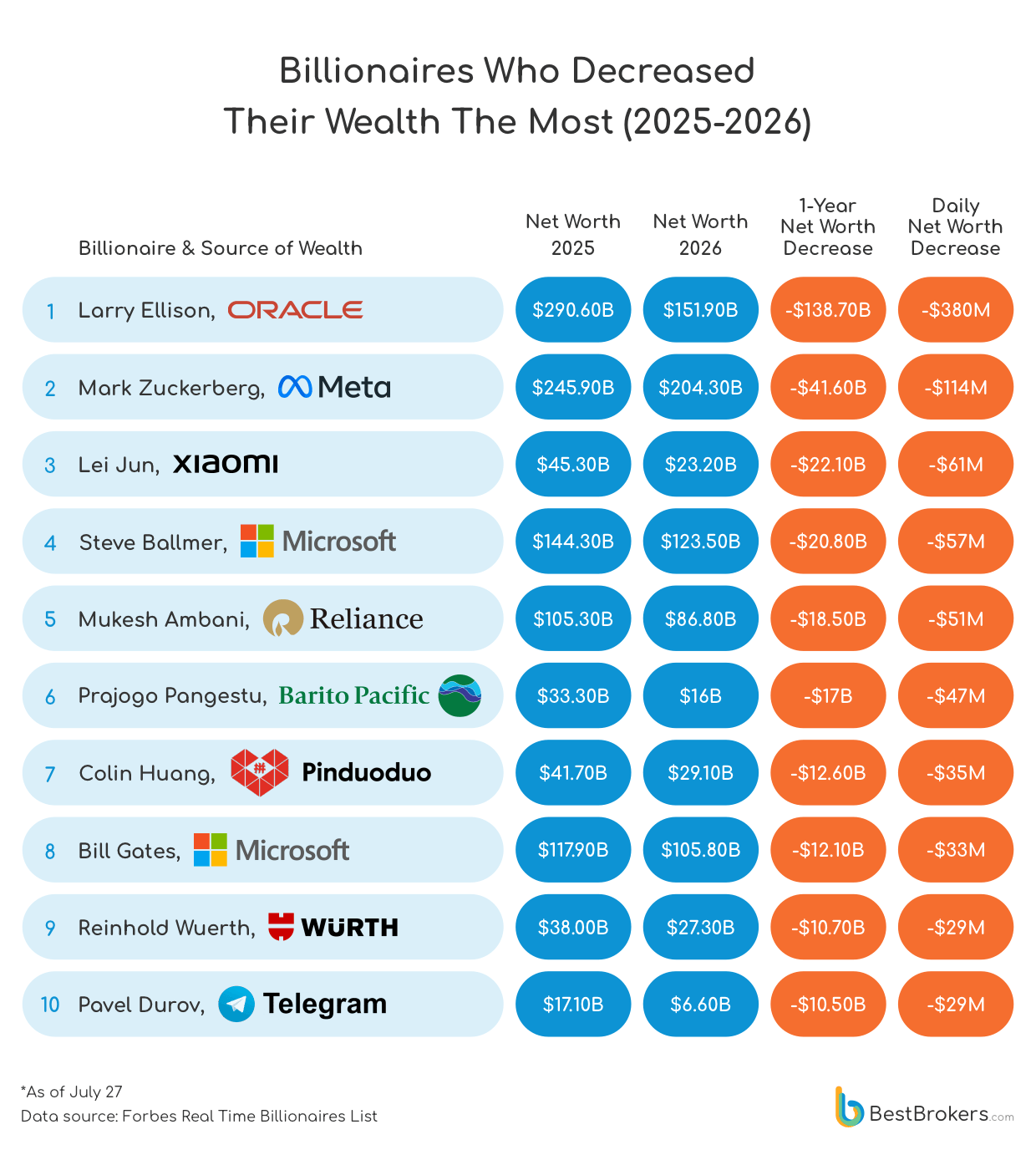
Meta’s Mark Zuckerberg recorded the second-largest decline, with his net worth falling from $245.9 billion to $204.3 billion, a $41.6 billion drop equivalent to roughly $114 million a day. The decline came as investors grew increasingly concerned about Meta’s enormous AI spending, with the company expected to spend as much as $145 billion on capital expenditure in 2026.
Elsewhere, India’s richest man Mukesh Ambani lost $18.5 billion as shares in Reliance Industries weakened, with the conglomerate facing weaker-than-expected earnings, slower growth in its retail business and pressure on its refining operations. Colin Huang’s $12.6 billion decline reflects continuing pressure on PDD Holdings, the parent company of Temu, as the business faced intensifying competition in China and increasing regulatory and trade-policy challenges in international markets. Indonesian tycoon Prajogo Pangestu also saw his fortune fall by $17 billion amid weakness in the shares of companies including Barito Renewables and other businesses in his energy empire; Indonesian stocks linked to Pangestu came under additional pressure after Morgan Stanley Capital International and FTSE Russell both raised concerns around transparency and concentrated ownership.
The Industries Mining Billionaires
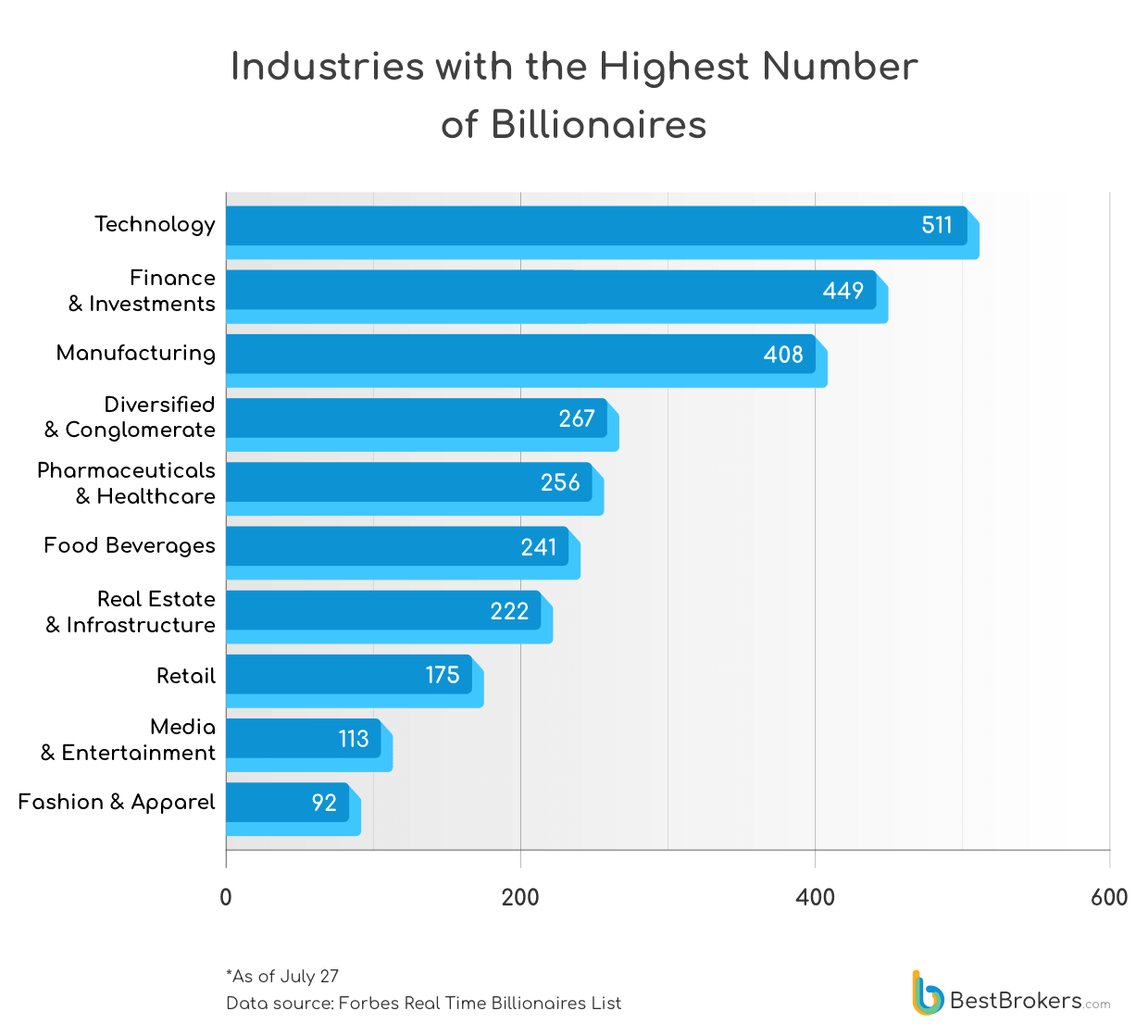
Tech is by far the biggest driver of billionaire wealth in 2026, with 511 of the world’s 3,356 billionaires, around 15% of the global total, deriving their fortunes from the sector. Finance & Investments follows with 449 billionaires, while Manufacturing accounts for a further 408. Diversified and conglomerate businesses rank fourth with 267 billionaires, followed by Pharmaceuticals & Healthcare with 256 and Food & Beverages with 241.
The concentration of billionaires in technology is reflected even more strongly in the amount of wealth held by the sector’s billionaires. Collectively, tech billionaires are worth $5.30 trillion in 2026, more than double the combined wealth of Finance & Investments tycoons who collectively own $2.39 trillion. Technology is also home to eight of the world’s ten richest people, including Elon Musk, Larry Page and Jeff Bezos, highlighting the extraordinary fortunes that can be generated by the world’s largest technology companies.
Finance & Investments remains one of the most established routes to billionaire status, with 449 billionaires collectively worth $2.39 trillion. Manufacturing also has a substantial billionaire population, with 408 billionaires and a combined fortune of $1.37 trillion. Meanwhile, diversified businesses and conglomerates account for 267 billionaires worth $1.69 trillion, reflecting the fortunes built across multiple industries and asset classes rather than around a single business sector.
Beyond these leading categories, Pharmaceuticals & Healthcare, Food & Beverages, Real Estate & Infrastructure, and Retail each account for more than 170 billionaires. Together, these sectors demonstrate that billionaire wealth remains highly diverse, spanning everything from healthcare and consumer goods to property and retail, even as technology continues to dominate at the very top of the wealth rankings.
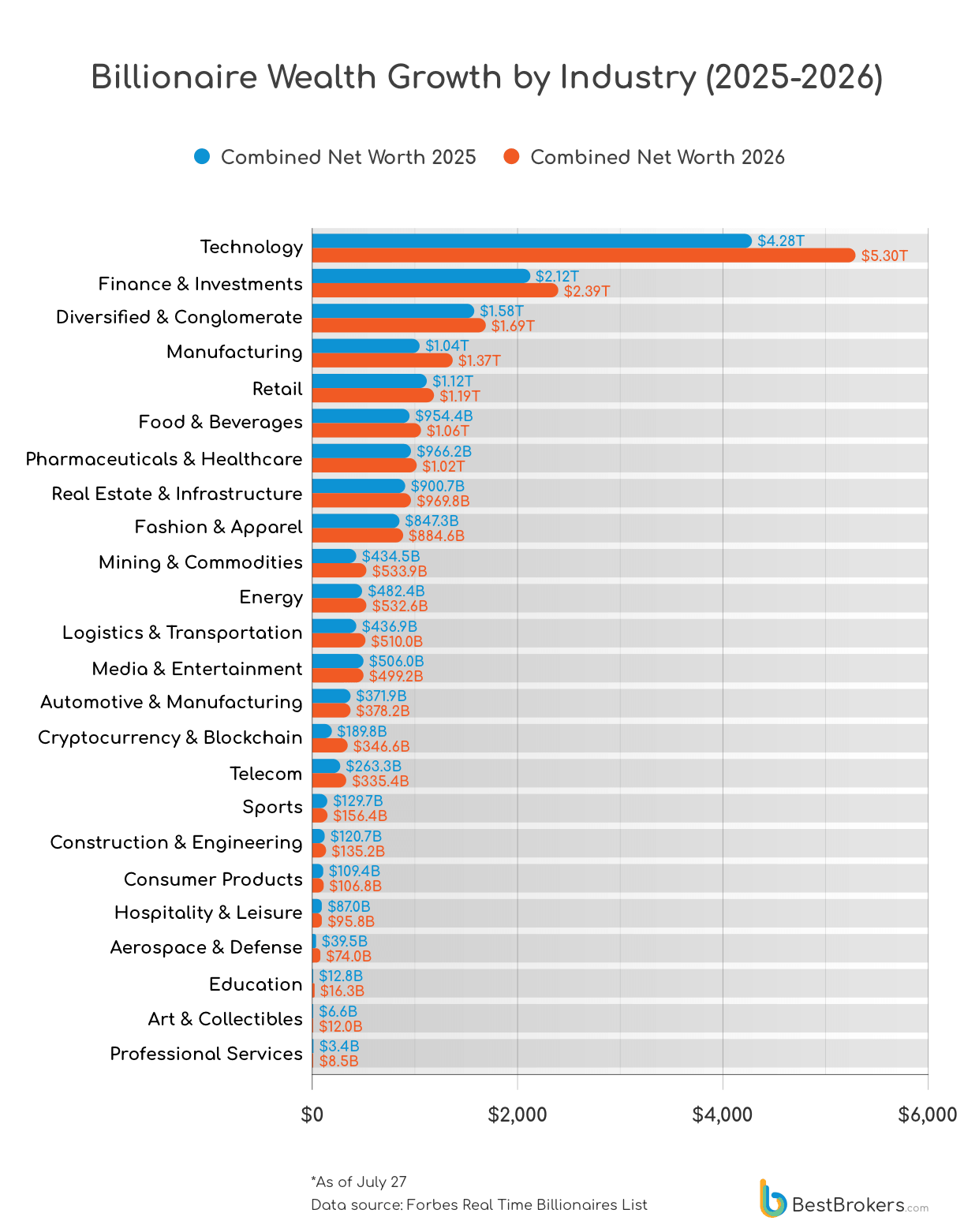
The distribution of billionaire wealth has also shifted significantly over the past year. Technology recorded by far the largest increase, with the combined fortunes of its billionaires rising from $4.28 trillion in 2025 to $5.30 trillion in 2026, an increase of more than $1 trillion in just one year. Finance & Investments followed, with combined billionaire wealth increasing by $263.5 billion, while Manufacturing recorded a $328.3 billion increase, taking the sector’s total from $1.04 trillion to $1.37 trillion.
Several other industries also recorded substantial gains. Cryptocurrency & Blockchain saw one of the fastest expansions in percentage terms, with combined billionaire wealth rising from $189.8 billion to $346.6 billion. Mining & Commodities, Logistics & Transportation, and Telecom also recorded sizeable increases as the fortunes of billionaires across these industries grew during the year.
Not every industry became wealthier over the past year, however. Media & Entertainment was one of the few major sectors to record a decline, with combined billionaire wealth falling from $506 billion to $499.2 billion. The biggest decline came from Canadian billionaire Sherry Brydson, whose fortune fell by $7.6 billion over the year. Her wealth is largely tied to Thomson Reuters, whose shares fell by nearly 18% in February amid concerns over the potential impact of new AI tools on its legal and professional-information businesses.
Consumer Products also declined slightly, from $109.4 billion to $106.8 billion, with Chinese billionaire Chen Zhiping recording the largest individual loss in the sector. The chairman and CEO of vaping-device maker Smoore International saw his fortune fall by $3 billion, from $5.5 billion to $2.5 billion, as the company’s profits fell despite strong revenue growth, with higher costs and increased spending on its own-brand products weighing on its bottom line.
Methodology
To analyse the changing fortunes of the world’s billionaires, the team at BestBrokers analysed data from the Forbes Real-Time Billionaires List as of 27 July 2026. To establish a consistent year-on-year comparison, we used the Internet Archive’s Wayback Machine to retrieve an archived version of the Forbes list from 27 July 2025 and recorded the estimated net worth of the same billionaires at that point in time. This allowed us to calculate how much each individual’s fortune increased or decreased over the one-year period.
Using these datasets, we identified the biggest absolute net worth and percentage gains over a 1-year period, while also calculating how much billionaires’ wealth has increased or shrunk on average every day over the past year. We analysed billionaires by country or territory to compare their numbers and combined wealth, and standardised their primary sources of wealth into 24 industry categories. This allowed us to analyse both the distribution of billionaires globally and how combined billionaire wealth changed across industries between 2025 and 2026.
All figures represent estimates based on Forbes’ Real-Time Billionaires List and archived Forbes data available through the Wayback Machine. Billionaire net worths can fluctuate significantly with changes in public and private company valuations, asset prices and other market conditions, meaning the figures represent a snapshot of estimated wealth on the specified dates. All calculations and comparisons were based on the same methodology and dates to provide a consistent measure of changes in billionaire wealth over the year.