

A generation ago, losing a job often meant moving on to another opportunity. Today, many workers fear something different: that the role they rely on may no longer exist as industries are transformed by new technologies. Across Europe, the labour market is becoming a land of both anxiety and opportunity, where some professions face mounting uncertainty while others are in greater demand than ever.
Аrtificial intelligence dominates conversations about the future of work, raising fears that automation will replace millions of workers. But is that what Europe’s labour market actually looks like? To answer this question, the team at BestBrokers examined the latest employment and hiring data across Europe and identified the occupations and professional groups attracting the strongest demand from employers between July 2025 and June 2026.
In 2026, Europe’s labour market remains remarkably active – employment rates exceed 80% in eleven countries, led by Malta (83.4%) and the Netherlands (83.3%), and at the same time, employers continue to compete aggressively for talent, advertising around 10 million vacancies across the continent.
Key Takeaways:
- With 735,436 experts wanted, technical labourers emergе as Europe’s most sought-after occupation, ranking as the top job vacancy category in Germany, France, Austria, Czechia, and Romania.
- The number of employed people in Spain climbed by around 430,000 in just one year, the largest increase in Europe, while Turkey lost 392,000 workers, the continent’s steepest employment decline.
- Germany is simultaneously one of Europe’s biggest employers and one of its largest workforce losers in 2026 – employed people are 32,000 fewer compared to 2025, yet employers seek to fill over 2.4 million positions.
- The Netherlands tops Europe in both employment and hiring demand – it boasts the second-highest employment rate (83.3%) after Malta (83.40%) and the highest number of job vacancies (2.81 million).
Europe’s employment boom is built on unequal ground
The labour market in Europe may appear stable but the headline figures mask significant disparities between countries. Malta tops Europe’s employment rankings with a rate of 83.4%, closely followed by the Netherlands (83.3%), and Czechia (82.8%), meaning more than four in five working-age residents in these countries are working. In total, 11 countries surpass the 80% threshold, while the EU average stands at 76.3%, indicating that employment remains robust across much of Northern and Central Europe.
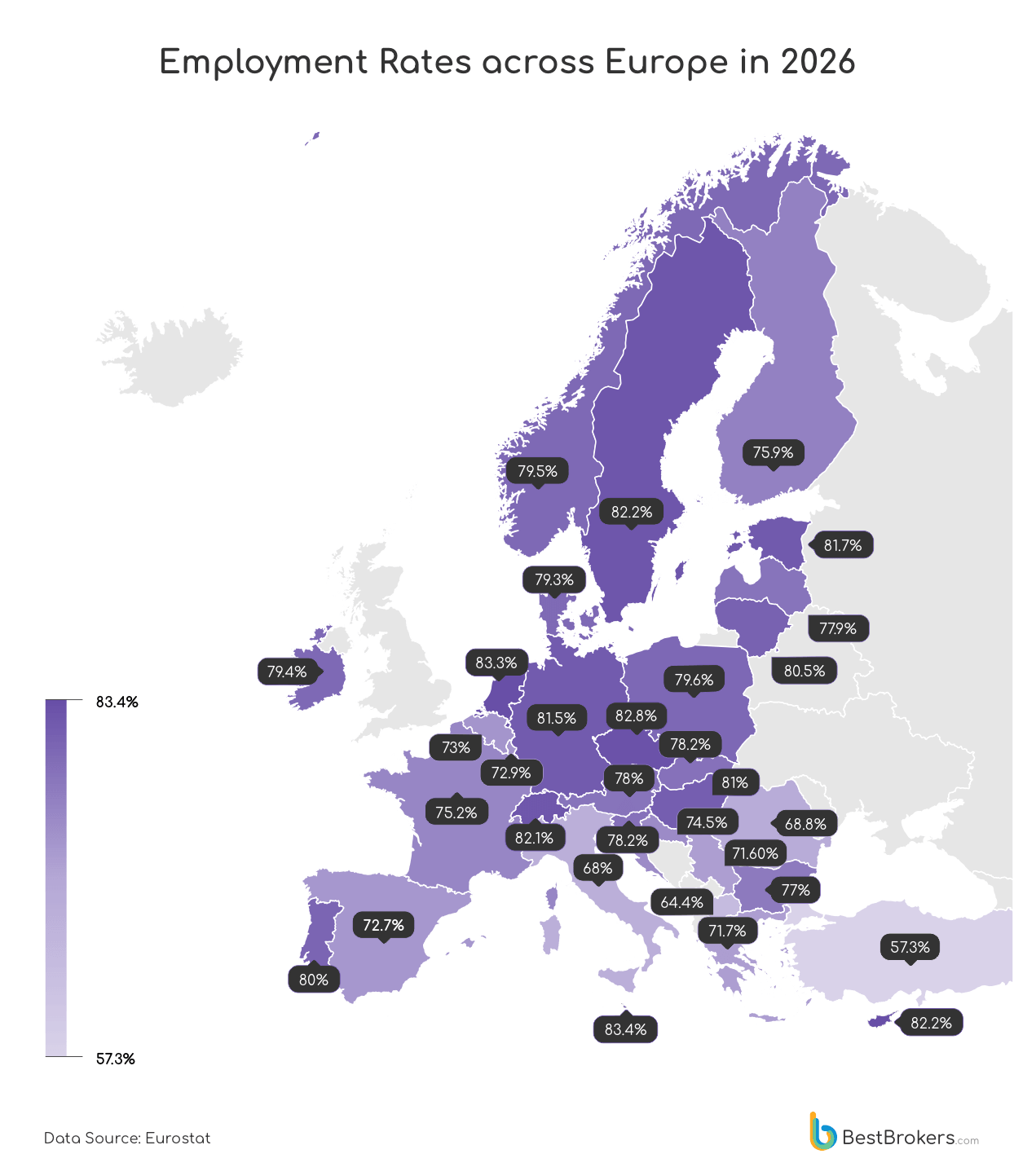
The gap between Europe’s labour-market leaders and laggards extends far beyond percentages, reflecting thousands of working-age people who remain outside employment. Among the countries analysed, Turkey recorded the lowest employment rate, with only 57.3% of working-age residents in employment, followed by North Macedonia (64.40%), Italy (68%), and Romania (68.8%). In contrast, more than eight in ten working-age residents were employed in countries such as Malta, the Netherlands and Czechia, highlighting the wide differences in labour-market participation across the continent.
However, employment rates alone reveal only part of Europe’s labour-market story – research by Eurofound found that 18.8% of jobs across the EU could be classified as vulnerable, a measure that combines income inadequacy, employment insecurity and lack of workplace rights, showing that the strength of Europe’s labour market depends not only on how many people are employed, but also on the quality and security of those jobs.
Spain powers Europe’s workforce expansion, while Turkey loses nearly 400,000 workers
Europe’s traditional economic map is shifting: the south, long associated with higher unemployment and weaker labour participation, has become a surprising driver of workforce expansion. Spain accounts for the largest share of new jobs in Europe, adding 430,000 employed people, followed by Portugal (+82,000), Greece (+34,000), Croatia (+16,000) and Cyprus (+12,000) – a combined increase of 574,000 workers.
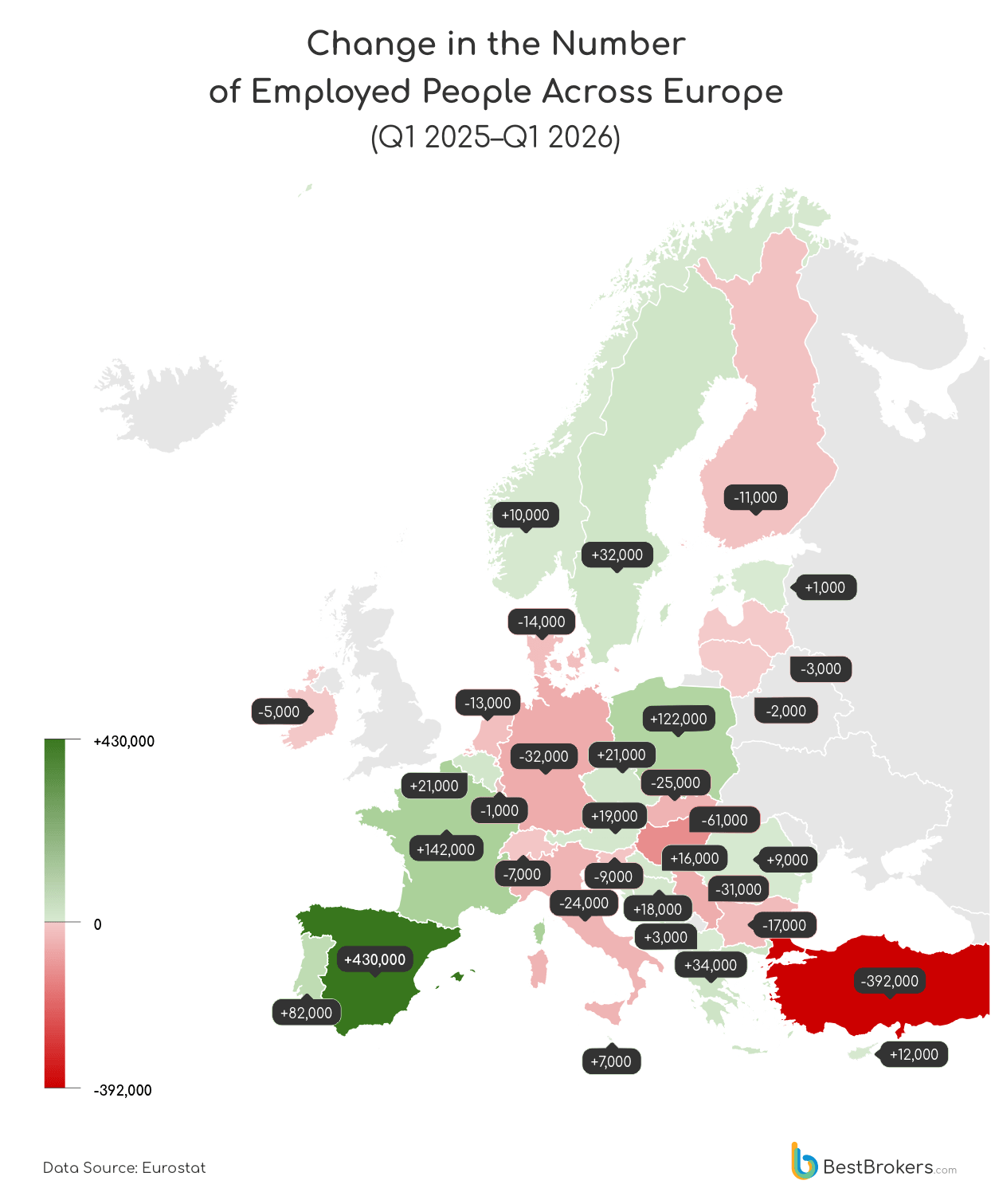
But every rising tide leaves behind a changing shoreline. As Spain and its southern European neighbours added hundreds of thousands of workers, other parts of the continent saw their labour forces slowly ebb away. In addition to having the lowest employment rates, Turkey experienced the steepest workforce decline, losing 392,000 employed people between Q1 2025 and Q1 2026 – a contraction larger than the combined losses of Germany (-32,000), Italy (-24,000) and Slovakia (-25,000). It comes amid a period of economic strain marked by high inflation, currency depreciation and rising business costs, factors that have weighed on hiring momentum and household purchasing power.
Cyprus and Malta expand their workforce faster than any other European country
Size is not destiny in Europe’s labour market. Spain may have added more workers than any other country in Europe, but the fastest workforce growth occurred elsewhere. Cyprus expanded its employed population by 2.52% over the year, followed by Malta at 2.22%, placing two of Europe’s smallest economies at the top of the continent’s employment-growth ranking. Both countries have relied heavily on foreign workers in recent years. Unlike many larger European economies constrained by ageing populations and slower labour-force growth, they have been able to expand their workforce through immigration, while strong tourism demand has continued to generate jobs across hospitality, transport, retail and other service industries.
European Countries
with the Largest Annual Changes in Employment
Percentage change between Q1 2025 and Q1 2026
Data Sources: Eurostat
The countries appearing at the bottom of Europe’s employment-growth rankings are becoming increasingly familiar. Hungary, which recorded the second-largest absolute decline in employment, also posted the steepest percentage contraction, with its workforce shrinking by 1.34% year-on-year. Close behind is Turkey (-1.32%), which has consistently featured among the weakest labour-market performers in the analysis. Slovenia (-0.93%), Slovakia (-0.98%), and Serbia (-1.14%) also rank among the largest percentage declines, reflecting a repeating pattern across parts of Central and Southeastern Europe. Demographic ageing, outward migration and weaker economic momentum have likely contributed to these contractions, placing growing pressure on countries already grappling with shrinking labour pools.
Labour shortages, not unemployment, are becoming Europe’s defining challenge
The surge in recruitment activity comes as Europe faces a serious challenge: a growing shortage of workers. While high vacancy numbers are often seen as a sign of economic strength, they increasingly reflect a widening gap between employer demand and the availability of skilled labour. In June 2026, the European Union launched the EU Talent Pool, a bloc-wide platform designed to connect employers with non-EU jobseekers, reflecting concerns that demographic ageing and skills shortages are becoming long-term constraints on economic growth rather than temporary labour-market imbalances.
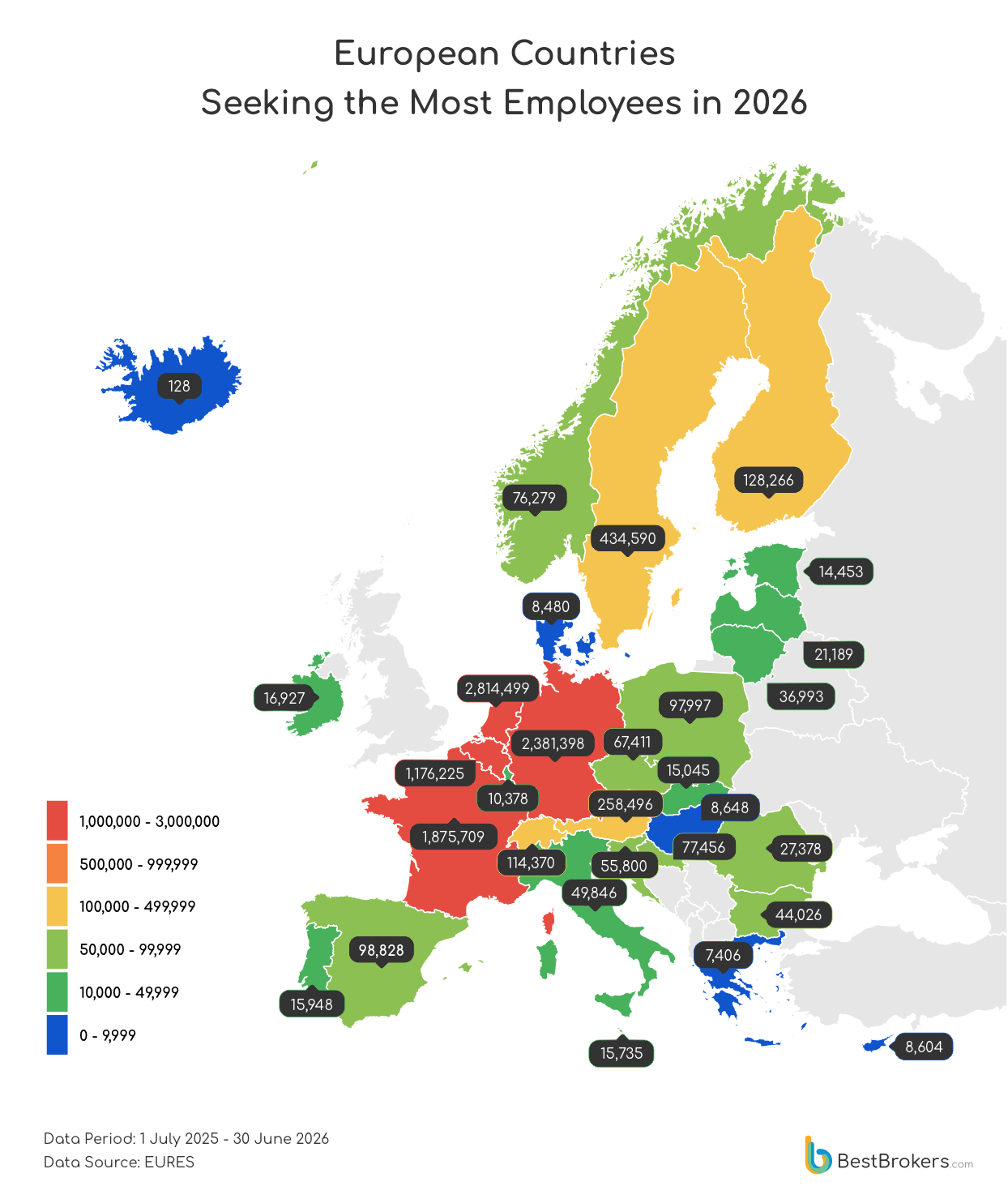
Perhaps the most striking pattern is that some of Europe’s most labour-hungry economies are no longer expanding their workforce. The Netherlands and Germany recorded employment declines compared to last year, yet together advertised around 5.2 million positions. In both countries, demographic ageing and persistent skills shortages have left employers competing for an increasingly scarce pool of workers.
Мany European economies are creating vacancies faster than their workforces are expanding. Sweden advertised 434,590 vacancies while adding only 32,000 employed people over the year, while Finland sought more than 128,000 workers despite a decline of 11,000 employed people. Belgium faced a similar imbalance, with roughly 1.2 million vacancies alongside employment growth of just 21,000 workers. Together, these figures suggest that the challenge facing many European labour markets is not a shortage of jobs, but a shortage of available workers with the right skills.
A vacancy count of 8,000 carries a very different meaning in Cyprus than it does in Germany, just as Iceland’s 128 job openings cannot be judged by the same yardstick as the Netherlands’ 2.8 million. Labour demand, much like employment itself, is shaped by scale. The smallest economies may generate only a trickle of vacancies in absolute terms, yet relative to their population they can still reveal labour markets operating near full capacity. The real story is not how many vacancies countries post, but whether they have enough workers left to fill them.
Technical labourers and office associate professionals are Europe’s most sought-after positions
Europe’s labour market is searching less for the jobs of the future than for the workers needed to keep the present running. Technical labourers top the continent’s vacancy ranking with 735,436 job openings, followed by office associate professionals (608,712), metal and machinery workers (586,897), drivers and vehicle operators (522,299), and machine and plant operators (517,592). Together, these occupations account for nearly 3 million vacancies, highlighting a persistent shortage of workers across manufacturing, logistics, construction, and industrial production.
From Technical Labourers to CEOs:
The Most Wanted Professionals across Europe in 2026
Data Period: 1 July 2025 – 30 June 2026
Data Sources: EURES
The findings challenge the perception that Europe’s labour shortages are primarily concentrated in highly specialised digital roles. While Information and Communication Technology (ICT) professionals remain among the most sought-after occupations with 376,756 vacancies, demand for technical labourers is nearly twice as high. The contrast suggests that Europe’s workforce challenge extends far beyond the digital economy, encompassing the skilled trades, industrial workers and logistics personnel that underpin supply chains, infrastructure and everyday economic activity.
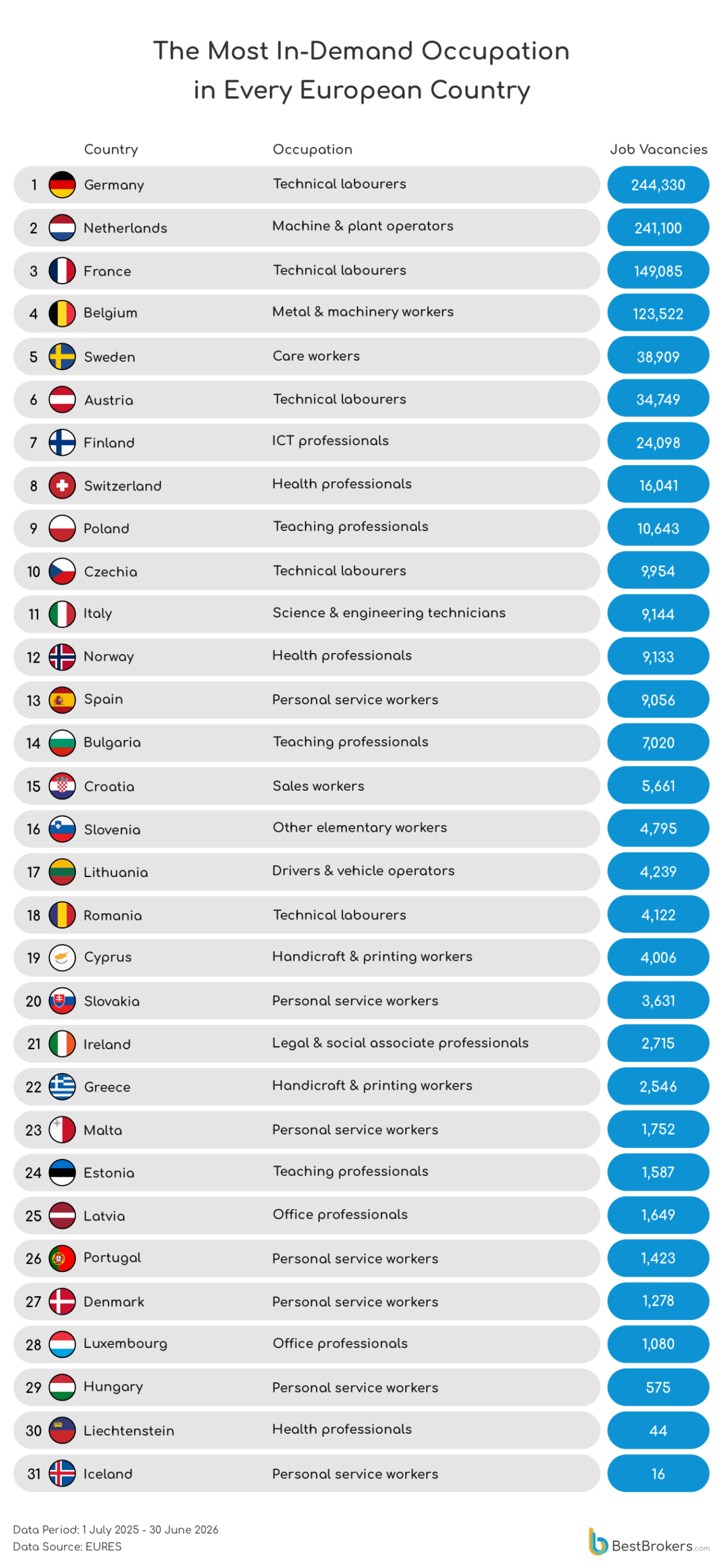
Despite the attention surrounding artificial intelligence and digitalisation, Europe’s largest labour shortages remain rooted in both the old and new economies. In Germany, France, Austria, Czechia and Romania, technical labourers are the most sought-after positions, posting between 4,122 and 244,330 vacancies, while in Finland, ICT professionals are most in need – 24,098 experts are wanted. The divide reflects two parallel challenges: maintaining the skilled workforce needed for Europe’s industrial base while simultaneously building the digital talent pool required for its technological ambitions. Those ambitions are increasingly under pressure, with recent Eurofound research warning that the EU is likely to miss its Digital Decade target for ICT employment.
Sweden, Switzerland, Norway, and Liechtenstein record the highest demand for care and health professionals, highlighting the growing strain that ageing populations are placing on healthcare systems across the continent. Elsewhere, personal service workers emergе as the most sought-after occupation in Spain, Portugal, Malta, Denmark, Slovakia, Hungary, and Iceland, reflecting the continued importance of tourism, hospitality and consumer-facing industries to many European economies.
Yet the labour shortage extends beyond hospitals and hotels. Europe’s classrooms are increasingly feeling the effects of a shrinking talent pipeline, with teaching professionals ranking as the most sought-after occupation in Poland, Bulgaria and Estonia. Together, the three countries advertised more than 19,000 teaching vacancies, signalling mounting recruitment challenges as large numbers of educators approach retirement and fewer new entrants step forward to replace them.
Methodology
This analysis examined employment and recruitment trends across Europe to identify where jobs are being created or lost, which countries are facing the strongest demand for workers, and which occupations are currently most sought after. The research combined the latest employment statistics from Eurostat with vacancy data from the European Employment Services (EURES) network.
We analysed employment rates across European countries in 2026 and tracked changes in the number of employed people between Q1 2025 and Q1 2026, measuring both absolute changes and workforce growth or decline as a percentage. To assess labour demand, we examined all job vacancies advertised through EURES between 1 July 2025 and 30 June 2026,, ranking countries by the total number of available positions, identifying the most in-demand occupation in each country, and determining which professional groups accounted for the highest number of vacancies across Europe.
Together, these indicators provide a comprehensive view of a labour market in transition – showing not only where employment is expanding or contracting, but also where employers are searching for talent and which skills are becoming increasingly valuable across the continent.