

Artificial intelligence has rapidly evolved from a niche investment theme centred on a handful of technology giants into the defining force behind much of the U.S. and global stock markets. In 2024, at the height of the AI boom on Wall Street, investors primarily associated AI with companies such as Nvidia, Microsoft and AMD. Just two years later, AI extends far beyond chipmakers and cloud providers, encompassing utilities, networking firms, data centre operators, industrial suppliers and enterprise software companies.
To examine the progression of this trend, the team at BestBrokers analysed America’s largest stock market index, the S&P 500 (Standard & Poor’s 500 index), which tracks the stock performance of 500 of the largest publicly traded companies in the United States and covers approximately 80% of the total U.S. equity market value. Our analysis of all S&P 500 constituents shows that 218 companies – more than two in five – are now directly exposed to the AI economy, collectively accounting for $42.4 trillion in market value, or 62% of the entire index. This illustrates that the AI boom has gradually evolved from the companies building the intelligence to those building the infrastructure that powers it.
Key Findings:
- AI-linked companies now represent 218 of the S&P 500’s 503 constituents (43.3%).
- Together, they are worth $42.39 trillion and account for 62.04% of the index’s market capitalisation.
- Companies outside the AI ecosystem now represent only 37.96% of total market value, despite making up 285 companies.
AI: The Dominant Investment Theme in the S&P 500
Artificial intelligence has become the largest investment ecosystem in the S&P 500 – not because every company builds AI, but because AI now influences almost every layer of the modern economy. Only a few years ago, investors largely viewed artificial intelligence through the lens of a small group of companies building the technology itself. Nvidia, Microsoft, AMD, Alphabet and a handful of semiconductor businesses dominated conversations about AI investing.
S&P 500 Constituents in July 2026: AI Companies Weight
Number of companies as of July 2026
Share of market capitalization as of July 2026
Sources: Yahoo Finance, S&P Global, CompaniesMarketCap, Nasdaq
That picture has changed dramatically. Today, 218 companies – more than two in every five S&P 500 constituents – have a meaningful connection to the AI economy. Together, they account for $42.39 trillion in market value, representing almost two-thirds of the index.
The remaining 285 companies, despite making up the majority of index constituents, collectively account for only 37.96% of total market capitalisation. This does not mean that fewer than half of the S&P 500 use artificial intelligence. In reality, almost every large business is now adopting AI in some form, whether through automation, productivity tools, customer service or internal analytics.
However, our analysis focuses on companies where AI has become materially important to their business model, investment thesis or long-term growth prospects. These businesses either develop AI technologies directly, provide the infrastructure that enables AI, supply essential components to the AI value chain or have deeply integrated AI into the products and services they sell. For that reason, the AI Adopters category in this report should not be interpreted as the only companies using AI. Rather, it identifies companies where AI has become a defining strategic capability rather than simply another productivity tool.
The Dramatic Expansion of the AI Boom in Just 2 Years
The AI story of 2024 was relatively straightforward. AI investing revolved around a small group of technology leaders, with the biggest winners being companies building the technology itself: chip designers, cloud providers and the developers of increasingly sophisticated large language models.
The AI Ecosystem in the S&P 500 Index
Number of companies
Share of market capitalization
Sources: Yahoo Finance, S&P Global, CompaniesMarketCap
Two years later, the market is rewarding a much broader range of businesses. Today, the AI economy extends well beyond the companies creating intelligence. It now includes those supplying electricity to data centres, manufacturing cooling systems, expanding fibre-optic networks, building server infrastructure and providing specialised enterprise software.
The numbers illustrate this transformation. While 58 Core AI companies, including chipmakers, cloud and model providers, AI software developers and AI security firms, collectively account for $32.20 trillion in market value, another 160 companies form the broader AI ecosystem, contributing an additional $10.19 trillion.
Mapping the Modern AI Economy
The largest segment of today’s AI ecosystem remains AI Chips & Hardware Suppliers, representing 28 companies with a combined market capitalisation of $12.39 trillion and an index weight of 18.14%.
The S&P 500: Companies with Material Exposure to the AI Value Chain
Number of companies as of July 2026
Share of market capitalization as of July 2026
Sources: Yahoo Finance, S&P Global, CompaniesMarketCap, Nasdaq
Close behind are AI Cloud & Model Providers, whose six companies, including the hyperscale cloud leaders, account for another $11.74 trillion, or 17.18% of the index. However, one of the most interesting developments is the growing importance of industries that would rarely have appeared in an AI investment report just a few years ago.
The AI Energy & Power Infrastructure category now includes 58 companies, the largest group by company count, reflecting surging investor interest in the enormous electricity requirements of AI data centres. Similarly, AI Infrastructure Suppliers (Pick-and-Shovel) and AI Infrastructure & Data Centres now comprise 60 companies, highlighting how AI has become as much a story about physical infrastructure as software.
Even the AI Software & Applications category has expanded beyond traditional technology firms to include businesses embedding generative and agentic AI into enterprise software, advertising, design platforms and decision-making systems. Together, these categories, however limiting or broad they may seem to different people, show that AI has become an entire industrial ecosystem – ever-expanding and ever-demanding, rather than a single technology sector.
The Market’s Biggest Winners Are No Longer Just Chipmakers
One of the clearest signs of AI’s evolution can be seen in stock performance. The strongest performers over the past two years are no longer limited to the largest technology companies. We looked at two-year growth rather than year-to-date performance or price changes over the past year, since we wanted to see the progress after the AI boom had already started.
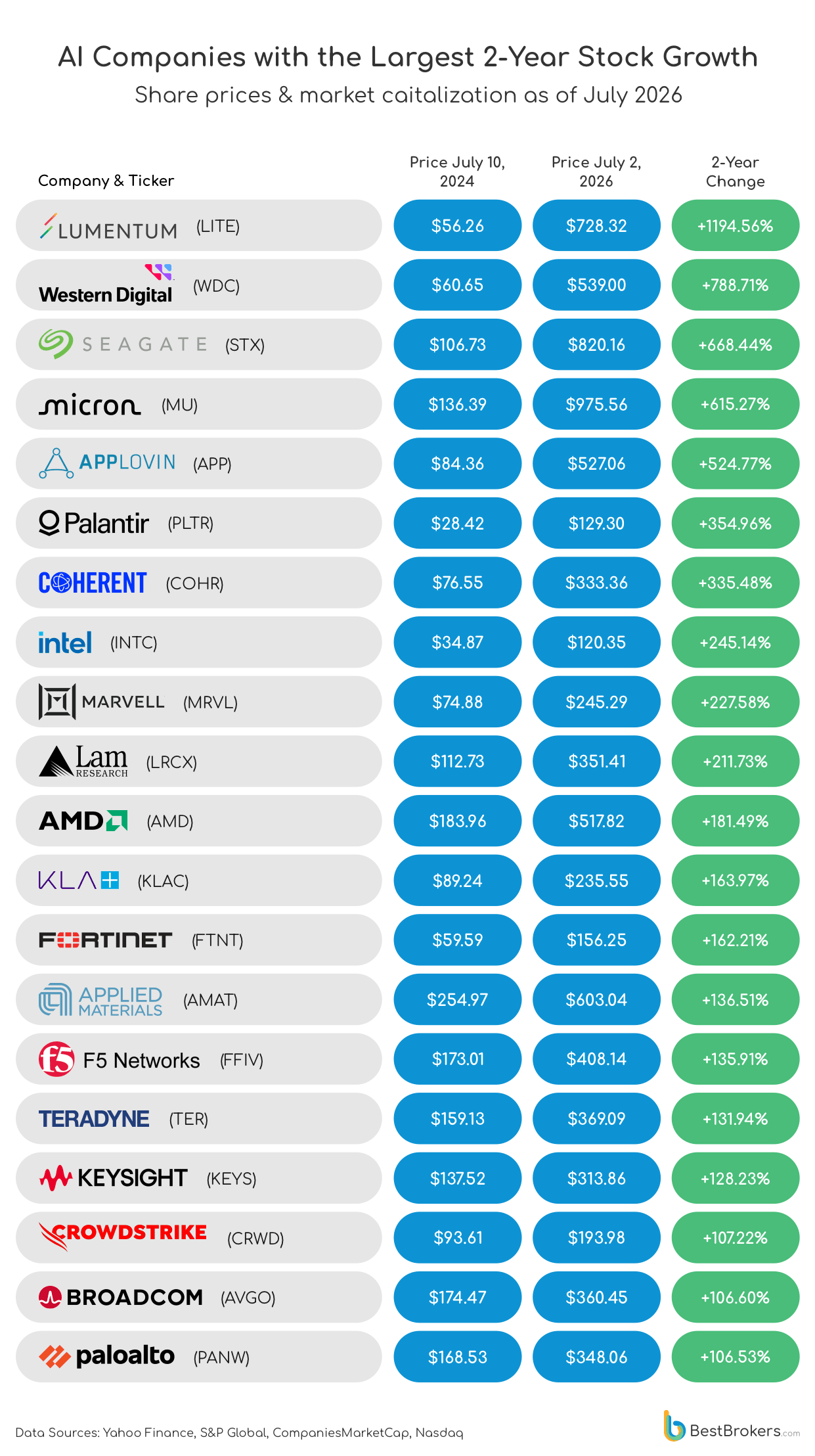
Among the top-performing AI-linked stocks are optical networking specialist Lumentum Holdings (stock +1194.56% between July 2024 and July 2026), storage companies Western Digital (+788.71%) and Seagate (+668.44%), memory producer Micron Technology (+615.27%), enterprise AI leader Palantir (+354.96%), advertising platform AppLovin (+524.77%) and semiconductor infrastructure firms such as Lam Research (+211.73%), Applied Materials (+136.51%), and KLA Corporation (+163.97%).
Many of these businesses play supporting rather than starring roles in the AI revolution. Yet they have become indispensable to its expansion, and the growth in their stocks is demonstrating how investors think. The market increasingly recognises that every AI model ultimately depends on a much larger ecosystem of hardware, networking, energy and specialised infrastructure. In many cases, the companies selling the “picks and shovels” are proving just as attractive to investors as those digging for gold.
AI Is Reshaping the Entire Index
It is clear as day that artificial intelligence has become one of the fastest-expanding investment narratives in modern market history. In just two years, the number of companies materially linked to the AI economy has grown almost sixfold – from 38 to 218.
More importantly, AI’s influence has spread far beyond the technology sector itself. Utilities, industrial manufacturers, infrastructure suppliers, cybersecurity firms and enterprise software providers now all form part of the same value chain, each enabling the continued expansion of AI in different ways.
But who is actually growing by creating and feeding artificial intelligence, and who is just riding the AI wave? As more businesses highlight AI strategies during earnings calls and product launches, investors must increasingly distinguish between companies genuinely creating value from AI and those simply benefiting from market enthusiasm surrounding the technology.
The AI economy is clearly becoming broader. Whether every company now presenting itself as an AI winner ultimately deserves that label remains one of the defining investment questions of the coming years. For now, however, one conclusion is difficult to dispute: AI is no longer a niche corner of the stock market. It has become one of the foundations upon which the modern S&P 500 is increasingly built.
Methodology
The analysis covers all 503 constituents of the S&P 500 Index as of July 2026. Companies were classified into one of eight categories based on their primary role within the AI value chain: AI Chips & Hardware Suppliers, AI Cloud & Model Providers, AI Software & Applications, AI Security & Trust Layer, AI Infrastructure & Data Centres, AI Infrastructure Suppliers (Pick-and-Shovel), AI Energy & Power Infrastructure and AI Adopters. Classification was based on each company’s products, services, infrastructure role and the material importance of AI to its business strategy and investment narrative.
Market capitalization as of July 6 2026, from CompaniesMarketCap and index weight were aggregated for each category to measure AI’s overall footprint within the index. Share prices were sourced from Yahoo Finance, with additional information about the index and its constituents taken from Nasdaq and S&P Global.