
Nvidia was closing in on a $6 trillion valuation last week, a figure that would have sounded absurd just a few years ago. Its rise over the past couple of years has captured the market’s extraordinary appetite for companies seen as indispensable to the AI boom – and how quickly investors can pile into a business they believe will shape the future.
On Thursday, Nvidia and Oracle showed just how quickly the market’s mood can turn. Nvidia shares fell nearly 3%, while Oracle dropped more than 5%, after a Financial Times report put OpenAI’s annualised revenue at around $50 billion at the end of September, below the roughly $68 billion figure previously reported. The discrepancy reflected different ways of counting revenue, rather than a sudden collapse in sales, yet the reaction was swift: billions of dollars in shareholder wealth disappeared in a single session.
This other side of the stock market’s success stories is less often told. For every company whose value soars on expectations of what comes next, there are businesses that lose billions in market capitalisation as growth stalls, competition intensifies, or investors simply lose faith. To identify the biggest destroyers of market value, the team at BestBrokers analysed market-cap changes among the world’s current 1,000 largest publicly listed companies since 2021.
Leaving out companies with major acquisitions, mergers, and other significant changes to the corporate structure, as well as those that have executed major forward stock splits, we discovered 172 companies that saw large chunks of their market value being wiped out over the past five years. We tracked the stock performance of those 172 and calculated what investors would have lost on a $1,000 investment made back in 2021. The results serve as a reminder that a famous name, a once-dominant position or a history of success is no guarantee of lasting investor confidence.
Key Takeaways:
- PayPal has suffered the steepest market-cap collapse among the world’s 1,000 largest publicly traded companies, shedding 85.41% of its value since 2021.
- Roblox lost 64% of its market valuation within a year, while most of the decline in Boston Scientific has occurred over the last 9 months – nearly 55% of its value has disappeared since January 5.
- Investing in major brands does not protect against losses – a hypothetical $1,000 stake in PayPal five years ago would have withered to just $200.21 by September 2026, while in Nike, it would have shrunk to $208.22.
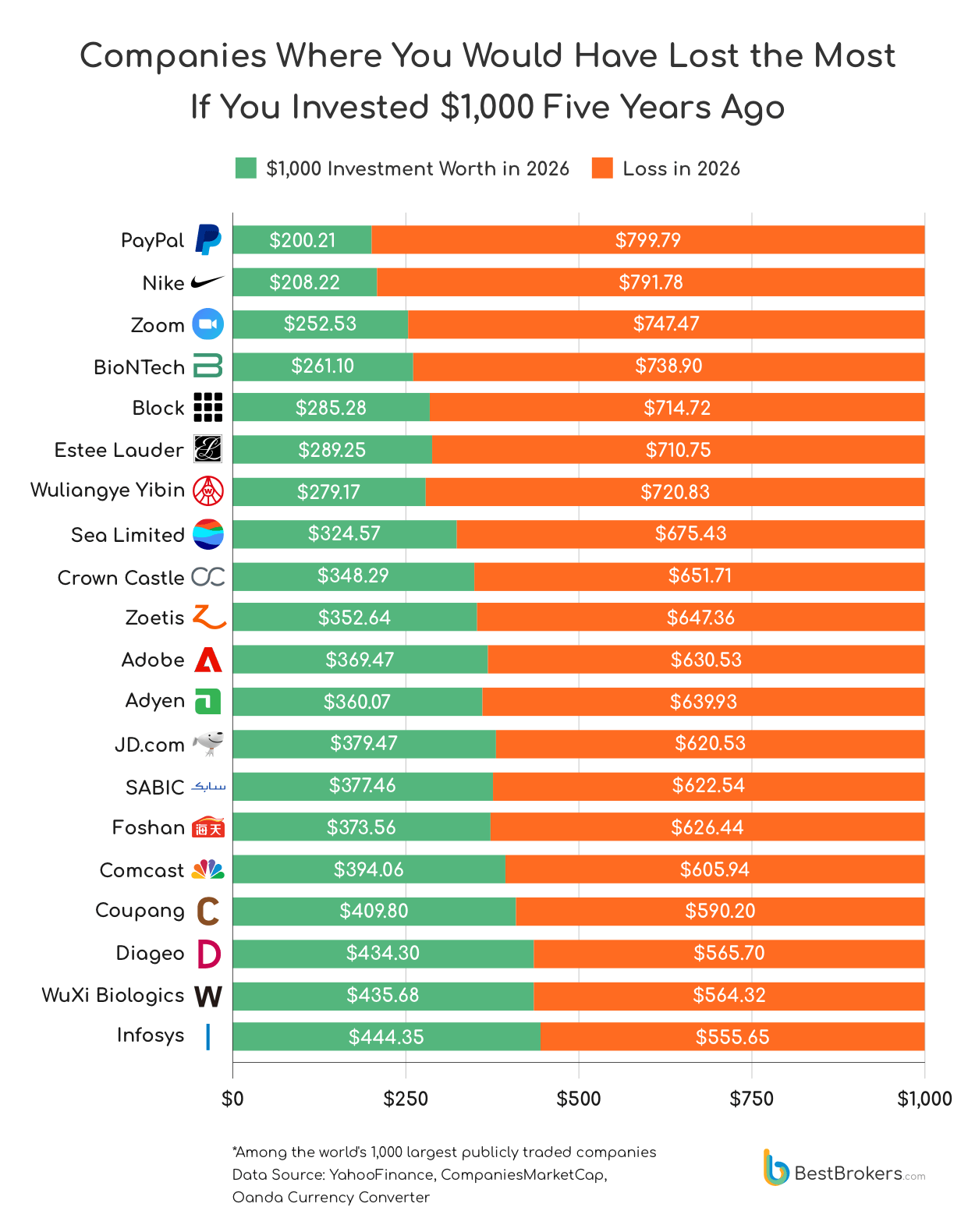
The Price of Bad Timing: Where a $1,000 Investment Crumbled Since 2021
Between 2021 and 2026, global equity markets witnessed a historic re-rating that erased trillions of dollars in corporate market capitalisation. Once a company’s share price tumbles, it directly shrinks the overall market value of the entire enterprise, but for shareholders, this downward trend immediately translates into severe portfolio damage. Those unlucky enough to lock in initial capital into a company during its peak valuation saw their investment evaporate. The slow-motion reality check that deflated corporate valuations between 2021 and 2026 becomes painfully clear when we trace a concrete financial footprint.
If you had put $1,000 into a handful of the world’s most famous companies back in August 2021, you might have expected a handsome return by September 2026. Instead, the last five years for some delivered a masterclass in market re-rating and capital destruction. When companies trade at historically extreme multiples, even a globally recognised brand cannot protect investors from a harsh macroeconomic reality check.
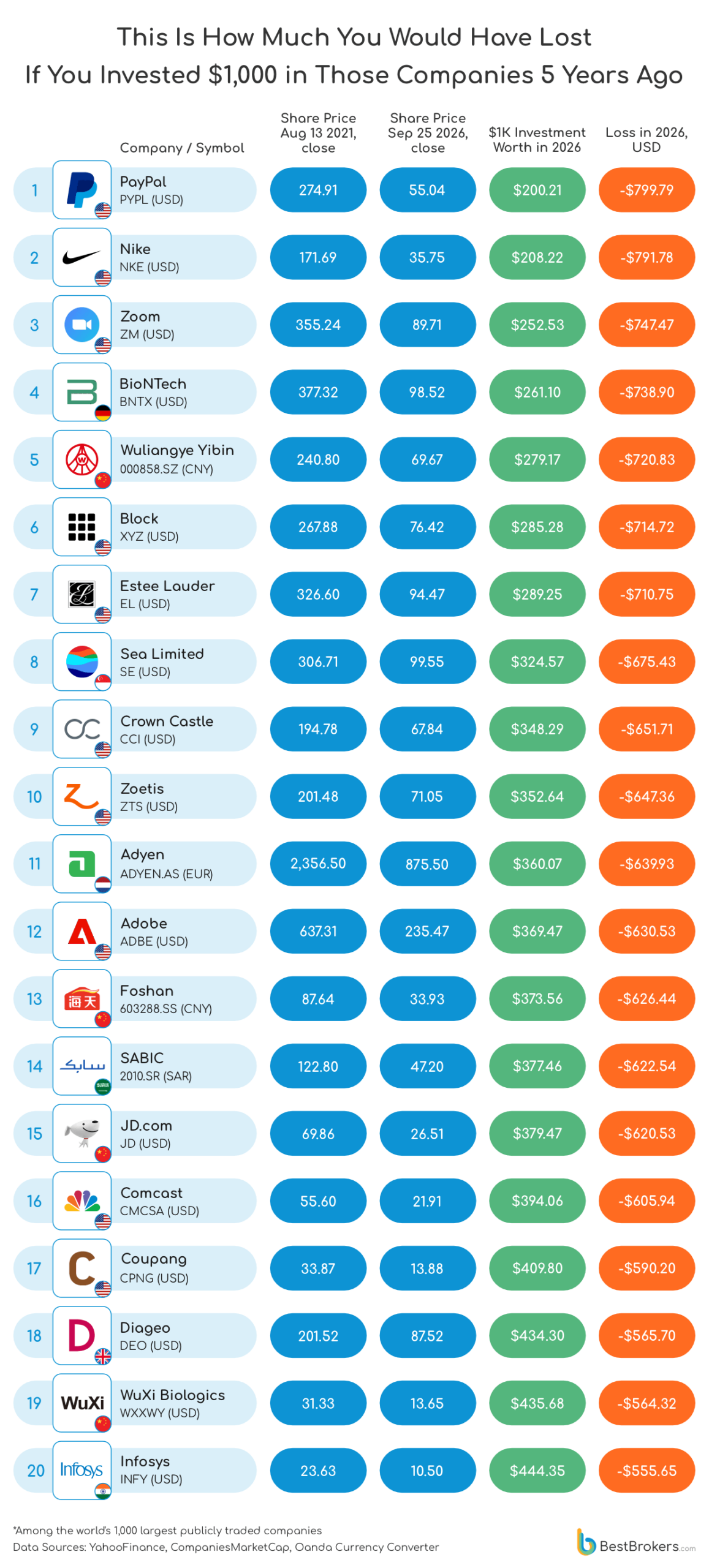
The most severe destruction of shareholder value occurred at PayPal, where a $1,000 investment made five years ago plummeted to a mere $200.21 – a devastating 80% capital loss.
Other pandemic-era market darlings suffered similar falls as the world went back to normal. That same $1,000 investment shrank to $208.22 in Nike and $252.53 in Zoom, while the same stake in BioNTech withered to $261.10 simply because the global demand for COVID-19 vaccines dried up.
Intense competition and shifting consumer habits also hammered digital payment and beauty companies. Block (formerly Square) and Estée Lauder dragged $1,000 investments down to $285.28 and $289.25, respectively. Block struggled as the digital payments landscape fractured into too many competing apps, while Estée Lauder failed to recover from a prolonged slowdown in travel retail and weak sales in mainland China.
Valuations Wiped Out Since 2021: Interest Rate Hikes & Correcting Pandemic-Era Overvaluations
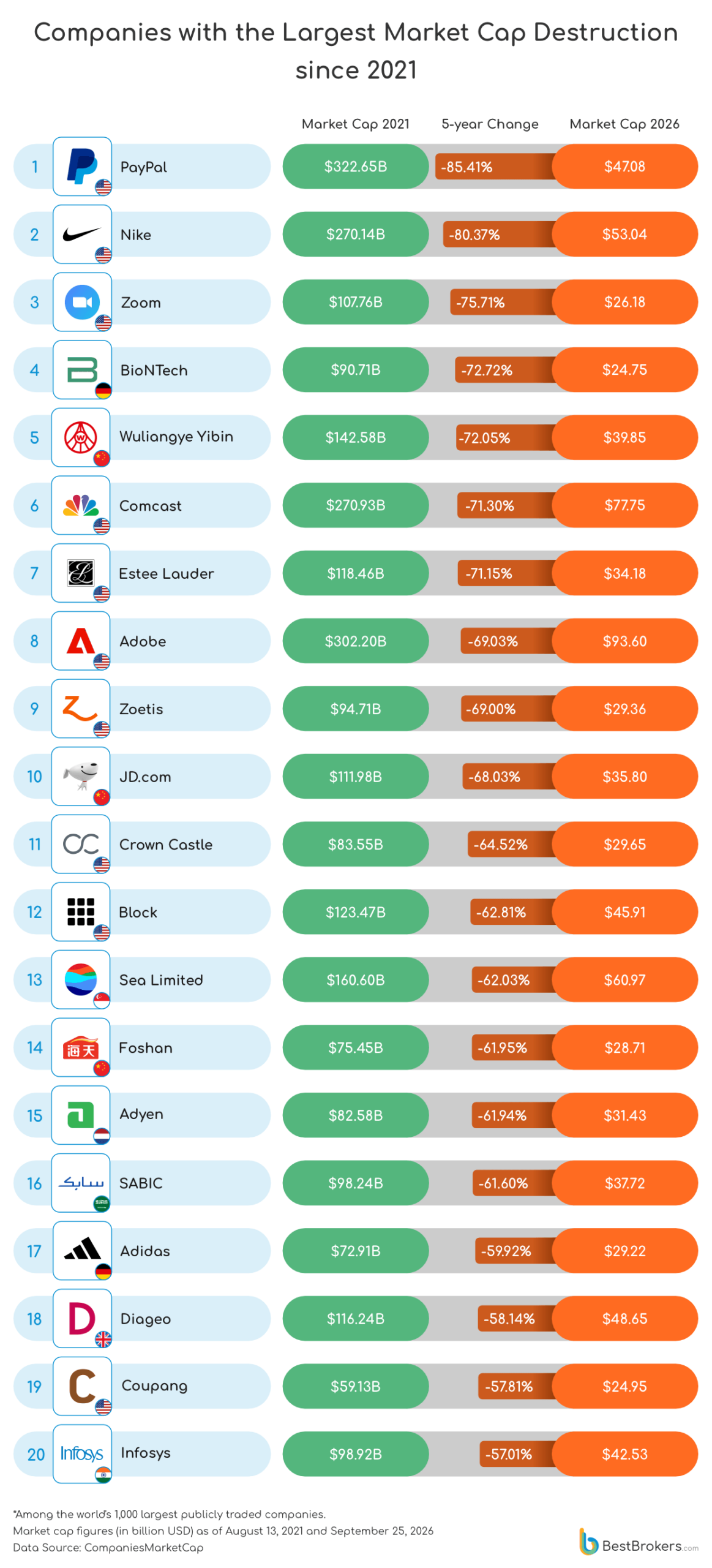
As a share of its former capitalisation, PayPal has lost more market value than any other company in the ranking, with its valuation plunging 85.41% from $322.65 billion in 2021 to $47.08 billion in September 2026. This decline is hardly a collapse in revenue or payments activity – the company remains a large, successful business that struggled to defend its pandemic-era leading position. As online shopping surged during lockdowns, investors priced in years of rapid growth. When consumers returned to physical stores, that momentum faded – and competition from Apple Pay, Google Pay, Stripe, and other payment providers intensified.
PayPal’s biggest weakness has been its branded checkout business, where growth slowed sharply: in the fourth quarter of 2025, branded online checkout volume grew just 1%, compared with 6% a year earlier. The company has also faced criticism for moving too slowly into new areas of digital commerce, while its buy-now-pay-later ambitions have yet to transform its growth prospects. Despite processing $1.79 trillion in payments during 2025, PayPal’s active accounts grew by just 1% that year. While the business has not disappeared, investors are seemingly no longer willing to value it as though its former growth is guaranteed.
Nike has endured a similarly dramatic reversal, losing 80.37% of its market value, or $217.1 billion, as its valuation fell from $270.14 billion to $53.04 billion. The company is still one of the world’s best-known sportswear brands, but it has struggled to turn its global reach into new growth. Tougher competition from newer running and sportswear labels has undoubtedly factored in, but another topic of discussion has been its own product mix, the online Direct-to-Consumer (DTC) model it has turned to, and the heavy reliance on promotions. All these have eroded its appeal and premium brand image; customer demand has gradually slowed, and, maybe unsurprisingly for industry insiders, revenues dropped.
China has been a particular problem: Nike’s first-quarter fiscal 2027 revenue there fell 22% year on year to $1.18 billion, the ninth consecutive quarter of revenue declines in Greater China, which accounts for about 15% of the company’s annual revenue. The restructuring under CEO Elliott Hill has already resulted in the laying off of 2,175 workers so far in 2026 across two major rounds, with another wave of job cuts announced in October. The plan, which will see more redundancies take place starting January 2027, is projected to result in $2.5 billion in cumulative savings through fiscal 2031.
While these two may be the most striking cases considering both companies’ massive global reach, the damage extends well beyond payments and sportswear. American video conferencing platform developer Zoom has lost 75.71% of its 2021 market value, falling from $107.76 billion to $26.18 billion. During the pandemic, video calls became essential almost overnight, and investors valued Zoom as though that exceptional demand would persist. As offices reopened, growth normalised, and the company had to compete with video-conferencing tools built into Microsoft 365 and Google Workspace. Zoom has since expanded into contact-centre software, phone services and AI features, but these initiatives have not restored its former, quite exceptional growth, nor investor confidence.
Adobe, once worth more than $300 billion, has lost 69.03% of its market capitalisation, wiping out $208.6 billion in value. The company remains deeply embedded in creative and professional workflows, but generative AI has changed everything – tools that can create images, edit content or produce designs from simple prompts could expand demand for digital creativity, but they can also make some traditional software features easier to replace. Even with Adobe building AI into its products, the evidence that these tools can generate substantial new revenue and defend subscription pricing is probably not clear enough, at least for investors. It seems that its software is not as difficult to replace as it once was; plus, the competition from AI tools is becoming tougher every day with newer, better, and cheaper models now taking up more and more market share.
Another interesting case is BioNTech, the German biotechnology group, whose vaccine partnership with Pfizer helped its valuation skyrocket at the height of the pandemic – by September 25, 2026, it had lost 72.72% of its market value as the extraordinary demand for its COVID-19 vaccine has faded. The company is investing in cancer treatments and other immunotherapies, but these programmes require costly trials and years of development before they can deliver comparable revenue.
Collapses in 2025-2026: De-digitalisation, E-Commerce Wars & Luxury Spending Slowdown
The period from 2021 to 2024 was marked by post-pandemic decline, soaring interest rates, and booming hype surrounding the new, exciting artificial intelligence companies (and the suppliers providing those with chips, equipment, and critical infrastructure). By mid-2025, many of the world’s biggest brands had clawed their way back to stunning financial heights. Investors were optimistic, companies were printing cash, and valuations looked unstoppable.
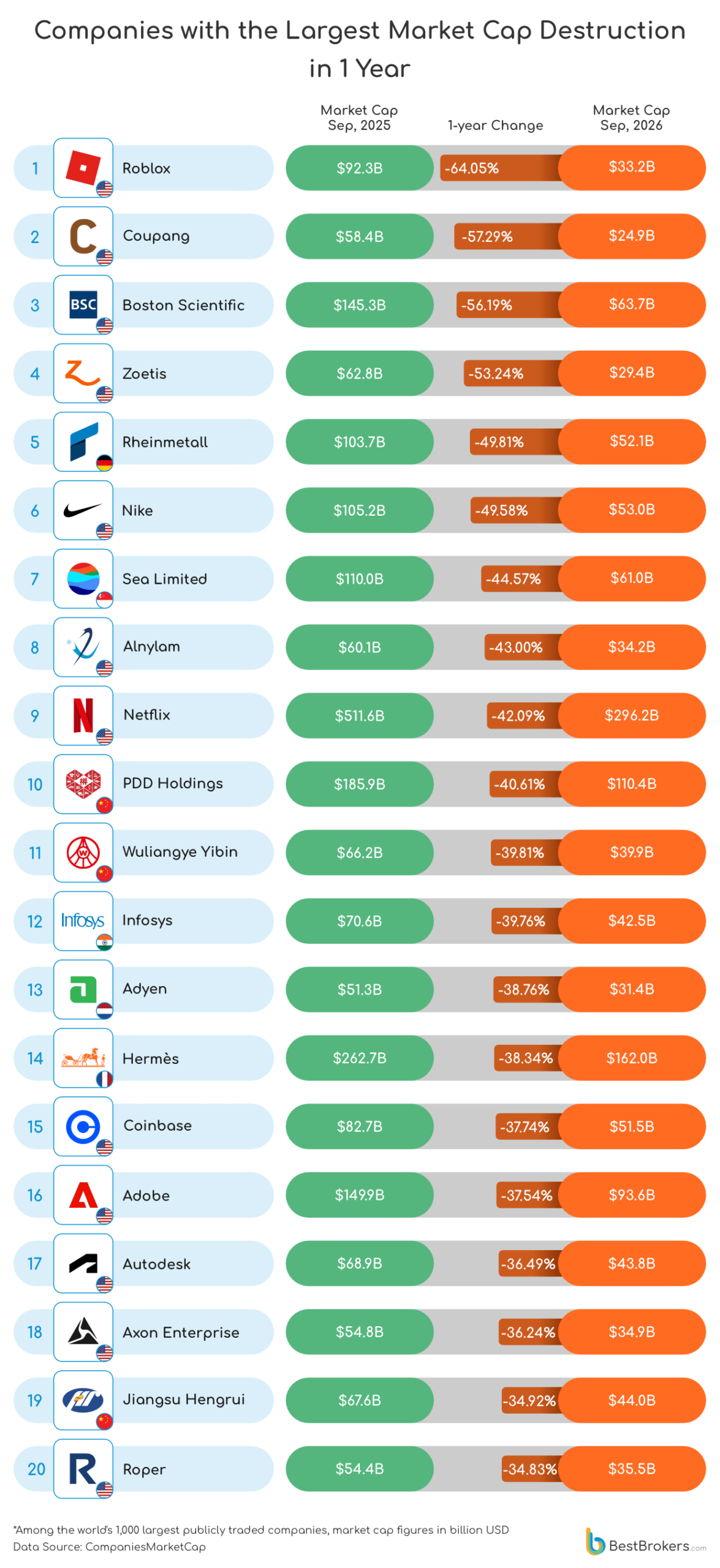
But not for everyone. Over the next twelve months, consumers grew exhausted, the digital space had changed, shaped by AI tools and overcrowding in e-commerce and deliveries. And some companies saw their market share shrink, revenues drop, and market valuations being slashed. By September 2026, trillions of dollars in market value had simply evaporated – rather than a sudden market crash, this was a gradual reality check. Although, to be fair, several sudden crashes did actually happen – such as the crypto market’s flash crash last October, the enterprise software and SaaS crisis in early 2026, or the AI semiconductor collapse in Korea this summer.
When looking at the period between September 2025 and September 2026, the steepest one-year decline belongs to California-based Roblox Corporation, whose market capitalisation plunged 64% to $33.18 billion. The company, which began trading on the New York Stock Exchange through a direct listing, rather than a traditional IPO in early March 2021, had already become highly successful the previous year. Shares surged on the first day, briefly valuing the company at around $47 billion amid strong investor demand. However, in its second-quarter 2026 results, Roblox said bookings growth was 8% year on year, at the low end of its guidance, partly because monetisation per hour declined, particularly among younger users in the U.S. and Canada.
Between August 2021 and September 2026, payments platform Adyen and cryptocurrency exchange Coinbase lost over a third of their market values. Both companies got hit hard as investors pulled their money out of speculative tech and moved it into AI hardware. Adyen dropped 38.76% as it got caught in a brutal price war in North America, while its own rising costs heavily squeezed profits. On the flip side, Coinbase fell 37.74% after a massive global tariff shock in October 2025 triggered the biggest leveraged liquidation event in crypto history, leaving trading volumes in a long slump.
But the issues in the fintech sector are just one side of the coin – online retailers and e-commerce platforms have also been hit hard. PDD Holdings, the parent company of the ultra-cheap shopping app Temu, had a spectacular run-up until 2025. But then, Western governments closed legal tax loopholes that allowed these apps to ship packages duty-free. Suddenly, shipping costs soared, and the ‘Temu bubble’ burst. Even Nike couldn’t run away from trouble; its heavy pivot to online-only sales backfired, leaving warehouses full of unsold sneakers while nimbler rivals like Hoka snatched away their customers.
The severe economic slowdown in China dragged a number of American and European companies with it, with the luxury sector finally seeing the effects of weaker consumer demand. Prestigious French luxury goods manufacturer Hermès saw its stock price fall, with investors probably realising they could no longer pay the premium connected with the brand itself. It lost $100.7 billion or around 38.34% of its value within a year. In China, Wuliangye Yibin, the maker of elite corporate spirits, saw its stock price slide dramatically from its 2021 historical peak as a deepening property crisis and intensifying anti-graft austerity measures fundamentally squeezed demand.
The macroeconomic structural shift away from a real estate-driven economy, combined with a cultural migration among younger consumers away from traditional, mandatory corporate banqueting, severely curtailed the high-end ‘obligation drinking’ and corporate gifting that historically drove premium baijiu volumes. According to data tracking from the IWSR China Market Analysis, the lavish business dining occasions that once served as the primary engine for premium spirit sales have largely disappeared as consumption pivots toward value and casual, personal enjoyment.
Then, the digital world hit a hard ceiling, with Roblox, the massive online gaming platform, being a great example. In late September 2025, its stock was flying high at over $141 a share. But as the year progressed, kids and teens spent less money on virtual currency, with the lower monetisation sending the stock tumbling back to earth. Within a year, more than $59 billion of the company’s capitalisation on the stock market was wiped out. Meanwhile, Adobe ran into a futuristic nightmare where cheap, open-source generative AI tools allowed anyone to create digital art with a simple text prompt. As a result, another massive chunk of its valuation disappeared. Netflix and various digital-first entertainment businesses faced similar fates as people simply hit their limit on streaming and gaming – and on paying for it.
Also, a handful of companies fell short of premium market expectations despite reporting robust operational growth. German defence giant Rheinmetall had seen its stock skyrocket after 2022 due to European military spending. However, by mid-2026, its stock faced severe pressure when the unexpected cancellation of Germany’s F126 frigate program forced a €300 million reduction in its full-year sales guidance. Separately, the company suffered a deep working capital drain that dragged operating free cash flow to minus €1.62 billion, an impact management attributed to the timing of customer advance payments, heavy inventory accumulation to back rising orders, and aggressive investment activity.
Recent Collapses: Largest Market Cap Destructions Since the Start of 2026
For some companies, 2026 has been even tougher, with one of the most shocking stories of the year probably belonging to Boston Scientific, with its market capitalisation down nearly 55%, from $140.4 billion to $63.7 billion. The medical technology leader started the year strong at a massive $140.4 billion valuation and saw steady 7.5% sales growth in mid-2026. The company was forced to repeatedly cut its full-year guidance due to an unexpected slowdown in its flagship Watchman heart implant market, loss of electrophysiology market share to rivals, and a severe global network outage caused by a late-August cyberattack. By late September 2026, it had crashed 54.67% to less than half of what it was valued on the stock market. That single $76.8 billion drop became the heaviest loss on the ledger percentage-wise, signalling a massive shift in how investors view the future of medical hardware.
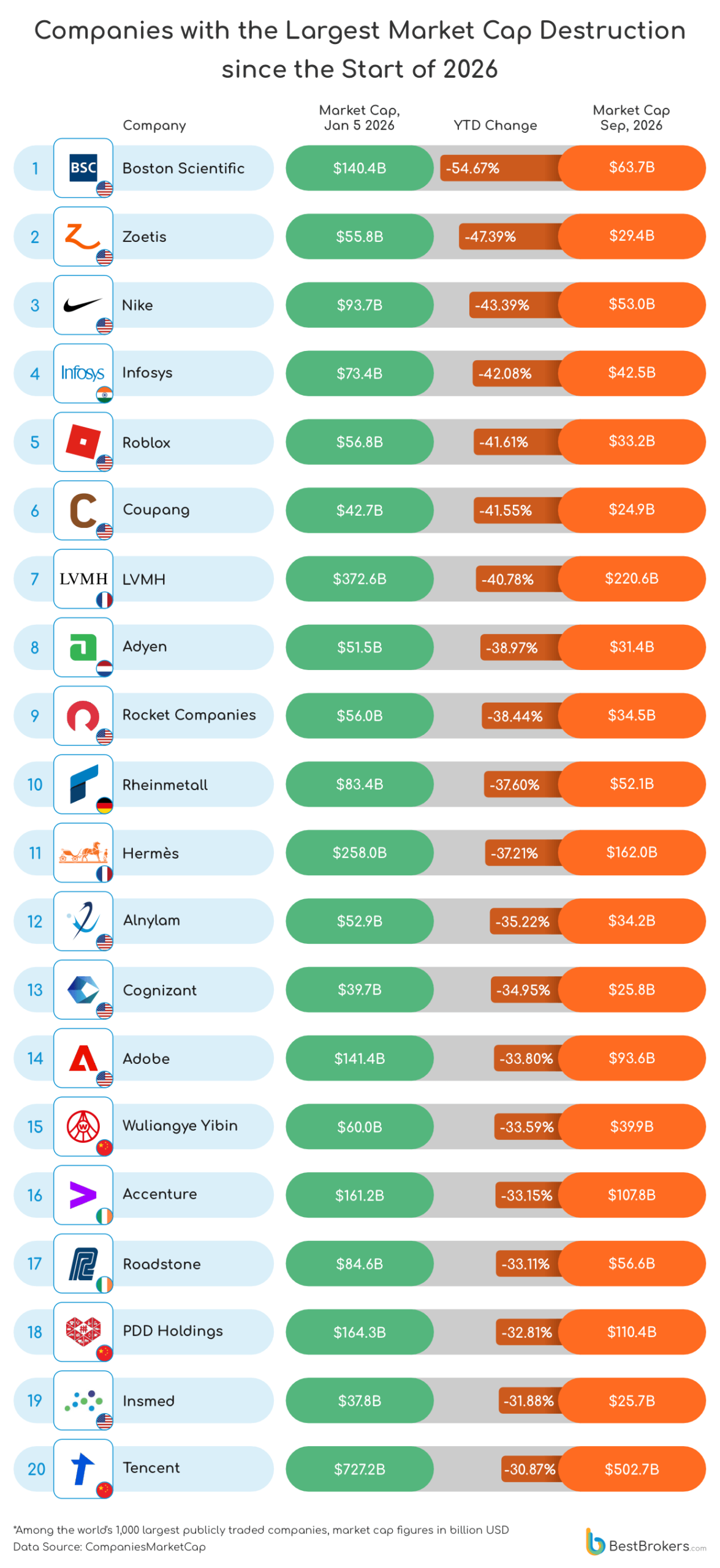
Right alongside it, the travel and convenience boom hit a wall. As people tightened their belts, skipped vacations, and ordered in, online platforms took a beating. American e-commerce and delivery company Coupang watched 41.55% of its value vanish between January 5 and September 25, shrinking from $42.7 billion to $24.9 billion, while Dutch payments platform Adyen dropped nearly 39%. Ultra-premium brands that once seemed bulletproof also lost their shine. The world’s ultimate luxury powerhouse, LVMH, suffered a staggering 40.78% collapse, erasing a mind-boggling $151.9 billion in value. At the same time, Hermès shed $96 billion, declining by over 37% – all this within months.
The tech and consulting world faced its own identity crisis. Global IT consulting giants Infosys, Accenture, and Cognizant all tumbled between 33% and 42%, and software giant Adobe bled $47.8 billion. Among the reasons for these collapses was the sudden, aggressive rise of artificial intelligence, which changed multiple industries and forced investors to wonder whether traditional tech giants would be the winners of the AI revolution, or its first casualties.
Methodology
This analysis compares global corporate market capitalisations over a five-year horizon from a baseline on August 13, 2021, to a terminal date of September 25, 2026. The team at BestBrokers sourced current and archived market cap data from CompaniesMarketCap and The Internet Archive, covering the 1,000 largest publicly traded companies around the world. Closing stock prices were taken from Yahoo Finance, and where not available, prices for the closest dates were taken. For the investment calculations, all figures were converted to U.S. dollars at exchange rates, using the OANDA Currency Converter.
The framework captures the transition from peak post-pandemic tech valuations to September 2026 economic normalisation. To isolate organic changes driven by market sentiment, macroeconomic shifts, and consumer behaviour, the initial sample of companies was put through a strict corporate filter. Entities that underwent major financial engineering or organisational re-layering inside this window were removed to protect data integrity. In fact, we tried to remove any company that experienced a forward or reverse stock split, bonus share dilution, corporate spin-off, business demerger, cross-border acquisition, or structural asset partition between August 2021 and September 2026.
This includes disqualifying companies with major demergers like ITC Limited and Thomson Reuters, asset divestitures like Las Vegas Sands, and complex cross-holding swaps or heavy buybacks like Prosus, Naspers, and BTG Pactual. Furthermore, Xiaomi was removed due to its fundamental shift from a consumer hardware play to a capital-intensive electric vehicle manufacturer. Of the 1,000 companies initially taken, 172 companies saw their market capitalisations decline over a 5-year period, while 241 suffered collapses over the past year; 283 companies witnessed their value drop since the start of 2026.
A hypothetical portfolio trace was applied, tracking a fixed one-thousand-dollar baseline investment to illustrate the practical financial impact on an individual investor. Once again, we took August 13, 2021, as a baseline, and September 25, 2026, as our final date. All figures are based on price-based calculations only, without factoring in dividend distributions, cash payout reinvestments, etc.