

Over the past years, minimum wages across Europe have risen at a pace rarely seen in recent decades, as governments responded to soaring living costs, labour shortages, and mounting political pressure to improve earnings at the bottom of the income distribution. From Central and Eastern Europe to Western economies, policymakers introduced repeated increases, pushing statutory wages to record highs. On paper, these changes suggest a substantial improvement in earnings, particularly in countries where minimum wages have grown by more than 50% since 2022.
However, much of this growth unfolded in the midst of one of the most severe inflationary periods in modern European history. Rapid increases in energy prices, food costs, and housing expenses have significantly eroded purchasing power, raising a critical question: how much of these wage gains have actually translated into real income growth?
To assess the real impact of these increases, the team at BestBrokers analysed minimum wage data across Europe between 2022 and 2026, alongside annual inflation rates, calculating both nominal increases and real wage changes after adjusting for annual and cumulative inflation. This approach provides a clearer picture of where workers have genuinely gained ground and where rising wages have been largely offset by higher prices. The results reveal a sharply uneven landscape, where some countries have delivered meaningful improvements in living standards, while others have seen wage growth fall short of inflation.
Key Takeaways:
- The highest nominal minimum wages in 2026 are recorded in Luxembourg (€2,704), Ireland (€2,391), and Germany (€2,343), while the lowest are in Bulgaria (€620) and Latvia (€780).
- In 2026, Hungary recorded the strongest real wage growth at +18.53% on an annual basis, followed by Bulgaria (+12.32%) and Slovakia (+12.03%).
- The largest nominal-to-real yearly wage losses in 2026 were seen in Belgium (-€51.51) and Luxembourg (-€37.33), as inflation reduced real purchasing power.
- Between 2022 and 2025, inflation outpaced wage growth in Estonia, Slovenia, and France, resulting in real wage declines of -6.10%, -3.51%, and -1.82%, respectively.
Western-Eastern Europe Wage Divide Persists in 2026 Despite Easing Inflation
Across Europe, 2026 minimum wages confirm a clear structural hierarchy that remains largely unchanged, despite recent inflation cycles. The gap between Western and Eastern Europe remains substantial, with convergence occurring only gradually and unevenly across countries.
European Countries with the Highest and Lowest Minimum Wages in 2026
Data Source: Eurostat
At the top, Luxembourg (€2,704), Ireland (€2,391), and Germany (€2,343) continue to dominate, with wage levels more than triple those seen in parts of Eastern Europe. These countries combine relatively high nominal wage levels with low inflation in February 2026, particularly Ireland (0.8%) and France (0.7%), helping preserve purchasing power despite only modest nominal increases.
Spain (€1,342), Slovenia (€1,254), and Estonia (€843) stand out, as wages remain effectively frozen year-on-year, meaning any real movement depends almost entirely on inflation dynamics rather than active wage policy. This creates a low-growth equilibrium across parts of Southern and Central Europe, where wage momentum has not fully returned, despite broader macroeconomic stabilisation and easing price pressures.
At the lower end, Bulgaria (€620), Latvia (€780), and Romania (€795) remain the lowest minimum wage economies, but also among the most dynamic in terms of adjustment. Bulgaria (+12.52%) and Slovakia (+12.13%) show strong nominal increases that continue the long-run convergence trend with Western Europe. However, the region is far from uniform: Romania is the only country in the dataset recording a nominal wage decline (-2.33%), though this does not reflect an actual reduction in the statutory minimum wage in local currency. Instead, the drop is driven by exchange rate effects when converting Romanian leu into euros. This highlights how currency movements can distort cross-country comparisons, rather than pointing to a reversal in wage policy.
Where Nominal Growth Still Matters: Europe’s Real Wage Divide in 2026
Rather than reflecting a single European trend, the 2026 data exposes three increasingly distinct wage realities within the minimum wage landscape: a high-wage Western core with limited movement, a catching-up Central and Eastern bloc where increases still translate into meaningful gains, and a smaller group of countries where wage stagnation proves more damaging than inflation itself. What emerges is less a single trajectory and more a segmentation of Europe’s labour market into very different wage dynamics.
European Countries Where Real Minimum Wages
Grew the Most and Least between 2025 and 2026
Data Source: Eurostat
The most striking development is that the strongest real wage gains are now concentrated almost entirely in Central and Eastern Europe, with Hungary (+18.53%), Bulgaria (+12.32%), Slovakia (+12.03%), and Czechia (+11.96%) leading the continent, driven less by price distortions and more by aggressive nominal wage increases landing in a near-zero inflation environment. This creates a rare ‘clean pass-through’ effect: every wage increase translates directly into real income gains. The result is a reversal of earlier crisis dynamics, with parts of Eastern Europe now experiencing the fastest real wage convergence in the EU.
In Western Europe, however, the gap between nominal and real wage growth becomes more visible, even when inflation is relatively low. Germany (+8.42% nominal growth/ +8.02% real growth) and Ireland (+4.78% / +3.98%) still deliver positive real gains, but a portion of nominal growth is already being absorbed by residual inflation. The Netherlands (+4.65% / +3.15%) and France (+1.17% / +0.47%) show an even clearer erosion effect, where modest inflation steadily reduces the impact of wage adjustments. This creates a pattern where nominal growth remains present, but its effectiveness in improving living standards is becoming increasingly diluted.
At the lower end of the distribution, the dominant theme is not inflation, but wage inertia. Spain (0.00% inflation / -0.40% real wage growth), Slovenia (0.00% / -0.60%), and Estonia (0.00% / -0.80%) all show that even low inflation is sufficient to generate real losses when nominal wages are frozen. Romania (-2.33% / -2.93%) stands out further, where negative nominal adjustments directly translate into a deeper real income contraction. Across this group, the key takeaway is that in 2026, the decisive variable is no longer inflation volatility, but the presence – or absence – of nominal wage growth itself.
Highest Minimum Wages See the Biggest Real Losses in 2026
Inflation has quietly reduced the real value of minimum wages across Europe in 2026, but the impact is far from uniform. While most countries see only small declines, higher-wage economies experience noticeably larger absolute losses.
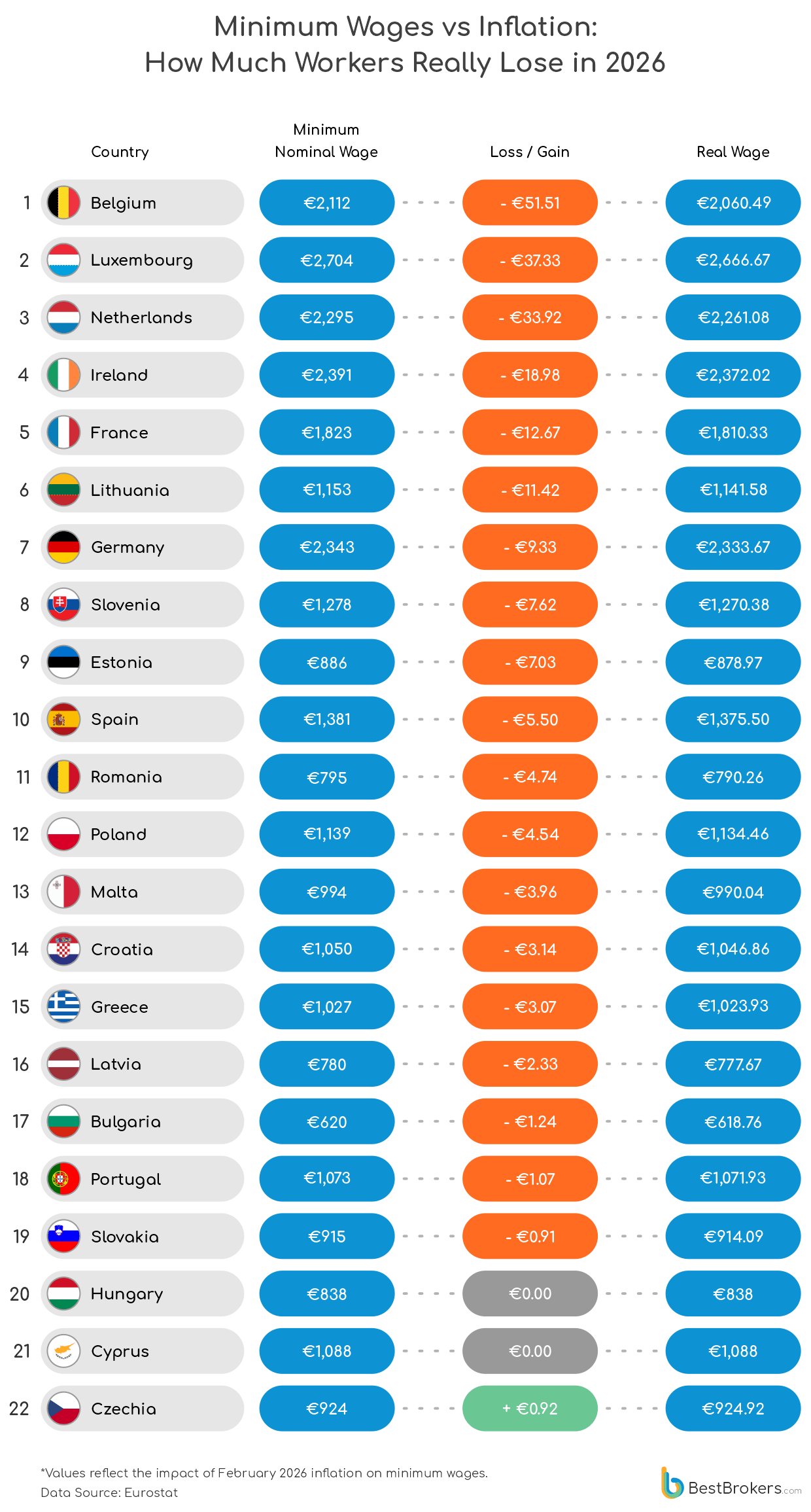
Overall, higher-wage countries like Belgium (-€51.51), Luxembourg (-€37.33), and the Netherlands (-€33.92) see the largest absolute losses, but this is mainly because their starting wages are higher, not because inflation hits them harder. In contrast, lower-wage countries such as Bulgaria (-€1.24), Romania (-€4.74), and Latvia (-€2.33) show only minimal euro losses, suggesting a largely proportional impact across the region.
A few countries, including Hungary, Cyprus, and Czechia, even appear effectively inflation-neutral, with real wages holding steady or slightly improving. This points to broadly aligned wage adjustments across Europe, where inflation is being offset in most cases rather than creating sharp divergences in purchasing power.
Annual Inflation vs Wage Growth in Europe (2022-2025): Who Came Out Ahead
Between 2022 and 2025, Europe went through a sharp inflation cycle triggered by post-pandemic demand, energy shocks, and supply disruptions. Inflation peaked in 2022-2023 across most countries before easing significantly in 2024-2025. Governments responded with a wave of minimum wage increases, but the extent and timing of these adjustments varied widely, creating clear winners and losers in real terms.
Real Wage Gain 2022-2025: How Minimum Wages Fared Against Inflation
Data Source: Eurostat
The scale and speed of wage growth in Central and Eastern Europe stand out over this period. Countries like Bulgaria (+56.43% real gain), Poland (+39.53%), and Croatia (+37.98%) didn’t just offset inflation; they significantly outpaced it. This reflects a structural pattern: lower-income economies responded to the inflation shock with aggressive wage increases, resulting in faster relative growth. However, despite this momentum, wage levels remain substantially below those in Western Europe, meaning the gap is narrowing only gradually rather than disappearing. Notably, many of these countries posted double-digit inflation in 2022, yet still delivered large real gains due to repeated wage hikes.
By contrast, Western Europe shows a more restrained and reactive pattern. Countries such as Germany (+22.57%) and Ireland (+17.09%) achieved solid real gains, but these came from more gradual increases that closely tracked inflation rather than exceeding it. Others, like the Netherlands (+9.55%) and Spain (+4.31%), show that even consistent nominal growth can translate into relatively modest real improvements when inflation is persistent.
The most notable underperformers highlight a different dynamic: delayed or insufficient wage adjustment during peak inflation years. France (-1.82%), Slovenia (-3.51%), and especially Estonia (-6.10%) saw cumulative inflation (up to 41.57% in Estonia) outpace wage growth. In these cases, even though wages increased nominally, they failed to recover the purchasing power lost during the 2022-2023 inflation spike.
Overall, the data reveals a clear shift over time: inflation was front-loaded, while wage growth was staggered and policy-driven. Countries that acted early and aggressively turned the inflation shock into a net gain for minimum wage earners, while those that adjusted more cautiously or with delay are still catching up.
Methodology
This analysis tracks minimum wage developments across European countries from 2022 to 2026, combining wage growth with inflation trends to assess real changes in purchasing power. Minimum wage data reflects statutory national rates from Eurostat for the first half (S1) of each year, expressed in euros for comparability.
Nominal wage growth is measured in two stages: a four-year change (2022-2025) capturing the response during peak inflation, and year-on-year growth (2025-2026) reflecting the latest adjustments. Inflation is applied annually from 2022 to 2025 and compounded to calculate cumulative inflation, with additional data for February 2025 and February 2026 used to capture recent price trends.
Real wages for 2025 and 2026 are calculated by adjusting nominal wages for cumulative and latest inflation. Real wage growth (2025-2026) shows how much of the recent increases remain after inflation, while the loss/gain figure captures the gap between nominal and real wages in 2026. Real wage gain (2022-2025) compares total wage growth with cumulative inflation to show overall changes in purchasing power.
A total of 22 countries were included in the analysis, due to several factors affecting data coverage and comparability. Denmark, Italy, Austria, Finland, Sweden, Norway, Switzerland, Iceland and Liechtenstein do not have a statutory minimum wage, while others are not consistently present across the Eurostat minimum wage and inflation datasets. Cyprus is excluded from some rankings due to missing 2022 inflation data, which prevents full-period calculations.
All figures are gross and do not account for taxes, social contributions, or cost-of-living differences beyond inflation, focusing solely on the relationship between wages and prices.