


 Naylyan NazifovaNaylyan Nazifova is a Financial Research and Platform Testing Analyst at BestBrokers.com, where she reviews and tests online brokers across forex, stocks, investing and personal finance. Her experience in online trading content and broker analysis helps readers understand how platforms perform in practice, including their trading tools, fees, ease of use and suitability for different types of investors.
 | Updated:
 As per the comprehensive BIS Triennial Survey data finalized in June 2026, the average daily global forex trading volume reached $9.5 trillion, marking a 27% increase compared to $7.5 trillion per day in 2022. When annualized over 252 trading days, this turnover equates to approximately $2.4 quadrillion traded per year, up from an estimated $1.9 quadrillion in 2022. This rapid expansion aligns with broader forecasts for the industry. Market projection models updated in 2026 indicate that the global foreign exchange sector is expected to expand steadily, climbing toward a market size of $1.16 trillion by 2030 while sustaining a compound annual growth rate of roughly 6.9%. Unlike other markets, forex has no physical location, being an over-the-counter (OTC) market that can be accessed online from different parts of the world.
While numerous countries contribute to the rapid increase of the forex industry, a few key financial hubs command a prominent influence on its growth. The US stands as one of the biggest markets in the forex sector. This is driven heavily by the complete dominance of the US dollar, which maintains its position as the most traded currency, being on either side of 89% of all traded currency pairs worldwide.
In this report (updated July 2026), we will focus on the forex market in the USA and how it contributes to the global forex industry’s scale. We have utilized several sources to compile the most up-to-date data on the US forex market, using surveys and reports by major entities like the Bank for International Settlements (BIS), the New York Foreign Exchange Committee (FXC), and other key participants in the global forex sector.
North America’s Place in the Global Forex Scene
As far as the number of active traders goes, North America effectively shares the second-place tier globally with Europe, with both regions commanding roughly 1.5 million active traders. While Europe holds a microscopic lead in the raw data, placing North America technically in third place, both regions trail Asia, which dominates the global landscape with approximately 3.2 million active traders.
Number of Forex Traders by Region
Source: VT Markets
Despite Asia being the region with the highest cumulative number of active traders, when it comes to comparing individual countries with the highest trading activity, the USA ranks in second place, with 335,000 active traders. The first place is taken by the UK, with a slightly higher number of 341,000 active traders.
Top 10 Countries with Most Forex Traders
Source: VT Markets
Data from 2022 revealed that the US ranked second among the top 10 countries with the highest daily forex turnover, averaging $1.9 trillion and accounting for about 19% of global volume. The latest 2025 survey shows an increase to $2.3 trillion, representing nearly 18% of the total.
Average OTC Forex Daily Turnover in 2022 and 2025 (in trillion USD)
The US, along with the UK, Singapore, Hong Kong, and Japan, is part of the five major financial regions where 78.5% of the global forex turnover took place in 2022. The combined share of global forex turnover of these five leading countries rose to 78.7% in 2025. The UK had the biggest forex turnover in 2022, accounting for 38% of the global forex turnover in 2022 (down by 5.2 percentage points from 43.2% in 2019) and 37.8% in 2025.
Meanwhile, the US was second, contributing 19.5% to the global forex turnover in 2022, and 18.6% in 2025. Data for 2022 revealed that Hong Kong, Japan, and Singapore accounted for 7.1% (down 0.5 pp from 2019), 4.4% (down 0.1 pp), and 9.5% (up 1.8 pp) of the global forex turnover, respectively. According to the 2025 edition, the shares of global forex turnover for Hong Kong, Japan, and Singapore were 7.00%, 3.50%, and 11.8%, respectively. (Bank for International Settlements Triennial Survey, April 2022 and April 2025).
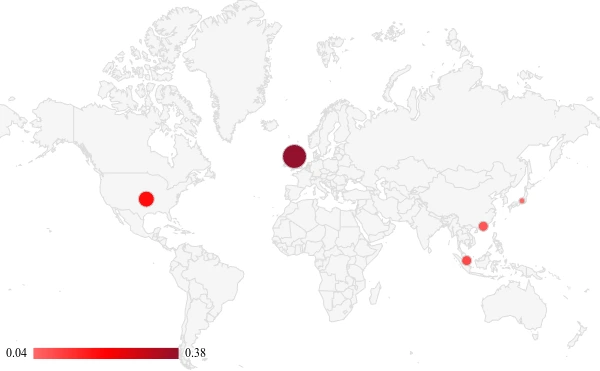
Data shows that by 2019, the daily forex turnover in the US had reached almost $1.4 trillion, achieving a growth of over $100 billion (around 7.7%) compared to results from 2016. While the UK’s daily forex turnover for that period was still higher at $3.58 trillion, the US was still a strong second, with derivatives like spot transactions, swaps, forwards, and options contributing to the surge in the trade volume in April 2019.
The upward trajectory sustained into the next decade, with the 2022 survey registering a US turnover of $1.9 trillion, which subsequently expanded to a record-breaking $2.3 trillion per day by April 2025. During this same 2025 window, the UK solidified its top position by clearing an average of $4.74 trillion daily.
US Daily Forex Turnover 2001 – 2025 (in billion USD)
Source: Bank for International Settlements (BIS) Triennial Surveys (2001-2025)
Reasons Why the US is a Major Forex Market
We can pinpoint several reasons why the US has grown to be one of the leading markets in the global forex industry. We can start by noting that the US is currently the largest economy in the world, with a total GDP of $32.38 trillion (up 5.23% from 2025) and GDP per capita of $94.43 thousand (up 4.93% from 2025) as of mid-July 2026. What is more, the biggest financial markets that boast the most liquidity are located in the US.
Largest Economies in the World by GDP in 2026 (in USD trillion)
Source: International Monetary Fund
The trading volume of the US dollar significantly contributes to the growth in US forex turnover, as higher volume translates to greater monetary value traded. The US dollar is considered the reserve currency of the world with a 57.13% share in Q1 2026, and half of international loans as well as bonds are in USD. The currency is also used for a majority of cross-border orders, as many commodities are priced in USD.
Forex Volume in the US
One of the easiest ways to track the growth of the forex industry in the US is to take a look at the increasing forex volume recorded across the US. The most recent survey results published by the the Federal Reserve Bank of New York’s Foreign Exchange Committee (FXC) revealed that the turnover recorded in October 2025 decreased across several counterparties. “Reporting Dealers” saw a 3.1% decline, while “Other Financial Customers” witnessed a 13.3% drop, and “Non-financial Customers” experienced a 5.4% reduction compared to data from April 2025.
The total OTC average daily volume across all forex instruments reported in October 2025 amounted to $1,303.2 billion. Compared to the results published in April 2025, this volume marked a 5.41% decrease from $1,377.7 billion. Meanwhile, the volume recorded in October 2025 indicated an 8.93% year-over-year growth from $1,196.4 billion reported in October 2024.
The average daily volume in October 2025 saw a decrease across spot and forward instruments, marking a six-month decline of 18.9% and 12.5%, respectively. Meanwhile, swaps and OTC options volumes were up 25.5% and 35.1%, respectively, from April 2025 numbers. The year-over-year results show a decrease across most instruments, with spot declining by 6%, forwards by 4.3%, and OTC options by 24%. FX swaps solely surged by 47.6%.
| Average Daily Forex Volume by Instruments ((April 2025 and October 2025 in million USD) | |||
|---|---|---|---|
| Instrument | April 2025 | October 2025 | Change % |
| Spot | 602,289 | 488,320 | -18.92 |
| Outright forwards | 271,962 | 237,852 | -12.54 |
| Forex swaps | 412,800 | 518,146 | 25.52 |
| OTC options | 90,650 | 58,843 | -35.09 |
| Total | 1,377,701 | 1,303,161 | -5.41 |
| Average Forex Volume by Instruments YoY Growth (in million USD) | |||
|---|---|---|---|
| Instrument | October 2025 | October 2024 | Change % |
| Spot | 488,320 | 519,307 | -5.97 |
| Outright forwards | 237,852 | 248,553 | -4.31 |
| Forex swaps | 518,146 | 351,041 | 47.60 |
| OTC options | 58,843 | 77,473 | -24.05 |
| Total | 1,303,161 | 1,196,374 | 8.93 |
The monthly forex volume decreased 1.11% in October 2025 compared to the April 2025 stats, with contractions visible across most instruments. On a year-over-year basis, spot transactions volume fell 15.24% to $11,231 billion, forwards dropped 8.57% to $5,470 billion, and OTC options contracted 32.14% to $1,353 billion. In contrast, foreign exchange swaps expanded 31.23% over the same period to reach $11,917 billion.
| Total Monthly Volume by Instrument (April 2025 and October 2025 in million USD) | |||
|---|---|---|---|
| Instrument | April 2025 | October 2025 | Change % |
| Spot transactions | 13,250,355 | 11,231,355 | -15.24 |
| Outright forwards | 5,983,159 | 5,470,598 | -8.57 |
| Forex swaps | 9,081,589 | 11,917,358 | 31.23 |
| OTC options | 1,994,307 | 1,353,396 | -32.14 |
| Total | 30,309,409 | 29,972,707 | -1.11 |
| Total Monthly Volume by Instrument YoY Growth (in million USD) | |||
|---|---|---|---|
| Instrument | October 2024 | October 2025 | Change % |
| Spot transactions | 11,944,052 | 11,231,355 | -5.97 |
| Outright forwards | 5,716,724 | 5,470,598 | -4.31 |
| Forex swaps | 8,073,946 | 11,917,358 | 47.60 |
| OTC options | 1,781,883 | 1,353,396 | -24.05 |
| Total | 27,516,604 | 29,972,707 | 8.93 |
The currency pairs that experienced the biggest volume decrease across all instruments in October 2025 were EUR/USD and USD/JPY. Compared to the April 2025 data, the pairs experienced declines of $42.8 billion and $14.5 billion, respectively. In contrast, the GBP/USD and USD/BRL pairs registered an increase across all instruments, rising by $34.1 billion and $8.4 billion, respectively.
On a year-over-year basis, USD/CNY recorded the largest transaction value decline across all instruments, dropping by $14.8 billion, closely followed by USD/HKD with a $13.9 billion contraction. Conversely, USD/JPY posted the strongest growth over the same period, expanding by $60.8 billion, while GBP/USD surged by $47.0 billion.
Trading Volume of the USD
While different factors play into the significant size of the forex market in the US, the popularity of the USD as a tradable currency is definitely also a significant element influencing the market growth in the US. The triennial issued by BIS shows that the USD was present on either side of 88.5% of the currencies traded in April 2022. The percentage rose to 89% in April 2025. It should be noted that since currencies are part of both sides of currency pair transactions, the total daily average amounts to 200% instead of 100%.
OTC Forex Daily Turnover by Currencies
Source: www.bis.org
*Since each forex pair consists of two currencies, the total daily average for April 2022 and 2025 adds up to 200% rather than 100%.
According to the International Monetary Fund (IMF), the USD was a part of 56.42% of allocated forex reserves for Q2 2025. That percentage rose to 57.13% in Q1 2026.
Allocated Forex Reserves by Currencies (Q1 2026)
Source: International Monetary Fund
Like any of the major currencies enjoying high trading volumes, the USD is significantly influenced by central bank policy. The Federal Reserve plays a dominant role in shaping the value of the US dollar, which ultimately impacts liquidity and positioning across key global forex markets.
The Fed affects foreign exchange trading primarily through adjustments to interest rates. These rate shifts impact hedging costs, options and futures pricing, which also lead to trading strategy adjustments.
The Federal Reserve held the federal funds rate steady at 4.25% to 4.50% from December 2024 until September 2025, following three rate cuts in late 2024. The first rate cut of 0.50% was implemented in September 2024, followed by a 0.25% cut in November, and another 0.25% cut in December.
By September 2025, markets were widely expecting the Fed to begin reducing rates further, pricing in multiple cuts throughout the remainder of the year. The median forecast for the federal funds rate by the end of 2025 had shifted closer to 3.50% to 3.75%, down from prior forecasts.
At the Fed’s interest rate decision on September 17, 2025, an initial rate cut of 0.25% was implemented, bringing the federal funds rate to a new range of 4% to 4.25%, marking the start of what many analysts anticipated would be a series of reductions. The decision was inspired by a moderation in economic activity, slowing job gains, and somewhat elevated inflation, with the Fed acknowledging increased downside risks to employment.
Following this cut, the Fed signaled that two more rate cuts were likely before the end of 2025, aiming to transition monetary policy to a more neutral stance amid uncertainty over the economic outlook. However, within the Fed, there remained some policy divergence, with at least one member favoring a more aggressive reduction.
The outcome from the 28-29 October, 2025 Federal Reserve meeting indicated a divided stance among policymakers. The Fed decided to cut the interest rate by 25 basis points, bringing the new target range to 3.75% to 4%, which was in line with market expectations. However, there was a notable split in views: most participants judged further rate reductions might be appropriate over time, but several indicated that a December cut might not be suitable given the economic uncertainties and risks of persistent inflation. The last meeting of 2025 took place on December 9-10.
The Federal Reserve held its benchmark interest rate steady at 3.50% to 3.75% throughout all four policy meetings in the first half of 2026. This prolonged pause followed the central bank’s final rate movement in December 2025. Persistently elevated inflation ultimately shifted the central bank toward a more hawkish tone mid-year under newly appointed Fed Chair Kevin Warsh.
Leading Retail Forex Brokers Operating in the US
The Commodity Futures Trading Commission (CFTC) is one of the authorities responsible for the monitoring of financial services provided by retail brokers operating in the US. Under CFTC regulations, each Retail Foreign Exchange Dealer (RFED) and Futures Commission Merchant (FCM) is required to submit monthly reports to the commission, providing data on their adjusted capital and customers’ assets.
RFEDs and FCMs that offer retail spot forex are required to report and publish their total retail forex obligations, which reflect the total amount of funds held as money, securities, and property deposited by customers into their forex accounts. The combined sum is adjusted for the customers’ realized and unrealized net profit or loss.
The latest CFTC data from May 31, 2026, shows that six of the 73 FCMs and RFEDs that have been registered to operate in the US have published their forex obligations. Said entities include Charles Schwab Futures and Forex LLC, Gain Capital Group LLC, Interactive Brokers LLC, OANDA Corporation, TastyFX LLC, and Trading.com Markets INC. The broker handling the largest deposit sum in May 2026 was Gain Capital, with its forex obligations amounting to $201.60 million. OANDA recorded the second-highest forex obligations amount for May 2026 ($135.74 million), followed by Charles Schwab ($54.71 million), TastyFX with $48.92 million, Interactive Brokers ($27.18 million), and Trading.com ($2.86 million).
US Brokers’ Total Forex Obligations (May 31, 2026)
Source: CFTC
US Forex Brokers Market Share Based on Forex Obligations (May 31, 2026)
Source: CFTC
Forex Trends and Trading Demographics in the US
The United States stands as the world’s second-largest foreign exchange market, accounting for roughly $2.3 trillion in daily OTC turnover and hosting over 335,000 active retail traders. Driven by the expansion of mobile platforms and algorithmic tools, retail participation in North America continues to see steady growth.
To understand the US forex market better, we should inspect some of the trends among US traders as well as the typical demographics partaking in the growth of the forex industry in the US.
Globally, forex is an industry dominated by males, with data revealing that 87.6% of forex traders worldwide are males while females represent only 12.4% of global forex traders. Statistics about forex trading in the US are quite similar, with 91.5% of US traders being males and only 8.5% being females. If we take a look at the ratio between women and men in forex trading throughout the years, we can see that not only does forex continue to be a male-dominated industry, but the percentage of females in this sector has reduced in recent years.
Recent general trends confirm that forex remains a male-dominated industry globally and in the US. The longstanding trend is that males constitute 90% of US forex traders, and this demographic composition has not significantly shifted in the latest data available. Subsequent reporting through 2026 indicates that this demographic split has remained largely unchanged.
Percentage of US Forex Traders by Gender 2010 – 2021
Source: Zippia
Data shows that about 29,521 US residents are employed in the forex trading sector in the US. When speaking of professional forex traders in the US, we can see that the predominant portion of employed forex traders are above the age of 40. However, we should also mention that the percentage of Gen Z individuals participating in the US forex market as retail traders is constantly increasing, with social media often used as the primary source of information on current forex trends.
Age of Forex Traders in the US
As far as education is concerned, the majority of forex traders in the US (61%) have a bachelor’s degree, while 20% have also obtained a master’s degree.
Education of US Forex Traders
Source: Zippia
Market Regulation and Retail Trader Profitability
In the United States, retail forex brokers registered as Futures Commission Merchants (FCMs) or Retail Foreign Exchange Dealers (RFEDs) are legally required by the Commodity Futures Trading Commission (CFTC) and the National Futures Association (NFA) to publish quarterly profitability reports. Typically, between 72% and 84.60% of online forex traders end up losing their money while trading forex pairs with some of the top retail brokers in the US. You can see the exact percentage on the official website of the online retail broker you have chosen to trade with, such as GAIN Capital, OANDA, Interactive Brokers, Charles Schwab, Trading.com, and TastyFX. As far as successful forex trading goes, about 29% of retail traders gain profit from their forex trading sessions.
With online forex trading gaining massive popularity across the globe, the regulation of the market has become an important issue. While there are numerous regulatory bodies responsible for monitoring forex activities carried out across different jurisdictions, some authorities are stricter, offering higher levels of protection to forex traders. The CFTC and the NFA, which are the two main authorities regulating forex in the US, fall under the category of tier-1 regulators, meaning US traders can enjoy some of the best trading conditions online. Other tier-1 regulators include European bodies like the CySEC, BaFin, FINMA, the UK’s FCA, Australia’s ASIC, CIRO in Canada, and more.
In addition to having the CFTC regulate the forex market in the US, the financial sector in the North American country has further tightened regulatory measures with the passing of the Dodd-Frank Act in 2010. With several respected authorities overseeing the forex industry in the US, 78% of US forex traders have expressed higher confidence in the trading industry in the country.
Best Trading Hours in North America
While it is true that the forex market never closes, there are certain hours when it is mostly recommended to place your orders. There are four trading sessions to keep in mind whenever you are trading forex pairs – Sydney, Tokyo, London, and New York. With the four sessions opening and closing at a different time of the day due to differences in time zones, you can trade currency pairs 24 hours a day, five days a week.
That said, the best time to trade forex if you are a US trader is probably when the London and New York sessions overlap. You can find different Time Zone Converters online if you need to see the exact time in your country when a session is closing or opening. Below, we have provided a table with the four trading sessions and their opening and closing hours based on the New York time zone (GMT -4).
| Sydney | Tokyo | London | New York | |
|---|---|---|---|---|
| 12 am | ||||
| 1 am | ||||
| 2 am | ||||
| 3 am | ||||
| 4 am | ||||
| 5 am | ||||
| 6 am | ||||
| 7 am | ||||
| 8 am | ||||
| 9 am | ||||
| 10 am | ||||
| 11 am | ||||
| 12 pm | ||||
| 1 pm | ||||
| 2 pm | ||||
| 3 pm | ||||
| 4 pm | ||||
| 5 pm | ||||
| 6 pm | ||||
| 7 pm | ||||
| 8 pm | ||||
| 9 pm | ||||
| 10 pm | ||||
| 11 pm |
Trading Activity Throughout the Day (New York Time Zone GMT -4)
Source: Compare Forex Brokers
Predictions for the US and Global Forex Market
One of the main factors that plays a major role in the future of both the US and global forex sectors is the stability of the USD. Even though inflation, geopolitical issues, and other economic factors have impacted the most traded currency, the USD has maintained its strength through somewhat stable inflation rates.
Experts at J.P. Morgan predict that the USD will command a bullish position, with December 2026 forecasts for major currency pairs like GBP/USD, EUR/USD, and USD/JPY predicting bearish trajectories for the euro and sterling, reaching targets of 1.28, 1.14, and 164, respectively.
While experts initially anticipated an earlier timeline, the Federal Reserve delayed its easing cycle until the second half of 2024, implementing three rate cuts before year-end. Following subsequent policy easing throughout 2025, the benchmark target range has been held steady at 3.50% to 3.75%.
After a modest increase of about 2.5% in commodity prices during 2024, the broader asset class faced downward pressure throughout 2025, culminating in an approximate 7% annual decline. As of July 2026, J.P. Morgan Global Research updated its outlook, shifting focus to late-2026 price trajectories, where analysts project Brent crude to average $86 per barrel in Q3 and $80 in Q4.
Correlation between USD and Brent Oil Prices
Source: Investing.com
The correlation between the U.S. dollar and Brent crude oil maintains a standard inverse (negative) relationship, meaning that as the dollar strengthens, oil prices typically fall, and when the dollar weakens, oil prices rise. However, major supply shocks can temporarily override this baseline correlation, causing both to move independently or in tandem based on macroeconomic pressures.
Despite different speculations, the future of the US forex market and the USD in particular depends on various factors that may often be unpredictable. One thing is sure, however: the global forex industry is bound to continue expanding, with the US region being an important driver of an overall bigger forex turnover in the upcoming years.
| Additional Forex Trading Statistics | |
|---|---|
| Forex Daily Trading Volume | Forex Trading Statistics |
| Most Traded Forex Currency Pairs | US Forex Trading Demographics |
| US Dollar Share of Global Currency Reserves | |
About the Editorial Team