



 Naylyan NazifovaNaylyan Nazifova is a Financial Research and Platform Testing Analyst at BestBrokers.com, where she reviews and tests online brokers across forex, stocks, investing and personal finance. Her experience in online trading content and broker analysis helps readers understand how platforms perform in practice, including their trading tools, fees, ease of use and suitability for different types of investors.
 | Expert Editor
  Eugene Lee, CFA
 Eugene Lee, CFA, is the Head of Research at BestBrokers.com, where he draws on more than two decades of experience in global markets, portfolio management, derivatives, and fintech to evaluate online brokers. His background in institutional investing and quantitative research helps ensure that broker reviews are based on data, risk assessment, and real-world trading conditions.
  | Updated:
 The following brokers are licensed by the Cyprus Securities and Exchange Commission (CySEC). The picks reviewed below uphold strong security and transparency standards and operate in compliance with the requirements of the Cyprus regulator. Traders may also benefit from competitive spreads, low commissions, and favorable trading conditions overall. These brokers offer a wide range of trading instruments, including forex, CFDs, commodities, and cryptocurrencies, catering to both beginner and experienced traders. Clients can also expect user-friendly platforms, responsive customer support, and account types designed for different trading preferences and strategies.
 FP Markets73.33% of retail investor accounts lose money
 Pepperstone74.1% of retail investor accounts lose money
 AvaTrade57% of retail investor accounts lose money
 IC Markets70.64% of retail investor accounts lose money when trading CFDs with this provider.
 Admirals73% of retail investor accounts lose money
 FxPro74% of retail investor accounts lose money
 XM Group72.82% of retail investor accounts lose money
 Plus500 USThis content applies only to Plus500 US and clients from the United States. Trading futures involves the risk of loss.
 Libertex83% of retail investor accounts lose money
 eToro52% of retail investor accounts lose money
Top 10 CySEC-Regulated Forex Brokers Ranked by Trustpilot Score
| Forex Broker | Trustpilot Reviews | |
|---|---|---|
| 1. FP Markets | 9,422 | 4.9 ⭐ |
| 2. IC Markets | 48,248 | 4.8 ⭐ |
| 3. AvaTrade | 11,076 | 4.7 ⭐ |
| 4. Pepperstone | 3,144 | 4.4 ⭐ |
| 5. Libertex | 9,532 | 3.9 ⭐ |
| 6. Admirals | 2,046 | 3.8 ⭐ |
| 7. Tickmill | 1,139 | 3.7 ⭐ |
| 8. Swissquote | 3,574 | 3.7 ⭐ |
| 9. FxPro | 751 | 3.2 ⭐ |
| 10. XM Group | 2,787 | 2.7 ⭐ |
Comprehensive Comparison of the Top 10 CySEC-Regulated Forex Brokers
| CySEC Forex Broker | Trading Platforms | Max Leverage | Our Score | License № |
|---|---|---|---|---|
| 1. FP Markets | MetaTrader 4, MetaTrader 5, WebTrader, IRESS, cTrader, TradingView | 1:30 for retail clients1:500 for professional clients | 4.37 ⭐ | 371/18 |
| 2. Pepperstone | MetaTrader 4, MetaTrader 5, cTrader, TradingView | 1:30 for retail clients1:500 for professional clients | 4.19 ⭐ | 388/20 |
| 3. AvaTrade | MetaTrader 4, MetaTrader 5, WebTrader, AvaTrade App, AvaSocial, AvaOptions, DupliTrade | 1:30 for retail clients1:400 for professional clients | 4.04 ⭐ | 347/17 |
| 4. IC Markets | MetaTrader 4, MetaTrader 5, cTrader, ZuluTrade | 1:30 for retail clients1:500 for professional clients | 4 ⭐ | 362/18 |
| 5. Admirals | MetaTrader 4, MetaTrader 5, WebTrader, MT Supreme Edition, StereoTrader | 1:30 for retail clients1:500 for professional clients | 3.99 ⭐ | 201/13 |
| 6. FxPro | MetaTrader 4, MetaTrader 5, cTrader, FxPro Edge (proprietary) | 1:30 for retail clientsDynamic leverage based on trading volume | 3.96 ⭐ | 078/07 |
| 7. XM Group | MetaTrader 4, MetaTrader 5, MT4 WebTrader, MT5 WebTrader, MT4 MultiTerminal, XM App | 1:30 for retail clients1:300 for professional clients | 3.90 ⭐ | 120/10 |
| 8. Tickmill | MT4, MT5, WebTrader, Tickmill Trader, TradingView | 1:30 for retail clients1:300 for professional clients | 3.88 ⭐ | 278/15 |
| 9. Swissquote | CFXD, MetaTrader 4, MetaTrader 5 | 1:30 for retail clients1:400 for professional clients | 3.71 ⭐ | 422/22 |
| 10. Libertex | Libretex Trading Platform, MT4, MT5 | 1:30 for retail clients 1:600 for professional clients. | 3.58 ⭐ | 164/12 |
Top 13 Brokers Licensed by CySEC
- Any
 Afghanistan
- Aland Islands
- Albania
- Algeria
- American Samoa
- Andorra
- Angola
- Anguilla
- Antarctica
- Antigua and Barbuda
- Argentina
- Armenia
- Aruba
- Australia
- Austria
- Azerbaijan
- Bahamas
- Bahrain
- Bangladesh
- Barbados
- Belarus
- Belgium
- Belize
- Benin
- Bermuda
- Bhutan
- Bolivia
- Bonaire, Sint Eustatius and Saba
- Bosnia and Herzegovina
- Botswana
- Bouvet Island
- Brazil
- British Indian Ocean Territory
- Brunei Darussalam
- Bulgaria
- Burkina Faso
- Burundi
- Cambodia
- Cameroon
- Canada
- Cape Verde
- Cayman Islands
- Central African Republic
- Chad
- Chile
- China
- Christmas Island
- Cocos (Keeling) Islands
- Colombia
- Comoros
- Congo
- Congo, Democratic Republic of the Congo
- Cook Islands
- Costa Rica
- Cote D'Ivoire
- Croatia
- Cuba
- Curacao
- Cyprus
- Czech Republic
- Denmark
- Djibouti
- Dominica
- Dominican Republic
- Ecuador
- Egypt
- El Salvador
- Equatorial Guinea
- Eritrea
- Estonia
- Ethiopia
- Falkland Islands (Malvinas)
- Faroe Islands
- Fiji
- Finland
- France
- French Guiana
- French Polynesia
- French Southern Territories
- Gabon
- Gambia
- Georgia
- Germany
- Ghana
- Gibraltar
- Greece
- Greenland
- Grenada
- Guadeloupe
- Guam
- Guatemala
- Guernsey
- Guinea
- Guinea-Bissau
- Guyana
- Haiti
- Heard Island and Mcdonald Islands
- Holy See (Vatican City State)
- Honduras
- Hong Kong
- Hungary
- Iceland
- India
- Indonesia
- Iran, Islamic Republic of
- Iraq
- Ireland
- Isle of Man
- Israel
- Italy
- Jamaica
- Japan
- Jersey
- Jordan
- Kazakhstan
- Kenya
- Kiribati
- Korea, Democratic People's Republic of
- Korea, Republic of
- Kosovo
- Kuwait
- Kyrgyzstan
- Lao People's Democratic Republic
- Latvia
- Lebanon
- Lesotho
- Liberia
- Libyan Arab Jamahiriya
- Liechtenstein
- Lithuania
- Luxembourg
- Macao
- Macedonia, the Former Yugoslav Republic of
- Madagascar
- Malawi
- Malaysia
- Maldives
- Mali
- Malta
- Marshall Islands
- Martinique
- Mauritania
- Mauritius
- Mayotte
- Mexico
- Micronesia, Federated States of
- Moldova, Republic of
- Monaco
- Mongolia
- Montenegro
- Montserrat
- Morocco
- Mozambique
- Myanmar
- Namibia
- Nauru
- Nepal
- Netherlands
- Netherlands Antilles
- New Caledonia
- New Zealand
- Nicaragua
- Niger
- Nigeria
- Niue
- Norfolk Island
- Northern Mariana Islands
- Norway
- Oman
- Pakistan
- Palau
- Palestinian Territory, Occupied
- Panama
- Papua New Guinea
- Paraguay
- Peru
- Philippines
- Pitcairn
- Poland
- Portugal
- Puerto Rico
- Qatar
- Reunion
- Romania
- Russian Federation
- Rwanda
- Saint Barthelemy
- Saint Helena
- Saint Kitts and Nevis
- Saint Lucia
- Saint Martin
- Saint Pierre and Miquelon
- Saint Vincent and the Grenadines
- Samoa
- San Marino
- Sao Tome and Principe
- Saudi Arabia
- Senegal
- Serbia
- Serbia and Montenegro
- Seychelles
- Sierra Leone
- Singapore
- Sint Maarten
- Slovakia
- Slovenia
- Solomon Islands
- Somalia
- South Africa
- South Georgia and the South Sandwich Islands
- South Sudan
- Spain
- Sri Lanka
- Sudan
- Suriname
- Svalbard and Jan Mayen
- Swaziland
- Sweden
- Switzerland
- Syrian Arab Republic
- Taiwan, Province of China
- Tajikistan
- Tanzania, United Republic of
- Thailand
- Timor-Leste
- Togo
- Tokelau
- Tonga
- Trinidad and Tobago
- Tunisia
- Turkey
- Turkmenistan
- Turks and Caicos Islands
- Tuvalu
- Uganda
- Ukraine
- United Arab Emirates
- United Kingdom
- United States Minor Outlying Islands
- Uruguay
- Uzbekistan
- Vanuatu
- Venezuela
- Viet Nam
- Virgin Islands, British
- Virgin Islands, U.S.
- Wallis and Futuna
- Western Sahara
- Yemen
- Zambia
- Zimbabwe
 Afghanistan
 Aland Islands
 Albania
 Algeria
 American Samoa
 Andorra
 Angola
 Anguilla
 Antarctica
 Antigua and Barbuda
 Argentina
 Armenia
 Aruba
Aruba Australia
 Austria
 Azerbaijan
 Bahamas
 Bahrain
 Bangladesh
 Barbados
 Belarus
 Belgium
 Belize
 Benin
Benin Bermuda
 Bhutan
 Bolivia
 Bonaire, Sint Eustatius and Saba
 Bosnia and Herzegovina
 Botswana
 Bouvet Island
 Brazil
 British Indian Ocean Territory
 Brunei Darussalam
 Bulgaria
 Burkina Faso
 Burundi
 Cambodia
 Cameroon
 Canada
 Cape Verde
 Cayman Islands
 Central African Republic
 Chad
Chad Chile
Chile China
China Christmas Island
 Cocos (Keeling) Islands
 Colombia
 Comoros
 Congo
Congo Congo, Democratic Republic of the Congo
 Cook Islands
 Costa Rica
 Cote D'Ivoire
 Croatia
 Cuba
Cuba Curacao
 Cyprus
 Czech Republic
 Denmark
 Djibouti
 Dominica
 Dominican Republic
 Ecuador
 Egypt
Egypt El Salvador
 Equatorial Guinea
 Eritrea
 Estonia
 Ethiopia
 Falkland Islands (Malvinas)
 Faroe Islands
 Fiji
Fiji Finland
 France
 French Guiana
 French Polynesia
 French Southern Territories
 Gabon
Gabon Gambia
 Georgia
 Germany
 Ghana
Ghana Gibraltar
 Greece
 Greenland
 Grenada
 Guadeloupe
 Guam
Guam Guatemala
 Guernsey
 Guinea
 Guinea-Bissau
 Guyana
 Haiti
Haiti Heard Island and Mcdonald Islands
 Holy See (Vatican City State)
 Honduras
 Hong Kong
 Hungary
 Iceland
 India
India Indonesia
 Iran, Islamic Republic of
 Iraq
Iraq Ireland
 Isle of Man
 Israel
 Italy
Italy Jamaica
 Japan
Japan Jersey
 Jordan
 Kazakhstan
 Kenya
Kenya Kiribati
 Korea, Democratic People's Republic of
 Korea, Republic of
 Kosovo
 Kuwait
 Kyrgyzstan
 Lao People's Democratic Republic
 Latvia
 Lebanon
 Lesotho
 Liberia
 Libyan Arab Jamahiriya
 Liechtenstein
 Lithuania
 Luxembourg
 Macao
Macao Macedonia, the Former Yugoslav Republic of
 Madagascar
 Malawi
 Malaysia
 Maldives
 Mali
Mali Malta
Malta Marshall Islands
 Martinique
 Mauritania
 Mauritius
 Mayotte
 Mexico
 Micronesia, Federated States of
 Moldova, Republic of
 Monaco
 Mongolia
 Montenegro
 Montserrat
 Morocco
 Mozambique
 Myanmar
 Namibia
 Nauru
Nauru Nepal
Nepal Netherlands
 Netherlands Antilles
 New Caledonia
 New Zealand
 Nicaragua
 Niger
Niger Nigeria
 Niue
Niue Norfolk Island
 Northern Mariana Islands
 Norway
 Oman
Oman Pakistan
 Palau
Palau Palestinian Territory, Occupied
 Panama
 Papua New Guinea
 Paraguay
 Peru
Peru Philippines
 Pitcairn
 Poland
 Portugal
 Puerto Rico
 Qatar
Qatar Reunion
 Romania
 Russian Federation
 Rwanda
 Saint Barthelemy
 Saint Helena
 Saint Kitts and Nevis
 Saint Lucia
 Saint Martin
 Saint Pierre and Miquelon
 Saint Vincent and the Grenadines
 Samoa
Samoa San Marino
 Sao Tome and Principe
 Saudi Arabia
 Senegal
 Serbia
 Serbia and Montenegro
 Seychelles
 Sierra Leone
 Singapore
 Sint Maarten
 Slovakia
 Slovenia
 Solomon Islands
 Somalia
 South Africa
 South Georgia and the South Sandwich Islands
 South Sudan
 Spain
Spain Sri Lanka
 Sudan
Sudan Suriname
 Svalbard and Jan Mayen
 Swaziland
 Sweden
 Switzerland
 Syrian Arab Republic
 Taiwan, Province of China
 Tajikistan
 Tanzania, United Republic of
 Thailand
 Timor-Leste
 Togo
Togo Tokelau
 Tonga
Tonga Trinidad and Tobago
 Tunisia
 Turkey
 Turkmenistan
 Turks and Caicos Islands
 Tuvalu
 Uganda
 Ukraine
 United Arab Emirates
 United Kingdom
 United States Minor Outlying Islands
 Uruguay
 Uzbekistan
 Vanuatu
 Venezuela
 Viet Nam
 Virgin Islands, British
 Virgin Islands, U.S.
 Wallis and Futuna
 Western Sahara
 Yemen
Yemen Zambia
 Zimbabwe
Showing 13 brokers with the current filter selection.
- 1. FP Markets
FP Markets is a broker that has earned and continues to hold authorization from CySEC (371/18). The CySEC arm is operated by First Prudential Markets with a registered address at 109 Georgiou Griva Digeni, 3rd floor, 3101 Limassol, Cyprus. Customer protections under CySEC for FP Markets’ EU entity include segregated bank accounts for client funds, participation in the Cyprus Investor Compensation Fund (ICF), and negative balance protection.
As retail clients, we were eligible for maximum compensation of up to €20,000 per claim in the event of the broker’s insolvency. The broker offers over 10,000 instruments, with forex traders, in particular, able to access 60+ currency pairs like EUR/USD, AUD/JPY, EUR/NZD, and more. Traders have multiple platform options, as FP Markets supports MT4, MT5, cTrader, and TradingView.
We tested FP Markets firsthand by opening a live Raw MT4 account at the CySEC entity and funding it instantly with PayPal. European clients can deposit as little as €50 using cards, e-wallets, bank transfers, or Nuvei. Pricing was very competitive during testing, with average spreads of 0.17 pips on EUR/USD, 9 pips on gold, and 2.5 pips on the US500, plus a $3 commission per side on positions in forex and precious metals. Retail leverage ranges from 1:2 on cryptocurrencies up to 1:30 on major forex pairs, while professional clients can access leverage of up to 1:500 on gold, silver, major pairs, and minor pairs.
Although FP Markets’ website is easy to navigate, you can contact a representative of FP Markets’ support team if you need help finding information or require general assistance. Customer support is available around the clock, seven days a week.
CFDs are complex instruments and come with a high risk of losing money rapidly due to leverage. 73.33% of retail investor accounts lose money when trading CFDs with this provider. You should consider whether you understand how CFDs work and whether you can afford to take the high risk of losing your money. - 2. Pepperstone
Founded in 2010, Pepperstone gives traders access to a broad range of markets, including dozens of currency pairs. Its product selection spans all major asset classes, covering forex, commodities, indices, shares, CFD forwards, cryptocurrencies, and ETFs. In terms of licensing, Pepperstone’s operations are authorized by multiple trusted regulators, including ASIC in Australia and the FCA in the UK.
Pepperstone EU Limited, the Cyprus-regulated arm of Pepperstone, operates under license number 388/20. In line with CySEC rules, Pepperstone offers negative balance protection to retail traders, and the maximum leverage available is capped at 1:30. The broker participates in the Investor Compensation Fund (ICF), ensuring funds are protected up to €20,000 per client in the event of broker insolvency.
We opened a retail Razor account on MT4 with a minimum deposit of €10, allowing us to trade major forex pairs with leverage of 1:30. Minor pairs and gold were capped at 1:20, while other commodities and stocks were limited to 1:10 and 1:5, respectively. Cryptocurrencies carried the lowest leverage of 1:2, in line with CySEC requirements. Our retail account had a 50% stop-out level for losing leveraged positions. Eligible professional traders can access higher leverage of up to 1:500 on major and minor forex pairs, as well as gold.
Pepperstone’s CySEC entity delivered average spreads of 0.1 pips on EUR/USD, 23 pips on gold, and 4 pips on the US500. We paid an industry-standard $3.50 commission per lot each way on forex and gold trades. Trading conditions are transparent, with all key costs listed on the broker’s website, including the $20 fee for withdrawals via international bank transfer.
CFDs are complex instruments and come with a high risk of losing money rapidly due to leverage. 74.1% of retail investor accounts lose money when trading CFDs with this provider. You should consider whether you understand how CFDs work and whether you can afford to take the high risk of losing your money. - 3. Eightcap
Eightcap is a forex and CFD broker operating across multiple jurisdictions while maintaining compliance with international financial standards. In the European Union, Eightcap EU Ltd is regulated by the CySEC financial regulator, holding license number 246/14, with registered offices situated at Aiolou & Panagioti Diomidous 9, Katholiki, 3020 in Limassol.
The broker complies with all regulatory requirements designed to keep its customers’ data and funds secure. Customers’ funds are held in segregated client accounts in tier-1 banks, separate from the company’s operating funds. Furthermore, to safeguard traders from losing more than their initial balance, the broker offers negative balance protection. Leverage for forex is capped at 1:30 for retail customers registered under the CySEC entity.
Retail accounts trigger margin call alerts at 80%, with a stop-out level set at 50%. Professional clients can access leverage of up to 1:400 on currency pairs and 1:200 on gold and major indices, but that status also means giving up negative balance protection, margin close-out safeguards, and eligibility for ICF compensation.
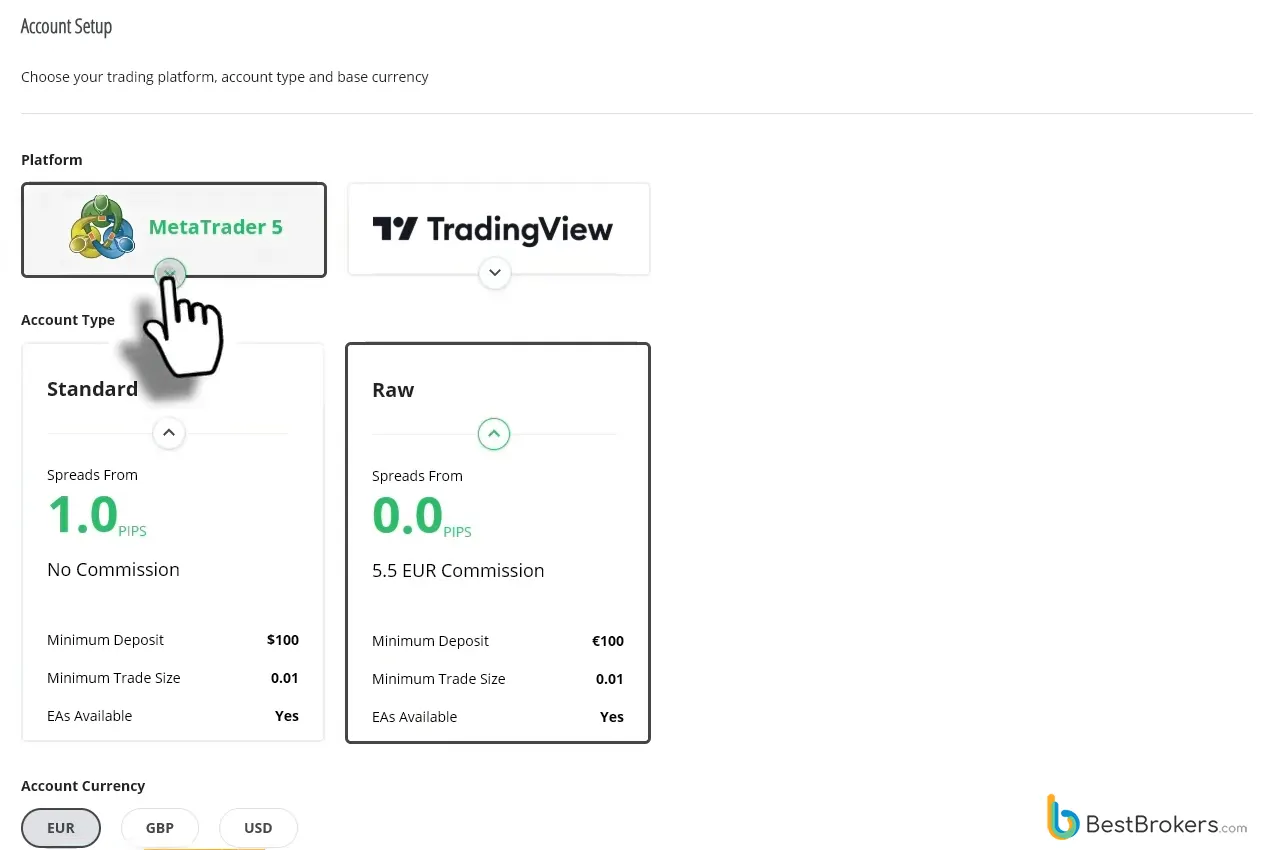
We tested the broker through a funded Raw MT5 account with a minimum deposit requirement of €100. Visa, Skrill, PayPal, and bank transfers are all supported for deposits. Pricing was competitive, with average spreads of 0.17 pips on EUR/USD, 14 pips on gold, and 4.5 pips on the US500, plus a €2.75 commission per side. Funding was free, but bank withdrawals through Eurobank carried an internal fee of €4 to €10.
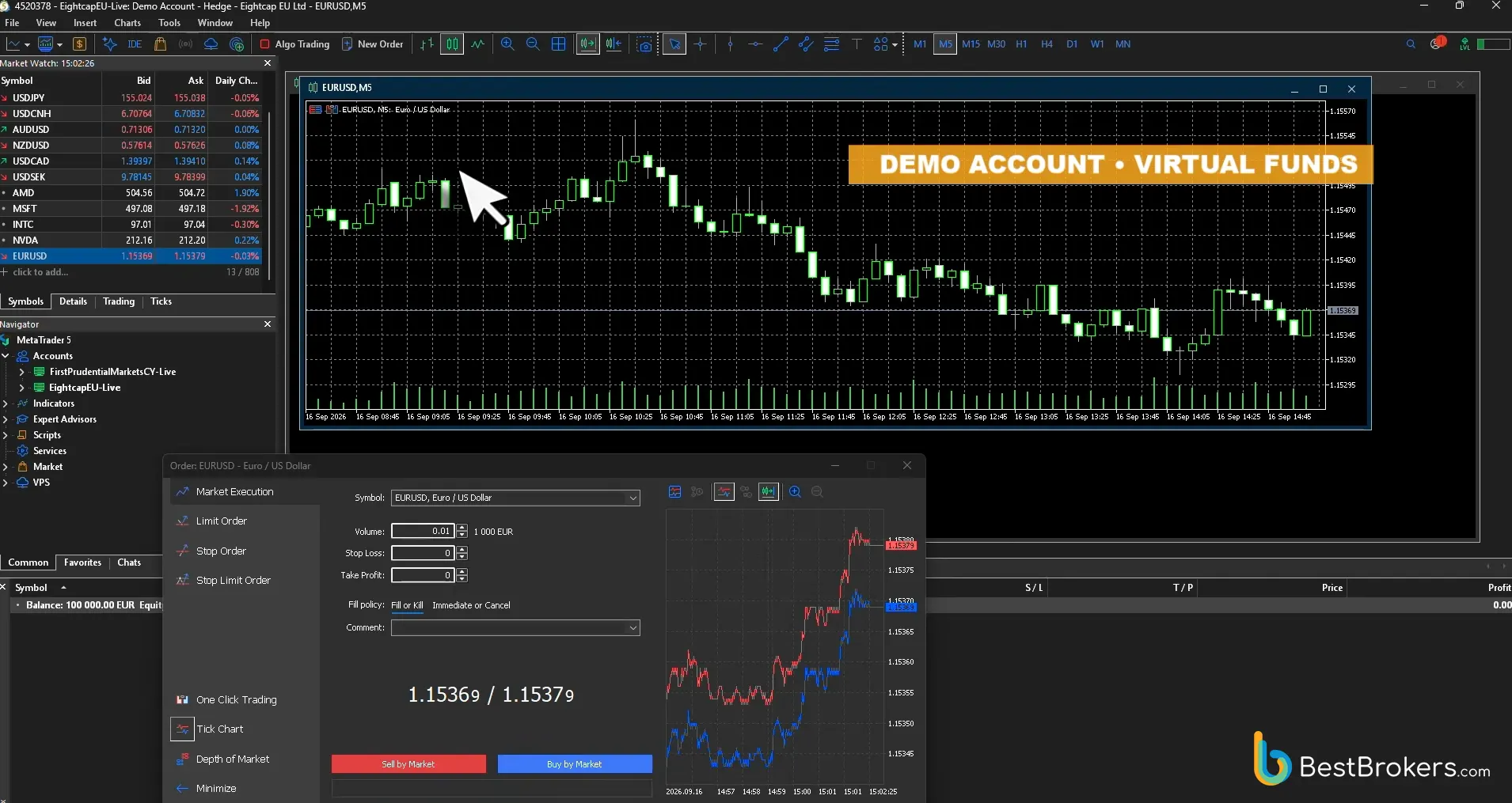
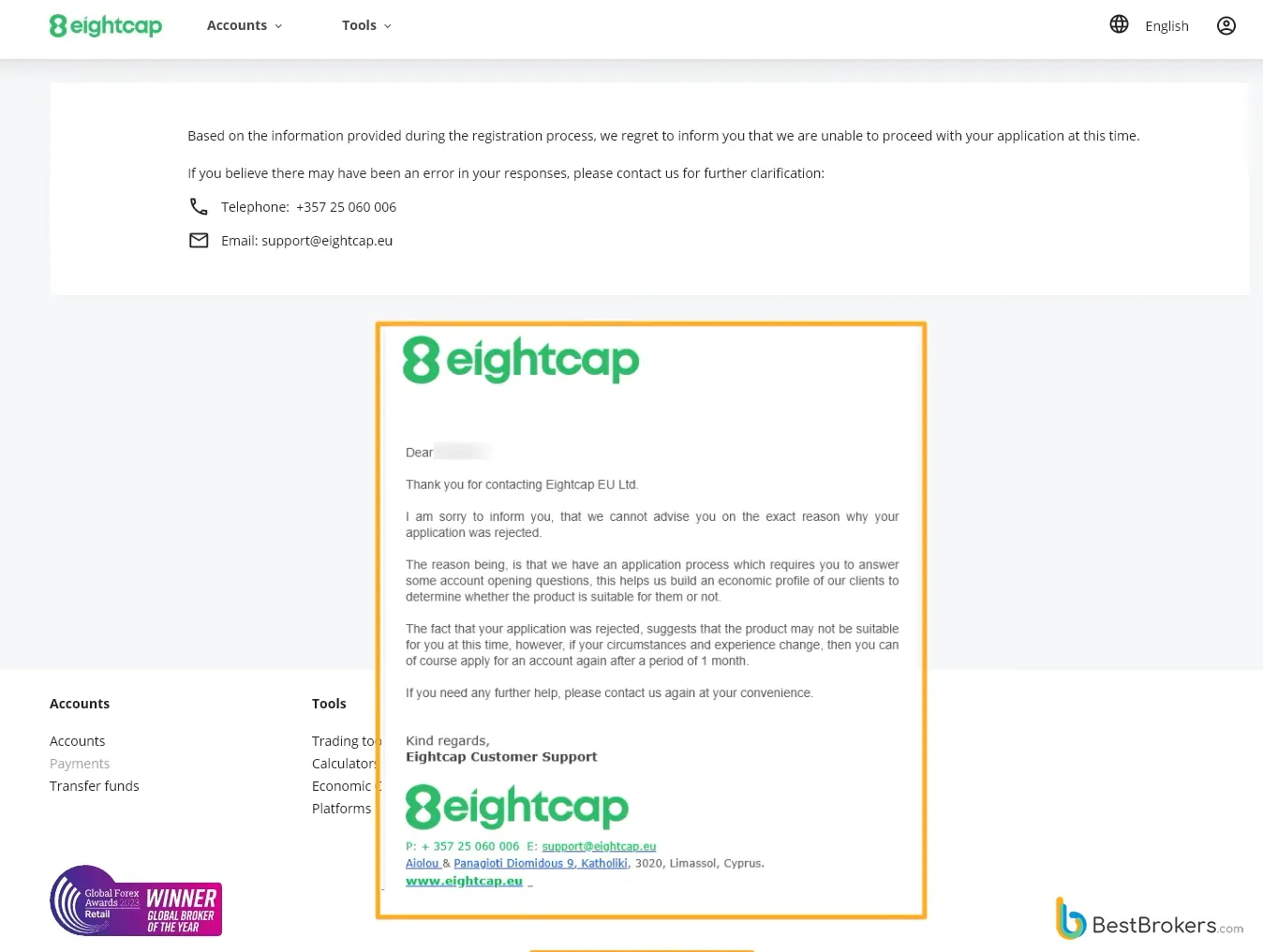
Evidence from our live-account test
Account application Live account applicationDemo trading
 EURUSD demo tradeApplication declined
 Application declined
- Account opened
CFDs are complex instruments and come with a high risk of losing money rapidly due to leverage. 76.09% of retail investor accounts lose money when trading CFDs with this provider. You should consider whether you understand how CFDs work and whether you can afford to take the high risk of losing your money. - 4. AvaTrade
AvaTrade was founded in 2006, and its EU entity, AVA Trade EU Ltd, is licensed by the Cyprus Securities and Exchange Commission (CySEC) under license number 347/17. The firm complies with the Markets in Financial Instruments Directive (MiFID), which provides a harmonized regulatory framework for entities within the EEA. Under the Irish Investor Compensation Company Ltd. (ICCL), retail clients are covered for 90% of their net losses, up to €20,000. AvaTrade also segregates client funds at tier-1 banks such as NatWest and Barclays. The broker received the 2023 Most Reliable Trading Platform UK award from World Business Stars Magazine.
As AvaTrade’s authorization allows it to accept clients from various European countries, the website supports languages like English, Portuguese, Italian, and Finnish, to name a few. Customer support is multilingual as well, and clients can contact the support team via live chat, phone, or email.
We tested AvaTrade using an MT4 retail account with a minimum deposit requirement of €100. Pricing was spread-only, with average spreads of 0.8 pips on EUR/USD, 37 pips on gold, and 2 pips on the US500. Retail leverage starts from 1:2 on digital assets and reaches 1:30 on major forex pairs.
Professional accounts are available for MT5 and offer maximum leverage of 1:25 for cryptocurrencies and 1:400 for forex. We also tested the proprietary AvaProtect feature, which allowed us to safeguard eligible positions from losses of up to $1 million in exchange for a nominal hedging fee. European clients can fund their accounts via cards, bank transfers, Neteller, Skrill, and WebMoney.
CFDs are complex instruments and come with a high risk of losing money rapidly due to leverage. 57% of retail investor accounts lose money when trading CFDs with this provider. You should consider whether you understand how CFDs work and whether you can afford to take the high risk of losing your money. - 5. IC Markets
IC Markets has a Trustpilot score of 4.8 and holds licenses from multiple regulators. ASIC and Britain’s FCA are among the regulators that have authorized IC Markets, as has CySEC (license number 362/18). You can view further details on IC Markets’ CySEC license page. The Cyprus-regulated entity, IC Markets (EU) Ltd, operates from a head office located at 86 Franklinou Roosvelt, 4th floor, Office 401, 3011 Omonoia in Limassol.
As per CySEC regulation, retail clients registered under the EU entity of the broker can use maximum leverage of 1:30 on major forex pairs. Professional traders are eligible for higher leverage of up to 1:500 for major pairs, but do not qualify for negative balance protection or coverage under the ICF.
For traders seeking low spreads, IC Markets offers multiple account types. With a Standard account, clients can access spreads that start at 0.8 pips, while choosing either of the Raw Spread account options will lower the minimum spread to zero pips.
We deposited into a live Raw Spread account connected to MT4, which required a minimum balance of €200. The funding options we could choose from included OpenPayd, Visa, Mastercard, PayPal, Skrill, and Neteller. The broker keeps client funds in segregated trust accounts at top-tier European banks in line with CySEC requirements.
Our live testing confirmed ECN execution with very tight average spreads of 0.06 pips on EUR/USD, 19 pips on gold, and 3.6 pips on the US500, plus a clear €3.25 commission per lot on forex and gold. Our withdrawals were processed efficiently, with funds arriving in our account in two to three business days.
CFDs are complex instruments and come with a high risk of losing money rapidly due to leverage. 70.64% of retail investor accounts lose money when trading CFDs with this provider. You should consider whether you understand how CFDs work and whether you can afford to take the high risk of losing your money. - 6. Admirals
Founded in 2001, Admiral Markets (now known as Admirals) is a broker regulated by Cyprus’s financial regulator (license number 201/13). The registered office for Admirals Europe Ltd is situated at Agias Zonis 63, 3090 in Limassol. Under CySEC rules, Admirals segregates clients’ funds in secure bank accounts, negative balance protection is available, and leverage for retail clients cannot exceed 1:30 for forex.
For professionals, the leverage limit is much higher at 1:500 for major currency pairs and gold. Other markets have lower ratios. Silver positions, for instance, are capped at 1:100. For those seeking to trade other financial instruments in addition to forex, Admirals offers a market selection that includes commodities, ETFs, stocks, and more.
We tested Admirals with a live Zero MT4 account under the CySEC entity, which required a €100 minimum deposit. The account uses STP execution with raw spreads from 0.0 pips. Our tests showed average spreads of 0.1 pips on EUR/USD, 40 pips on gold, and 3 pips on the US500 cash index. Positions in forex and gold incurred a $/€3 commission per side.
EU clients can fund their accounts free of charge with Visa, Mastercard, Klarna, Brite, and bank transfers. We also noticed a few extra fees. The broker charges 0.3% for currency conversion and imposes a €10 inactivity fee after two years of dormancy. We were entitled to one free withdrawal per month, and a 1% fee with a minimum of €1 applied for subsequent withdrawal requests.
CFDs are complex instruments and come with a high risk of losing money rapidly due to leverage. 73% of retail investor accounts lose money when trading CFDs with this provider. You should consider whether you understand how CFDs work and whether you can afford to take the high risk of losing your money. - 7. FxPro
FxPro provides relatively low spreads and a range of currency pairs, and the broker is fully authorized to operate in multiple countries by CySEC under license number 078/07. The local division operates from offices located at 5 Dimokratias, Ergates, Nicosia, 2643, Cyprus. As a CySEC-compliant entity, FxPro Financial Services Ltd provides negative balance protection, segregation of client funds, and participation in the Cyprus compensation scheme. Negative balance protection is available to both retail and professional clients, although professionals are excluded from ICF coverage.
FxPro supports multiple trading platforms, including proprietary software, MT4, MT5, and cTrader. You can compare platforms on FxPro’s platform comparison page. Our tests were conducted with a live cTrader account with no minimum deposit requirements and a $/€3.50 commission per 100,000 currency units traded. Our order logs showed true NDD market execution with VWAP routing. Over 90% of all trades were filled at the requested price or better.
Pricing was competitive, with raw spreads from 0.0 pips and averages of 0.48 pips on EUR/USD, 17.03 pips on gold, and 8.4 pips on the US500 index. Retail leverage goes up to 1:30, while professional accounts can access higher dynamic ratios. EU customers can fund their accounts through cards, PayPal, Neteller, Skrill, bank wires, and broker-to-broker transfers. However, our team noted that requesting a withdrawal without any trading activity in an account triggers an internal fee between 2% and 2.7% on Skrill, Neteller, and PayPal transactions.
Trade Responsibly. CFDs are complex instruments and come with a high risk of losing money rapidly due to leverage. 74% of retail investor accounts lose money when trading CFDs with this provider. You should consider whether you understand how CFDs work and whether you can afford to take the high risk of losing your money. - 8. XM Group
XM holds licenses from several supervisory authorities, including the KNF, BaFin, CNMV, MNB, ACPR, FIN-FSA, and CONSOB. Its EU entity, Trading Point of Financial Instruments Ltd, is authorized and regulated by CySEC under license number 120/10, with registered offices at 12 Richard and Verengaria Street, Araouzos Castle Court, 3rd Floor, 3042 Limassol, Cyprus. As a CySEC-regulated and MiFID II-compliant broker, XM follows rules on transparency and execution, segregated client accounts, negative balance protection, and ICF participation.
The broker is known for low forex spreads that can go below 1 pip, and its selection of currency pairs encompasses EUR/USD, AUD/USD, GBP/CHF, and many others. We opened a live Zero account at the CySEC entity, complying with the broker’s low €5 minimum deposit. This provided us with access to real-time margin monitoring and stable leverage that does not change on weekends. The account enables hedging. Client funds are segregated and held at tier-1 European banks such as Barclays.
During testing, the Zero account delivered average spreads of 0.3 pips on EUR/USD, 12 pips on gold, and 5 pips on the US500, plus a $/€3.50 commission per side. Retail leverage is fixed by instrument, ranging from 1:2 on crypto to 1:30 on major forex pairs, and even professional clients cannot exceed that cap, as customer support informed us.
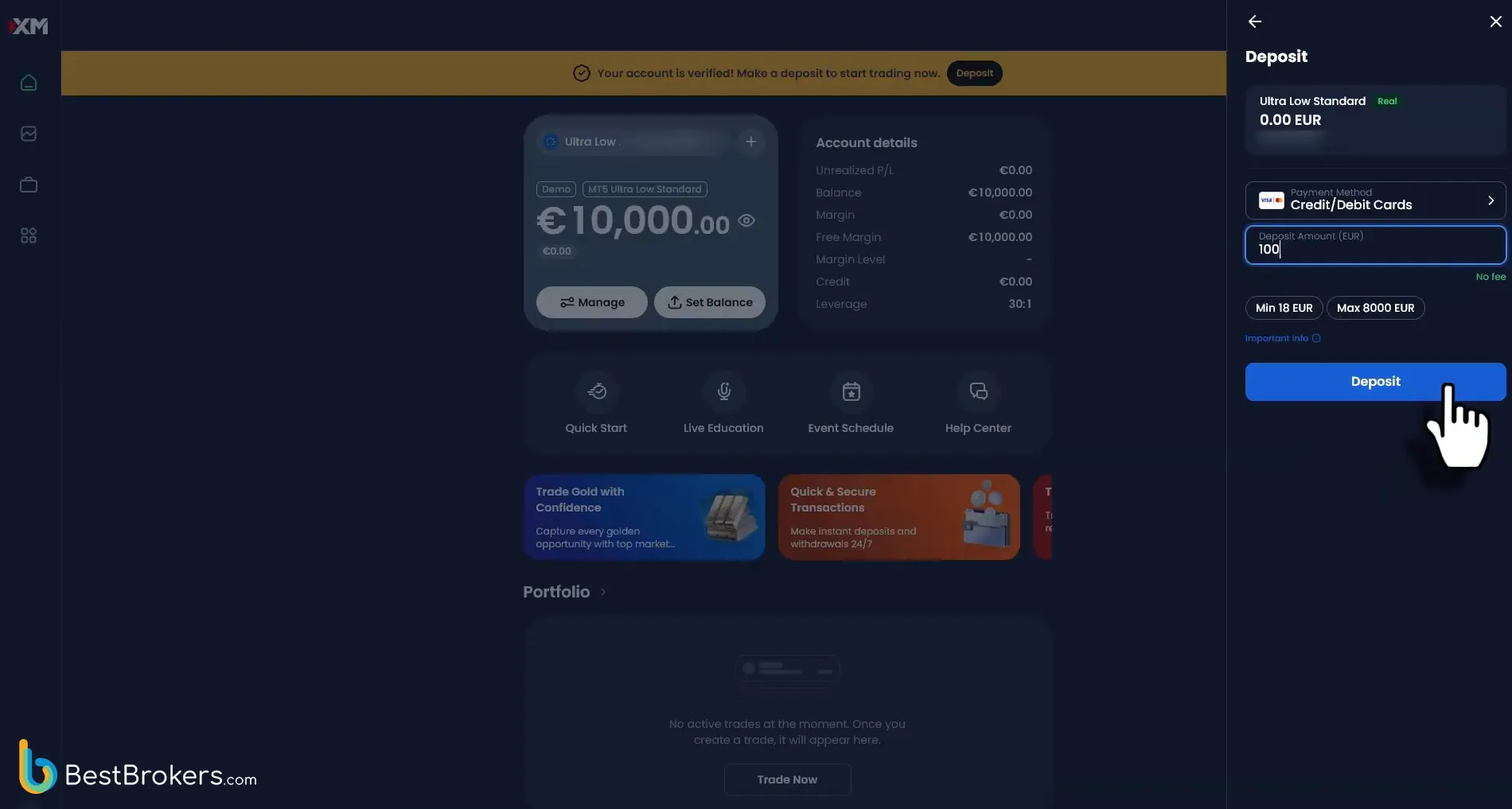
Funding was easy, with support for cards, bank transfers, local transfers, and e-wallets. International wires of $200 incur no additional fees. For individuals who are new to forex or trading in general, XM offers educational content through its education section. A wealth of educational videos and tutorials is available, and users may also choose to learn via live webinars and Q&As.
Evidence from our live-account test
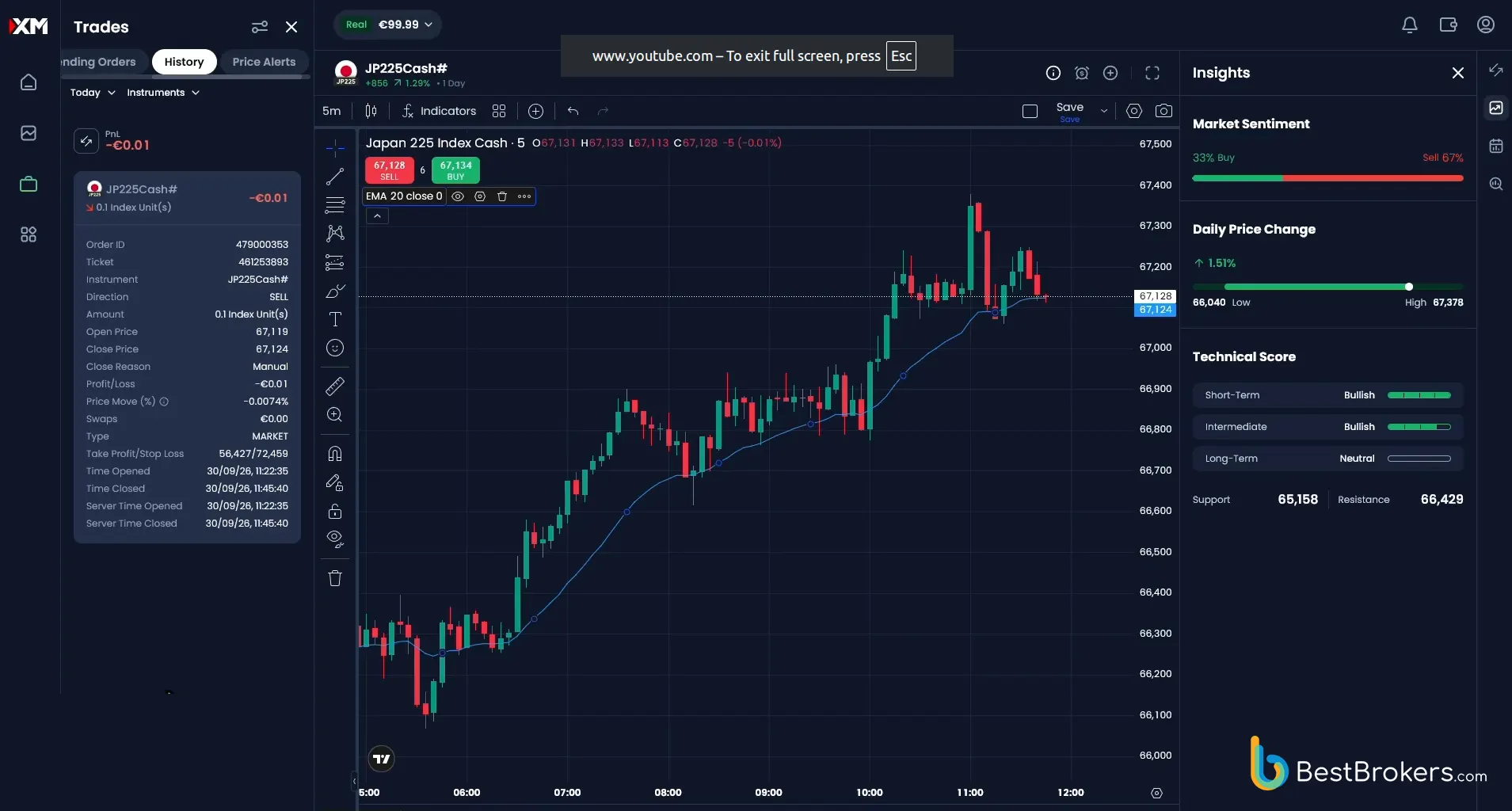
Deposit test €100 debit card depositLive tradingWeb live trade Japan 225Withdrawal test
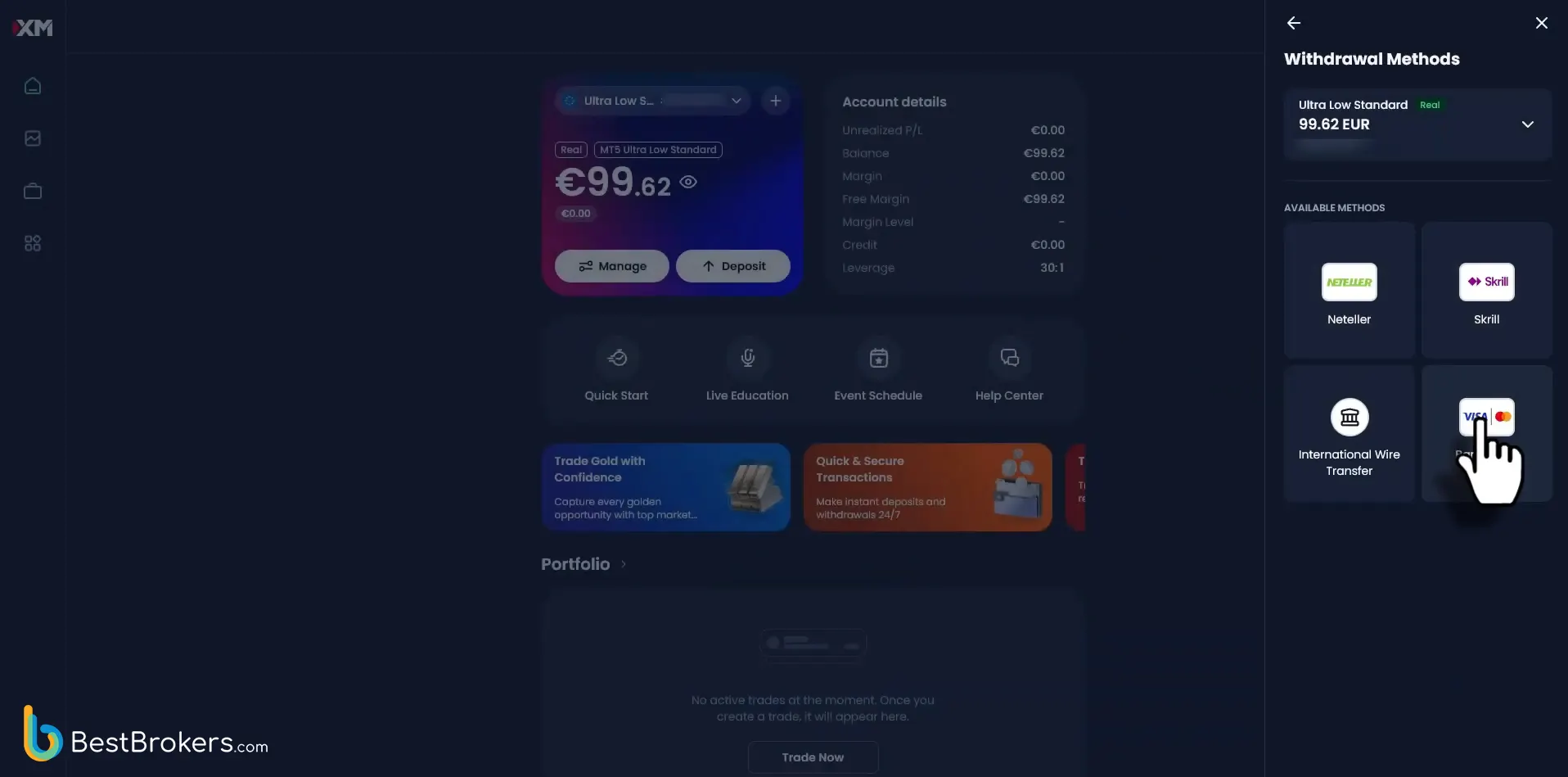
 XM withdrawal test
- Account opened
- Real-money deposit
- Live trades performed
- Withdrawal completed
Risk Warning: CFDs are complex instruments and come with a high risk of losing money rapidly due to leverage. 72.82% of retail investor accounts lose money when trading CFDs with this provider. You should consider whether you understand how CFDs work and whether you can afford to take the high risk of losing your money. - 9. Tickmill
Regulated by CySEC under license number 278/15, Tickmill offers a broad market selection, diverse trading tools, and low spreads. The EU subsidiary is operated by Tickmill Europe Ltd, with registered offices at Kedron 9, Mesa Geitonia 4004, Cyprus. As a CySEC-regulated broker, Tickmill keeps clients’ funds in segregated accounts and participates in the Investor Compensation Fund (ICF). The broker offers additional indemnity and insolvency insurance coverage with Lloyd’s up to €1 million, available alongside the ICF compensation.
Tickmill supports both MetaTrader 4 and MetaTrader 5, making it a suitable choice for traders familiar with either platform. Mobile trading is available through the Tickmill app for iOS and Android devices. Clients can choose between Classic and Raw accounts, with the latter offering spreads from 0.0 pips.
We conducted our tests with a Raw account, which required a €100 minimum deposit. EU clients can fund their accounts via Visa, Mastercard, Skrill, Neteller, Trustly, PayPal, and Przelewy24. Tickmill’s zero-fee policy applies to bank transfers of €5,000 or more and covers up to €100 in banking charges.
During testing, Raw spreads occasionally reached 0.0 pips and averaged 0.1 pips on EUR/USD, 9 pips on gold, and 3.9 pips on the US500, with a €3 commission per side. Retail leverage ranges from 1:2 on cryptocurrencies to 1:30 on major forex pairs, with negative balance protection included. Professional clients can access leverage of up to 1:200 on cryptocurrencies and 1:500 on major pairs, while negative balance protection is provided on a case-by-case basis.
CFDs are complex instruments and come with a high risk of losing money rapidly due to leverage. 70% of retail investor accounts lose money when trading CFDs with Tickmill Europe Ltd. You should consider whether you understand how CFDs work and whether you can afford to take the high risk of losing your money. - 10. Axi
Founded in 2007 and headquartered in Sydney, Australia, Axi is a global forex and CFD broker with a strong regulatory track record. The Cyprus Securities and Exchange Commission is among the financial authorities that regulate the broker. The company operates under CySEC license number 433/23, following the applicable trading guidelines and limitations. The CySEC subsidiary, Solaris EMEA Ltd, is based in the Magnum Business Center in Limassol.
Customers can access 220+ markets, including forex, shares, indices, commodities, and cryptocurrencies, with minimum deposits as low as $/€5 for Standard accounts and competitive average spreads of 0.7 pips. The maximum allowable leverage for major currency pairs is 1:30, while for minor pairs, the ratio is capped at 1:20. In other regions, Axi offers up to 1:400 leverage for retail trading accounts.
Our team registered a live Pro account on MT4, which required a $/€500 minimum deposit. Although it is marketed as “Pro,” the account is still treated as a retail account under CySEC rules. Funding it with Visa, Mastercard, or bank wire transfers is free of additional charges.
We benefited from competitive pricing during testing, with average spreads of 0.1 pips on EUR/USD, 9 pips on gold, and 3 pips on the US500, plus a €4 commission per side for forex. Actual professional traders at the CySEC entity can access higher leverage, up to 1:400 on Standard and Pro accounts and 1:500 on Elite accounts, but they forfeit retail safeguards such as negative balance protection and ICF compensation.
CFDs are complex instruments and come with a high risk of losing money rapidly due to leverage. The vast majority of retail client accounts lose money when trading in CFDs. You should consider whether you understand how CFDs work and whether you can afford to take the high risk of losing your money. - 11. Swissquote
Launched in 1996, Swissquote is one of the oldest online brokers to begin catering to retail forex traders. The EU subsidiary, Swissquote Capital Markets Ltd, is authorized by CySEC under license number 422/22, and operates from Limassol, Cyprus. It also holds licenses from other supervisory entities, including the UK’s FCA.
The broker offers a broad selection of financial instruments, giving clients the opportunity to trade forex, ETFs, stocks, and more. Both MT4 and MT5 are supported, and retail traders can choose from several account types, as well as one designated for professionals.
The BestBrokers team used a live MT5 Standard account, which required a €1,000 minimum deposit. We deposited with a Visa card, but Mastercard and bank transfers are also accepted. The broker delivered deep liquidity and a solid fill rate exceeding 98%. Approximately 58% of our orders were executed without any slippage. During testing, average spreads came in at 1.4 pips on EUR/USD, 53 pips on gold, and 2.7 pips on the US500.
Retail leverage is capped at 1:30 with a 50% stop-out level, while professional clients can access ratios as high as 1:400 with a 30% stop-out level. That said, professional accounts do not qualify for ICF coverage or negative balance protection.
CFDs are complex instruments and come with a high risk of losing money rapidly due to leverage. 61% of retail investor accounts lose money when trading CFDs with this provider. You should consider whether you understand how CFDs work and whether you can afford to take the high risk of losing your money. - 12. Libertex
Libertex is part of the Libertex Group, a broker that has operated since 1997. Its parent company, Indication Investments Ltd, is licensed by CySEC under license number 164/12 and has registered offices at 116 Gladstonos St., Michael Kyprianou Building, 1st Floor, 3032 Limassol, Cyprus. EU retail clients are covered by negative balance protection, ensuring they cannot lose more than their deposit. Eligible clients are also protected by investor compensation of up to €20,000 under the local regulatory framework.
Clients can choose from several platforms, including MetaTrader 4, MetaTrader 5, and Libertex’s in-house platform. The broker offers access to a broad range of markets, including forex, stocks, metals, and indices.
We assessed Libertex with a live MT4 retail account, where the minimum deposit started from €100. We recorded average spreads of 0.1 pips on EUR/USD, 32 pips on gold, and 4 pips on the US500 cash index. Forex, silver, and gold positions incurred a $/€3 commission per side. Retail leverage is capped at 1:30, while professional traders can access higher ratios of up to 1:500 on major currency pairs.
Funding our account was free. EU clients can deposit via Visa, Mastercard, Skrill, Neteller, iDeal, Przelewy24, Blik, and Multibanco. For withdrawals, SEPA bank transfers are subject to a 0.5% fee, with a minimum charge of €2 and a maximum of €10.
CFDs are complex instruments and come with a high risk of losing money rapidly due to leverage. 83% of retail investor accounts lose money when trading CFDs with this provider. You should consider whether you understand how CFDs work and whether you can afford to take the high risk of losing your money. - 13. Plus500
Plus500 is overseen by multiple regulators, including CySEC, which licenses the broker’s operations within the EU (license No. 250/14), ensuring fair trading conditions for both retail and professional traders. Operating as Plus500CY Ltd, the entity maintains its registered corporate office in the Cedars Oasis Tower, Floor 1, 3027 in Limassol.
Following CySEC’s regulatory guidelines, Plus500 imposes a mandatory leverage limit of 1:30 on major FX pairs and offers investor compensation of up to €20,000 to eligible retail clients. Our reviewers evaluated Plus500 using a live retail account, requiring a €100 minimum deposit. MT4 and MT5 were not supported, so we used the broker’s proprietary WebTrader for testing purposes.
Retail accounts follow the 50% stop-out rule under CySEC requirements. Professional clients can access leverage of up to 1:300 on currency pairs and indices and 1:150 on commodities like gold. That said, professionals waive retail protections such as negative balance protection and ICF compensation.
During our tests, we traded with average spreads of 0.9 pips on EUR/USD, 74 pips on gold, and 4 pips on the US500. We also found that Guaranteed Stop Loss Orders (GSLOs) are available for additional risk mitigation, although they widen the spread when triggered. Deposits and withdrawals are free across EU payment methods, but the broker charges a €10 monthly inactivity fee after three months of dormancy.
81% of retail investor accounts lose money when trading CFDs with this provider. You should consider whether you can afford to take the high risk of losing your money.













About the Regulator
Any forex broker looking to operate in Cyprus must obtain authorization from the country’s Securities and Exchange Commission, also known as CySEC. This regulatory entity was established in 2001 and oversees the financial services industry in Cyprus. Its rules align with the Markets in Financial Instruments Directive 2014 (MiFID II). This means retail traders have access to additional customer protection tools, including negative balance protection from CySEC-regulated brokers.
Moreover, CySEC enforces strict caps on retail leverage to protect traders from excessive risk and potential losses. In line with the product intervention measures of the European Securities and Markets Authority (ESMA) under MiFID II, retail clients trading forex and CFDs through CySEC-regulated brokers face leverage limits that vary by asset class:
- Major forex currency pairs: 1:30
- Minor currency pairs, gold, major indices: 1:20
- Other commodities: 1:10
- Individual stocks: 1:5
- Cryptocurrencies: 1:2
Thanks to Cyprus’ status as a member of the European Union, a broker with a CySEC license can passport its services to other EU member countries and regions within the European Economic Area (EEA). Known as passporting, this licensing system enables CySEC brokers to provide their services across the EU without necessarily obtaining individual permits from other European regulators.
The Cyprus regulator was established under Section 5 of the Securities and Exchange Commission (Establishment and Responsibilities) Law. The body is responsible for the oversight of and compliance monitoring for various financial market participants, including investment firms, fiduciary services providers, brokers, and crypto-asset services providers. The entity also oversees the operations of the Cyprus Stock Exchange, established in 1996.
Apart from supervisory responsibilities, CySEC serves other important functions, such as issuing operating licenses and revoking them in cases of non-compliance. CySEC conducts investigations when necessary and imposes disciplinary and administrative sanctions on non-compliant licensees. The regulator is committed to ensuring high levels of consumer protection and preserving the integrity of the Cyprus financial markets. While CySEC is an independent regulatory body, its leadership is appointed by the Cyprus Minister of Finance (Makis Keravnos at the time of publication).
As of January 1, 2025, forex brokers operating as CySEC-licensed CIFs (Cyprus Investment Firms) are required to comply with the new European Banking Authority (EBA) guidelines, which include enhanced capital adequacy and risk management standards. Under the new rules, many CIFs, including forex brokers, may be classified as low-risk and sufficiently simple, allowing them to benefit from special provisions related to capital requirements.
Requirements for Obtaining a Cypriot Forex Brokerage License
Here is more detailed information on the licensing criteria and requirements forex brokers must satisfy to receive authorization from the Cyprus Securities and Exchange Commission (CySEC).
- Application fees: Upon submitting their applications, brokers interested in receiving CySEC licenses must pay application fees ranging from €7,500 to €12,000 based on the services they seek to provide.
- Minimum capital requirements: Minimum capital requirements start at €75,000 for forex brokers that provide investment advice without holding customer funds. Brokerage firms that hold client funds, provide investment advice, and manage portfolios on customers’ behalf must meet a minimum capital threshold of €150,000. Market makers must satisfy the highest minimum capital requirements of €750,000. Setting up an account at a Cypriot bank is also necessary.
- Application assessment timeframe: The Cypriot financial regulator normally requires four to nine months to evaluate license applications, depending on its workload. However, processing times can sometimes extend beyond this due to additional regulatory scrutiny or incomplete submissions.
- Physical presence required: License applicants must set up physical offices in the country to qualify for evaluation as registered Cyprus Investment Firms (CIFs). Office rental costs per square meter typically range from €6 to €10 in Larnaca, from €8 to €15 in Nicosia, and from €15 to €30 in Limassol.
- Key employees: License applications must contain comprehensive information about key employees, with proof of their good standing. Key personnel include risk managers, internal and external auditors, compliance control officers, and four or more company directors (two non-executives and two executives). At least three of the four company directors must reside in the country.
- Corporate tax rates: Cyprus-resident brokerages are subject to corporate taxes of 12.5%. The country’s low corporate tax rate renders it a highly appealing licensing destination for forex brokers looking to legally service EU and EEA customers.
- Segregation of client funds: Forex brokers seeking CySEC’s approval must segregate client assets from their operating capital by storing them in separate accounts at approved tier-one banks. Barclays and Lloyds are two prominent examples that come to mind. The practice ensures traders can access their money if a broker becomes insolvent and prevents licensees from misusing their clients’ funds.
- Negative balance protection: Negative balance protection (NBP) is a safety mechanism provided by CySEC-regulated forex brokers that ensures retail clients cannot lose more than the funds they have deposited in their trading accounts. If extreme market movements or high leverage would otherwise result in a negative account balance, the broker automatically resets the account to zero, protecting the client from owing additional money. This protection typically applies only to clients classified as retail under CySEC/MiFID II rules.
- Investor protection scheme: CySEC licensees must deposit a certain amount in the Investor Compensation Fund (ICF) to ensure clients can recover their money if their broker begins to struggle financially or files for bankruptcy. Retail clients of CySEC-licensed forex brokerages are eligible for maximum compensation of €20,000 per person.
- Other requirements: Documentation packages submitted by license applicants must contain a detailed three-year business plan and a financial plan with quarterly projections of the companies’ budget and revenue for the first three years of operation. The CIF registration itself requires submitting certified copies of the passports of the brokerage firm’s directors and beneficial owners. License applicants must clearly outline their anti-money laundering and risk management policies.
Obtaining a license from the Cyprus Securities and Exchange Commission requires brokers to meet multiple conditions. An application includes various documents that cover most of the requirements a company must meet for a CySEC license. Once the application has been submitted, applicants should expect the regulator’s final decision to take several months.
A company first needs to provide proof that it is based in Cyprus. Next, a contribution amount must be paid through a Central Bank of Cyprus account. Membership in the Association of International Investment Firms of Cyprus is also mandatory, and this comes at a cost. Proof of this must be included in the application documentation. Another requirement concerns authorized capital, and the amount depends on whether the application concerns a consultant, broker agent, or liquidity provider.
Applicants must have a compliance officer who oversees the company’s anti-fraud and anti-money laundering (AML) measures and compliance. A risk manager and an internal auditor must also be employed. Any aspiring licensee needs to meet typical requirements, such as having a board of directors and individuals covering a range of management positions. They must all have no criminal record and must not be bankrupt.
Know Your Customer (KYC), anti-fraud, and anti-money laundering (AML) policies are also required. Additionally, none of the individuals in management positions can have bankruptcy status.
Overall, CySEC licensing remains a thorough and demanding process intended to guarantee high professional and ethical standards. Entities licensed by CySEC have demonstrated substantial commitment to regulatory compliance and client security, making them reliable operators in the forex brokerage space.
Is Your Money Protected?
As established, Cyprus is a member of the European Union, and it therefore falls under ESMA’s Markets in Financial Instruments Directive II (MiFID II). This, in turn, means that CySEC’s rules meet high standards of safety regarding customer funds.
Traders can also rest assured that no CySEC broker will commingle client funds with company money. Instead, all customer money is segregated into separate bank accounts at tier-1 financial institutions. This practice is important as it prevents brokers and other financial institutions from using client money for investments and operational expenses. Fund segregation also serves as a safety net against potential insolvency. If a broker files for bankruptcy, the segregated money and assets are returned to customers rather than being used to pay off creditors.
Earlier, we also noted that leverage at CySEC brokers must be capped to help prevent traders from incurring excessive losses. High leverage can amplify both gains and losses, and inexperienced traders might quickly incur losses exceeding their account balance without these limits. By capping leverage, CySEC, following ESMA rules, helps reduce the likelihood of large, sudden losses, promotes more responsible trading, and aligns with broader investor-protection obligations under MiFID II.
For retail traders, negative balance protection is also available. This mechanism prevents customers from suffering losses that exceed their initial balance. When a client’s leveraged positions start losing rapidly, and the customer can no longer maintain the necessary margin, brokers with negative balance protection will close all losing trades via automatic stop-outs. In the unlikely event of the balance going into the red, the broker will reset the account to zero.
Additionally, all CySEC-regulated brokers must contribute to investor compensation schemes. This helps protect the claims of eligible clients if their broker can no longer fulfill its financial obligations. Each customer is entitled to a maximum compensation of €20,000. We should highlight that professional traders are ineligible for investor compensation and negative balance protection because brokers deem them to have a sufficient understanding of the financial markets and their associated risks.
FAQ
A broker’s licenses will typically be listed in the footer section of its homepage or on a page specifically designated for its regulation. To verify that the CySEC license a broker presumably has is legitimate, however, your best course of action will be to check the regulator’s register of licensed entities.
This will vary depending on your broker of choice. Some have chosen to create their own platforms, and usually, they give clients the opportunity to use other options. Others offer platforms such as MT4, MT5, cTrader, and more, typically allowing users to pick whichever platform they prefer.
In general, yes. In fact, if you go with a broker from our top list, you are likely to have access to trading markets such as commodities, shares, cryptocurrencies, and ETFs, among others.
Making deposits is simple and something you can do as soon as you finish your account application process. To top up your balance, simply navigate to your broker’s “wallet” or “deposit” section and pick from one of the payment methods. Typically, this will include bank cards, digital wallets, and bank transfers.
If you are a retail trader and stick to a CySEC-regulated broker, then no. The 1:30 cap does not apply to professional traders, however, so becoming a professional is what you can do if you are adamant about being able to try with higher leverage someday. To classify as a professional trader, however, you must meet certain requirements proving your forex knowledge, experience, and tolerance to high-risk trading.
You might also be interested in exploring forex brokers regulated by other institutions
- FCA (United Kingdom) Regulated Forex Brokers
- IFSC (Belize) Regulated Forex Brokers
- FSA (Seychelles) Regulated Forex Brokers
- VFSC (Vanuatu) Regulated Forex Brokers
- ASIC (Australia) Regulated Forex Brokers
| Top 30 CySEC-Regulated Forex Brokers Ranked by Trustpilot Score | ||||
|---|---|---|---|---|
| CySEC Broker | License Number | Trading Platforms | Max Leverage (Retail) | Trustpilot Rating |
| Markets.com | 092/08 | MT4, MT5 | 1:30 | 4.7 / 5 |
| BDSwiss | 199/13 | MT4, MT5, Proprietary | 1:30 | 4.7 / 5 |
| Trading 212 | 398/21 | Proprietary | 1:30 | 4.6 / 5 |
| GoMarkets | 322/17 | MT4, MT5, cTrader, WebTrader | 1:30 | 4.6 / 5 |
| OQtima | 406/21 | MT4, MT5, cTrader | 1:30 | 4.6 / 5 |
| easyMarkets | 079/07 | MT4, MT5, TradingView | 1:30 | 4.5 / 5 |
| NAGA | 204/13 | MT4, MT5, Proprietary | 1:30 | 4.5 / 5 |
| Skilling | 357/18 | MT4, cTrader | 1:30 | 4.4 / 5 |
| JustMarkets | 401/21 | MT4, MT5 | 1:30 | 4.4 / 5 |
| Eightcap | 246/14 | MT4, MT5, TradingView | 1:30 | 4.3 / 5 |
| ThinkMarkets | 215/13 | MT4, MT5, ThinkTrader | 1:30 | 4.3 / 5 |
| Capital.com | 319/17 | MT4, TradingView | 1:30 | 4.2 / 5 |
| eToro | 109/10 | Proprietary | 1:30 | 4.2 / 5 |
| City Index | 400/21 | MT4, TradingView | 1:30 | 4.2 / 5 |
| FXCM | 392/20 | MT4, TradingView, ZuluTrade, Capitalise AI, Trading Station | 1:30 | 4.2 / 5 |
| Plus500 | 250/14 | Proprietary | 1:30 | 4.1 / 5 |
| RoboMarkets | 191/13 | MT4, MT5, TradingView, Proprietary | 1:30 | 4.0 / 5 |
| FXView | 367/18 | MT4, MT5, ActTrader | 1:30 | 4.0 / 5 |
| XTB | 169/12 | Proprietary | 1:30 | 3.7 / 5 |
| IronFX | 125/10 | MT4, Trade Copier | 1:30 | 3.7 / 5 |
| iFOREX Europe | 143/11 | Proprietary | 1:30 | 3.7 / 5 |
| FBS | 331/17 | MT5, MT4 | 1:30 | 3.5 / 5 |
| Axi Trade | 433/23 | MT4, Proprietary | 1:30 | 3.4 / 5 |
| SquaredFinancial | 329/17 | MT4, MT5 | 1:30 | 3.3 / 5 |
| AAA Trade | 244/14 | MT5 | 1:30 | 3.1 / 5 |
| Alvexo | 236/14 | Proprietary | 1:30 | 3.1 / 5 |
| HF Markets | 183/12 | MT4, MT5, Proprietary | 1:30 | 2.8 / 5 |
| InstaForex | 266/15 | Proprietary | 1:30 | 2.7 / 5 |
| TopFX | 138/11 | MT4, cTrader | 1:30 | 2.7 / 5 |
| ATFX | 285/15 | MT4 | 1:30 | 2.5 / 5 |
About the Editorial Team