


 Zornitsa Stefanova
 Zornitsa Stefanova is a Financial Research and Platform Testing Analyst at BestBrokers.com, specialising in hands-on reviews of forex, cryptocurrency and stock trading platforms. She evaluates brokerage companies from a user-focused perspective, testing key areas such as account setup, trading conditions, platform usability, available markets and overall reliability.
 | Expert Editor
  Eugene Lee, CFA
 Eugene Lee, CFA, is the Head of Research at BestBrokers.com, where he draws on more than two decades of experience in global markets, portfolio management, derivatives, and fintech to evaluate online brokers. His background in institutional investing and quantitative research helps ensure that broker reviews are based on data, risk assessment, and real-world trading conditions.
  | Updated:
 Introduction to Leverage Trading
Our Methodology in Compiling This Guide:
To prepare this guide, our team conducted hands-on testing of the leverage trading conditions across a range of regulated brokers, including Fusion Markets, FP Markets, IC Markets, and Pepperstone. Testing was primarily executed on the web platform versions of cTrader and MetaTrader 5, as well as Pepperstone’s proprietary trading platform. During testing, we opened and managed leveraged positions using ratios ranging from 1:1 to 1:100. Additionally, we closely evaluated and documented real-time margin requirements, margin call triggers, and automated stop-out execution levels. You can read a complete breakdown of our review framework by visiting our full methodology.
Leverage trading allows traders to control a larger position in the market with a smaller amount of capital. It can increase both potential profits and losses, which is why understanding how leverage, margin, and risk management work is essential before trading.
What This Guide Covers
This guide is designed to take traders from the basic mechanics of market exposure to the professional application of risk management. We have organized the content into several core pillars:
- The Foundations of Leverage and Margin: An exploration of how leverage functions as a multiplier, the differences between various margin types (initial, maintenance, and free), and how these mechanics vary across forex, CFDs, and cryptocurrency markets.
- The Mathematics of Trading: Practical formulas for calculating notional value, required margin, and position sizing to ensure your trade size is dictated by your strategy, not just your available buying power.
- Regulatory Landscapes and Account Types: A breakdown of global leverage limits (UK, EU, US, Australia) as per the latest regulatory frameworks of financial watchdogs like the FCA, ESMA, ASIC, and the CFTC. We also cover the critical distinctions between retail protections and professional account statuses.
- Operational Realities and Costs: Understanding how leverage scales your trading costs, including the impact on spreads, commissions, and overnight financing (swaps).
- Account Thresholds and Safety Protocols: A detailed examination, covering margin calls, automated stop-outs, liquidation prices, and the role of negative balance protection.
- Strategic Risk Management: Professional workflows for managing volatility, placing logic-based stop losses, and avoiding common pitfalls like overexposure and emotional sizing.
- Practical Execution: A step-by-step beginner workflow and checklist to help you plan, execute, and review leveraged trades with discipline.
Who This Guide Is For
This guide is for beginners, newer active traders, and anyone reviewing the basics before using leverage in a live account. It is especially useful for readers who:
- Understand simple buying and selling.
- Want a clearer explanation of margin, stop-outs, and liquidation.
- Need help turning theory into practical trade planning.
This guide is educational and does not constitute personal investment advice. Keep in mind that leveraged trading carries a high level of risk.
Why Leverage Matters
Leverage changes how much market exposure you take relative to your own capital. That can make small price moves feel much larger in account terms, which affects profit potential, loss speed, margin pressure, overnight cost exposure, and emotional stress.
Key point: Leverage is not free money. It is a way to control a larger position with a smaller amount of your own funds by borrowing exposure from your broker, and this larger exposure can work against you very quickly.
What Readers Will Learn
By the end of this guide, readers should be able to:
- Decode Leverage Ratios: Understand exactly what 1:10 or 1:30 means for your capital.
- Calculate with Confidence: Estimate required margin, total exposure, and effective leverage.
- Master Account Metrics: Distinguish between Balance, Equity, and Free Margin.
- Avoid Common Pitfalls: Spot the mistakes that lead to “margin calls” and account liquidations.
- Navigate Regulations: Understand why available leverage varies by country, broker, and asset class.
What Is Leverage Trading?
Leverage Trading Explained
Leverage trading is a financial mechanism that allows market participants to initiate a position with a value significantly higher than the capital they personally commit. By providing a fraction of the total trade value, referred to as margin, the trader gains exposure to the full notional value of the asset. This practice is standard across various asset classes, including forex, Contracts for difference (CFDs), futures, options, margin stock trading, and many cryptocurrency derivatives.
How Leverage Increases Market Exposure
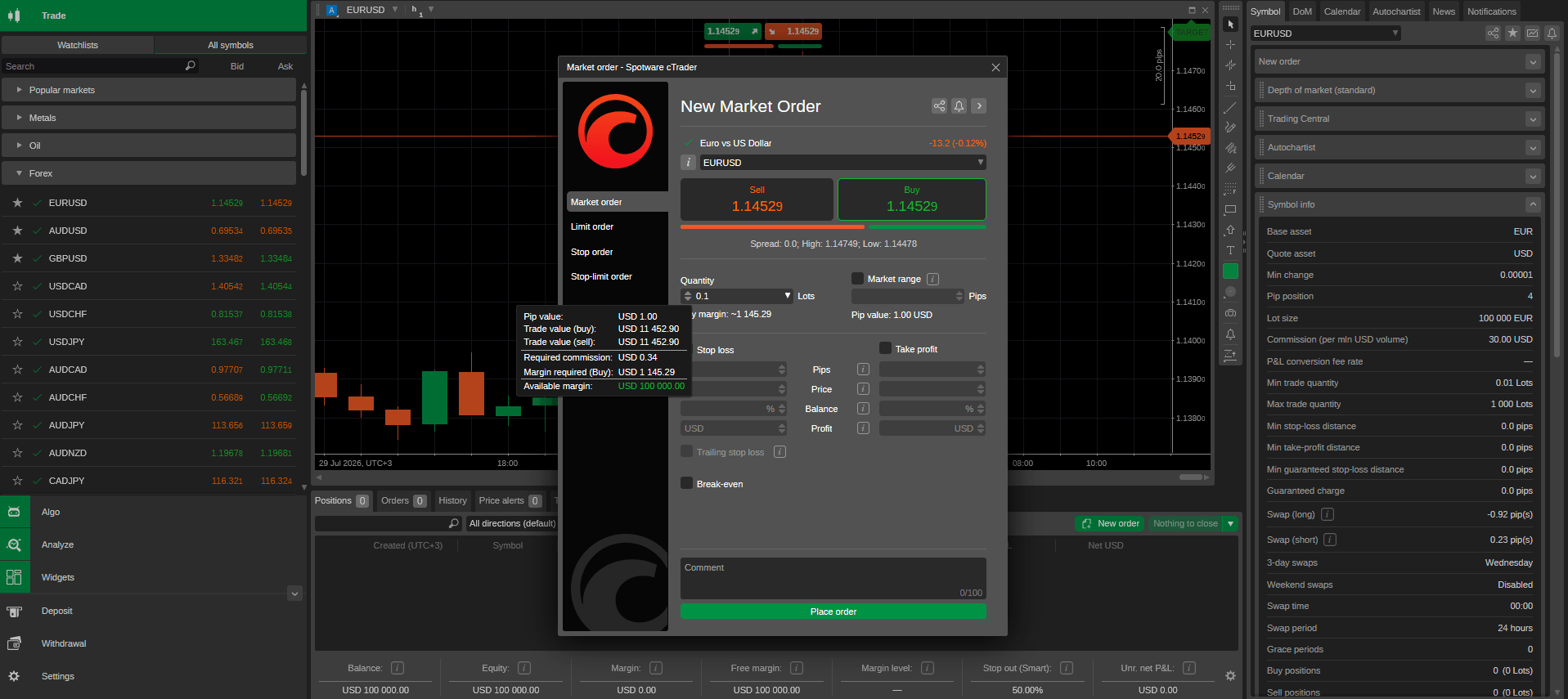
Leverage functions as a multiplier for market participation. In the example below, we utilized a leverage ratio of 1:10 to open a buy position on the EUR/USD while testing IC Markets through the cTrader platform. Our initial capital requirement was $1,145.29, which allowed us to control $11,452.90 in market exposure. All of our profit and loss calculations were based on the total notional exposure ($11,452.90) rather than the margin deposit ($1,145.29). Consequently, a 2% price movement in the underlying market resulted in a 20% fluctuation in the deposited capital.
Leverage vs Margin
Margin is the amount of money required to open and support a leveraged position, while leverage is the ratio that describes how much exposure the margin controls. A simple way to think about it is that margin is the deposit, and leverage is the multiplier. Traders often use the terms together, but they describe different parts of the same setup.
- Margin: The specific percentage of the total position value required by the broker to open and maintain the trade.
- Leverage: The resulting ratio of total exposure relative to the margin requirement.
| Margin Requirement | Leverage |
|---|---|
| 100% | 1:1 (No Leverage) |
| 50% | 1:2 |
| 20% | 1:5 |
| 10% | 1:10 |
| 5% | 1:20 |
| 3.33% | 1:30 |
| 2% | 1:50 |
| 1% | 1:100 |
Leverage vs Traditional Borrowing
While leverage involves the use of capital beyond one’s own, the legal and structural execution varies by instrument:
- Margin Trading (Equities): Involves a direct loan from a brokerage to purchase securities. The trader typically incurs interest charges on the borrowed amount.
- Derivatives (CFDs and Futures): These instruments do not involve a traditional loan. Instead, they are contracts based on price movements. However, holding these positions beyond a single trading session often triggers “overnight financing” or “swap” charges, which reflect the cost of maintaining the leveraged exposure.
Leveraged Trading vs Unleveraged Trading
To illustrate the impact of leverage on capital efficiency, consider a 5% increase in the price of an asset:
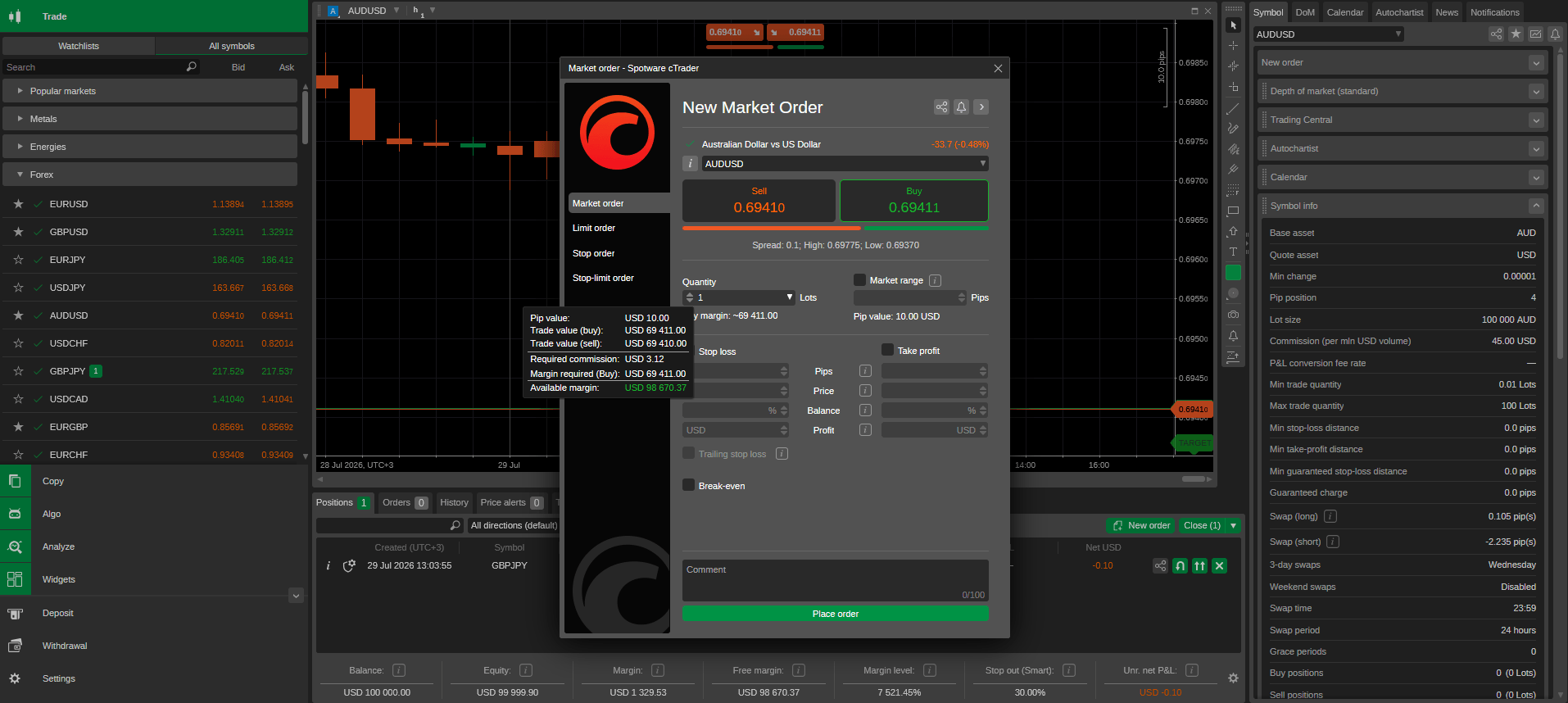
- Unleveraged Position (1:1): A trader allocates money to purchase an equivalent value of an asset. In the example showcased below, we opened a 1-lot AUD/USD position with no leverage, and the margin requirement matched the trade value of the buy position: $69,411. A 5% increase resulted in a profit of $3470.55 (a 5% return on capital).

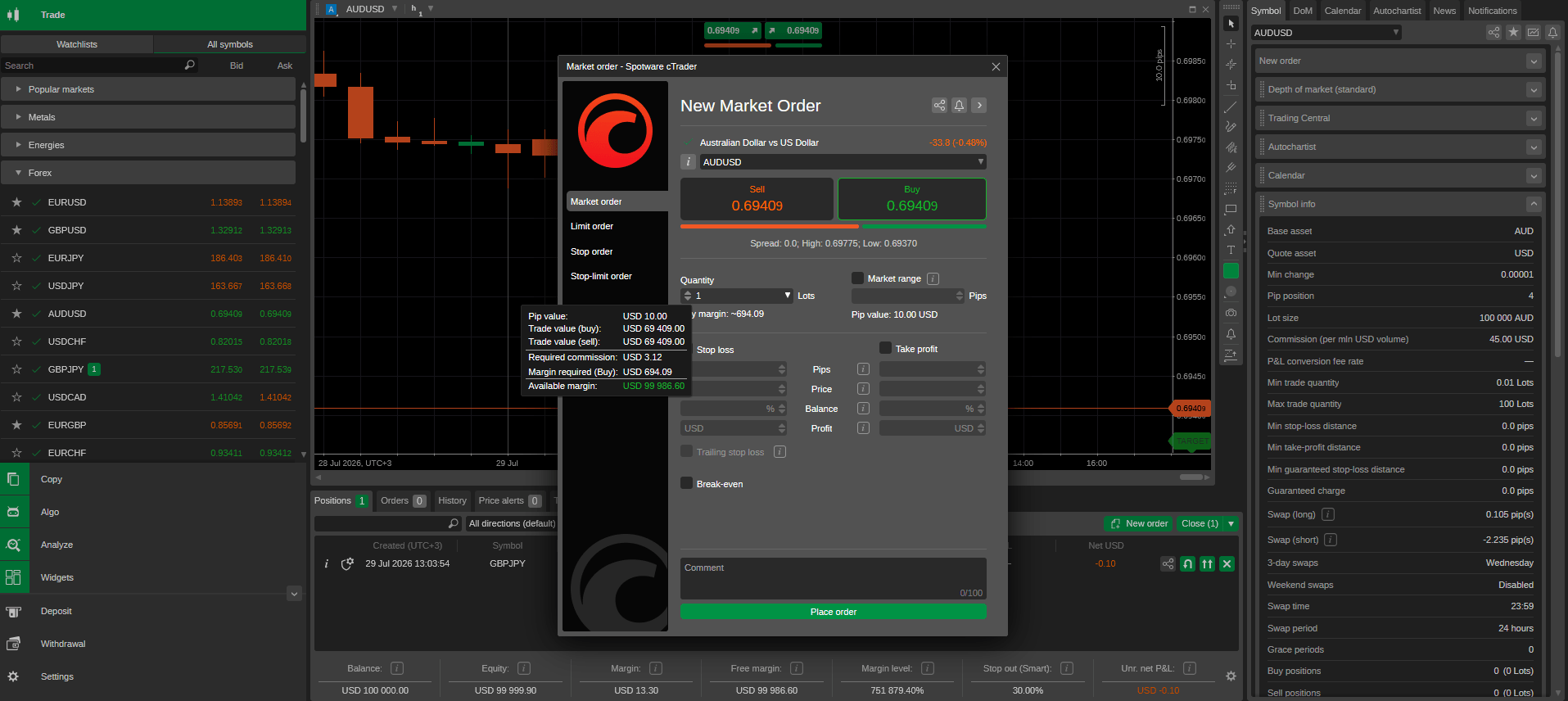
- Leveraged Position (1:100): Here, we allocated $694.09 to control a position worth $69,409. The 5% increase in the underlying asset results in a profit of $3470.45 (a 500% return on capital).
Why Leverage Can Magnify Both Profits and Losses
Leverage provides a symmetrical amplification of outcomes. While it enhances the potential for higher returns on equity, it simultaneously accelerates the depletion of capital during adverse market moves. If the market moves against a leveraged position, the reduction in account equity can occur rapidly, leading to a margin call or automatic liquidation (stop-out) to prevent the account from falling into a negative balance.
How Leverage Works
Leverage Ratio Explained
A 1:10 leverage ratio means market exposure is ten times the capital supporting that position. In this example, every $1 of equity supports $10 of notional position value.
It is essential to distinguish between three types of leverage:
- Maximum Account Leverage: The upper limit permitted by the broker or regulator.
- Symbol Leverage: The specific limit applied to a particular asset class (for example, lower leverage for volatile equities).
- Effective Leverage: The actual ratio currently in use, calculated as Total Position Value / Total Equity.
Account Balance, Equity, and Position Size
Understanding the distinction between these figures is critical for risk management:
- Account Balance: The cash value of the account, reflecting realized profits and losses, deposits, and withdrawals.
- Equity: The real-time value of the account, including floating (unrealized) profits and losses. Equity is the primary metric used to determine margin health.
- Position Size (Notional Value): The total market value of the trade. While leverage allows a trader to open a position much larger than their balance, doing so increases the velocity at which equity can be depleted.
What Margin Is
Margin is the capital required to initiate and maintain a leveraged position. It is not a fee or a purchase cost; rather, it functions as collateral to cover potential losses. The relationship is inverse: a 2% margin requirement results in 1:50 leverage, while a 1% margin requirement translates to leverage of 1:100.
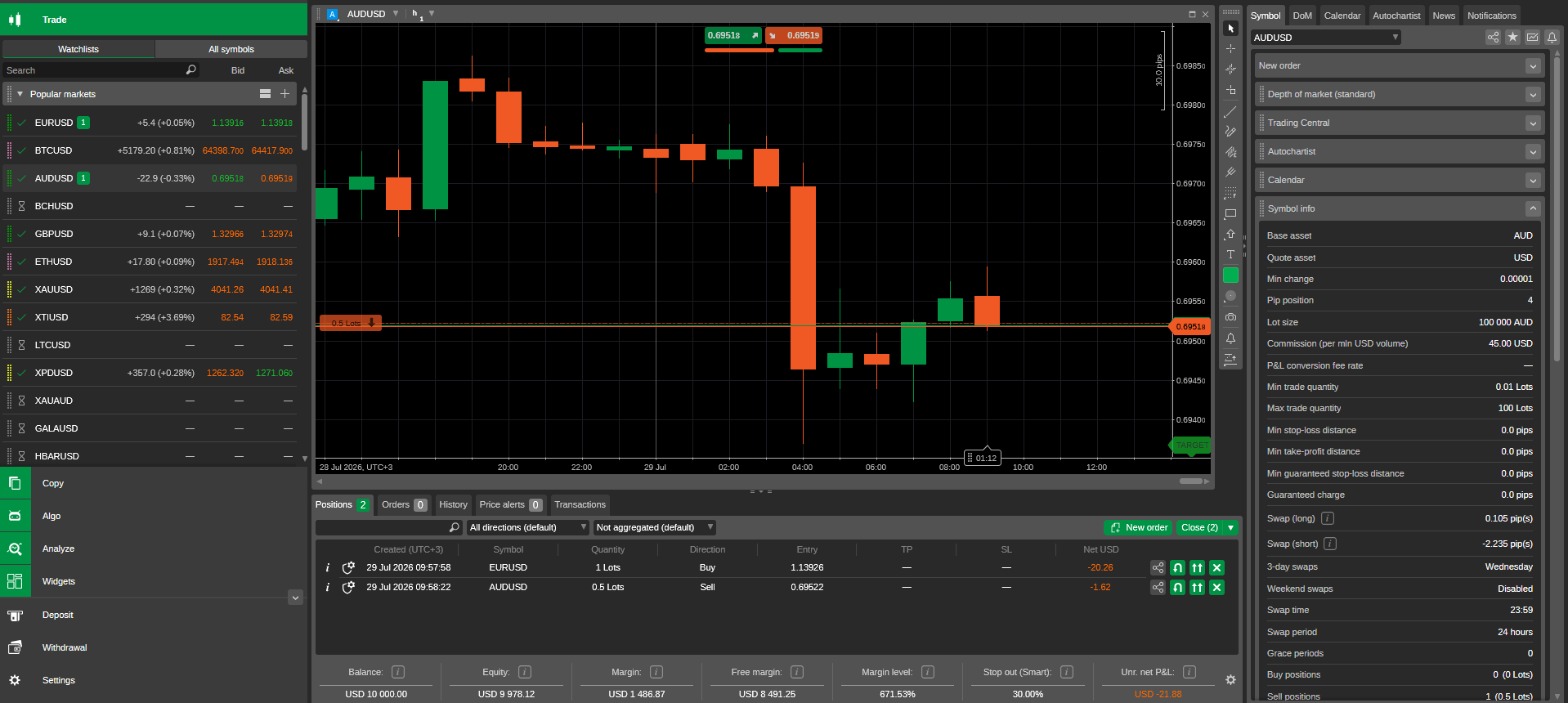
A screenshot illustrating used margin, free margin, and margin level in the Trade Watch menu at the bottom.
- Used (Required) Margin: Used (Required) margin is the total capital currently locked to support leveraged positions. This is calculated as: Used (Required) Margin = Position Value / Leverage Ratio. In the above example, we can see that the account’s used margin stands at $1,486.87.
- Free Margin: Free margin is the amount of account equity that remains available after used margin has been set aside for open positions. If free margin becomes too low, the account has less room to absorb losses or open new trades. This is calculated as: Free Margin = Equity – Used Margin. The example account featured in this section has a free margin of $8,491.25.
- Margin Level: Margin level is a percentage-based risk metric shown on many platforms. A higher margin level usually means the account has more room before broker intervention. A falling margin level is a warning sign that losses are eating into the account’s ability to support its open trades, with margin below 100% showing that the account equity is too low to support them. The margin level is calculated as: Margin Level = (Equity / Used Margin) × 100. Our example account’s margin level is 671.53%, which is well above the 100% threshold.
Specialized Types of Margin
Margin is further categorized by its functions:
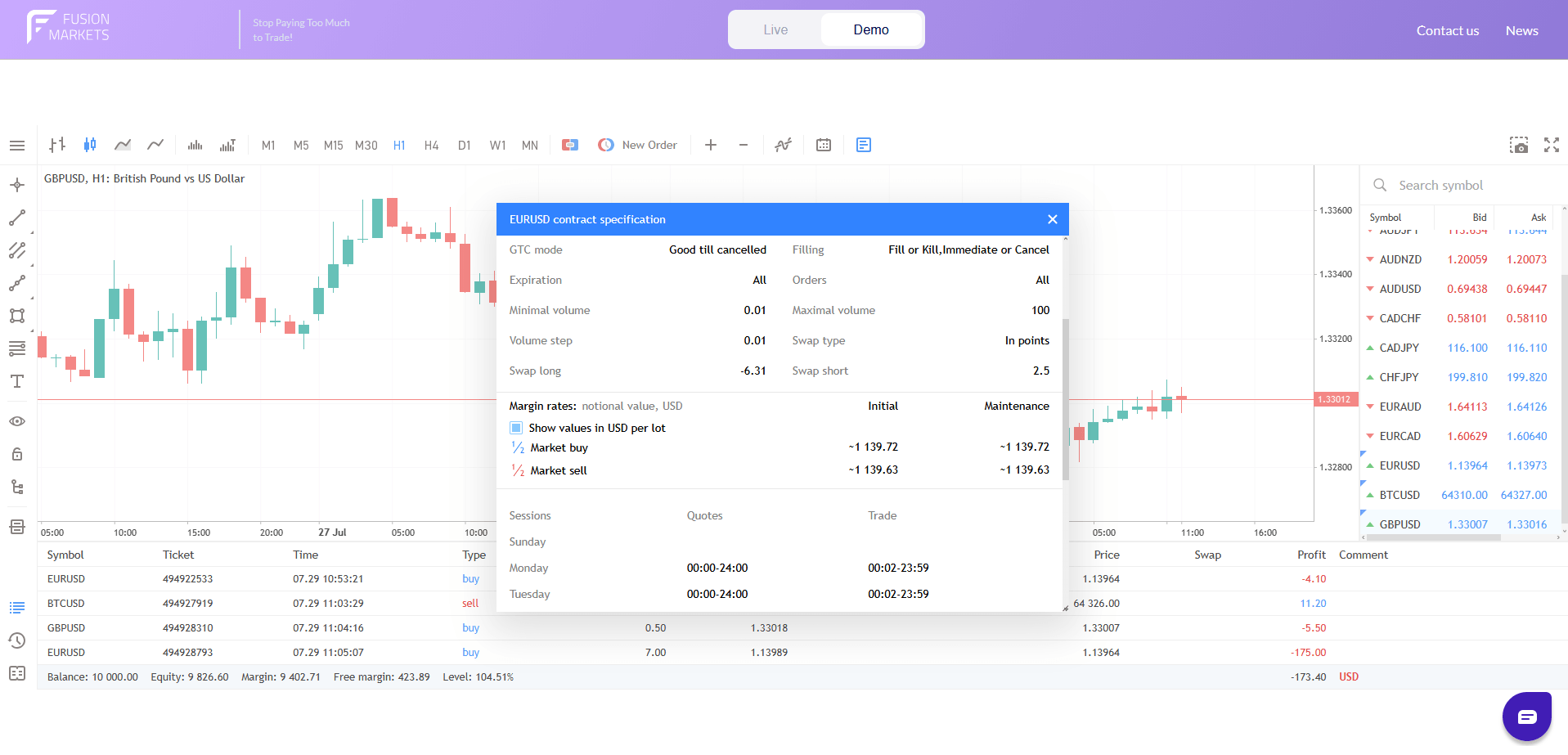
- Initial Margin: Initial margin is the amount required to open a new leveraged position. In some markets, it is fixed by the broker or exchange, while in others it can change with product type, volatility, contract size, or account classification. If you do not have enough available funds to meet the initial margin, the trade cannot be opened. In a test MT5 account registered with Fusion Markets, we can see that opening a 1-lot buy position on the EUR/USD with leverage of 1:100 required an initial margin of $1,330.03.
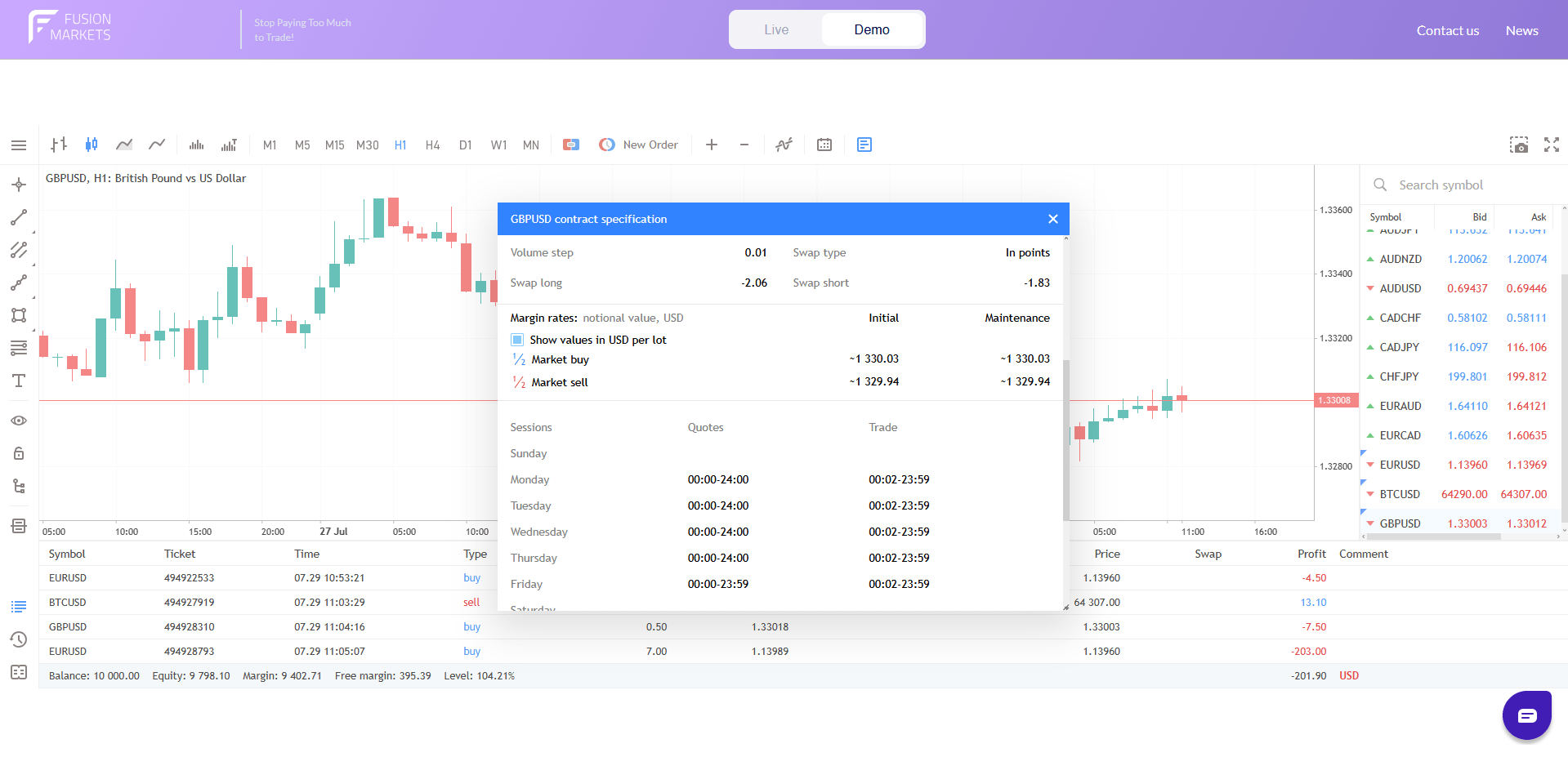
- Maintenance Margin: Maintenance margin is the minimum ongoing margin or equity threshold needed to keep a position open. If your account falls below this level, you may receive a warning, face restrictions, or have positions reduced or closed automatically. In some retail OTC products, this concept is expressed through margin level and stop-out rules rather than a separately labeled maintenance margin field. As per the requirements outlined below, to open a 1-lot GBP/USD sell position, our team would need to maintain a margin of $1,329.94 to keep this GBP/USD position open.
- Variation Margin: Variation margin is most common in exchange-traded derivatives such as futures. It reflects the daily or intraday mark-to-market process in which gains and losses are settled against your account as prices move. This means that losing positions can require additional funds faster than many beginners expect.
Factors Influencing Margin Requirements
Asset Volatility
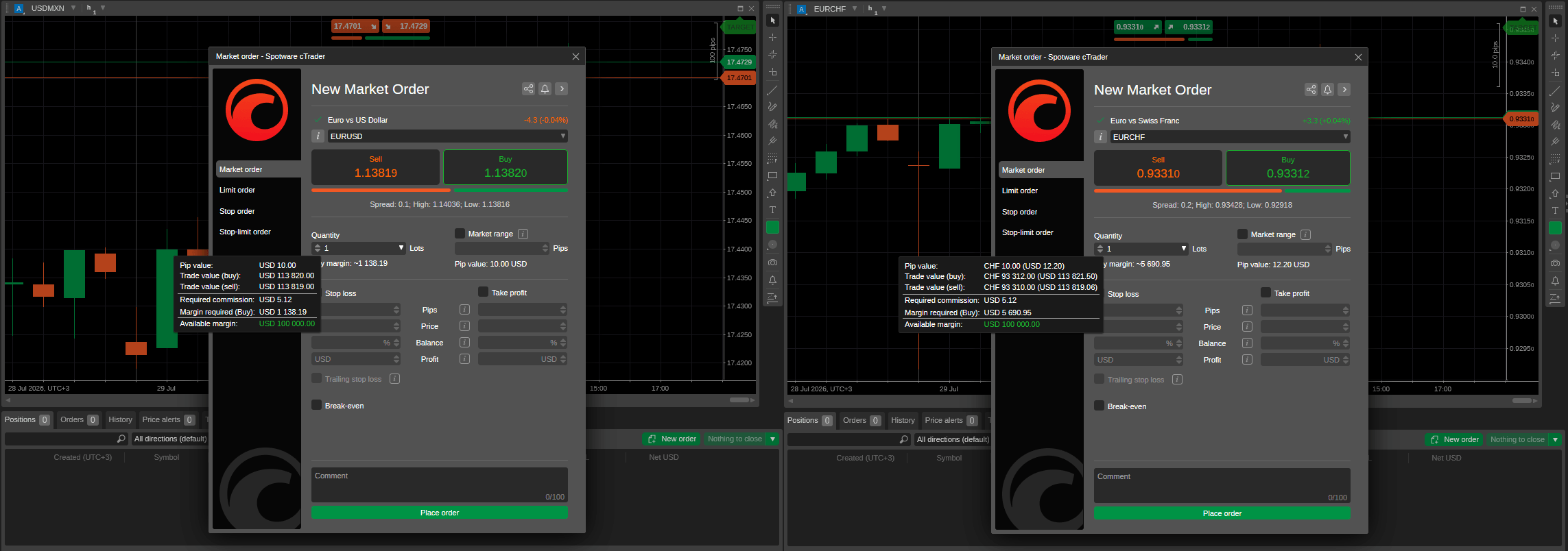
 Margin requirements often differ by instrument because markets do not all move the same way. A highly liquid major forex pair may require less margin than a minor or an exotic currency pair, a small-cap share CFD, or a volatile crypto derivative. In the following example on the cTrader platform, a 1-lot EUR/USD buy position necessitated our team to meet a margin requirement of $1,138.19, while trading the EUR/CHF minor pair involved a much higher margin of $5,690.95.
Regulatory Frameworks
 Regulation plays a major role in how much leverage retail traders can use and, therefore, how much margin is required. A stricter leverage cap means a higher margin requirement for the same position size. Since rules vary by country, regulator, product, and client classification, the current terms should be verified with both the broker and the relevant regulator.
Broker Risk Management
 Different brokers can apply different margin models even for similar products, subject to regulation and internal risk controls. Some use simple fixed margin percentages, while others use dynamic or tiered margin that increases with position size or around volatile events. This is why traders should always check the exact margin rules for the broker and regulated entity they plan to use.
Account Classification
 Account type can affect margin because brokers may offer different leverage settings or product access across standard, professional, micro, ECN, or other account categories. The same instrument can therefore require a different margin depending on the account and client classification. Traders should not assume that a platform’s headline maximum leverage applies equally to every account or symbol.
Leverage Ratio Examples
To illustrate the magnifying effect of leverage on capital, the following table compares various leverage ratios using a constant capital allocation of $1,000. The figures below demonstrate how a modest 1% market movement impacts account equity across different leverage tiers.
| Leverage Ratio | Account Capital Used | Notional Market Exposure | 1% Market Move (Gain/Loss) | Impact on Used Capital |
|---|---|---|---|---|
| 1:1 (No Leverage) | $1,000 | $1,000 | $10 | 1% |
| 1:2 | $1,000 | $2,000 | $20 | 2% |
| 1:5 | $1,000 | $5,000 | $50 | 5% |
| 1:10 | $1,000 | $10,000 | $100 | 10% |
| 1:30 | $1,000 | $30,000 | $300 | 30% |
| 1:50 | $1,000 | $50,000 | $500 | 50% |
| 1:100 | $1,000 | $100,000 | $1,000 | 100% |
How Leverage Changes Exposure and Risk
The pattern in these examples is simple: higher leverage increases exposure per dollar of account capital, so the same market move creates a larger account swing. Leverage does not change the market’s percentage move; it changes your exposure to it. That is why practical leverage choice is mainly a risk decision, not just a buying-power decision.
Key Observations for Risk Planning
- Linear Scaling of Risk: At a 1:100 ratio, a market move of only 1% against the position is sufficient to deplete the entire capital allocation supporting that trade.
- Volatility Sensitivity: At higher leverage, such as 1:30 or 1:50, minor price fluctuations can trigger significant equity drawdowns or automated margin interventions.
- Excluded Costs: Note that these examples are illustrative and represent gross outcomes. In live trading, the actual net gain or loss would be further impacted by:
- Spreads: The difference between the buy and sell price.
- Commissions: Fixed fees per trade.
- Financing (Swaps): Costs for holding leveraged positions overnight.
- Slippage: Differences between the requested price and the execution price during periods of high volatility.
Markets Where Leverage Is Used
Forex Leverage
Leverage is a fundamental component in the Foreign Exchange market primarily because major currency pairs often move in relatively small percentage increments (pips), so traders use leverage to make those moves more meaningful in account terms. With leverage, those same moves have greater account impact, but so do spread costs, slippage, rollover, and sudden macro-driven volatility. Forex leverage availability usually depends on regulation, client type, the specific pair, and the broker’s symbol settings.
Leverage by Currency Pair Category
Brokers adjust available leverage based on the underlying liquidity and risk profile of the specific pair:
- Major currency pairs, such as those involving the U.S. dollar and other highly traded currencies (EUR, JPY, and GBP), often receive the highest leverage among forex symbols (typically up to 1:30 and 1:50 for retail clients, depending on jurisdiction) because they tend to be the most liquid. Even so, available leverage is not guaranteed and may be reduced during volatile conditions, around major data releases, or on certain account types. Lower spreads do not make high leverage safe.
- Minor currency pairs, which involve major currencies but exclude the US Dollar, usually have less liquidity and wider spreads than majors, so leverage availability is often lower. In practice, traders may need more margin for the same notional exposure. Wider spreads also mean that a position starts farther from breakeven, which matters more when leverage is high.
- Exotic currency pairs, which involve a major currency with that of a developing economy, often combine lower liquidity, wider spreads, and higher event risk, so leverage tends to be more restricted. Price moves can be uneven, and gaps are more likely during political, central bank, or local market stress. Beginners should be especially careful with exotic pairs because higher volatility and higher transaction costs can combine badly with leverage.
Retail Forex Leverage Limits
Retail forex leverage limits vary by jurisdiction and product type. For example, retail CFD rules in the EU and Australia commonly cap major forex pairs at 1:30 and non-major pairs at 1:20, while U.S. retail spot forex rules generally allow up to 1:50 on major currency pairs and 1:20 on other pairs. Rules can change, so traders should verify current limits with the broker’s regulated entity and the relevant regulator.
| Jurisdiction | Major Forex Leverage (Retail) | Non-Major Forex Leverage (Retail) |
|---|---|---|
| UK (FCA) and EU (ESMA) | 1:30 | 1:20 |
| Australia (ASIC) | 1:30 | 1:20 |
| United States (CFTC) | 1:50 | 1:20 |
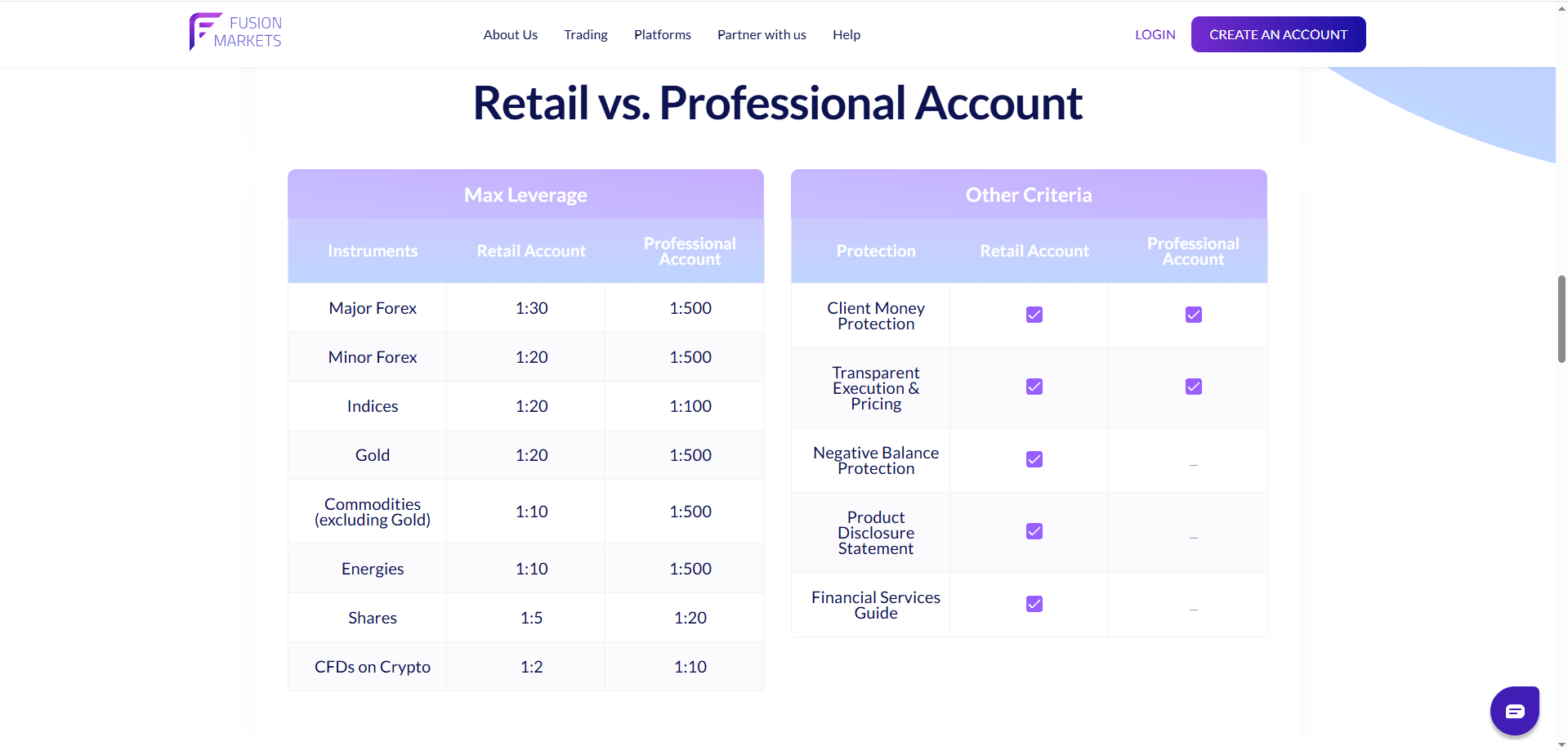
Before you begin trading with a broker, you should always check if their retail leverage restrictions align with their regulatory status. Trading firms typically provide their leverage restrictions on a dedicated webpage or the section outlining account conditions. For instance, we verified that Fusion Markets (AU) offers a full overview of its retail and professional leverage limits on its Fusion Pro page. As shown, the broker fully adheres to ASIC’s mandated retail leverage cap of 1:30:
Professional Forex Leverage Access
Professional or elective professional clients may qualify for materially higher forex leverage than retail clients, depending on jurisdiction and broker policy. Higher leverage increases both opportunity and danger, and it may come with reduced regulatory protections. Traders considering professional status should compare the extra buying power with the protections they may lose.
Forex Leverage Risks
While leverage makes low-volatility movements more meaningful, it does not reduce the inherent risk of the trade. In fact, high leverage introduces several critical factors that can accelerate capital depletion:
- Amplified Transaction Costs: Spread costs, slippage, and overnight financing (rollover/swaps) are calculated based on the total notional exposure, meaning they consume a larger percentage of the actual margin as leverage increases.
- Macro-Driven Volatility: Economic announcements or geopolitical shifts can cause sudden, sharp movements that can quickly trigger margin calls in highly leveraged accounts.
CFD Leverage
Contracts for difference, or CFDs, are leveraged derivatives that track the price movement of an underlying asset without giving direct ownership of that asset. They are used on forex, indices, commodities, shares, ETFs, and sometimes crypto, depending on jurisdiction. Because CFDs are leveraged OTC products, regulation, margin rules, financing costs, and counterparty structure all matter.
Leverage on Indices
Index CFDs typically offer higher leverage ratios than individual share CFDs, reflecting the inherent diversification and superior liquidity of broad market benchmarks. These instruments provide exposure to a diversified basket of underlying equities through a single contract, though the specific leverage available may vary depending on the index’s volatility, time of day, and regional regulatory framework.
Despite their diversified nature, indices remain highly sensitive to systemic risks such as central bank policy shifts, macroeconomic data releases, and major corporate earnings seasons. During these events, markets may experience significant price gaps or sudden spread expansion. For traders utilizing high leverage, these rapid movements increase the risk of maintenance margin breaches and subsequent forced liquidation, particularly during cash-market openings when volatility peaks.
Leverage on Commodities
Commodity leverage is utilized across metals, energy, and agricultural markets through various instruments, including CFDs, futures, options, and ETFs. Gold may receive different treatment from crude oil or natural gas because their volatility profiles are not the same.
Brokers and exchanges adjust leverage based on the underlying liquidity and price stability of the specific commodity:
- Precious Metals: Assets like Gold often permit higher leverage (e.g., 1:20) compared to other commodities due to their role as established stores of value and relatively deeper liquidity.
- Energy and Agriculture: Instruments such as Crude Oil, Natural Gas, or Wheat typically require a higher margin (resulting in lower leverage) because they are susceptible to extreme price fluctuations driven by supply shocks, weather events, or geopolitical shifts.
Leverage on Shares
Leverage on individual equities is typically more restricted than on highly liquid indices or major currency pairs. This lower leverage threshold, often capped at 1:5 for retail traders, reflects the risk inherent in single stocks, which are susceptible to extreme volatility from corporate actions and company-specific news.
Traders can gain leveraged exposure to stocks through several distinct financial vehicles, each with a unique risk profile:
- Margin Accounts: Involves borrowing funds directly from a broker to purchase physical shares. This typically incurs interest charges and requires the shares to serve as collateral.
- Share CFDs (Contracts for Difference): Derivatives that allow for speculation on price movements without ownership of the underlying asset. These often provide higher flexibility for short-selling but involve overnight financing costs.
- Options and ETFs: Leveraged Exchange-Traded Funds (ETFs) and options contracts provide “built-in” leverage. However, the decay factors in options and the daily rebalancing of leveraged ETFs make them structurally different from margin or CFD trading.
Leverage on ETFs
ETF CFDs can provide leveraged access to a basket of assets, but leverage on ETFs is often lower than on major indices or forex. Traders should also check whether the underlying ETF is itself leveraged, inverse, or sector-specific, because layering leverage on top of an already leveraged product can increase complexity. Product structure matters as much as the headline leverage ratio.
CFD Margin Requirements
CFD margin requirements are usually shown as a leverage ratio or a margin percentage for each symbol. For example, a 5% margin requirement is roughly equivalent to 1:20 leverage, while a 10% margin requirement is roughly 1:10. Requirements can change due to regulation, volatility, larger position tiers, weekend rules, or broker risk management decisions.
CFD Leverage Risks
CFD risks include rapid losses from leverage, overnight financing charges, spread widening, slippage, and gaps through stop-loss levels. Because CFDs are OTC products, execution quality, available protections, and margin-closeout rules depend on the broker’s legal entity and terms. Beginners should understand the product documentation carefully before using leverage in a live CFD account.
Crypto Leverage Explained
How Crypto Leverage Works
Crypto leverage works by allowing a trader to control a larger crypto position than the cash posted as collateral. This can happen through spot margin, CFDs where permitted, futures, perpetual swaps, and options. Because crypto markets can move quickly and trade around the clock, leverage should be treated with extra caution.
- Spot Margin: Involves borrowing actual assets to purchase or short “physical” cryptocurrency. This method typically incurs interest on the loan and is subject to specific collateral rules.
- Crypto Derivatives (CFDs and Futures): These provide exposure to price movements via contracts without requiring ownership of the underlying coins.
- Perpetual Swaps (Perpetuals): The most common crypto derivative. Unlike standard futures, these have no expiry date and utilize a Funding Rate mechanism to anchor the contract price to the spot market.
Volatility and Liquidation Risk
Crypto volatility can be intense, especially during liquidation cascades, thin liquidity periods, or exchange-specific stress. When leverage is high, a normal intraday swing can be enough to liquidate a position before the broader trade idea has time to play out. This is one reason many experienced traders use far less than the maximum leverage offered.
Crypto Leverage Limits
Crypto leverage limits vary widely by venue, product type, jurisdiction, and regulatory oversight. In some regulated retail CFD frameworks, crypto exposure is restricted to very low leverage or unavailable altogether, while some offshore venues advertise much higher maximums. Availability and protections can differ sharply, so traders should verify the current rules, product terms, and legal entity before trading.
| Jurisdiction | Regulator | Common Retail Leverage Limit | Notes |
|---|---|---|---|
| United Kingdom | FCA | Prohibited | Retail ban on crypto derivatives (including CFDs). |
| European Union | ESMA | 1:2 | Strictly enforced for all retail crypto CFDs. |
| Australia | ASIC | 1:2 | Aligned with international consumer protection standards. |
| Offshore | Various | Up to 1:100 | Offers higher leverage but often lacks negative balance protection. |
Key Crypto Leverage Risks
- Extreme volatility.
- Rapid liquidation risk.
- Funding charges on leveraged exposure.
- Mark-price and liquidation-engine mechanics.
- Exchange outages or reduced liquidity.
- Weaker protections in some jurisdictions.
Negative balance protection may not apply, or it may apply differently depending on the product and account classification. For beginners, high crypto leverage is one of the least forgiving trading setups.
Futures and Options Leverage
Futures and options both offer built-in leverage, but they work differently and carry distinct risks. Futures provide linear exposure through margin on standardized contracts, while options create non-linear exposure via premiums that control larger underlying values.
Leverage in Futures Trading
Futures contracts are inherently leveraged because traders post margin to control a standardized contract with a larger notional value.
- Initial margin: The exchange sets baseline margin, but brokers can require more, especially in volatile periods. Because futures are marked to market (gains and losses affect available funds as the market moves), losses can reduce available funds immediately rather than only at final settlement. Margin is not the maximum possible loss and should not be mistaken for total risk. It can rise with volatility, forcing more capital or early exits.
- Maintenance margin: Lower threshold to keep the position open. Falling below triggers a margin call, requiring more funds or position reduction. Because futures can move quickly, traders should not assume they will always have plenty of time to react.
- Marked-to-market: Gains/losses settle daily, so equity updates immediately with market moves.
Leverage in Options Trading
Options create leveraged exposure because the premium paid can be much smaller than the underlying value controlled.
- For buyers, the maximum loss is usually limited to the premium paid, but time decay, volatility drops, or adverse moves can erase it quickly.
- For sellers, margin is often required, and losses can be large or, in some strategies, theoretically unlimited.
- Effective leverage varies with delta (price sensitivity), gamma (delta changes), implied volatility, and time to expiry.
Risks of Derivatives Leverage
Derivatives leverage can amplify not just price risk but also complexity risk. Beginners should learn product mechanics in detail before trading leveraged futures or options with real money. Demo accounts can be a great starting point. Once they transition into live accounts, they should start with low leverage, use stop-losses, and never risk more than 1-2% of capital per trade. Below are the main risks associated with derivatives leverage:
- Margin changes: Volatility spikes can increase requirements mid-trade.
- Forced liquidations: Quick moves trigger calls or auto-closes.
- Complexity: Contract specs, expirations, and assignments add layers beyond price risk.
- No forgiveness: Beginners often underestimate non-linear effects in options or intraday margin pressure in futures.
Retail vs Professional Leverage
The classification of a trader, either as Retail or Professional, is the primary factor determining the maximum leverage available to them and the degree of regulatory protection they receive.
Retail Trader Leverage Limits by Regulator and Instrument
Retail leverage is usually capped more tightly because retail clients are assumed to need stronger risk protections. Lower caps increase the margin required for a given position size, which can reduce the chance of catastrophic losses from small price moves. Retail limits, however, still allow meaningful exposure and can still be risky if position sizing is poor.
Regulators across major jurisdictions have harmonized many leverage caps to protect retail participants. Offshore entities, however, remain outside these frameworks.
Client Protections for Retail Traders
Retail accounts are designed for individual market participants and carry the highest level of regulatory oversight. These protections are intended to prevent total capital depletion during periods of extreme volatility.
- Negative Balance Protection: A mechanism ensuring a client cannot lose more than the total funds in their trading account. If a market “gap” causes equity to turn negative, the broker is legally required to reset the balance to zero at their own expense.
- Standardized Risk Warnings: Mandated disclosures requiring brokers to reveal the percentage of retail accounts that lose money. For example, when assessing the trading conditions of IC Markets (EU), we noted that the following warning is displayed on the website:
Risk Warning: CFDs are complex instruments and come with a high risk of losing money rapidly due to leverage. 72.52% of retail investor accounts lose money when trading CFDs with this provider. You should consider whether you understand how CFDs work and whether you can afford to take the high risk of losing your money.
- Margin Close-Out Rules: Standardized thresholds (typically 50%) at which a broker must automatically liquidate positions to protect the remaining equity.
Professional Trader Leverage Limits
Professional clients may be offered higher leverage than retail clients, depending on local rules and broker policy. For example, we confirmed that the professional clients of FP Markets’ European branch can use leverage of up to 1:500 when trading forex, far higher than the 1:30 available to retail traders.
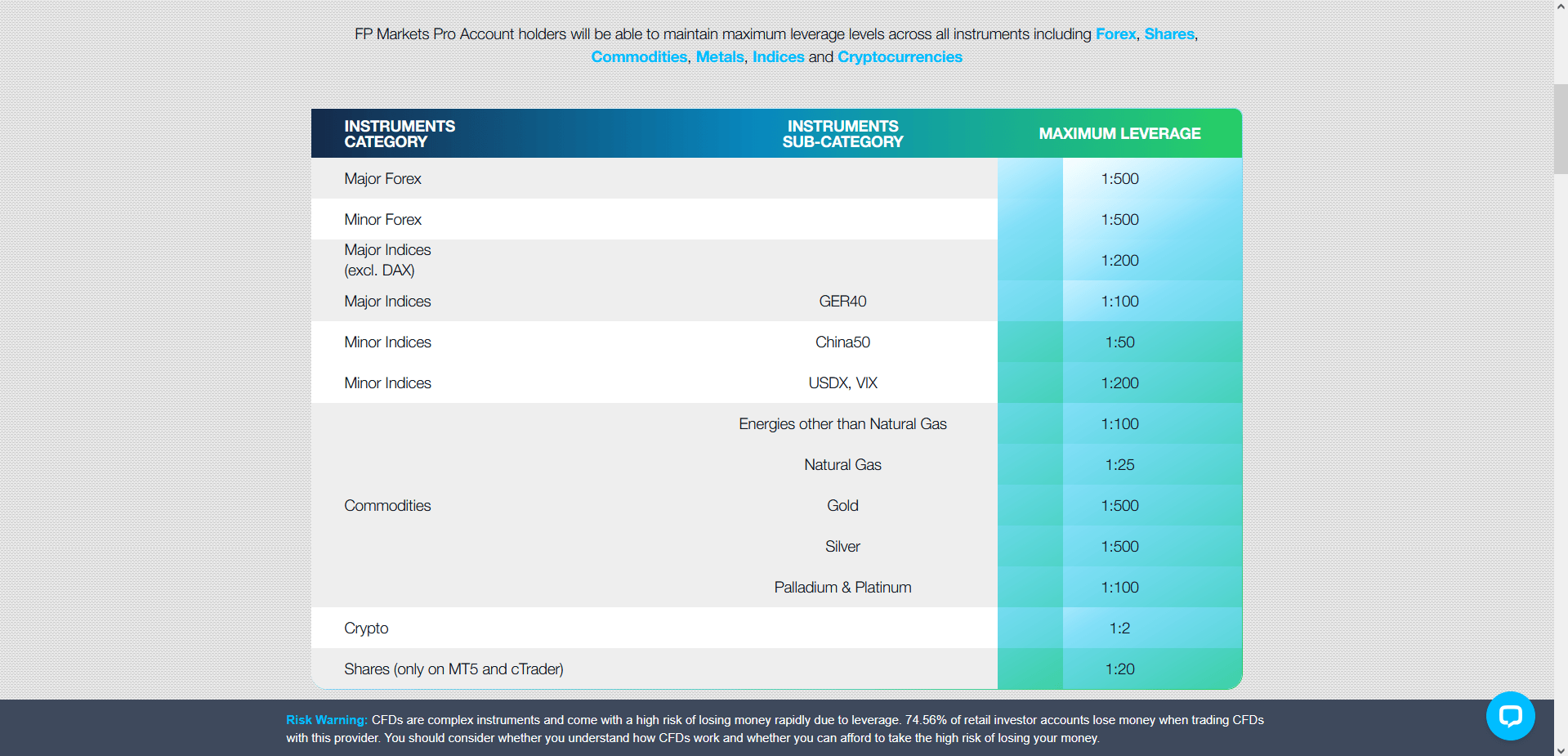
We should also stress that brokers will not necessarily offer 1:500 leverage to their pro users. During our practical evaluation of the professional trading conditions of Plus500 EU, we were able to use leverage of up to 1:300.
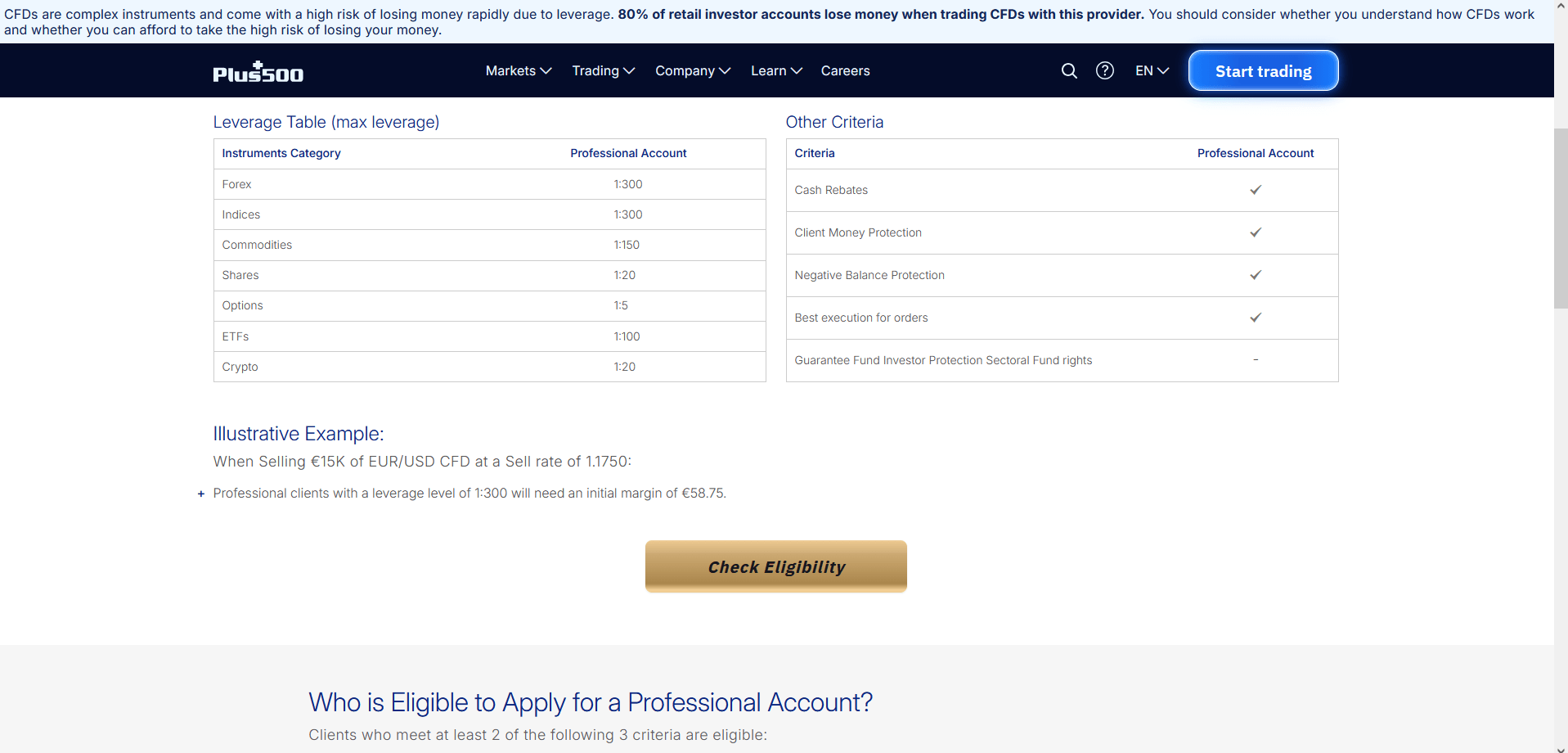
Higher leverage can lower margin requirements and increase flexibility, but it also increases the speed and scale of potential losses. Higher leverage should be treated as additional responsibility rather than as an automatic advantage.
Eligibility for Professional Status
When applying for professional status during our testing of forex trading platforms, we were typically required to meet two of the following three criteria:
- Trading Activity: The applicant has carried out transactions, in significant size, on the relevant market at an average frequency of 10 per quarter over the previous four quarters.
- Portfolio Size: The size of the trader’s financial instrument portfolio, including cash deposits and financial instruments, exceeds €500,000 (or local currency equivalent).
- Professional Experience: The trader works or has worked in the financial sector for at least one year in a professional position that requires knowledge of the transactions or services envisaged.
The requirements can vary depending on the jurisdictions. Opening a professional account at Fusion Markets’ Australia-facing entity, for example, involved meeting one of two sets of criteria:
- Wealth Test:
- Criteria one: net assets of A$2.5 million or higher
- Criteria two: gross income of A$250,000 per annum over the past two financial years
- Sophisticated investor test:
- Criteria one: pass the Pro Knowledge Quiz, provide the broker with trading statements proving that you have executed no less than 20 trades per quarter and that you achieved a quarterly notional volume of A$1,000,000 across four quarters in the past 2 years
- Criteria two: submit proof that you have held a professional position in the financial sector that involved leveraged trading of CFDs or forex
Protections Lost with Professional Status
Professional clients are assumed to have a sophisticated understanding of market risk. When we open a professional account at a given broker, we consequently forfeit several key safeguards:
- Leverage Caps: Professionals can access much higher ratios (e.g., 1:400 on forex), requiring significantly less margin to control large positions.
- Negative Balance Protection: In many jurisdictions, professional clients are not legally entitled to negative balance protection, and most brokers choose to exclude professionals from this safeguard. If a trade results in a deficit, the trader may be personally liable to the broker for the debt.
- Sophisticated Communication: Brokers may use more technical language and are not required to provide the same level of standardized risk warnings or simplified disclosures.
- Eligibility for Compensation Schemes: The FCA, ASIC, and regulators across Europe mandate that brokers join compensation schemes structured to cover losses for traders and investors if a brokerage becomes insolvent. However, this protection is generally limited to retail clients.
Which Status Is Best for Beginners?
For beginners, retail status is the more sensible starting point because it typically comes with stronger protections and lower maximum leverage. Lower leverage is not a barrier to learning; it often improves survival and decision quality. A beginner rarely needs professional leverage to test a strategy or build discipline.
Always verify the specific legal entity of your broker. A single brokerage brand may hold licenses from the FCA, ASIC, and an offshore regulator simultaneously; the protections you receive depend entirely on which specific entity holds your account.
Leverage Limits by Regulation
Why Regulators Limit Leverage
Most financial authorities enforce leverage caps to protect retail investor assets and mitigate the high risks associated with leveraged trading. For instance, as per policy statement PS19/18, the UK’s FCA tightened its leverage restrictions in 2019 with the goal of protecting retail participants from rapid capital depletion that can result from excessive leverage.
Global Retail Leverage Comparison
| Asset Class | FCA (UK) | ESMA (EU) | ASIC (Australia) | USA (CFTC/NFA) | Offshore |
|---|---|---|---|---|---|
| Major Forex | 1:30 | 1:30 | 1:30 | 1:50 | 1:500 and more |
| Minor Forex / Gold / Major Indices | 1:20 | 1:20 | 1:20 | N/A (CFDs restricted) | 1:200 |
| Commodities / Minor Indices | 1:10 | 1:10 | 1:10 | N/A (CFDs restricted) | 1:100 |
| Individual Equities | 1:5 | 1:5 | 1:5 | 1:2 (Reg T) | 1:20 |
| Cryptocurrencies | Prohibited | 1:2 | 1:2 | Restricted | 1:100 |
Key Regional Nuances
- United Kingdom (FCA): Maintains a total ban on the sale of crypto-asset derivatives (including CFDs) to retail consumers.
- European Union (ESMA): Implementation details can vary by country, so local regulator guidance should be checked. The broker’s specific EU entity also matters.
- Australia (ASIC): ASIC’s retail CFD product intervention rules broadly mirror the major European-style caps
- United States (CFTC): Focuses on “Spot Forex” rather than CFDs, which are generally unavailable to retail traders. Stock margin is strictly governed by Federal Reserve Regulation T, which typically limits leverage to 1:2 for overnight positions.
- Offshore Jurisdictions: These regions offer the highest capital efficiency but often lack mandatory Negative Balance Protection and robust dispute resolution frameworks.
How Regulation Affects Your Account
Regulation affects more than just the “headline” leverage ratio. When choosing a regulated entity, consider these additional safeguards:
- Negative Balance Protection: Most Tier-1 regulators (FCA, ESMA, ASIC) require brokers to ensure retail clients cannot lose more than their account balance.
- Margin Close-Out Rules: Regulators mandate that brokers liquidate positions once account equity falls to a certain level to prevent further debt. CySEC-regulated brokers such as IC Markets are mandated to set close-out levels to 50%.
- Segregated Funds: Top-tier regulation ensures your capital is held in accounts separate from the broker’s operational funds.
A single brokerage brand may operate multiple legal entities globally. Always verify which specific entity holds your account, as this dictates the leverage limits and legal protections applied to your trades.
Leverage by Account Type
While the choice of account type often dictates execution methodology and fee structures, the regulatory framework remains the primary determinant of available leverage. Understanding the distinction between account types is essential for evaluating capital efficiency and institutional risk.
Retail-Tier Accounts: Standardized Risk Controls
These accounts are designed for individual market participants and are subject to the most stringent regulatory leverage caps.
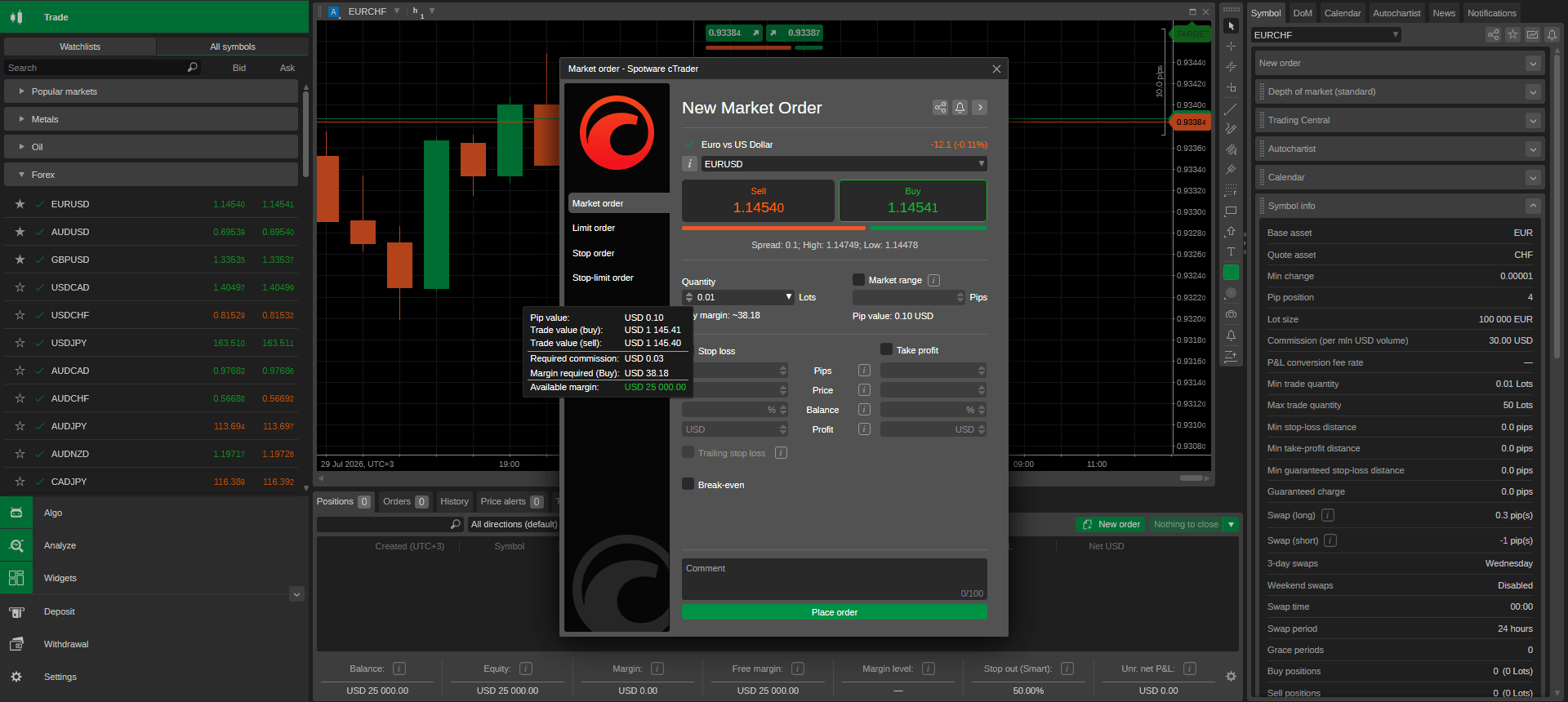
- Micro and Cent Accounts: These accounts prioritize fractional position sizing rather than elevated leverage. By utilizing smaller contract units, they allow for precise margin management. Leverage ratios typically mirror standard retail limits, but the reduced notional value per lot facilitates more granular risk control for smaller capital bases. In the example below, we could trade with micro lots (1,000 currency units), allowing us to open a position of $1,145.41 with leverage of 1:30 and a margin requirement of $38.18.
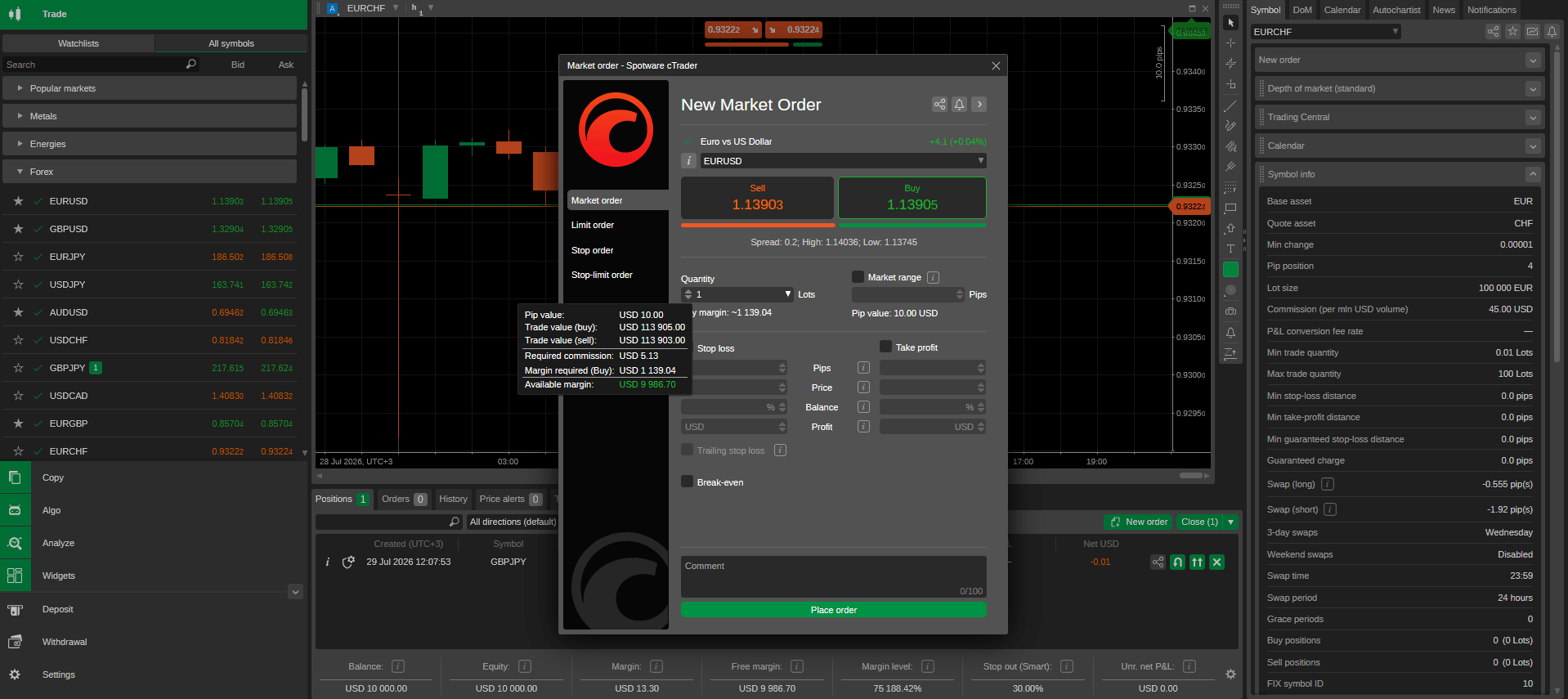
- Standard Accounts: The baseline offering for retail participants. These accounts operate under default regulatory frameworks, such as the 1:30 cap for major currency pairs in Tier-1 jurisdictions. Margin requirements are predictable and standardized, providing a stable environment for strategic planning and execution. They tend to offer micro, mini, and standard lots. In the example below, we opened a standard-lot position of $113,905.
Execution-Focused Accounts: Performance and Cost
These accounts cater to traders who prioritize the technical environment and liquidity access over simplified pricing models.
- ECN (Electronic Communication Network) and STP (Straight Through Processing): Marketed based on their direct-to-market execution and high-speed throughput. Our testing of ECN brokers like FP Markets, BlackBull Markets, and IC Markets confirmed that leverage ratios usually align with standard accounts. However, the high-speed nature of these environments requires rigorous monitoring of the Margin Level. Market volatility can impact equity rapidly, necessitating sophisticated risk-management tools.
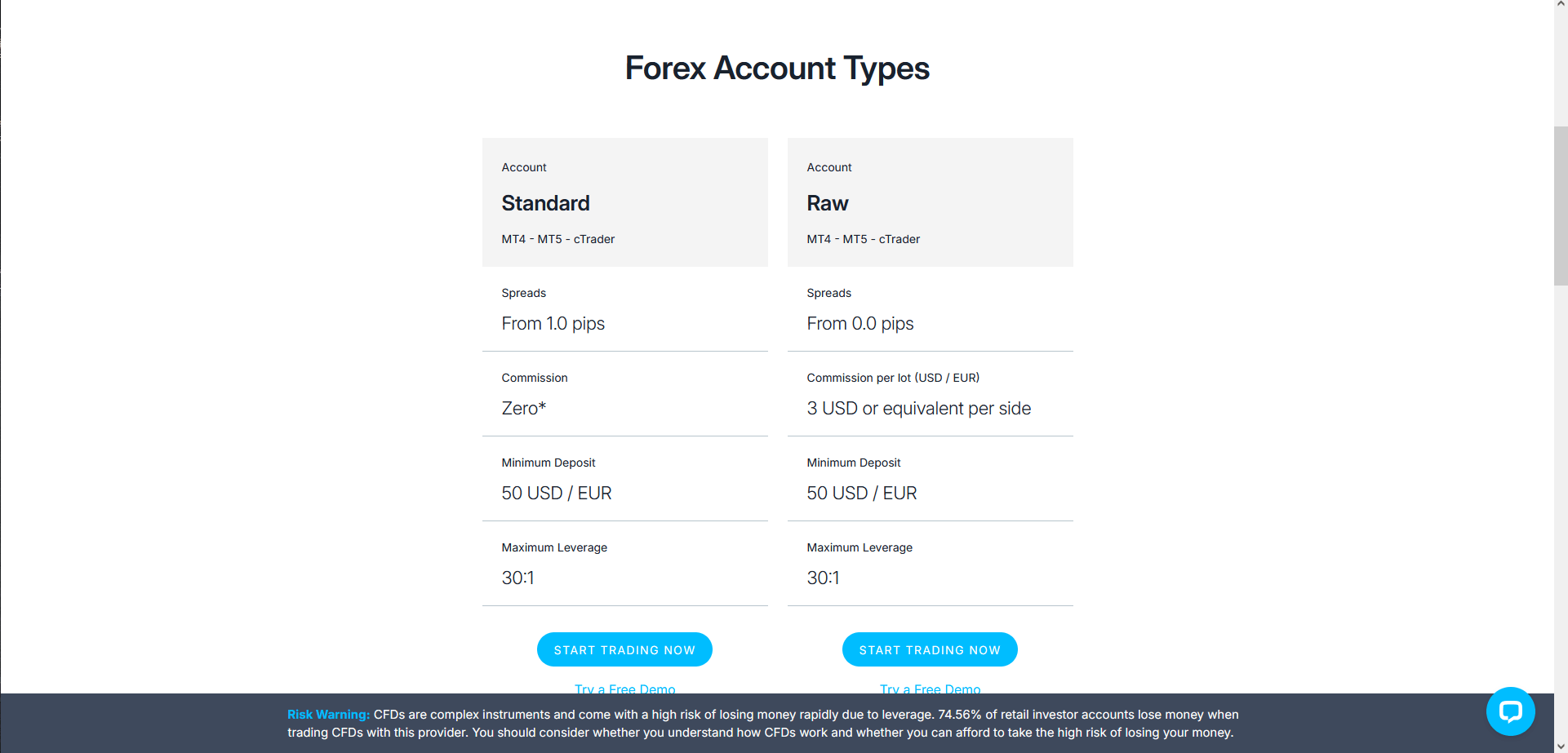
- Raw Spread Accounts: Defined by institutional-grade pricing (near-zero spreads) combined with a fixed commission per trade. It is a common misconception that cost-effective pricing implies higher leverage. Leverage is a risk-mitigation constraint and remains independent of the spread or commission structure and is, instead, reliant on whether a given account caters to retail or professional clients. As you can see below, FP Markets offers retail leverage of up to 1:30 to both Standard and Raw account holders.
Specialized and Professional Classifications
These accounts are defined by specific legal, religious, or high-net-worth eligibility criteria.
- Professional Accounts: Reserved for participants who meet specific institutional criteria regarding portfolio size, trading frequency, and industry experience. This classification allows for a significant expansion of leverage (e.g., 1:400 or 1:500). However, the increase in capital efficiency is accompanied by the forfeiture of key retail protections, including mandatory Negative Balance Protection.
- VIP Accounts: Tailored for high-net-worth individuals or institutional-scale traders maintaining substantial account balances. While VIP status often grants access to customized service and lower commission tiers, leverage remains strictly bound by the trader’s regulatory classification (Retail vs. Professional). However, VIP accounts may benefit from customized Margin Call protocols or dedicated risk-management support.
- Islamic (Swap-Free) Accounts: Designed to align with Sharia principles by eliminating interest-based overnight financing. Leverage ratios generally remain consistent with standard accounts. However, the elimination of “swaps” alters the holding cost of leveraged positions, often replaced by a flat administrative fee after a predetermined grace period.
Leverage on Trading Platforms
Leverage on MetaTrader 4
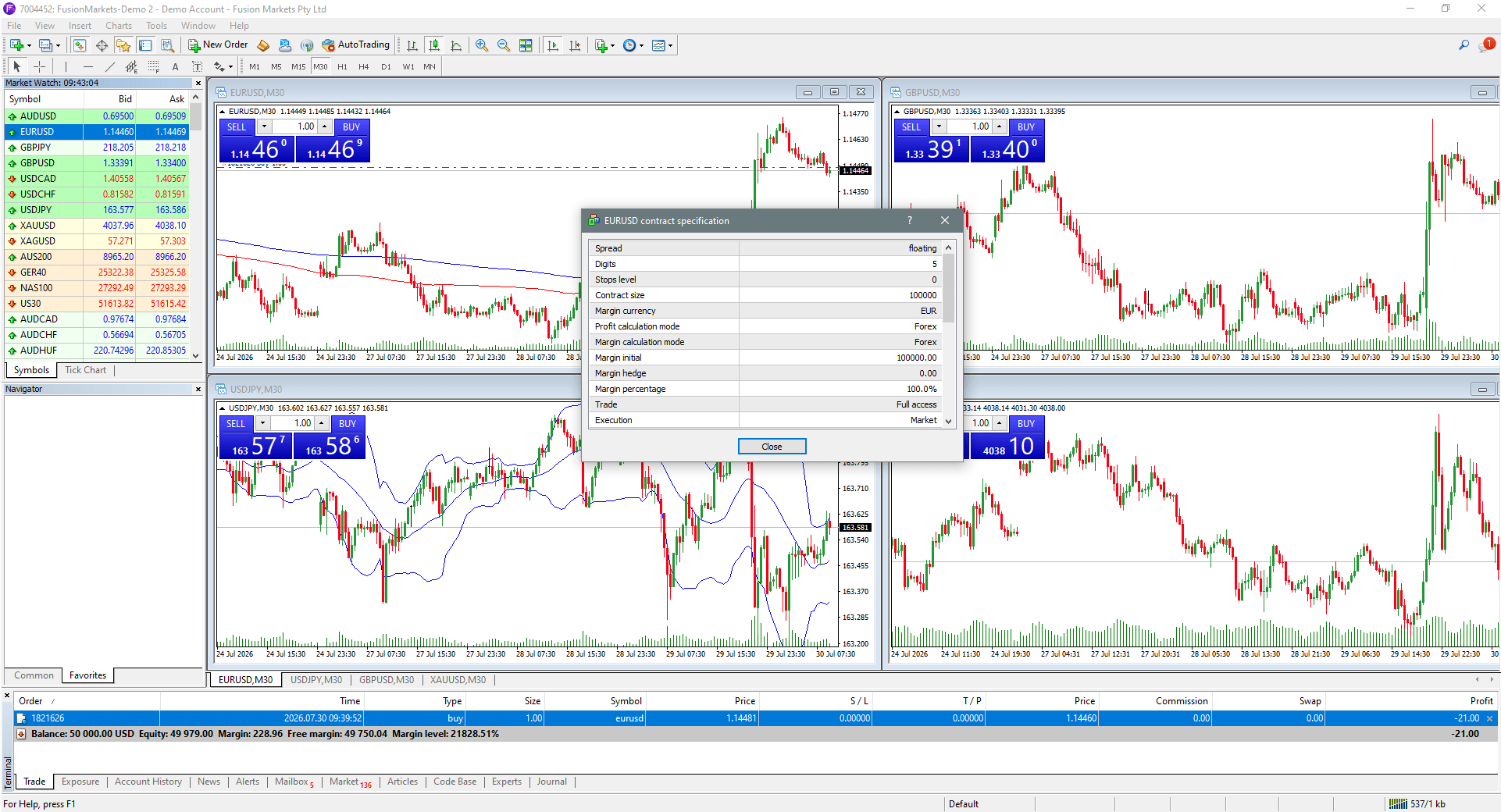
 On MetaTrader 4, leverage is usually set at the account and symbol level by the broker’s server rather than by the platform brand itself. MT4 can display margin impact in the order window and symbol specifications, but those figures depend on the broker’s configuration. Traders should verify symbol margin rules directly in the platform and account portal.
Leverage on MetaTrader 5
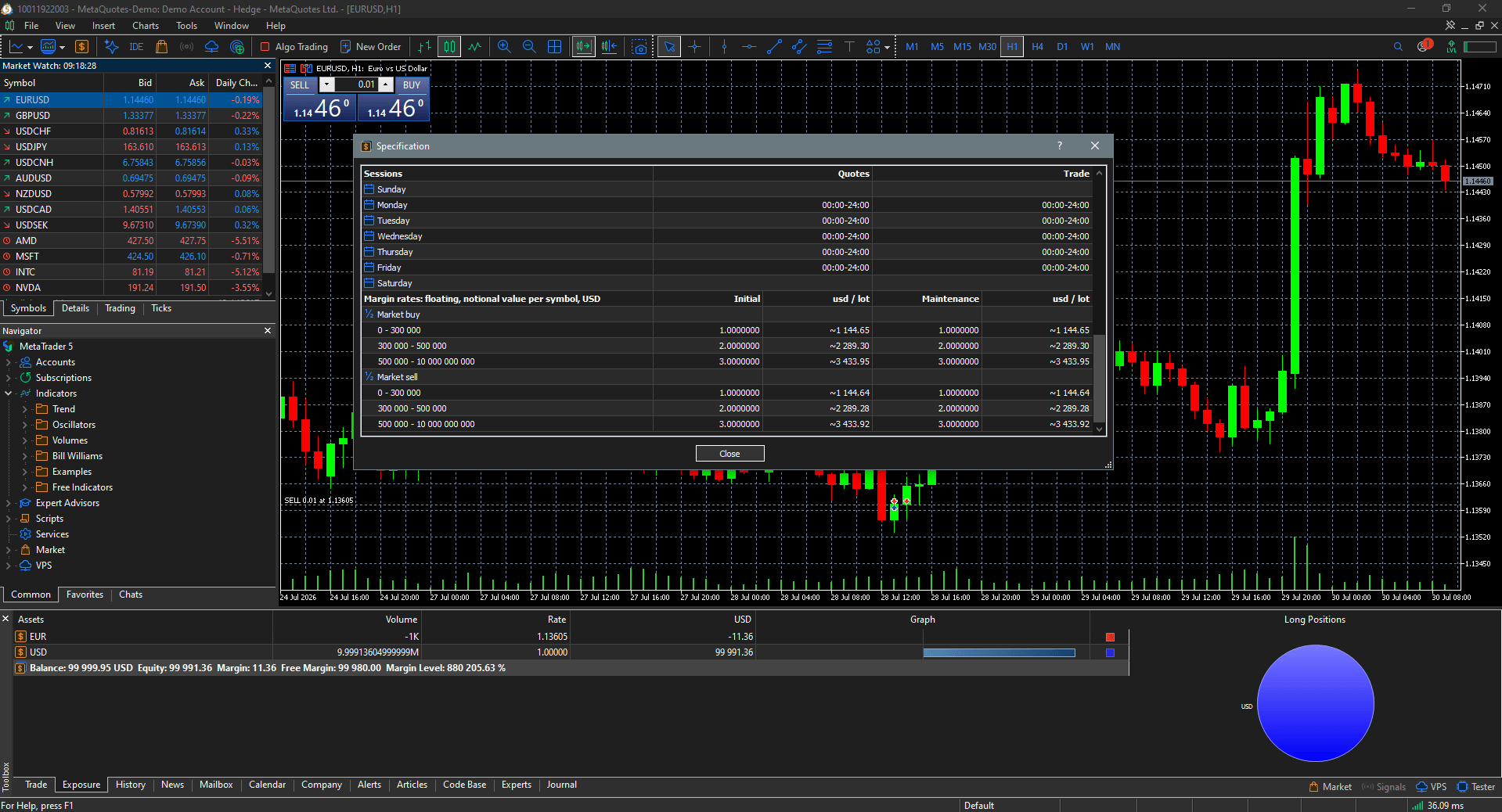
 MetaTrader 5 supports more asset classes and margin modes than MT4, including exchange-style products at some brokers. As with MT4, leverage is not determined by the software alone; it comes from the broker’s settings, the specific symbol, and the account type. Margin shown in MT5 should be treated as a platform estimate based on current conditions. You can view a given symbol’s initial and maintenance margin by opening the Specification window:
Leverage on cTrader
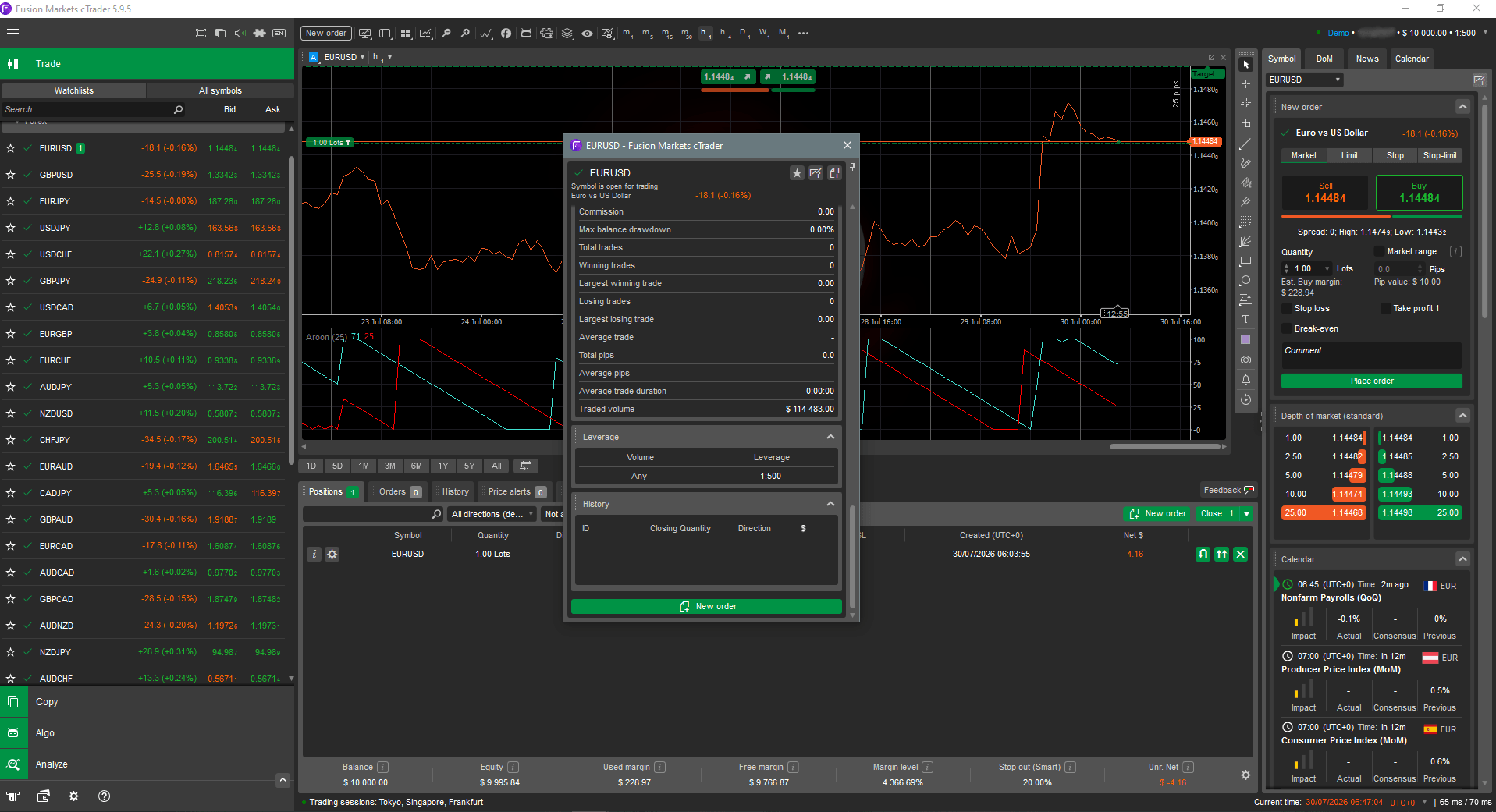
 cTrader usually provides clear symbol information on leverage and estimated margin, but the underlying leverage policy still comes from the broker and legal entity. Some traders find cTrader’s margin display easier to read, especially for CFDs and forex. Even so, symbol-specific leverage, tiered margin, and volatility adjustments can still apply.
Leverage on Proprietary Platforms
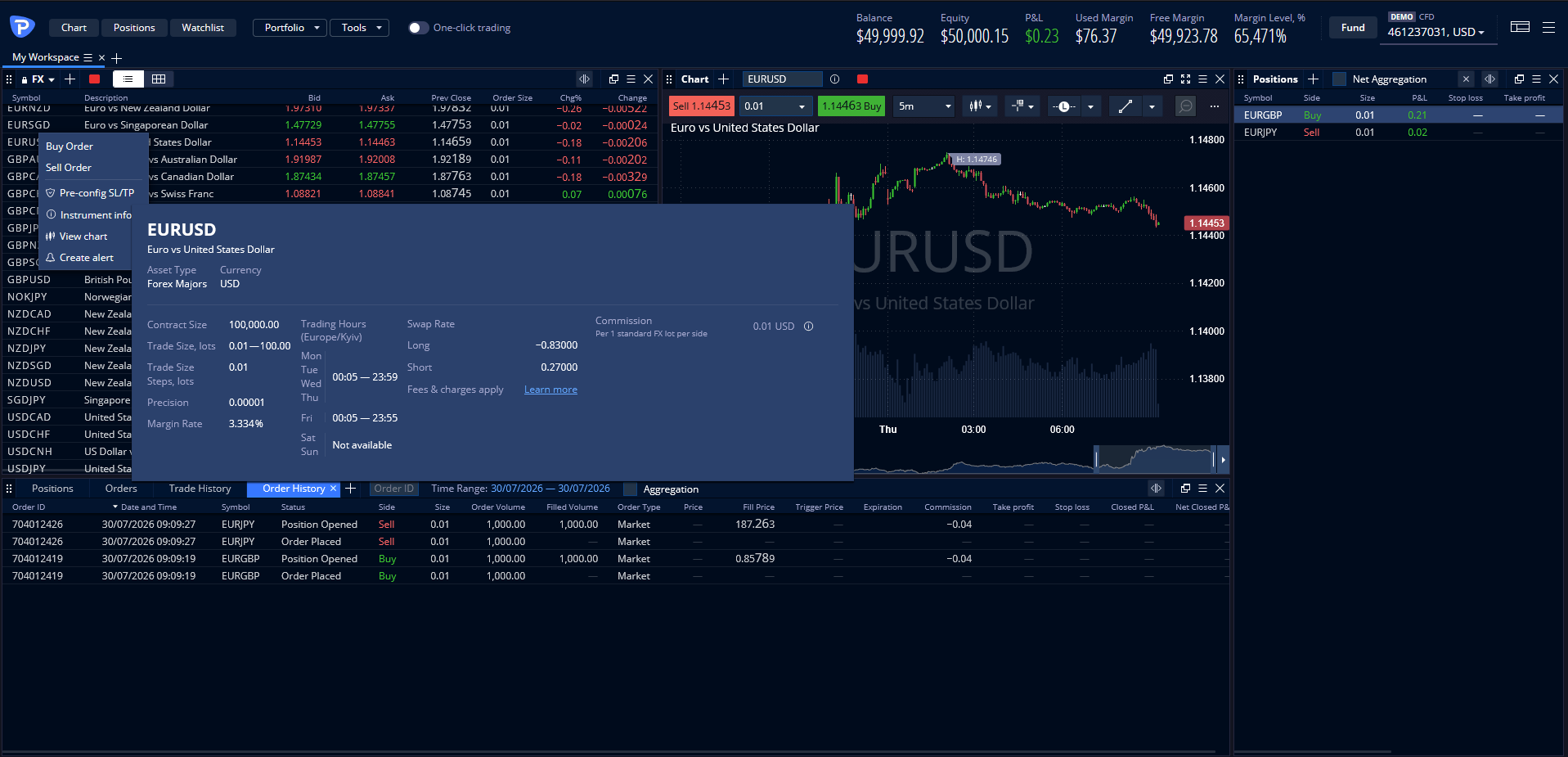
 Proprietary platforms of brokers like Pepperstone often present leverage and margin in a more customized way, sometimes through margin percentages, product risk scores, or buying-power fields instead of a simple ratio. The display may be different, but the core logic is the same: more exposure requires more supporting capital. Traders should learn how the specific platform calculates and shows the required margin before trading live. In the example below, we can see that Pepperstone’s platform displays an instrument’s exact margin rate in the Instrument info menu:
Where to Check Account Leverage
According to our reviews of online trading platforms, account leverage is typically accessible through the broker’s client portal, account summary, onboarding documentation, or the platform’s account details window. While many brokers display a headline maximum for the account, the effective leverage utilized depends entirely on the specific position opened. To ensure accurate risk management, it is necessary to verify both the account-level maximum and the specific symbol-level margin requirements.
Many brokers provide the flexibility to select a preferred leverage ratio during the initial account creation phase. This allows traders to align their buying power with their specific risk tolerance and strategy before committing capital.
As demonstrated in the image below, modern trading interfaces often include a customizable dropdown menu during the demo or live account setup. This feature enables a customer to choose between various ratios, such as 1:100 up to 1:500 in the Vantage Markets current example, establishing the foundational leverage for that specific sub-account.
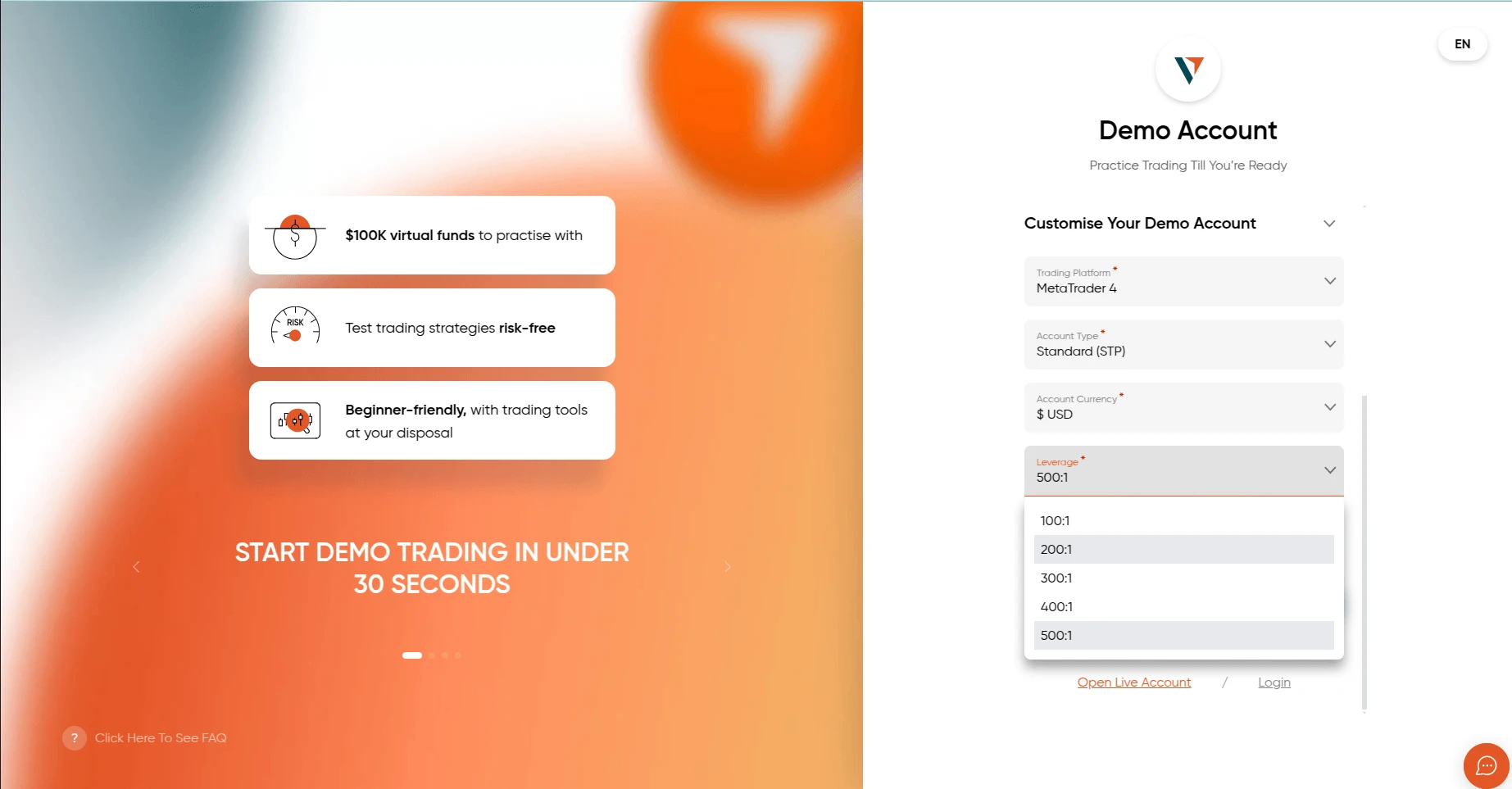
Financial institutions operating under the oversight of tier-1 regulators, such as the Financial Conduct Authority (FCA) in the United Kingdom or the Australian Securities and Investments Commission (ASIC), are strictly mandated to set leverage limits according to established regulatory frameworks. In these highly regulated environments, leverage is not a discretionary setting determined by the broker’s preference; it is a legally enforced constraint designed to protect retail participants.
Where to Check Margin Requirements
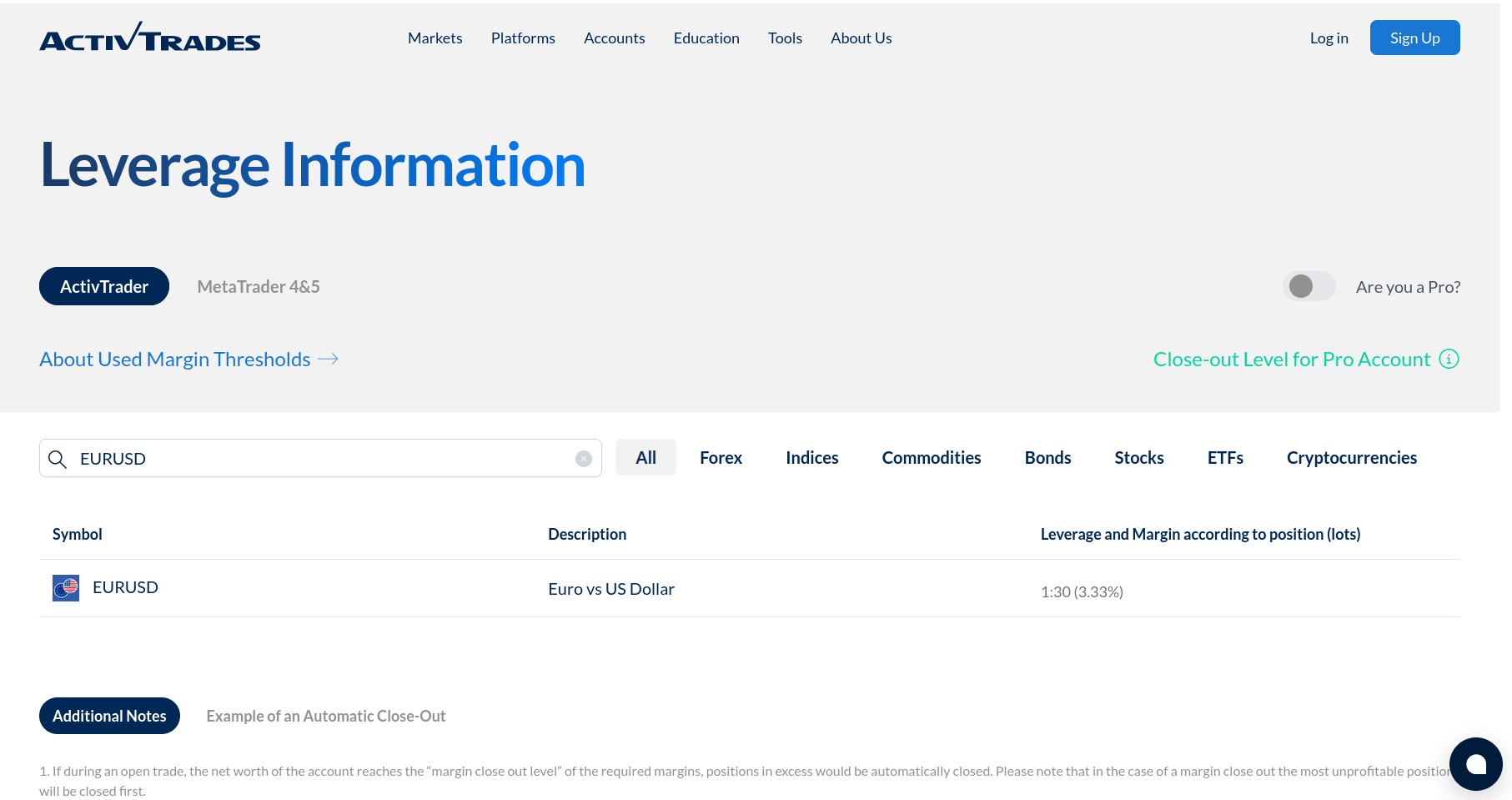
We have found that margin requirements are commonly listed in symbol specifications, product details pages, margin calculators, or order-ticket previews. On some platforms, the estimated margin updates when trade size changes. Traders should check these values before entering a trade because margin can differ by symbol, size tier, and market condition.
The ActivTrades example below illustrates how margin requirements are presented within a typical broker’s product detail page.
Why Platform Leverage May Differ by Symbol
Platform leverage may differ by symbol because each instrument has its own volatility, liquidity, contract size, trading session, and regulatory treatment. Brokers may also apply a higher margin to larger positions or during news events, market openings, or weekends. Seeing different leverage across symbols on the same platform is normal and does not necessarily indicate an error.
How to Calculate Leverage and Margin
Before performing any calculations, it is essential to understand the underlying mechanics of market exposure.
- Notional Value: This is the full face value of the position you control in the market. Whether you use $1,000 or $10,000 to open a position, if the market value of the assets is $100,000, that is your notional value. This is the amount on which your profit, loss, and trading costs are calculated. Bigger positions increase risk because each tick, pip, or point move becomes worth more money. With leverage, traders can reach a large notional size very quickly, which can make normal market noise feel like a major account event. Larger positions also increase the absolute effect of spreads, commissions, swaps, and slippage.
- Lot Size vs. Contract Size:
- In forex, lot size describes the quantity traded, while leverage determines how much margin is required to hold that quantity. Leverage does not change the lot size itself; it changes the capital needed to support it. One Standard Lot represents 100,000 units of the base currency. A micro lot (1,000 units of the base currency) may still be risky if account equity is small and several leveraged positions are open at once.
- In CFDs and futures, contract size defines how much one contract represents, and leverage determines how much capital is needed to control that contract. If the contract size is large, even one contract may create substantial exposure. This is why checking contract specifications is essential before placing an order.
Note: Leverage doesn’t change these sizes; it only changes how much of your own money is required to hold them.
- Real (Effective) vs. Maximum Leverage: Maximum leverage is the limit set by your broker (for example, 1:30). Real (Effective) leverage is what you are actually using based on your open exposure relative to your equity. A trader allowed 1:30 can choose to only use 1:3 by keeping a larger equity buffer, which is generally a healthier way to trade.
Leverage Formula
A simple leverage formula is Leverage = Position Value / Capital Supporting the Position. In many trading discussions, capital means required margin; in account-risk discussions, it often means equity. For example, if your exposure is $20,000 and your account equity is $2,000, your effective leverage is about 1:10.
Position Size Formula
A practical risk-based position size formula is Position Size = Risk Amount / (Stop Distance × Value per Point or Pip). This is often more useful than starting with maximum leverage because it ties trade size to planned loss. Leverage then determines whether the account has enough margin to support that risk-based size.
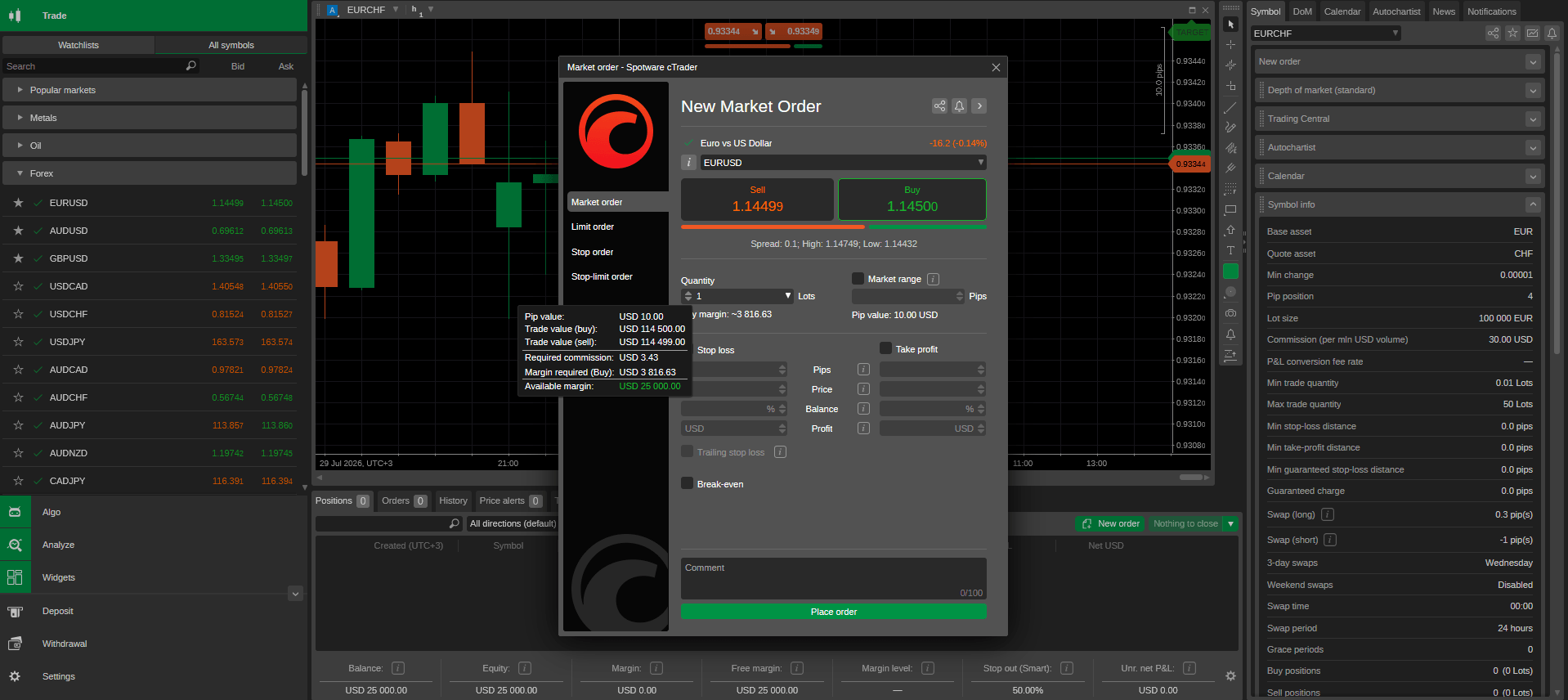
Below, you can view the example position sizes of the EUR/USD, US 500 index, and BTC/USD as recorded during our testing of IC Markets’ cTrader web platform:
Examples Using Forex, Indices, and Crypto
| Instrument | Notional Exposure | Account Equity | Effective Leverage |
|---|---|---|---|
| Forex (EUR/USD) | $114,330 | $3,814.33 | 1:30 |
| Indices (US500) | $7,328.70 | $732.88 | 1:10 |
| Cryptocurrencies (BTC/USD) | $63,979.51 | $31,995.23 | 1:2 |
How to Calculate Margin Requirement
Margin Requirement Formula
Required margin can be calculated using either a percentage (rate) or a ratio.
- Using Margin Rate: Required Margin = Position Value × Margin Rate
- Using Leverage Ratio: Required Margin = Position Value / Leverage
Both formulas describe the same relationship from different angles. Typically, your broker will perform these calculations for you, and the required margin will be displayed on your platform as shown below.
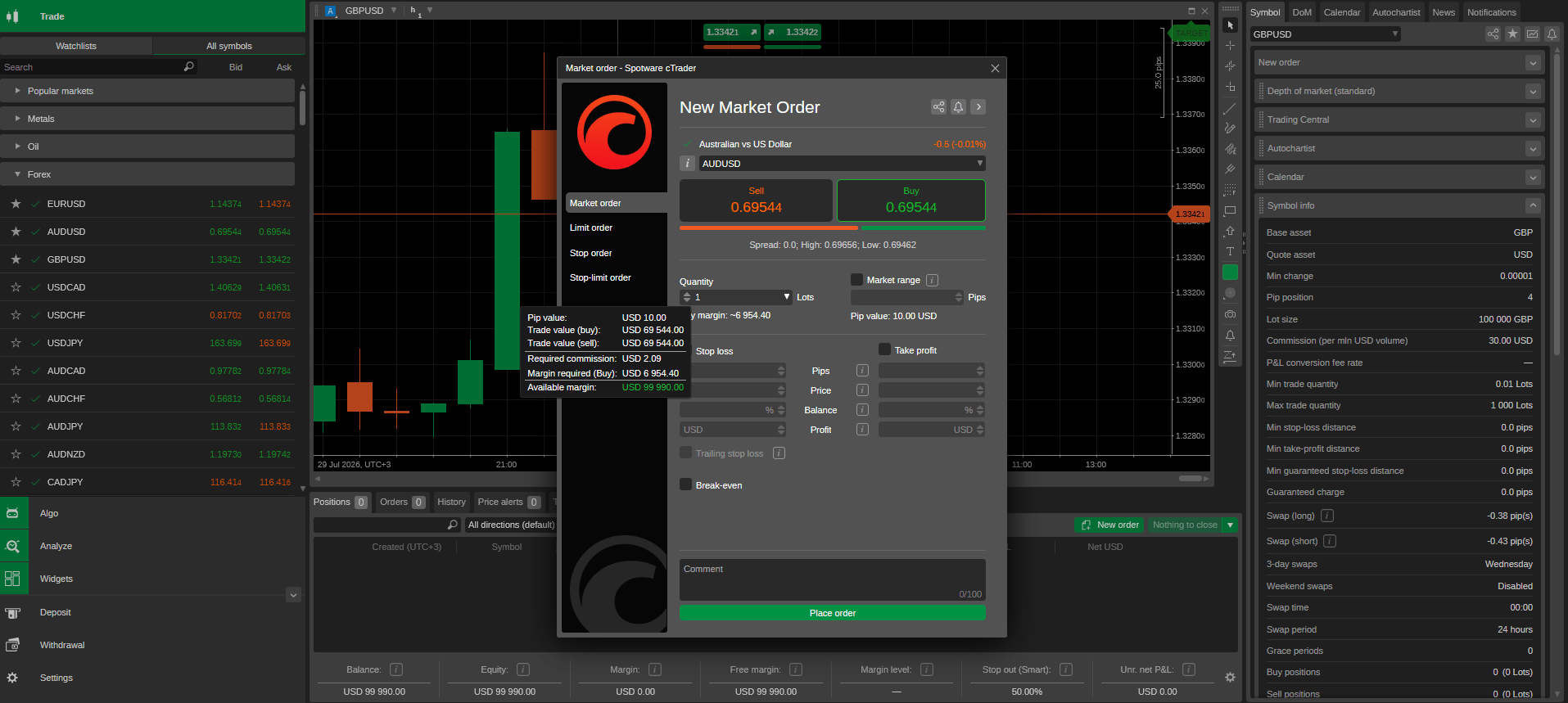
Here, we can see that opening a 1-lot AUD/USD position of $69,544 requires a margin of $6,954.
Instrument-Specific Calculations
- Margin Requirement for forex: For forex, margin is often based on the notional value of the currency position and then converted into account currency if needed. A simplified version is Units × Price / Leverage, though platform specifics vary. Traders should also remember that a small margin requirement does not mean a small risk if the stop is wide or the position is oversized.
- Margin Requirement for CFDs: For CFDs, a common approach is Contracts × Contract Size × Market Price × Margin Rate. Some brokers simplify this in the ticket so the estimated margin updates automatically as size changes. Share CFDs, index CFDs, and commodity CFDs often have different margin rates even on the same platform.
- Margin Requirement for Crypto: For crypto derivatives, required margin may be based on notional value divided by chosen leverage, but platforms can also include initial margin, maintenance margin, and liquidation buffers. Fees and funding are separate from the initial margin figure and can still affect available collateral. Because of volatility, the required margin can change more often than beginners expect.
Margin Requirement with Account Currency Conversion
If the product is priced in a different currency from your account, the platform may convert the margin requirement into your account currency using the current exchange rate. That means the required margin can change not only because the instrument price changes, but also because the conversion rate changes. This matters especially for multi-asset or multi-currency accounts.
Why Required Margin Changes by Instrument
Required margin changes by instrument because brokers and exchanges price risk differently across products. Higher volatility, lower liquidity, larger gap risk, and concentrated event risk often lead to higher margin requirements. Some venues also use tiered margin, so larger positions may require proportionally more margin than smaller ones.
Strategic Planning and Position Sizing
By following this disciplined sequence, readers will navigate the critical transition from identifying risk and assessing volatility to managing exposure through precise position sizing and protective orders.
Leverage and Risk Management
Professional risk management ensures that leverage remains a tool for growth rather than a catalyst for account failure.
- Risk Per Trade: Define the specific amount of account equity to risk (e.g., 1% or 2%) before entering a trade. Many traders keep this small as a percentage of equity, especially when learning, because leverage can make losses snowball. The important point is consistency: decide the acceptable loss before placing the trade.
- Risk-to-Reward Ratio: Risk-to-reward ratio compares the planned loss if the stop is hit with the planned gain if the target is reached. Leverage does not improve a poor risk-to-reward profile; it just scales the dollar amounts up or down. A highly leveraged trade with weak reward relative to risk is still a weak trade.
- Maximum Drawdown: Maximum drawdown is the largest peak-to-trough decline in account equity over a period. Leverage can increase drawdown speed dramatically, especially when losses cluster. Planning an account-level drawdown limit can help traders reduce size or pause before the account enters a harder recovery phase.
- Diversification and Correlation: Diversification can reduce risk, but correlated leveraged positions can create a false sense of safety. For example, several currency pairs tied to the same macro theme may behave like one oversized trade during a major news event. Traders should look at combined exposure, not just the number of positions.
- Keeping Free Margin Available: Free margin is a buffer, and leveraged traders need that buffer. Running an account with very little free margin leaves almost no room for normal fluctuations, spread widening, or temporary drawdown. Keeping a spare free margin available can help prevent routine volatility from turning into a margin event.
Leverage and Market Volatility
- Volatility Multiplied: Volatile markets produce larger and faster price swings, which means leveraged positions can reach their stop or liquidation threshold much sooner. High volatility also tends to increase slippage and widen spreads. This makes the same leverage ratio more dangerous in a volatile market than in a calm one.
- Price Gaps: Price gaps occur when the market jumps from one level to another without trading every price in between. Gaps can happen after major news, earnings, geopolitical events, or a market reopening. In leveraged trading, gaps are especially dangerous because losses can exceed the planned stop distance.
- Liquidity Risks: Low liquidity often appears around session changes, holidays, off-hours trading, and some overnight periods. During these times, prices can move farther on less volume, and spreads may widen unexpectedly. Leveraged traders should be especially cautious because lower liquidity can make exits more expensive.
- Crypto Volatility: Crypto is volatile not just because prices move quickly, but also because the market trades continuously and can react to exchange-specific issues, regulatory headlines, liquidations, and social-media-driven sentiment. That environment can make high leverage especially unforgiving. Beginners should treat crypto leverage as a higher-risk category than many traditional markets.
Leverage and Position Size
Position sizing is the primary mechanism for controlling effective leverage.
- Strategic Sizing: Leverage affects the maximum position size the account can support, but it should not decide the trade size by itself. A trader may be able to open a very large position because leverage allows it, yet that position may still be too risky for the account. Position size should usually start with planned risk, then be checked against margin availability. A simple rule is to size the trade so the predefined stop loss equals the planned risk amount. This keeps losses more stable from one trade to the next, even when market volatility changes. Position sizing is one of the most effective ways to prevent leverage from turning small mistakes into large account damage.
- Position Size vs Trade Size: Traders often use these terms interchangeably, but they can mean slightly different things. Trade size may refer to one order, while position size can refer to the total net exposure after several entries or partial exits. This distinction matters when scaling into leveraged trades because the total position may become much larger than any single order looked at in isolation.
- Matching Position Size to Account Equity: Position size should make sense relative to current equity, not just account balance at deposit time. As equity falls, the same position becomes larger in effective leverage terms. Matching size to equity helps traders keep risk more stable and reduces the chance that a temporary drawdown turns into a margin problem.
Stop Losses in Leveraged Trading
Stop losses matter more with leverage because adverse price movement affects a larger notional position. A move that would be inconvenient in an unleveraged trade can become account-threatening in a highly leveraged one. A stop loss does not guarantee a specific exit price, but it often provides a better risk framework than having no planned exit at all.
Stop losses should usually be based on market structure, volatility, and trade logic rather than on the amount of margin available. If the stop is too close, normal price noise may take you out; if it is too wide for your account, the position size should be reduced. Leverage should adapt to the stop, not the other way around.
Types of Protective Orders
- Fixed Stop Losses: Fixed stop losses are set at a specific price level when the trade is opened or shortly after. They are simple and help define risk clearly in advance. The key is to place them where the trade idea is invalidated, not merely at a distance that feels comfortable in money terms.
- Trailing Stop Losses: Trailing stop losses move in the trade’s favor as price advances, helping lock in gains while still giving the position room to continue. They can be useful in trending markets, but in choppy conditions, they may exit too early. On leveraged trades, a trailing stop should still be tested carefully because fast markets can produce slippage.
- Guaranteed Stop Losses: Guaranteed stop losses, where available, are designed to close at the exact stop level even if the market gaps through it. They are not offered by every broker or on every symbol, and they often come with conditions, limited availability, or an extra charge. Traders should never assume a normal stop is guaranteed unless the broker explicitly says so.
Slippage Risk on Stop Losses: Ordinary stop losses usually become market orders once triggered, which means execution can occur at the next available price rather than the exact stop level. In fast markets, gaps or thin liquidity can create negative slippage. This matters a lot in leveraged trading because even a modest slip can noticeably increase the realized loss.
Common Stop Loss mistakes include placing stops too tight, moving them farther away after the trade goes wrong, removing them entirely, or sizing the trade first and then forcing the stop to fit the margin available. Another mistake is assuming a stop removes all gap risk. Good stop use requires both sensible placement and sensible leverage.
Trading Costs and Live Performance
Trading Costs and Leverage
- Spread Costs with Leverage: The spread is the difference between the bid and ask price, and it applies to the full position size. When leverage increases exposure, the dollar effect of the spread increases too. A spread that looks small in pips can still be meaningful when the notional position is large relative to account equity.
During our evaluation of IC Markets’ raw account on the cTrader web platform, we had access to low spreads of 0.1 pips or lower when trading the EUR/USD pair. Our account leverage was set to the maximum of 1:30.
- Commission Costs with Leverage: Commissions, where charged, are usually tied to trade size or notional value. That means larger leveraged positions can produce larger commission costs even when the entry idea is unchanged. Traders who focus only on the leverage ratio often overlook how repeated commissions affect net performance.
- Overnight Costs with Leverage: Swap or overnight financing costs are common in leveraged forex and CFD positions held beyond the daily cutoff. These charges apply to the leveraged exposure, not just the trader’s margin deposit, so they can add up faster on larger positions or longer holding periods. Carrying leveraged positions overnight also adds gap risk on top of financing costs.
- Currency Conversion Costs: Currency conversion costs arise when the instrument, profit and loss, commission, or margin is denominated in a different currency from the account. Even small conversion spreads can matter when exposure is large or trades are frequent. This cost is easy to miss because it is not always shown as clearly as spread or commission.
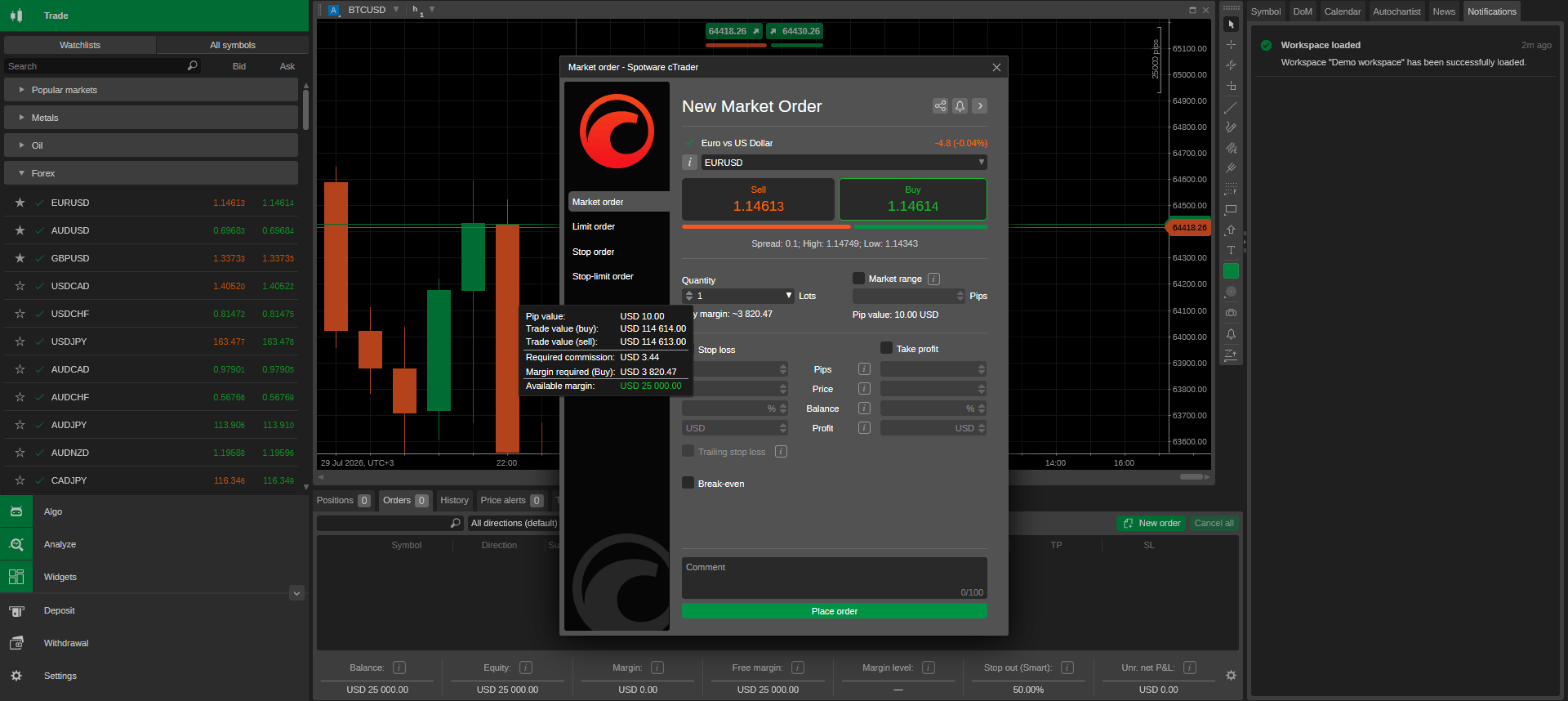
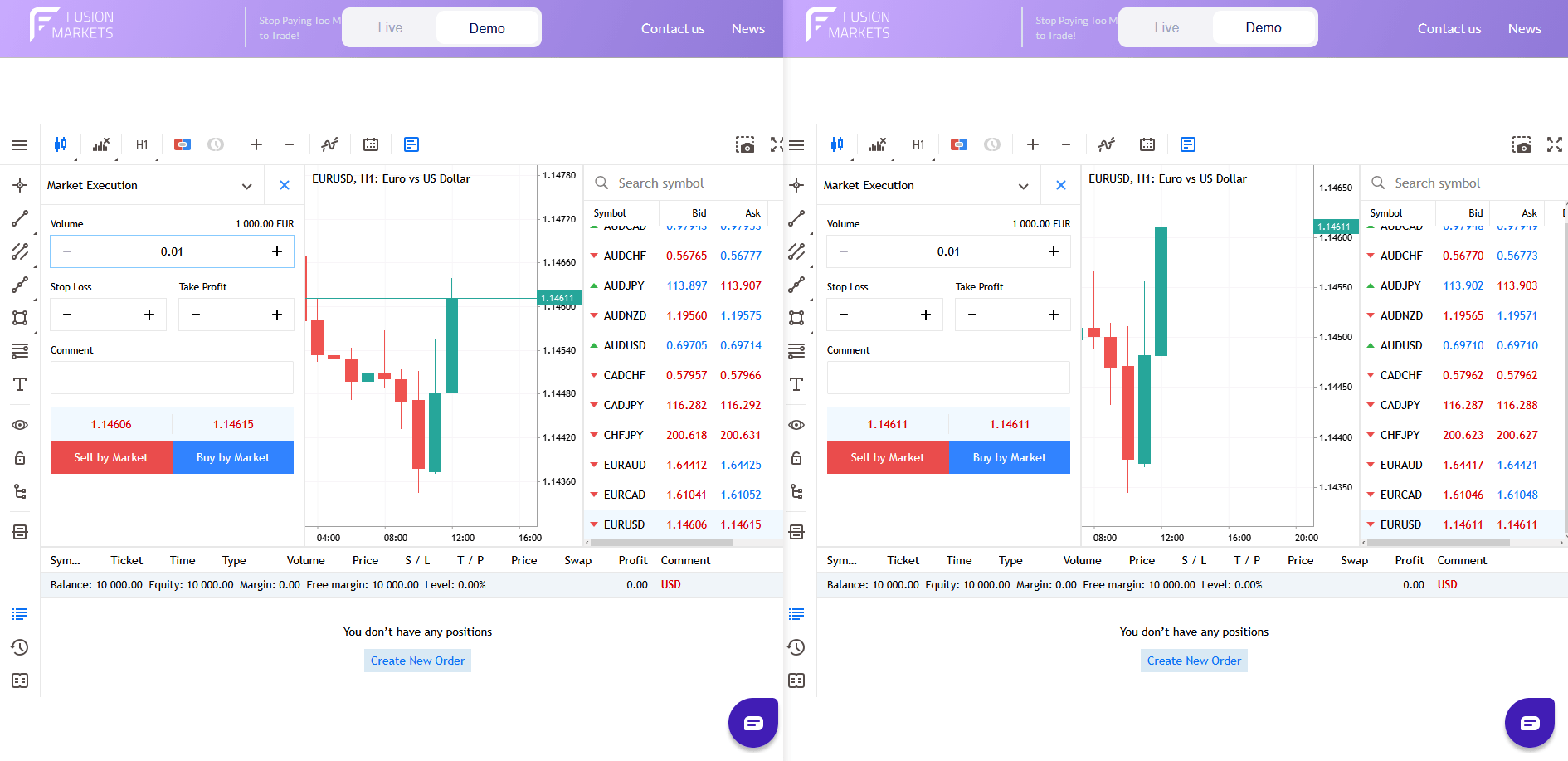
When examining the costs of Fusion Markets’ Classic (pictured on the left) and Zero (pictured on the right) accounts, we observed that the commission-based Zero account offered lower spreads. Above, we can see that the EUR/USD has a spread of 1.0 pip on the Classic account, while the Zero account features a EUR/USD spread of 0.0 pips.
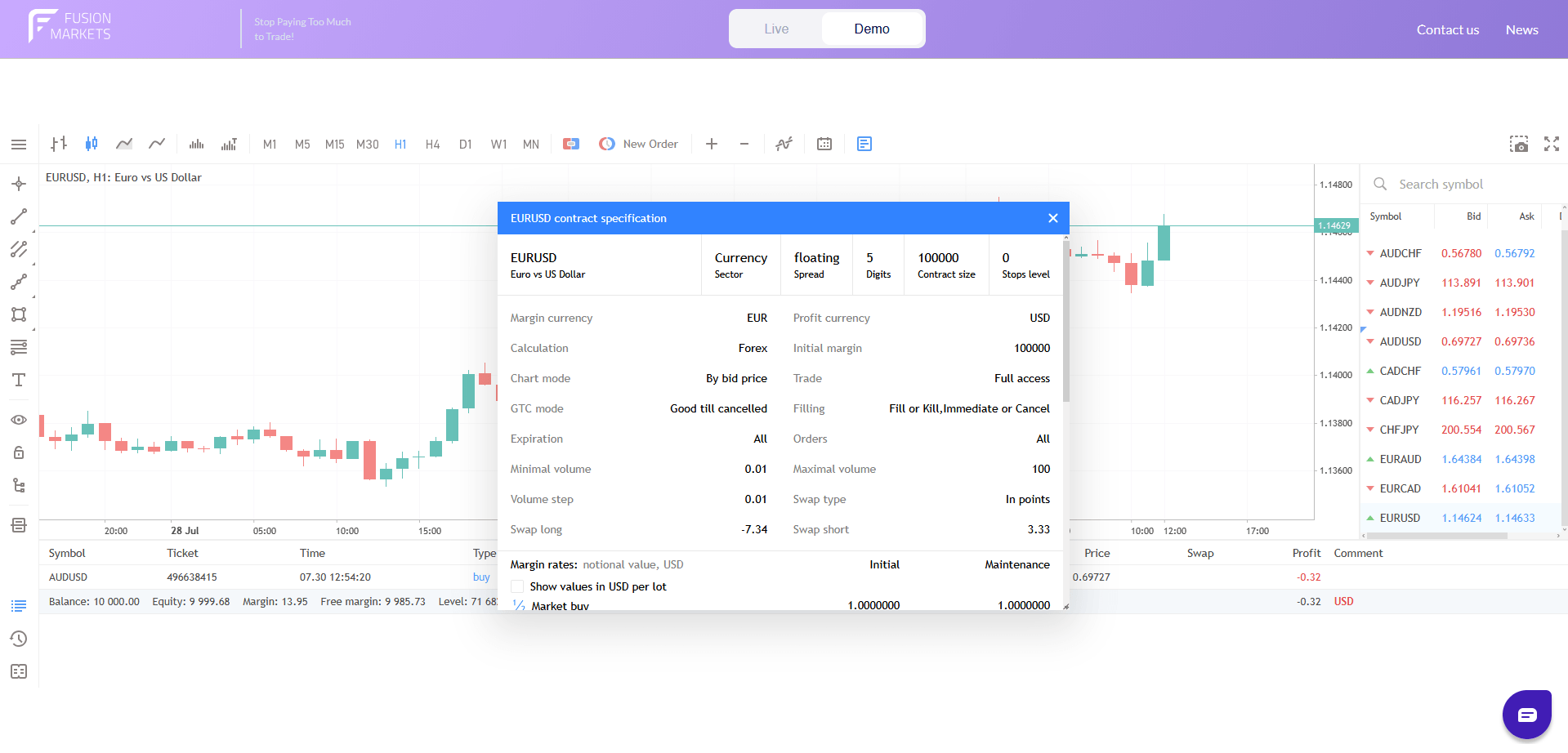
How to Estimate Total Leveraged Trading Cost?
Traders can use the following formula: Total Estimated Cost ≈ Spread Cost + Commissions + Overnight Financing or Funding + Conversion Costs + Expected Slippage. The exact numbers differ by product and venue, but the idea is to price the full trade, not just the entry. Cost awareness is especially important for short-term strategies where expected profit per trade is small.
Why Larger Exposure Increases Cost Impact?
Leverage increases exposure, and costs are generally linked to exposure. That means spreads, commissions, financing, funding, and slippage all become larger in dollar terms as position size grows. A trade that looks acceptable on a small size may become much less attractive once leverage magnifies cost drag.
Leverage and Profit or Loss
Once the operational costs are accounted for, leverage dictates the velocity at which your account equity fluctuates in response to market movement.
How Leverage Magnifies Gains and Losses
Leverage magnifies gains because profits are earned on the full position exposure, not just on the margin committed. If a leveraged position moves in your favor, the return on the capital supporting that position can be much larger than with unleveraged exposure. This is the attraction of leverage, but it is only one side of the equation.
Losses are magnified in exactly the same way. A move that looks small on the chart can be large relative to the margin supporting a high-leverage position. When losses grow, equity falls, free margin shrinks, and the account can move closer to a margin call or stop-out.
Percentage Move vs Account Impact
To quickly estimate how a market move affects your account before costs, use the following relationship: Approximate Account Impact = Market Move % × Effective Leverage
If your effective leverage is 1:10, a 1% adverse move is roughly a 10% hit to equity. This is only an approximation, but it helps explain why leverage can make routine price fluctuations feel dramatic.
Profit and Loss Examples
Illustrative example only: If a trader has $2,000 equity and opens $20,000 of exposure, effective leverage is 1:10. A 1% favorable move produces about a $200 gain before costs, while a 1% unfavorable move produces about a $200 loss. The market moved only 1%, but the account moved about 10% relative to equity.
Why Leverage Can Deplete Equity Quickly
Leverage can deplete equity quickly because floating losses reduce equity in real time, while used margin often stays allocated. As equity falls, the margin level drops, leaving less room for the trade to recover naturally. This can force a trader out of a position earlier than expected, even if the longer-term market view later proves right.
Realistic Expectations for Beginners
Beginners should avoid treating leverage as a shortcut to large, fast returns. In practice, high leverage often creates unstable results, emotional decisions, and account damage before skill is developed. A more realistic goal is to learn execution, risk control, and consistency while using modest effective leverage and small risk per trade.
Account Thresholds and Emergency Protocols
Margin Calls Explained
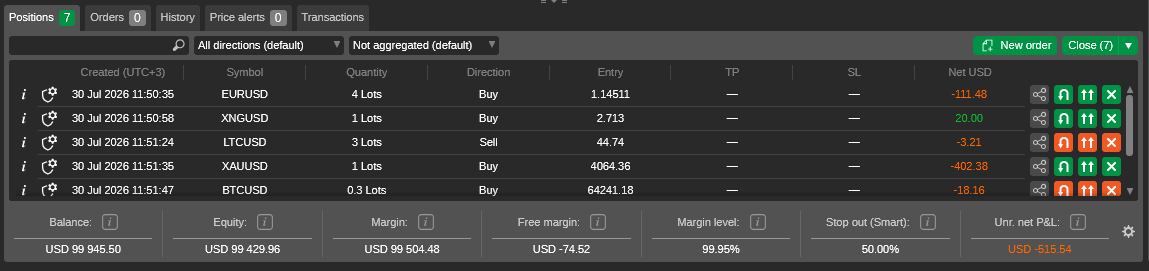
- What Triggers Margin Calls? A margin call is a warning or account event that signals your account no longer has enough excess equity relative to margin requirements. Margin calls can also happen if margin requirements rise due to volatility, symbol changes, or larger position tiers. Margin call level is often expressed as a percentage of the margin level at which the broker alerts the client or restricts certain actions. The exact percentage varies by broker, product, and regulatory entity. Traders should read the broker’s terms carefully because margin call thresholds are not universal. IC Markets Europe, for example, issues margin calls when a trader’s margin level drops below 100%, as demonstrated in the account below:
- Notification Phase: Depending on the product and broker, this may be a notification, a trading restriction, or an automated risk action. In some modern platforms, positions can be reduced automatically with little or no traditional phone-call style warning.
- How to Respond to a Margin Call?: The most practical responses are to reduce exposure, close or hedge risk if appropriate, and avoid opening new positions that worsen the problem. Adding funds is possible in some cases, but it should not be a reflexive attempt to rescue a poor trade. Beginners are often better served by reducing the size and reviewing why the account became overexposed.
Stop-Out Mechanics and Liquidation Explained
If an account’s health continues to decline past the warning stage, the broker will intervene through automated forced closures to protect both the firm and the remaining account equity. In this section, we break down key factors like stop-out and liquidation as they relate to the highly leveraged IC Markets test account pictured below:
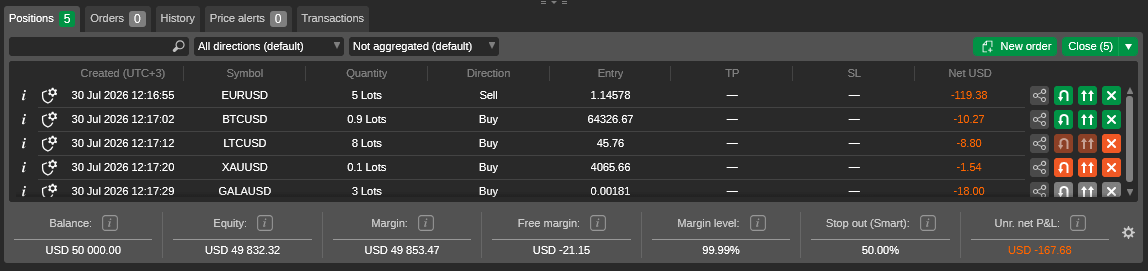
- Stop-out Level: Stop-out level is the point at which the broker begins closing positions automatically to protect against further losses. This threshold is usually lower than the margin call level, but the exact mechanics vary. Once an account reaches stop-out territory, the trader has very little flexibility left. The main difference between margin calls and stop-outs is that a margin call is generally a warning or threshold event, while a stop-out is an automatic forced reduction or closure of positions. A margin call may give the trader a chance to act; a stop-out means the broker has started acting. In fast markets, the gap between the two can feel very small. In the above example account, we can see that our testers’ stop-out level is set at 50%.
- Liquidation: Liquidation means a leveraged position is forcibly closed because the account no longer meets the platform’s margin requirements. In some markets, this happens at an estimated liquidation price, while in others it happens when a margin threshold is breached. Either way, liquidation is the end result of insufficient supporting equity. Our test account demonstrates a free margin of minus $21.15. Since the used margin exceeds our equity, its margin level dropped below 100%. If the margin level continues to fall, it may hit the 50% stop-out and trigger automatic liquidation.
- Liquidation Price: The liquidation price is the approximate market price at which the account no longer has enough margin to maintain the position. In crypto derivatives, platforms often display an estimated liquidation price directly. In forex and CFDs, there may be no single simple number because other open positions, fees, and margin-level rules also affect when stop-out occurs. The experience can feel different, but the principle is the same: too much exposure and too little equity lead to forced closure. Crypto can feel harsher because volatility is often higher, and price moves can be faster.
Negative Balance Protection
What Negative Balance Protection Is
Negative balance protection is a policy or regulatory requirement designed to prevent a client from owing more money than is in the account after trading losses. It can matter during extreme moves, gaps, or fast markets. However, it does not prevent the account from being heavily damaged or fully depleted.
When Negative Balance Protection Applies
Negative balance protection often applies to certain retail accounts under specific regulators, especially in some leveraged OTC products. Whether it applies can depend on the broker’s legal entity, the client’s classification, and the product being traded. Traders should confirm the exact scope in the account terms rather than assume it is universal.
When Negative Balance Protection May Not Apply
It may not apply to professional accounts, offshore accounts, institutional arrangements, or some exchange-traded products such as futures, depending on jurisdiction and broker policy. It may also apply differently across product categories under the same broker group. This is one reason traders should read legal disclosures carefully before using high leverage.
Gaps, Slippage, and Extreme Volatility
Even where negative balance protection exists, gaps and slippage can still cause severe losses because positions may be closed far from the intended stop level. Protection may cover the deficit after the fact, but it does not stop the market from moving violently through your level. Extreme volatility can therefore still wipe out an account very quickly.
Why Traders Should Not Rely Only on Protection
Negative balance protection is a backstop as opposed to a trading strategy. Traders who rely on it instead of managing leverage, position size, and event risk are still likely to suffer large losses. A better approach is to assume that protection may help only in worst-case outcomes and to manage the trade so that those outcomes are less likely.
Leverage by Trading Style
Leverage for Scalping
Scalping targets small price moves, so some traders are tempted to use high leverage to make those moves matter more. The problem is that spreads, commissions, slippage, and execution quality also become more important. Scalping with high leverage can produce fast losses if the market hesitates or costs are underestimated.
Leverage for Day Trading
Day traders often prefer not to hold positions overnight, which removes some financing and gap risk. Even so, intraday news, market opens, and volatile session overlaps can still create large swings. Suitable leverage for day trading depends on the instrument, stop distance, and the trader’s ability to control risk under pressure.
Leverage for Swing Trading
Swing traders usually hold positions for days, so they face overnight financing, swap, and gap risk more often than day traders. That usually makes lower effective leverage more practical. A swing trade should have enough room for normal multi-day volatility without putting the account under margin pressure.
Leverage for Position Trading
Position trading involves holding for weeks or longer, which generally favors lower leverage because macro views can experience deep temporary drawdowns. Carrying high leverage over long periods also increases exposure to financing costs and surprise events. For longer holding periods, durability often matters more than maximum short-term return.
Leverage for Algorithmic Trading
Algorithmic strategies can place multiple trades quickly, which means total leverage can be built across many positions even when every single trade looks modest. Portfolio-level risk, correlation, and margin usage matter as much as individual trade rules. Backtests should include realistic assumptions about slippage, spreads, leverage, and margin pressure.
Leverage for Copy Trading
Copy trading adds another layer of leverage risk because the copied strategy may use leverage that is inappropriate for the follower’s account size or risk tolerance. Differences in account balance, execution, slippage, and scaling can produce different results from the master strategy. Copying a leveraged trader without understanding the exposure is risky for beginners.
Why Trading Style Affects Suitable Leverage
Trading style affects suitable leverage because holding time, expected stop distance, trade frequency, cost sensitivity, and event exposure all differ. A leverage level that might be survivable for a short intraday trade can be far too aggressive for a multi-day swing trade. The practical question is not just “How much leverage is offered?” but “How much leverage fits this style and this market?”
High Leverage vs Low Leverage
The following table summarizes the strategic differences between operating with aggressive exposure versus a more conservative capital approach.
| Feature | High Leverage | Low Leverage |
|---|---|---|
| Market Exposure | Controls a large amount of market exposure relative to account equity. | Position exposure is modest relative to the account equity. |
| Capital Requirement | Reduces the initial capital needed to open a position. | Requires more margin for the same notional exposure. |
| Sensitivity to Price | Account becomes highly sensitive to ordinary price movements. | Normal market volatility is easier to absorb and manage. |
| Room for Error | Significantly reduces the margin for error. | Generally provides more staying power and tolerance for volatility. |
| Primary Risks | High chance of sharp drawdowns, margin calls, and forced exits. | Risk is not eliminated but is generally easier to manage. |
| Psychological Impact | Increases the likelihood of impulsive decision-making. | Results in smaller emotional swings and less margin stress. |
| Trading Costs | Costs and slippage are more damaging in percentage-of-equity terms. | Costs have a smaller impact on total equity. |
Common Leverage Trading Mistakes and Fixes
Using Maximum Leverage
- Why It Matters: During our examination of the leverage ratios offered by online brokers, we confirmed that using maximum leverage often leaves almost no room for normal price fluctuation. This can result in a margin problem before the original setup has time to develop. Maximum leverage tends to amplify both market noise and emotional decision-making.
- Quick Fix: Use far less than the maximum; set a practical leverage cap (for example, 1:5 or 1:10).
Trading Too Large for Account Size
- Why It Matters: Many traders look at what the platform will allow rather than what the account can realistically tolerate. Based on our stress tests of highly leveraged accounts, this can be a serious mistake that can quickly deplete equity and even drop your margin level enough to trigger margin calls or stop-outs. A trade that consumes too much equity or free margin can create unstable results even if the analysis is reasonable. Smaller accounts need stricter sizing, not more aggression.
- Quick Fix: Size positions so one loss hits a pre-defined percentage of the account (for example, 1–2%). Calculate the position size from risk first.
Ignoring Margin Requirements
- Why It Matters: Ignoring margin requirements can lead to unexpected trade rejection, low free margin, or surprise stop-outs when volatility rises. Margin should always be checked before entering the trade. Traders should also remember that margin requirements can differ by symbol and can change over time.
- Quick Fix: Check symbol margin before entry and re-check after sizing; keep a margin buffer.
Trading Without a Stop Loss
- Why It Matters: Trading without a stop loss can expose the account to open-ended downside, especially in leveraged markets. We must stress that even traders who intend to “watch the position manually” can be caught by fast moves, gaps, platform issues, or emotional hesitation. A stop is not perfect, but no stop usually means no defined risk.
- Quick Fix: Always set a stop; if manually monitored, define strict rules and acceptable slippage.
Holding Leveraged Positions Through Major News
- Why It Matters: Holding leveraged trades through central bank decisions, major economic releases, earnings, or geopolitical headlines can create sudden slippage and spread widening. We have observed that a good setup can still be damaged by chaotic execution. If the event risk is not part of the plan, reducing or closing exposure beforehand is often the more disciplined choice.
- Quick Fix: Close or reduce leveraged exposure before high-impact events unless the event is in your plan.
Confusing Margin with Risk
- Why It Matters: A trade with a small margin requirement can still have a very large loss potential. Margin only tells you how much capital is needed to open and support the trade under current rules. Real risk depends on volatility, stop placement, position size, gap exposure, and how much of the account is committed.
- Quick Fix: Тreat margin separately as a liquidity constraint.
Adding to Losing Positions
- Why It Matters: Adding to a losing leveraged position can quickly turn a manageable trade into a serious account threat. Averaging down increases exposure while the trade thesis is already under pressure.
- Quick Fix: If traders do add, it should be part of a predefined plan with strict account-level limits, not an emotional reaction.
Ignoring Overnight Costs
- Why It Matters: These costs are easy to overlook because they build gradually, especially when the trader is focused only on direction. Over time, they can materially change the expected value of a leveraged strategy.
- Quick Fix: Factor financing into expected returns and run a cost break-even check for multi-day trades.
Beginner Workflow: Leverage Trading Checklist
Beginners may follow the steps below when opening leveraged positions to ensure that technical configurations, market analysis, and risk management protocols are properly synchronized before any capital is committed to the market.
Account Leverage Checklist
Start by choosing a market you understand well enough to explain in simple terms. Before trading, confirm the basic account settings and legal framework that govern leverage. Many misunderstandings start here.
- Identify the broker’s regulated entity holding the account.
- Confirm whether the account is retail or professional.
- Check the headline maximum leverage, and any account-specific limits.
- Verify whether negative balance protection applies.
- Review margin call and stop-out rules.
Instrument Margin Checklist
Leverage is often symbol-specific, so each trade should begin with a product-level margin check. The same leverage ratio can feel very different across instruments. A highly liquid major forex pair, a volatile small-cap share CFD, and a crypto perpetual future are not comparable in risk, even if the ratio is numerically identical. Suitable leverage should therefore be chosen instrument by instrument, not account-wide by habit.
- Check the symbol’s current margin requirement or leverage ratio.
- Confirm contract size, lot size, or point value.
- Look for a tiered margin on larger positions.
- Check whether the margin changes around weekends or news events.
- Verify whether the instrument is especially volatile or illiquid.
Position Size Checklist
Position size should be driven by risk, then confirmed against available margin. This is one of the most important leverage habits.
- Set the maximum dollar or percentage loss first.
- Measure the stop-loss distance in points, pips, or dollars.
- Calculate the size that matches that risk.
- Check the notional exposure created by that size.
- Confirm the size still leaves enough free margin.
Stop-Loss Checklist
A stop-loss review helps prevent undefined risk and overly tight exits. The stop should make sense for the market, not just for the account balance.
- Place the stop at a logical invalidation point.
- Avoid moving the stop farther after entry without a rule-based reason.
- Remember that ordinary stops are not guaranteed.
- Consider gap and slippage risk around major events.
- Reduce size the if the proper stop is too wide for the account.
Cost Checklist
Cost checks matter more in leveraged trading because exposure is larger than the capital committed. Cost drag can turn a marginal setup into a poor one.
- Check current spread.
- Check commission per side or round turn.
- Estimate swap fees if holding overnight.
- Estimate funding rates on perpetual products if relevant.
- Check currency conversion charges where applicable.
Volatility Checklist
Volatility can change whether the same leverage level is reasonable. A calm market and a fast market do not deserve the same assumptions.
- Review the economic or earnings calendar.
- Check the recent average price movement.
- Look for low-liquidity periods or market opens.
- Consider weekend or holiday gap risk.
- Reduce leverage if market conditions are unstable.
Risk Management Checklist
The final checklist should confirm that the trade fits the account and the plan, not just the chart setup. If several boxes remain unchecked, patience is usually better than entry.
- Know the planned loss, target, and risk-to-reward ratio.
- Check total exposure across correlated positions.
- Keep a meaningful free-margin buffer.
- Avoid using maximum leverage just because it is available.
- Be ready to cancel the trade if the numbers do not fit.
Leverage Trading Glossary
Capital Metrics
Balance
Balance is the account value after closed trades, deposits, withdrawals, and booked charges, without including current floating profit or loss. It is a historical number, not the full live risk picture.
Equity
Equity is the real-time account value after including floating profit and loss on open positions. In leveraged trading, equity often matters more than balance because it determines current margin health.
Notional Value
Notional value is the full face value of the position being controlled in the market. Profit and loss are generally calculated on this full exposure rather than on the smaller margin amount.
Position Size
Position size is the quantity of the instrument traded, expressed in units, lots, contracts, or shares, depending on the market. It directly affects exposure, cost, and the money gained or lost per price movement.
Leverage and Margin
Leverage
Leverage is the use of a smaller amount of capital to control a larger market position. It increases exposure relative to your own funds and therefore increases the speed and scale of both potential gains and potential losses.
Margin
Margin is the amount of money required to open and support a leveraged position. It is collateral, not a fee, and it should not be confused with the actual risk of the trade.
Initial Margin
Initial margin is the amount required to open a new leveraged trade. It depends on the instrument, the broker or exchange, the regulatory framework, and sometimes the size of the position.
Maintenance Margin
Maintenance margin is the minimum level of equity or supporting funds needed to keep a position open after entry. Falling below it can trigger warnings, restrictions, or forced reductions.
Used Margin
Used margin is the total margin currently allocated to all open positions. It reduces the amount of equity that remains available for new trades or for absorbing losses.
Free Margin
Free margin is the portion of account equity not currently tied up by used margin. It acts as a buffer against losses and a source of capacity for opening additional positions.
Margin Level
Margin level is usually calculated as equity divided by used margin, multiplied by 100. It is a common measure of how close a leveraged account is to a margin call or stop-out.
Risk Events and Protections
Margin Call
A margin call is a warning or account event indicating that available equity has dropped too close to or below required levels. It can lead to restrictions, requests for more funds, or automatic position reductions.
Stop-Out
Stop-out is the automatic closure of positions by the broker or platform once the account breaches a predefined margin threshold. It is designed to protect the broker and limit further account deterioration.
Liquidation
Liquidation is the forced closure of a leveraged position because the account can no longer meet margin requirements. It is common language in derivatives, especially crypto and futures markets.
Negative Balance Protection
Negative balance protection is a rule or policy intended to stop a client from owing more than the account contains after trading losses. Its availability and scope depend on jurisdiction, client classification, product type, and broker policy.
About the Editorial Team