


 Zornitsa Stefanova
 Zornitsa Stefanova is a Financial Research and Platform Testing Analyst at BestBrokers.com, specialising in hands-on reviews of forex, cryptocurrency and stock trading platforms. She evaluates brokerage companies from a user-focused perspective, testing key areas such as account setup, trading conditions, platform usability, available markets and overall reliability.
 | Expert Editor
  Eugene Lee, CFA
 Eugene Lee, CFA, is the Head of Research at BestBrokers.com, where he draws on more than two decades of experience in global markets, portfolio management, derivatives, and fintech to evaluate online brokers. His background in institutional investing and quantitative research helps ensure that broker reviews are based on data, risk assessment, and real-world trading conditions.
  | Updated:
 Introduction to Forex Account Types
What This Guide Covers
In this guide, BestBrokers focuses on the main account types offered by forex brokers and the practical differences between them. It covers common account options such as standard, micro, mini, cent, raw spread, ECN, STP, VIP, demo, retail, professional, swap-free, managed, and copy trading accounts. It also explains how account type can affect pricing, execution, leverage, margin requirements, supported platform range, and the protections available to you.
One important aspect to point out is that account availability often varies across jurisdictions. Swap-free accounts are sometimes available only to customers residing in Muslim-majority countries. Similarly, the so-called professional accounts are typically offered by brokers licensed in jurisdictions with a clear regulatory distinction between retail and professional clients, such as the UK, EU, and Australia.
Who This Guide Is For
This guide is intended for beginners who want to understand the features of different account types before they register and deposit money, but it is also useful for more experienced traders comparing pricing models or account structures. Informed decision-making is key to avoiding the common mistake of opening an account that does not fit your trading style.
This guide may prove useful when you are weighing spread-only against commission-based accounts, or retail versus professional trading. It can also be helpful when you are already registered but are unsure whether you need a different sub-account, login, or client status to access specific features.
Why Account Type Matters
Your account type directly impacts your trading costs, margin requirements, and client protections. Even when using an identical strategy, two traders can see different results due to variations in the execution quality and cost structure of their accounts. While high-leverage professional accounts or raw spread setups may seem appealing, they often carry higher risks or additional costs resulting from slippage. The bottom line is choosing an account that aligns with your individual goals is essential for managing risk and protecting your capital.
What Readers Will Learn
By the end of this guide, you will differentiate between logging into your trading account and accessing a trading platform. You will also be able to identify common forex account types and weigh the trade-offs that matter most for your trading style. Here is a brief overview of the main topics covered in this guide:
- Differences between live, demo, retail, and professional accounts
- Lot size and cost structure of standard, micro, mini, cent, raw spread, ECN, and STP accounts
- Common trading costs, including spreads, commissions, swap rates
- Main features of swap-free, managed, and copy trading accounts

What Is a Forex Trading Account?
Forex Trading Accounts Explained
A forex trading account serves as a gateway to the foreign exchange markets. This is your dedicated trading environment where you can access your real-time balance, manage your positions, and track your free margin. It is common for brokers to provide a single client portal that houses multiple sub-accounts.
For instance, you might maintain a demo account for testing, a standard account for commission-free trading, and a raw-spread account for high-frequency strategies like scalping or day trading. Each of these sub-accounts can operate with different base currencies, varying leverage limits, platform compatibility, and features.
Broker Account vs Trading Platform Account
It is important to distinguish between your overall client profile at a broker and the broker’s trading platform, as they serve two completely different purposes. When you want to change your leverage or add funds, you go to your broker profile. If you are looking to buy or sell a currency pair, you should access the trading platform.
- Broker Client Portal: You use this to verify your identity, deposit or withdraw funds, manage your legal agreements, and monitor your margin. Think of it as a back-office where you handle the business side of your relationship with the broker, so to speak.
- Trading Platform: This is the specific trading software like MetaTrader 4, MetaTrader 5, or cTrader, although some brokers also run on proprietary platforms. Said software is used exclusively for executing trades, analyzing charts, and monitoring live positions.
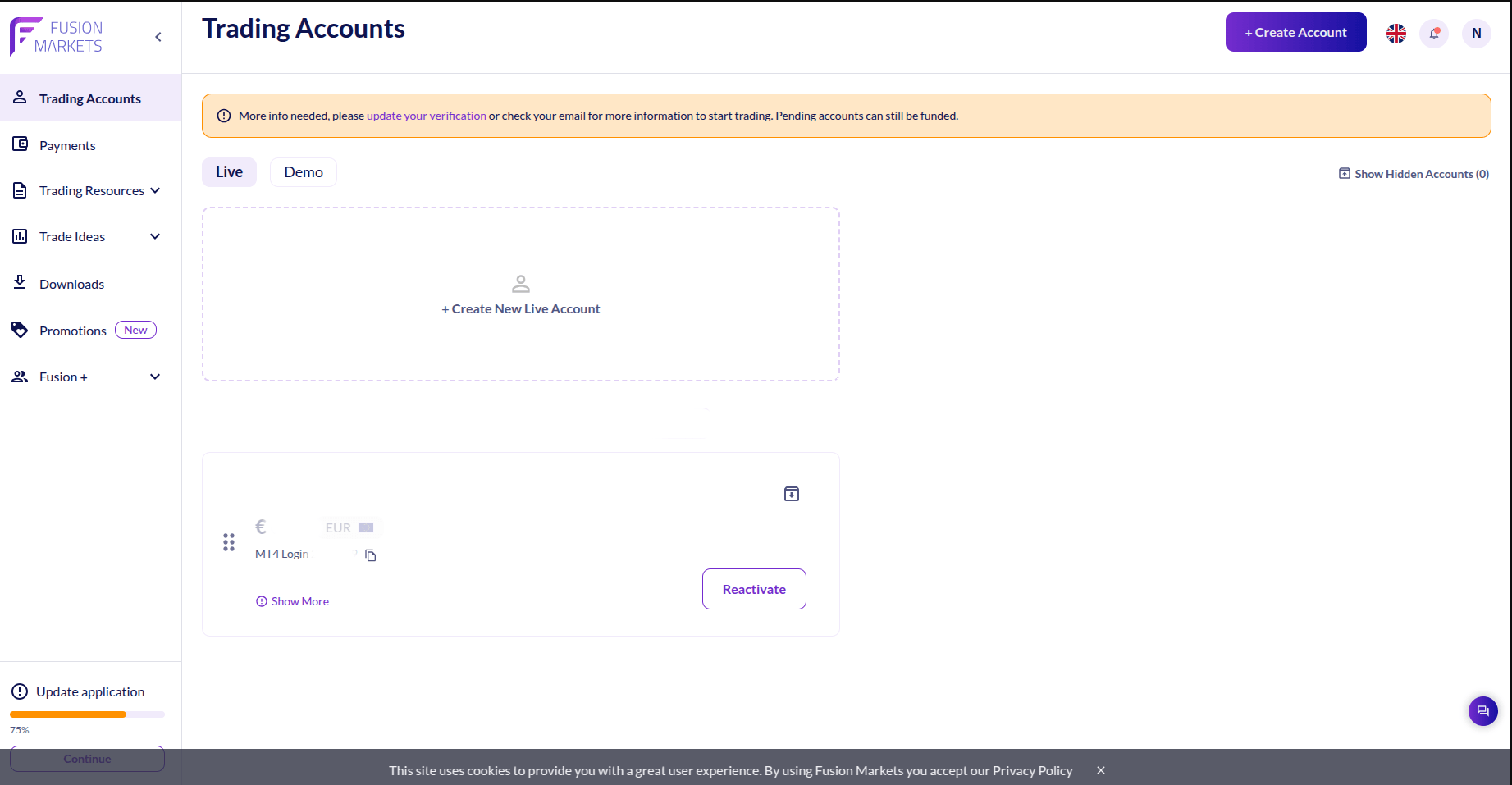
Editorial note: We tested Fusion Markets’ client portal, shown above, which provided a clear and straightforward way to manage administrative tasks like verification and funding. While the dashboard supports account setup and access to resources, we confirmed that trading, charting, and order execution are not available here. To place trades, we had to use a dedicated platform like MT4, and complete identity verification to fully activate the account.
Live Accounts vs Demo Accounts
The most obvious difference is that a live account involves real money and market risk, while a demo account uses virtual funds for practice. However, the differences go deeper than this.
In a demo, orders are often filled instantly at the quoted price. In a live account, your order must be matched with a real counterparty. If the market is moving fast, you may face slippage, requotes, or partial fills, where only a portion of your order is executed at your desired price.
Additionally, demo price feeds may not always show the same market depth as their live counterparts. A live account might show much wider spreads or significantly less liquidity during major news releases, making it harder to exit a position than it would be in demo mode.
Some tools like advanced chart packages, technical indicators, or third-party add-ons are often restricted to funded accounts and will not appear on your demo terminal.
Another critical difference has to do with margin and liquidations. Demo trades often remain open even if you have insufficient funds to cover your margin or mounting losses. This is not the case with a live account where the broker will automatically close your positions to prevent your balance from going negative.
| Feature | Our Demo Account Testing | Our Live Account Testing |
|---|---|---|
| Funds | We traded with a virtual balance | We deposited real funds |
| Emotional pressure | Usually low | Can be significant |
| Order execution | Our orders were typically filled instantly at the requested price | We experienced real liquidity, slippage, and market conditions |
| Costs | The accounts were free to open and loaded with virtual funds to trade with | Our orders were subject to real spreads, commissions, swaps, conversion charges, and other broker-specific costs |
| We used it for | Practicing and testing | Actual trading and speculation that entails risk of losing capital |
Retail Accounts vs Professional Accounts
The retail and professional classifications are regulatory labels that dictate the level of client protection and flexibility you receive. A retail account is designed for the general public and includes significant safeguards, such as mandatory negative balance protection and eligibility for investor compensation schemes. In contrast, the professional status is reserved for those who meet the criteria for minimum portfolio size, quarterly trading volume, and professional experience in the financial industry.
While professional accounts often grant access to much higher maximum leverage, they typically lack the safety nets provided to retail traders. It is also important not to confuse a “Pro” account label with actual professional categorization. Some brokers use the “Pro” wording as a marketing label for a specific retail pricing tier.
How Account Type Affects Trading Conditions
Your account type impacts almost every aspect of your trading experience, from technical capabilities to the total cost. Key differences usually include the quoted spreads, commissions, and swap rates, as well as the maximum leverage and margin call levels. Some accounts may also restrict your minimum trade size or the specific platforms and instruments you can access.
The base currency of the account is another vital factor. If your deposit currency, account currency, and the asset you are trading do not match, you may face additional conversion charges on every trade. Depending on your choice of account, your expenses might include inactivity fees, deposit or withdrawal charges, and platform or market data fees. Comparing the total costs is the only way to ensure a given account fully fits your strategy.
Main Types of Forex Broker Accounts
Choosing the right account depends on your trading volume, budget, and strategy. While some accounts prioritize simplicity with a spread-only pricing model, others focus on transparency through direct market access and commissions. Below, we briefly cover the most common account types you will encounter when comparing forex brokers.
- Standard Account: This is the most common retail option that typically offers a simplified pricing model where the broker’s trading fees are built directly into the spread.
- Micro Account: These accounts allow you to trade in micro lots consisting of 1,000 base currency units, making it easier to manage risk with a much smaller capital outlay.
- Mini Account: A mini account uses a contract size of 10,000 base currency units to provide a balance of flexibility and exposure.
- Cent Account: Your balance is displayed in cents rather than your base currency, allowing you to place orders with significantly reduced financial risk while trying out new strategies.
- Raw Spread Account: The broker passes on the tightest available market prices with no markups, but charges a fixed commission when you enter or exit positions.
- ECN Account: This account connects you directly to an Electronic Communication Network (ECN), providing deep liquidity and transparent execution through a pool of various market participants.
- STP Account: This type uses Straight-Through Processing (STP) to route your orders directly to liquidity providers without any manual intervention from a dealing desk.
- Pro Account: The name can refer either to a high-tier pricing model for active retail traders or to a formal regulatory classification for those who meet specific professional criteria.
- VIP Account: Designed for high-volume traders or those with large balances, these accounts often include lower spreads, dedicated support, and exclusive platform features.
- Islamic (Swap-Free) Account: These accounts allow traders to hold positions overnight without incurring interest-based swap charges, usually in exchange for a flat administrative fee.
| Account Type | Common Purpose | Typical Pricing Style | Main Caution |
|---|---|---|---|
| Standard | Suitable for general retail trading and speculation with CFDs | Spread-only pricing with marked-up spreads | Wider spreads result in greater long-term expenses |
| Micro/Mini/Cent | Fractional lot trading for lower risk exposure | Pricing could be spread-only or commission-based, depending on the broker | Higher leverage can still result in margin calls despite the smaller nominal value of your positions |
| Raw Spread | Suitable for high-frequency strategies like scalping as spreads often start from zero pips | A commission is charged upon opening and closing positions | Total trading costs depend heavily on liquidity and market depth |
| ECN | Direct market access to interbank liquidity | Spreads are variable and a round-turn commission applies | Execution quality may vary. The ECN label is sometimes used as a marketing term for STP account setups |
| STP | Automated order routing to a pool of liquidity providers without dealing-desk intervention | Commissions are typically charged but spreads may still include a small markup with some hybrid pricing models | Low market liquidity may lead to slippage, partial fills, and requotes |
| Pro/VIP | Intended for institutional-grade or high-volume trading | Tiered commission discounts based on notional trading volume | Most retail forex traders cannot meet the eligibility criteria for this account type |
| Islamic (Swap-Free) | Sharia-compliant accounts with no interest on overnight leveraged positions | Swap charges are replaced by administrative fees or wider spreads | Customers incur administrative charges after a fixed grace period |
Demo Accounts
What a Demo Account Is
A demo account is a simulated trading account funded with virtual money, typically ranging from $10,000 to $100,000 depending on the broker. It is designed to let you learn how a platform works, practice trading, test indicators or automated strategies involving trading bots, and familiarize yourself with a broker’s account types before risking real capital. For many traders, it is the first step to understanding forex trading dynamics, leverage, and pip calculation.
Demo accounts are especially useful because they remove the financial pressure of making mistakes while you are learning about order types, margin requirements, charting tools, and position sizing. They also enable side-by-side platform comparisons, say, MetaTrader 5 versus cTrader, without committing to a live account or undergoing account verification.
How Demo Accounts Work
Demo accounts stream real-time or near-real-time price feeds directly from liquidity providers, calculating profits, losses, swaps, and commissions just as they would for live trades. You can execute orders, set stop-loss or take-profit levels, hedge positions, and monitor your margin in real time. The main difference is that you gain or lose virtual funds rather than real money.
While this environment mirrors the basics of live trading, demo accounts often struggle to replicate live market nuances. Demo order execution usually prioritizes speed, meaning it may not accurately reflect slippage, liquidity gaps, or the dramatic spread widening that occurs during high-volatility events like NFP reports. Many brokers like IC Markets and Pepperstone explicitly disclose these differences in their terms. Ultimately, a strategy that appears highly successful in a demo environment may falter in the live market environment and yield different results.
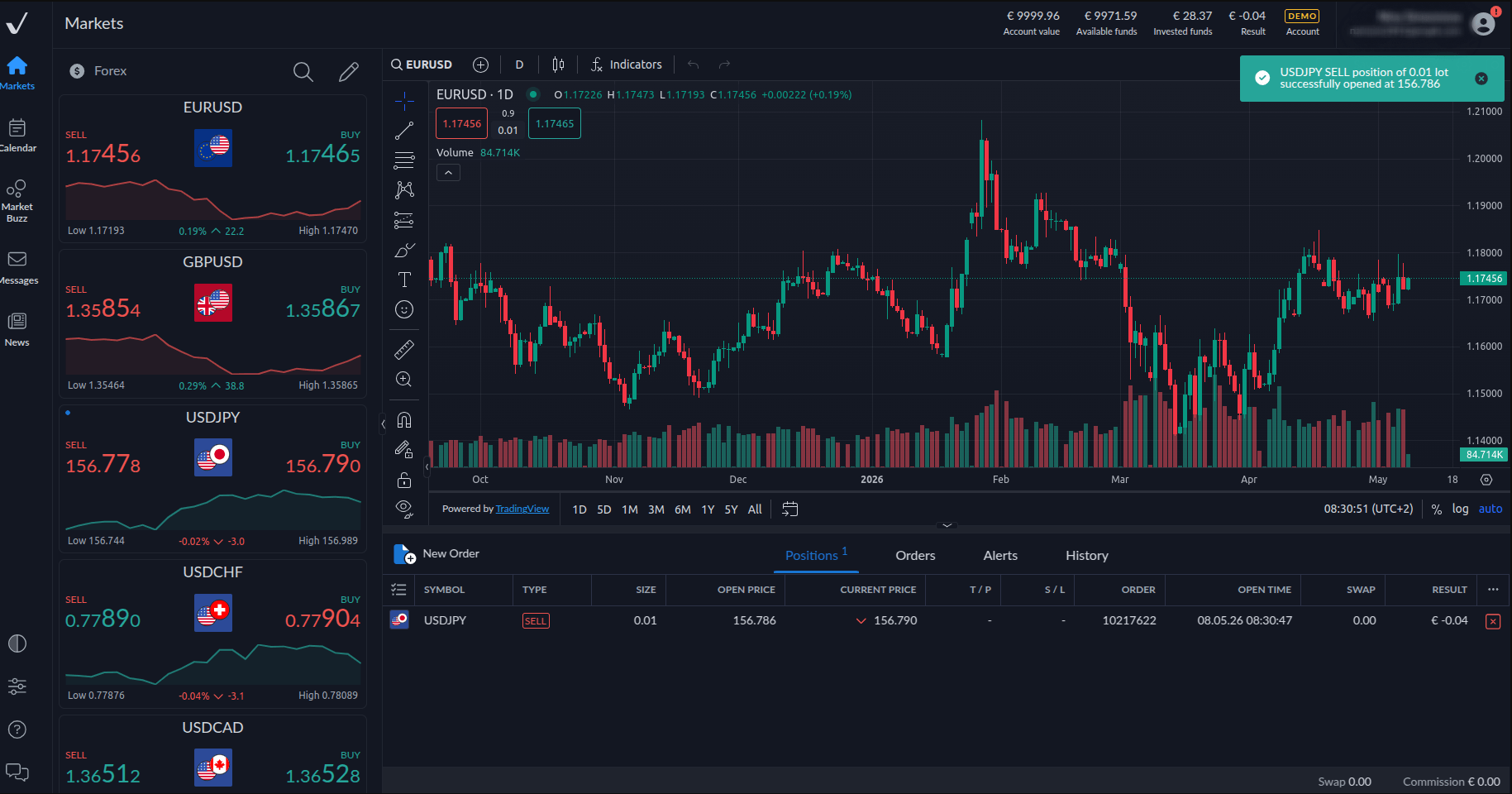
Editorial note: While testing ActivTrades’ demo account, we monitored multiple orders, including a short position in USD/JPY opened at 156.786. The top bar shows all important account metrics, including our total virtual balance of €9,999.96, available funds of €9,971.59, and €28.37 allocated to the position.
Demo Account Features
Standard features often mirror those of live accounts, including charting tools, economic calendars, one-click trading, trade history, export to CSV, and risk management tools like trailing stops or position size calculators. Some demo accounts support automated trading via robots like the MetaTrader Expert Advisors (EAs), custom scripts, and social or copy trading previews. While specifics vary across forex brokers, some of the most common features include:
- Fund Management: Some brokers allow for unlimited virtual top-ups, while others provide a one-time allocation that may expire after a specific period, usually 30 to 90 days. In the case of ActivTrades, our demo account expired after 30 days, but we were able to easily set up a new one.
- Instrument Range: Depending on the broker, you may have access to the full suite of live markets or find yourself restricted to a limited selection of instruments and leverage ratios.
- Data Integrity: Some demo accounts closely replicate the live trading environment, while others may utilize throttled data feeds that do not perfectly mirror real-time market movements. At ActivTrades, we found the demo environment effectively simulated live market conditions.
- Cross-Platform Syncing: Many modern demo environments offer seamless synchronization across desktop, web, and mobile apps to allow for consistent practice on any device.
Before relying on a demo, confirm it matches your target live setup. For example, does the account include weekend gap simulations or third-party add-ons like Autochartist?
Demo Account Limitations
The biggest limitation of demo trading is that it does not fully replicate the live trading environment. There is no real financial pressure when a stop-loss triggers, no hesitation before entering a trade, and no fear of losing a week’s gains in one bad session. Those emotional factors matter more than many beginners expect.
Execution quality can differ, too. In live trading, market gaps, reduced liquidity (for example, during the Asian session), partial fills, wider spreads during news, and slippage can all affect your results. While practicing on a demo account is highly valuable, simulated performance is not a guaranteed indicator of future live-market results. You should view demo trading as essential training rather than definitive proof of a strategy’s profitability.
When Beginners Should Use a Demo Account
New traders should prioritize demo accounts while mastering the technical basics of the market. This includes learning how to place various order types, such as market, limit, and OCO (One-Cancels-the-Other), as well as calculating position sizes, for example, risking 1% of virtual capital on a 0.01-lot position. It is also essential for understanding how to apply leverage responsibly and for seeing firsthand how margin calls are triggered.
A demo account is suitable for building a trading routine without financial risk. You can practice scanning the markets, maintaining a trading journal in Excel or Google Sheets, and enforcing risk management rules, such as limiting your exposure to 1% or 2% per position. Here are a few ideas on how to maximize the value of practicing with a demo:
- Identify a setup: When testing demo accounts, we first locate a clear technical signal, such as a support bounce on a 1H EUR/USD chart.
- Calculate your position size: To control our risk, we size our positions based on our available balance. For instance, when using a $10,000 account with a 1% risk cap ($100) and a 50-pip stop-loss, we divide our $100 maximum risk by the 50-pip distance to arrive at a $2 per pip value, which translates to a 0.2 lot position in a given currency pair.
- Execute and log: We place the order with a stop-loss set exactly 50 pips away, then record the results in our testing log, including key confluence factors such as RSI divergence.
- Review your trade: Once the position closes, we evaluate the outcome to refine our strategy and broker benchmarks.
Randomly clicking buttons bypasses the most critical aspects of the learning process. In contrast, structured practice with a demo account builds the technical muscle memory required to stay disciplined when you eventually face live market volatility.
Key Steps in Transitioning from Demo to Live Trading
Transition gradually to avoid the common mistake of scaling demo wins into oversized live positions. Many regulated brokers impose minimum deposit requirements of $100 to $200 and enable micro-lot trading where a price movement of one pip equals $0.10. It would be best to start with smaller positions rather than standard lots where a one-pip difference is equal to $10.
- Validate your strategy: Spend one to three months in a demo environment to fine-tune your strategy and aim for at least 100 trades with a win rate above 50% and a maximum drawdown of 5%.
- Use discretionary capital: Only fund your live account with disposable income that you can afford to lose without impacting your lifestyle or financial security.
- Scale gradually: Start with micro-lots to ensure your initial live risk matches your demo parameters, typically risking no more than 1% to 2% of your balance per position.
- Prepare for emotional pressure: Anticipate that emotions like fear and greed will be significantly amplified with real money on the line, and use psychological drills to stay grounded.
- Document technical discrepancies: Track the differences between live and demo conditions, specifically noting real-world spreads, slippage during news events, and the impact of overnight swap charges.
- Focus on execution quality: Prioritize your adherence to the trading process and rule compliance over your bottom line profit, as it is normal to see a performance dip of 20% to 50% during the initial stages of the transition.
Standard Trading Accounts
What a Standard Account Is
A standard account is usually the default live account offered to retail traders. It is intended to provide broad access to the broker’s core products including major, minor, and exotic currency pairs, and platform features like charting tools and technical indicators without requiring advanced knowledge of commission structures or specialized execution models.
Standard accounts can still differ a lot. Most are built around spread-only pricing, but some may mix spreads with commissions on certain instruments like forex and precious metals. Some support very small position sizes (typically as small as 0.01 lots), while others are better suited to larger positions. Always check the contract specifications and pricing schedule before opening a live standard account.
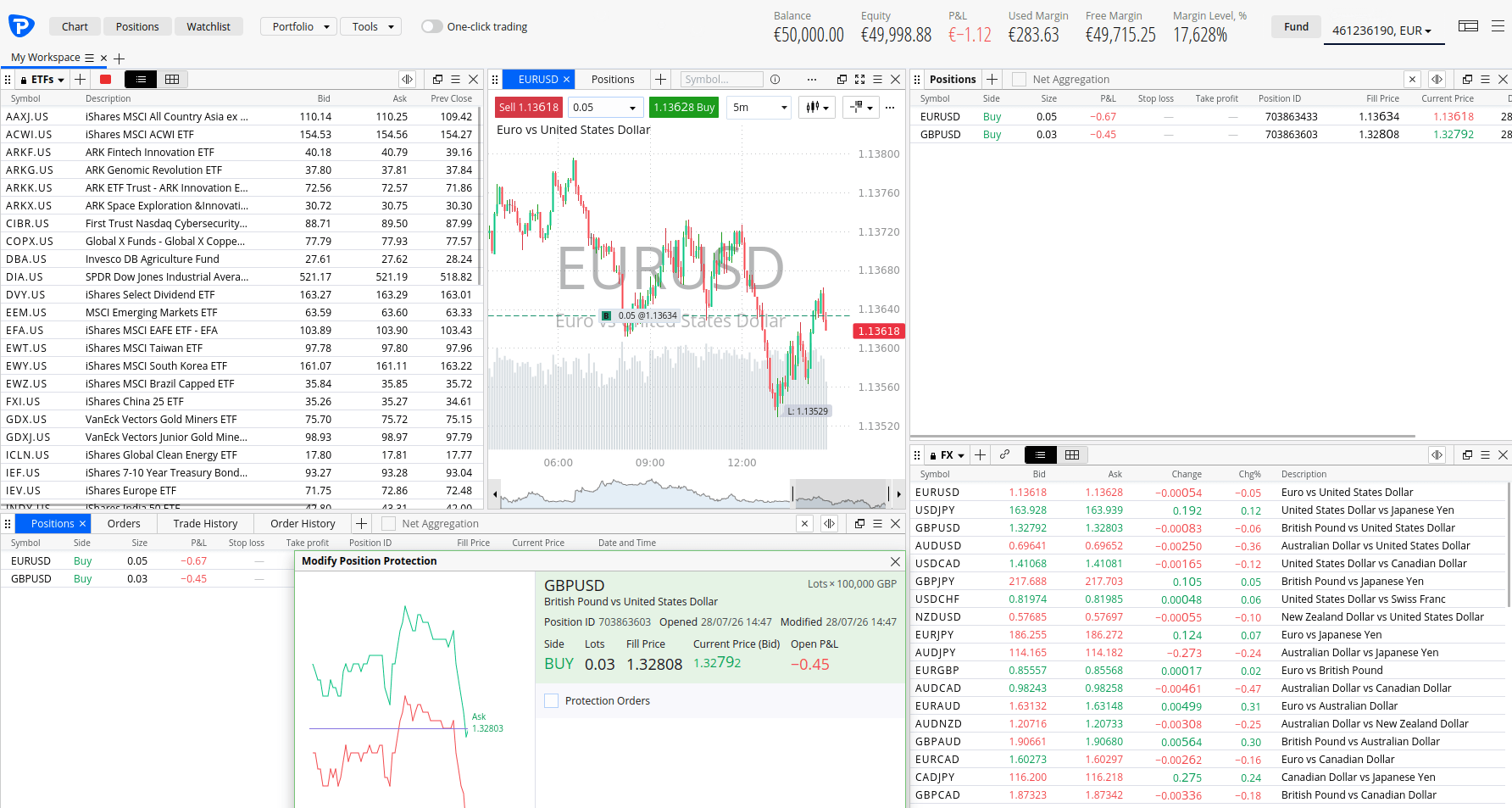
Editorial note: While trading forex on Pepperstone’s WebTrader with a Standard account, we observed built-in markups typically ranging between 1 and 1.1 pips on major pairs. In the screenshot above, the live EUR/USD quote shows a spread of exactly 1.0 pip, with prices at 1.13618 (sell) and 1.13628 (buy). By contrast, Raw accounts at Pepperstone offer spreads from 0.0 pips.
Typical Minimum Deposit
There is no universal minimum deposit for a standard account. Some brokers make standard accounts accessible with relatively small funding amounts, ranging from $50 to $200 in most cases, while others expect a larger opening balance of $1,000 or more. In some instances, there are no specific minimum account requirements, allowing traders to start with any amount they choose.
This was the case while testing Pepperstone where there were no minimum balance requirements but deposits started from $/€10 with most supported payment methods. The required amount can also depend on the platform, your country of residence, the regulated entity serving you, your account base currency, and the products you want to trade.
Instead of looking for a broker with the lowest possible minimum deposit, you should focus on the amount required to realistically execute your risk management strategy. If your starting capital is insufficient to support your planned stop-loss levels and position sizing, a low minimum deposit offers very little practical value.
Typical Spreads and Commissions
Standard accounts are commonly associated with spreads that already include a small markup (1 to 1.1 pips during Pepperstone tests), with no separate commissions on forex trades. The broker generates revenue mainly from the spread rather than charging a lot-based commission per side. However, this is not universal, and some standard accounts include other charges or different pricing by asset class.
When comparing costs, look beyond the spread. Depending on the broker and product, total cost can also include commissions, overnight swaps, inactivity fees, conversion charges, platform or data fees, and other account-specific charges. A standard account with a slightly wider spread may still be reasonable if your trading style is slower and you rarely trade or hold positions briefly. This is also a suitable option for beginners looking to avoid calculating their commissions based on position size.
Available Instruments
Standard accounts often offer the broadest general product access at a broker, but that does not mean every product is available everywhere. Instrument range can vary based on regulatory requirements, platform, and asset class. A broker may offer spot forex only in one region, and forex CFDs or other products in another region, subject to regulation. In Pepperstone’s case, both Standard and Razor accounts offered the same market range during testing, namely over 1,400 tradable instruments.
Before opening the account, verify whether it includes the instruments you actually plan to trade. While a beginner focused on major currency pairs might find a basic setup sufficient, those looking to diversify into indices, commodities, or share CFDs may find that asset availability varies significantly between different platforms and account types.
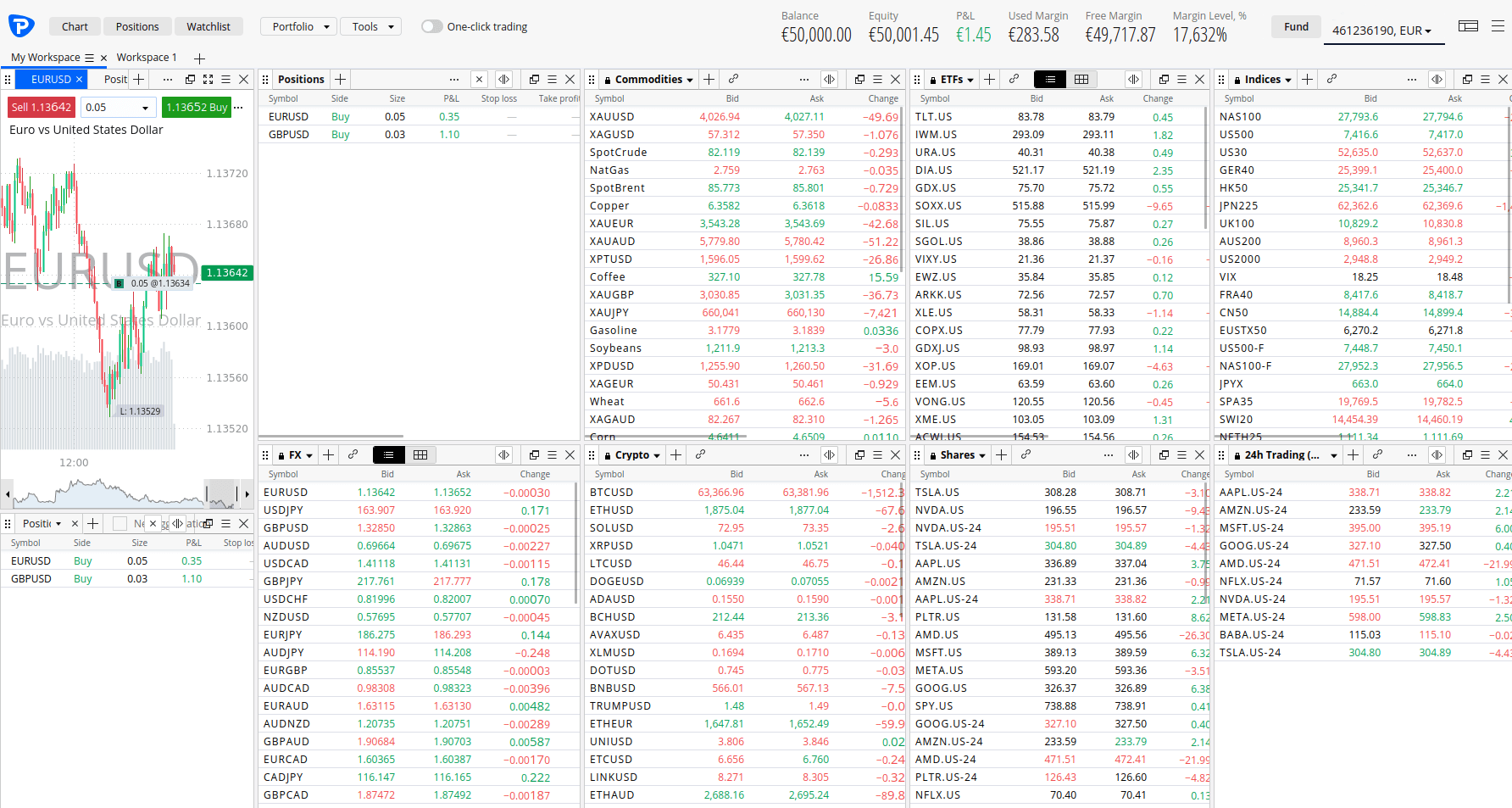
Editorial note: Pepperstone’s Standard account gave us access to more than 1,400 financial markets during testing, including 93 currency pairs, 26 indices, 40 commodities, 31 cryptocurrencies, 95 ETFs, and over 1,100 stocks. The open watchlists above serve to demonstrate this varied market range.
Who Standard Accounts Are Best For
Standard accounts are often a practical fit for new retail traders, occasional traders, and anyone who values simpler pricing structure and broad platform compatibility. They can also suit swing traders who are less sensitive to small spread differences than high-frequency traders or scalpers.
These accounts may be less ideal for short-term strategists who require the lowest possible entry costs, as well as for traders who prefer transparent, commission-based pricing and greater control over execution variables. That does not make standard accounts inferior; it just means they fit some styles better than others.
Pros and Cons of Standard Accounts
Standard accounts are popular because they are easier to understand, but simplicity does not remove trading risk. Costs, leverage, and margin still matter, and many losing retail accounts are opened through standard structures because the trader focuses on convenience instead of discipline.
Key Pros
- Simplified Cost Structure: The spread-only pricing model eliminates the need for separate commission calculations, making it much easier for beginners to track their total transaction costs at a glance.
- Comprehensive Platform Integration: These accounts are compatible with all major trading platforms, including MT4, MT5, TradingView, and cTrader, providing full access to automated expert advisors and technical indicators.
- Low Barrier to Entry: Support for micro-lot trading allows those with smaller starting balances to strictly adhere to risk management rules by risking as little as $0.10 per pip.
- Widespread Availability: This account type is offered by many regulated brokers globally, ensuring that traders can access standard retail protections and leverage limits across multiple jurisdictions.
Key Cons
- Higher Transaction Costs for Scalpers: The wider spreads associated with standard accounts can significantly undermine scalping strategies.
- Variable Features: One broker may offer a massive range of global stocks and cryptocurrencies, while another may limit its standard account users to a basic selection of forex and core commodities like gold and silver.
- Over-Leveraging: Small minimum deposits combined with leverage often lead new traders to take excessive risks that contribute to high retail loss rates.
- Secondary Fees: Inactivity fees, overnight swap rates, and currency conversion charges can accumulate quickly.
Micro, Mini and Cent Accounts
What Are Micro Accounts?
Micro accounts utilize 1,000-unit contracts where one lot is equal to 0.01 of the standard lot and a price movement of one pip corresponds to $0.10, compared to $10 with standard lots. Beginners often prefer these accounts because they provide an authentic trading experience, including live spreads, while allowing them to cap risk at roughly $1 to $5 per trade on a $500 balance.
Micro accounts can be separate account types, or they can simply be standard accounts that allow micro-sized orders. What matters most is the minimum trade size and contract specification, not the label alone. If you are comparing brokers, look at the smallest position size available on the actual platform.
What Are Mini Accounts?
Mini accounts enable forex trading in 10,000-unit increments, or 0.1 of the standard lot, with a pip value of $1. They serve as a middle ground for traders who have outgrown micro accounts, as well as for those pursuing strategies with 5 to 10-pip targets who want to avoid the higher exposure associated with standard lots.
Because mini accounts are not consistently defined across all brokers, you should confirm the underlying unit size, the pip value, and whether the account still supports smaller order increments. If not, you may end up with more exposure than you intended.
What Are Cent Accounts?
Cent accounts denominate all balances and trade sizes in cents. For example, a $100 deposit is displayed as 10,000 cents, and a 1,000-cent lot moves at $0.01 per pip. This account type is designed to help beginners practice position sizing by giving more psychological weight to small amounts. For instance, a $5 position feels much more significant when displayed as 500 cents.
However, the primary disadvantage of a cent account is that these “large” balances can lead to overtrading. Although a 50,000-cent balance represents only $500 in real equity, a significant drawdown will still have real financial consequences. Your discipline ultimately matters far more than how the numbers are displayed.
Managing Exposure on Smaller Accounts
Accounts with smaller lot sizes reduce exposure by scaling down both pip values and margin requirements. For example, on a micro account, a 50-pip stop-loss on EUR/USD risks only $5 based on a 0.01 lot at $0.10 per pip, compared to $50 on a mini account. This allows a $500 deposit to withstand a string of losses while the trader gains experience with live spreads and margin changes.
Even with smaller sizes, leverage remains a major factor. Under ESMA rules retail leverage is capped at 1:30, allowing a micro account with a $500 balance to control up to $15,000 in notional value. Cent accounts scale position‑size calculations down by a factor of 100, so a 50,000‑cent balance (equivalent to $500) lets a trader risk 500 cents ($5) per position when risking 1% of the account equity. Real exposure only drops when strict 1% to 2% risk rules are in place, so disciplined position sizing is ultimately more effective than simply relying on account type labeling to prevent huge losses.
Differences in Lot Size
The term “lot” refers to the contract size used to measure forex positions, directly determining how much each pip movement affects your balance. Common market conventions are a standard lot, mini lot, and micro lot, but brokers may also allow unit-based sizing or use different phrasing on certain platforms. Cent accounts can add another layer because the account balance is shown in cents even if the lot structure still follows standard, mini, or micro conventions.
| Common Term | Size | Practical Effect | What to Check |
|---|---|---|---|
| Standard lot | 100,000 units of the base currency | Larger pip values and higher risk per price move | Minimum trade increments and margin requirements |
| Mini lot | 10,000 units of the base currency | Smaller exposure than with a standard lot | Check if the broker supports fractional increments (for example, 0.11 or 0.12) or restricts you to fixed 0.10 increments. |
| Micro lot | 1,000 units of the base currency | Ideal for live-market practice with minimal financial risk. | Confirm the specific pip value for your instrument, as it may vary outside of major forex pairs. |
| Cent account lot sizing | Balance shown in cents; lot structure varies by broker | Enables the smallest possible exposure for testing strategies. | Ensure you understand how the platform displays margin and P/L to avoid confusion between cents and dollars. |
Who These Accounts Suit Best
Micro, mini, and cent accounts are ideal for beginners mastering live order execution, as well as cautious traders looking to test new strategies or platforms without risking more than $5 per position.
Experienced traders requiring higher volume, tighter execution, or commission-based raw pricing often find these smaller accounts limiting. For high-frequency strategies or larger positions, standard or ECN accounts are generally a better fit.
Pros and Cons of Micro, Mini and Cent Accounts
These account types often serve as bridges between demo and full-size live trading. They can reduce damage from early mistakes, but they do not remove the need for risk management. Emotional trading, revenge trading, and poor leverage decisions can still hurt a small account quickly.
Key Pros
- Lower risk exposure: These accounts offer minimal exposure per position, allowing a smaller balance to survive a string of losses.
- Beginner-friendly: They provide a beginner-friendly environment for practicing live trading, teaching traders how to manage real market spreads, margin calls, and swap charges without risking losing their entire deposits.
- Suitable for testing purposes: You can use these accounts to test new algorithmic trading strategies, platforms, or risk management approaches with modest positions before moving to larger ones.
- Helps with building discipline: Starting with smaller units helps you build good habits early on before you move to bigger orders.
Key Cons
- Inconsistent broker definitions: Some brokers define a micro lot as 1,000 units while others simply use it as a label for a standard account with a 0.01 minimum position size.
- Risk of overleveraging: A small deposit can still control a large position with high leverage, making it easier to accidentally wipe out half your balance after a few bad decisions.
- Cent accounts confusion: A massive balance in cents can cause you to take on excessive risk.
- Limited room to scale: You will likely outgrow these accounts in favor of the tighter spreads and larger position sizes.
Raw Spread Accounts
What Is a Raw Spread Account?
Raw spread accounts provide direct access to interbank pricing, often offering spreads as narrow as 0.0 to 0.2 pips on major pairs like EUR/USD. For instance, we traded major currency pairs with spreads from 0.0 pips using a Raw Spread account at IC Markets. Instead of adding a markup to the price, brokers charge a separate commission for each trade, making the total cost more transparent. This often results in lower overall expenses compared to spread-only accounts.
Scalpers and algorithmic traders favor this pricing structure because the narrower raw spreads help minimize the impact of slippage. This structure also rewards larger volumes, as separate commissions often make the cost per pip more efficient at scale. They can also appeal to traders who prefer seeing the spread and commission separately rather than paying a wider bundled spread.
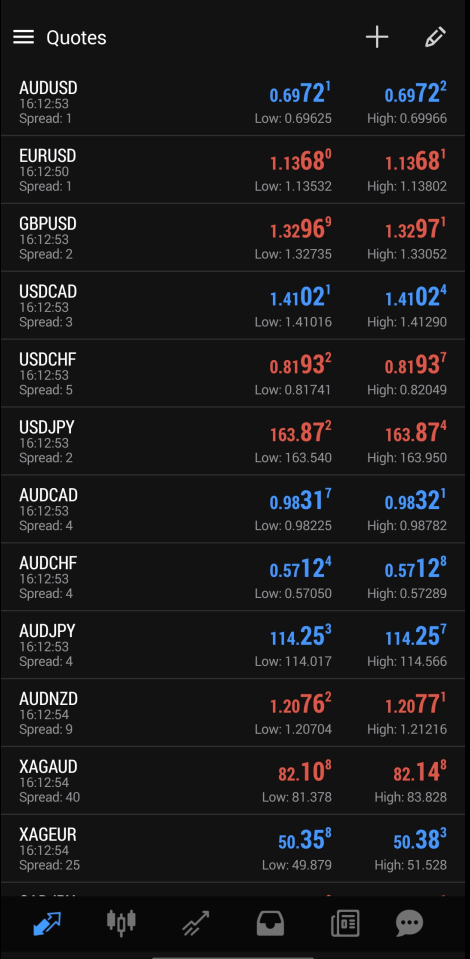
Editorial note: While testing IC Markets’ Raw Spread account on the MT4 mobile app, we noticed considerably tighter pricing. As you can see from the price quotes in the second image, we captured raw spreads as low as 0.1 pips on EUR/USD and USD/CAD and around 0.2 pips on GBP/USD.
How Raw Spreads Work
Raw spread accounts provide direct interbank bid and ask prices, sometimes offering EUR/USD spreads as low as 0.0 pips during peak hours. Rather than marking up the price, brokers cover their costs by charging a flat commission, such as $3 or $3.50 per standard lot, per side. One example is IC Markets, where we incurred commissions of round-turn commissions of $7 per standard lot with a Raw Spread account, connected to MT4.
This structure is ideal for scalpers and day traders targeting 3 to 10-pip price movements, as it eliminates the spread markups that would otherwise eat into their profits. Note that raw spreads can still widen significantly during high-impact news like NFP, the Asian rollover, or unexpected market shocks, behaving exactly like a standard account in those moments.
Commission-Based Pricing
Commission-based accounts replace the traditional spread markup with a flat fee, which often results in significantly lower overall expenses for active traders. Here are two examples for direct comparison.
- Raw Spread Account: A $3.50 commission per side ($3.50 X 2 = $7) plus a 0.1 pip spread (0.1 pips X $10 per pip = $1) brings your total cost to $8 per standard lot.
- Standard Account: A 1.1 pip spread (1.1 pips X $10 per pip) with no commission results in a total cost of $11 per standard lot.
While these savings are substantial, the commission is only one part of the total cost. Overnight swap charges, conversion fees, and inactivity fees still apply depending on your broker, platform, and country. If you frequently hold leveraged trades overnight, a seemingly low-cost, raw account can still become expensive once these additional fees are factored in.
Raw Spread Accounts vs Standard Accounts
The primary difference between these two account types is their pricing structure. Standard accounts typically include the broker’s service fee into a wider spread, while raw accounts provide direct market pricing with tighter spreads and a separate commission per side. While this allows active traders to perform more precise cost calculations, casual traders may find that the simplicity of a standard account outweighs the lower trading costs of the raw-spread option.
Average Spread Comparison of Raw vs. Standard Accounts
| Raw Account at IC Markets | Standard Account at IC Markets | Razor Account at Pepperstone | Standard Account at Pepperstone |
|---|---|---|---|
| 0.06 pips on EUR/USD | 0.86 pips on EUR/USD | 0.1 pips on EUR/USD | 1.1 pips on EUR/USD |
| 0.26 pips on GBP/USD | 1.06 pips on GBP/USD | 0.2 pips on GBP/USD | 1.2 pips on GBP/USD |
| 0.23 pips on USD/CAD | 1.03 pips on USD/CAD | 0.3 pips on USD/CAD | 1.3 pips on USD/CAD |
| 0.22 pips on USD/JPY | 1.02 pips on USD/JPY | 0.3 pips on USD/JPY | 1.3 pips on USD/JPY |
| 0.34 pips on USD/CHF | 1.14 pips on USD/CHF | 0.3 pips on USD/CHF | 1.3 pips on USD/CHF |
Editorial note: Our live testing of IC Markets and Pepperstone showed commission-based Raw and Razor accounts posting near‑zero spreads on majors like EUR/USD (about 0.06 to 0.1 pips), while Standard accounts delivered average spreads of 0.86 to 1.1 pips for the same pair.
Who Raw Spread Accounts Are Best For
Raw spread accounts are usually best for active traders, scalpers, day traders, and strategy-focused traders who want to measure transaction costs precisely. They can also suit traders using algorithmic systems where even small cost differences may impact long-term results.
These accounts are not always the best choice for beginners. If you are still learning order placement, margin, and basic discipline, a simple standard account may be easier to understand. A raw spread account helps only if you actually know how to evaluate the commission structure and whether it fits your trading behavior.
Pros and Cons of Raw Spread Accounts
While raw spread accounts offer professional-grade pricing, they require a higher level of analytical discipline than most retail traders realize. It is important to view them as a specific fee structure rather than a guarantee of increased profitability. Without rigorous risk management, the technical advantages of tighter spreads can be easily offset by poor execution or market volatility.
Key Pros
- Transparent pricing: You can see the exact interbank spread alongside a flat commission, rather than dealing with a hidden markup bundled into a wider spread.
- Advantageous for active traders: If you place 10 or more orders daily, you can significantly reduce your overall expenses with raw accounts.
- Simplified calculation: Using a fixed commission per lot makes it easier to calculate your precise break-even points for short-term scalping strategies.
- Advantageous for high-volume traders: Many brokers offer tiered pricing where the commission rate itself decreases as your total monthly volume increases.
Key Cons
- Possible spread widening: These accounts offer no special protection during news events or market rollovers, meaning raw spreads may still spike dramatically.
- Minimum activity threshold: You generally need to maintain a certain level of monthly trade volume to see a real financial benefit over a simple spread-only account.
ECN Accounts
What Is an ECN Account?
ECN accounts route orders directly to major liquidity providers, such as banks and hedge funds, through an Electronic Communications Network. By bypassing the broker’s dealing desk, these accounts offer variable spreads that often average 0.0 to 0.3 pips for major pairs like EUR/USD.
Instead of adding a price markup, brokers charge a commission typically ranging from $2.25 to $3.50 per lot. While we tested BlackBull Markets with an ECN Standard account, for example, we incurred no commissions, but ECN Prime accounts are subject to a $7 round-turn commission per standard forex lot. Similarly, our tests on Vantage Markets’ Raw ECN account revealed spreads from 0.0 pips and $6 round-turn commission. It is important to note that the ECN label varies significantly across the industry. A true ECN setup offers depth-of-book visibility and Level II pricing, whereas many brokers simply apply an ECN label to standard commission-based models.
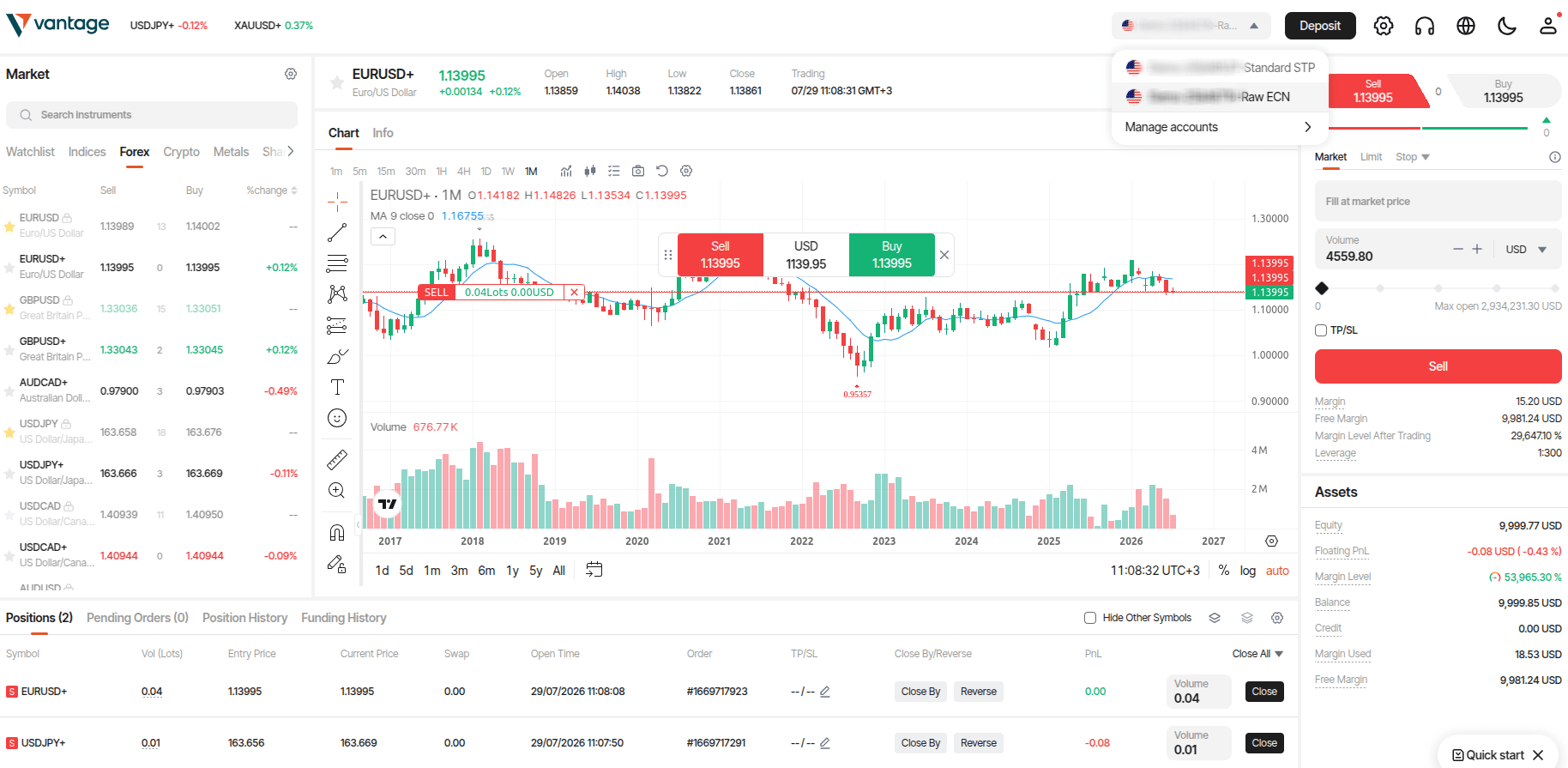
Editorial note: While testing Vantage Markets’ Raw ECN account on WebTrader, we had access to institutional-style pricing. On EUR/USD, the live chart and order panel pictured above show a 0.0-pip spread, with a 1.13995 bid and 1.13995 ask as our orders were routed directly through ECN.
How ECN Execution Works
ECN execution matches your orders directly with liquidity providers in the interbank market. This results in variable spreads that may shift from 0.1 pips during the London open to 3.0 pips or more during NFP releases. Fills occur at the best available bid or ask price with minimal latency. This ensures no requotes, although partial fills are still possible during dramatic market movements.
It is important to remember that ECN execution does not eliminate risk. Slippage can still occur during major news releases and black swan events, and under EU retail forex trading rules, 1:30 leverage on major pairs means the initial margin requirement is about 3.33% of position value. This can make accounts more vulnerable to margin calls if losses grow quickly. Execution quality depends on actual liquidity levels. Traders can test these conditions by monitoring the live order book on a demo account.
Market Depth and Liquidity Access
ECN accounts often provide access to Level II order book data, which shows the current liquidity depth across multiple price levels. For example, you might see a bid for 5.2 million units for EUR/USD at a price of 1.0800. For a retail trader, this simply means there is enough volume to fill 52 standard lots (5,200,000 / 100,000 units per lot) at that exact price. This transparency helps scalpers and high-volume traders gauge their “fill confidence”, allowing them to see whether larger orders will be filled instantly or if a significant slippage may occur due to thin liquidity.
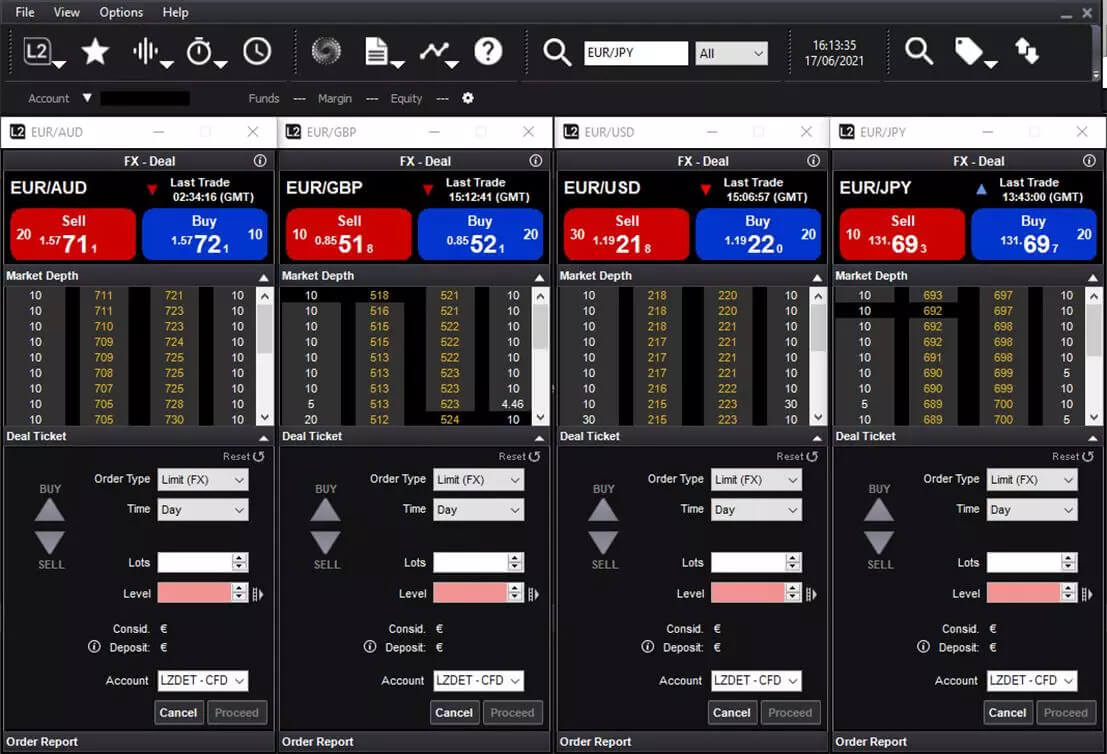
Editorial note: We used IG’s L2 Dealer with Depth of Market (DoM) ladders on a DMA account with raw pricing, which allowed us to track liquidity in real time. Based on our experience, this setup provides a clear view of market depth while maintaining the low latency needed to evaluate execution quality against our benchmarks.
However, the availability of this data depends heavily on your choice of platform. While MT4 lacks native Depth of Market (DOM) features, more advanced platforms like cTrader or MT5 offer it as a standard tool. Even with these tools, traders must remain cautious. Market depth updates in less than 100 milliseconds but can evaporate instantly during high volatility periods.
ECN Spreads and Commissions
ECN accounts usually combine variable spreads with a separate commission. In quiet and liquid markets, spreads may be quite tight. Around news or periods of uncertainty, they can widen sharply. Traders who focus only on the lowest quoted spread often miss the real picture because commissions, slippage, and overnight holding costs still affect their profitability.
If you compare ECN pricing, do it over time and for instruments you actually trade. A setup that looks efficient for major forex pairs during active sessions may be less attractive on less liquid pairs or if you regularly hold trades overnight and incur financing costs.
ECN Accounts vs Market Maker Accounts
A market maker typically acts as the counterparty to your trades and may internalize order flow to manage its own risk, whereas an ECN model focuses on routing orders through a network of external liquidity providers. Both structures are common within highly regulated frameworks, and their effectiveness largely depends on the broker’s execution speed and transparency.
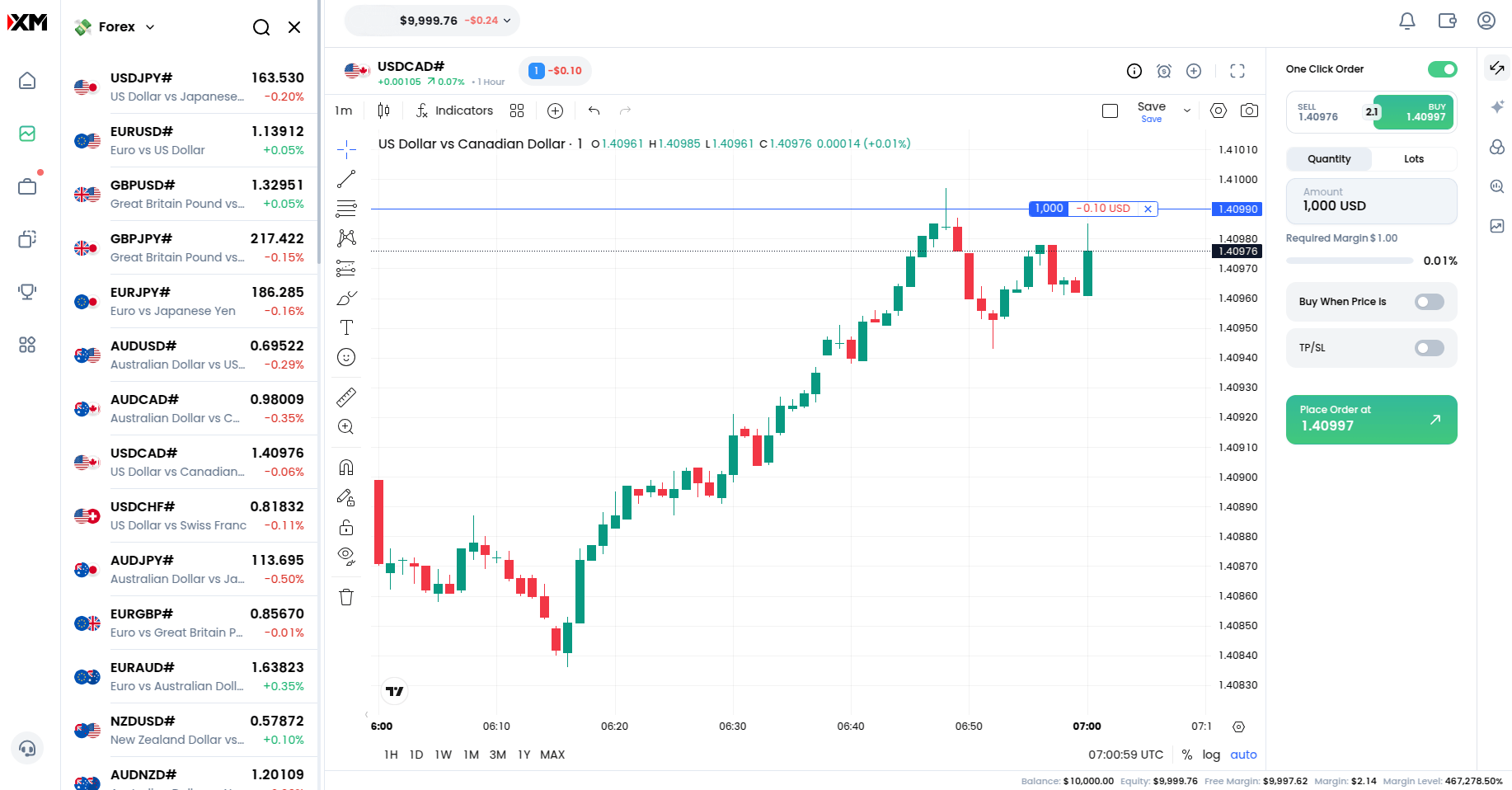
Editorial note: While testing XM, we observed a typical market-maker pricing, where trading costs are built into the spread rather than charged separately as a commission. On USD/CAD, the order ticket above shows a 2.1-pip spread, with quotes at 1.40976 sell and 1.40997 buy.
You should always evaluate the functional performance and cost structure of different accounts. This includes how the broker manages potential conflicts of interest, their average execution speed, and whether their pricing model (spread-only or commission-based) aligns with your specific trading frequency and strategy.
Average Spread Comparison of ECN and Market Maker Brokers
| Forex Pair | ECN Standard Account at BlackBull | Classic Account at Fusion Markets | Commission-Free Retail Account at Plus500 | Ultra-Low Account at XM |
|---|---|---|---|---|
| EUR/USD | 0.9 pips | 0.91 pips | 0.9 pips | 1.1 pips |
| GBP/USD | 0.9 pips | 0.95 pips | 1.6 pips | 1.3 pips |
| USD/CAD | 0.9 pips | 0.94 pips | 2.0 pips | 2.2 pips |
| USD/CHF | 1.2 pips | 1.02 pips | 1.7 pips | 1.5 pips |
| USD/JPY | 0.9 pips | 0.94 pips | 1.8 pips | 1.3 pips |
Editorial note: Our live testing of commission-free accounts showed the ECN pricing model at BlackBull and Fusion Markets delivers average spreads under 1 pip across most majors, whereas the spreads of market makers like Plus500 and XM widened noticeably on pairs like USD/CAD and USD/JPY. We used commission-free accounts while testing the four brokers, the only difference being BlackBull and Fusion Markets offer ECN pricing, while Plus500 and XM generally act as market makers with in-house dealing desks.
Who ECN Accounts Are Best For
ECN accounts are often best-suited for experienced traders, active intraday traders, and those who care a lot about spread behavior, liquidity conditions, and execution quality. They may also suit traders who use short-term strategies and want to see pricing that reflects changing market depth.
These accounts are generally less beginner-friendly than a basic standard setup. It is easy for new traders to get caught up in ECN branding, assuming that sophisticated execution will somehow fix a flawed strategy. In reality, no amount of advanced technology can replace discipline, proper position sizing, and strict risk control.
Pros and Cons of ECN Accounts
While ECN accounts provide institutional-grade execution, they require a more disciplined approach when it comes to cost monitoring because the combination of variable spreads and commissions usually favors high-volume over casual traders.
Key Pros
- Direct market access: Your orders are placed into a centralized network where they are matched against the best available prices from a diverse pool of participants, including major banks and other traders.
- Interbank spreads: You can benefit from significantly tighter pricing, such as EUR/USD averages of 0.1 to 0.3 pips during the London session, which can save active scalpers substantial money on transaction costs over time.
- Suitable for scalping and high-frequency trading: These accounts offer Level II price data on platforms like cTrader or MT5, allowing you to see exactly how much volume is available at various price levels.
- Volume-based incentives: Some brokers offer tiered commission structures where your costs per lot decrease as your monthly trading volume increases.
Key Cons
- Reduced efficiency for long-term positions: Paying commissions on top of overnight swaps often makes these accounts less cost-effective for swing traders.
- No volatility buffer: Since you are dealing with raw market prices, you are fully exposed to natural spread widening during news events or low-liquidity periods.
STP Accounts
What Is an STP Account?
STP stands for Straight-Through Processing, where your orders are sent directly to a pool of liquidity providers via automated gateways. With this pricing model, there is no manual price quoting or intervention as is the case with market makers. Retail STP accounts usually feature variable spreads, with a nominal broker markup in some instances.
The broker avoids the potential conflict of interest often associated with traditional market makers as orders are passed directly to its liquidity providers. Keep in mind that the STP labeling also varies across brokers, so you should always check their execution policy for details on liquidity providers and routing rules.
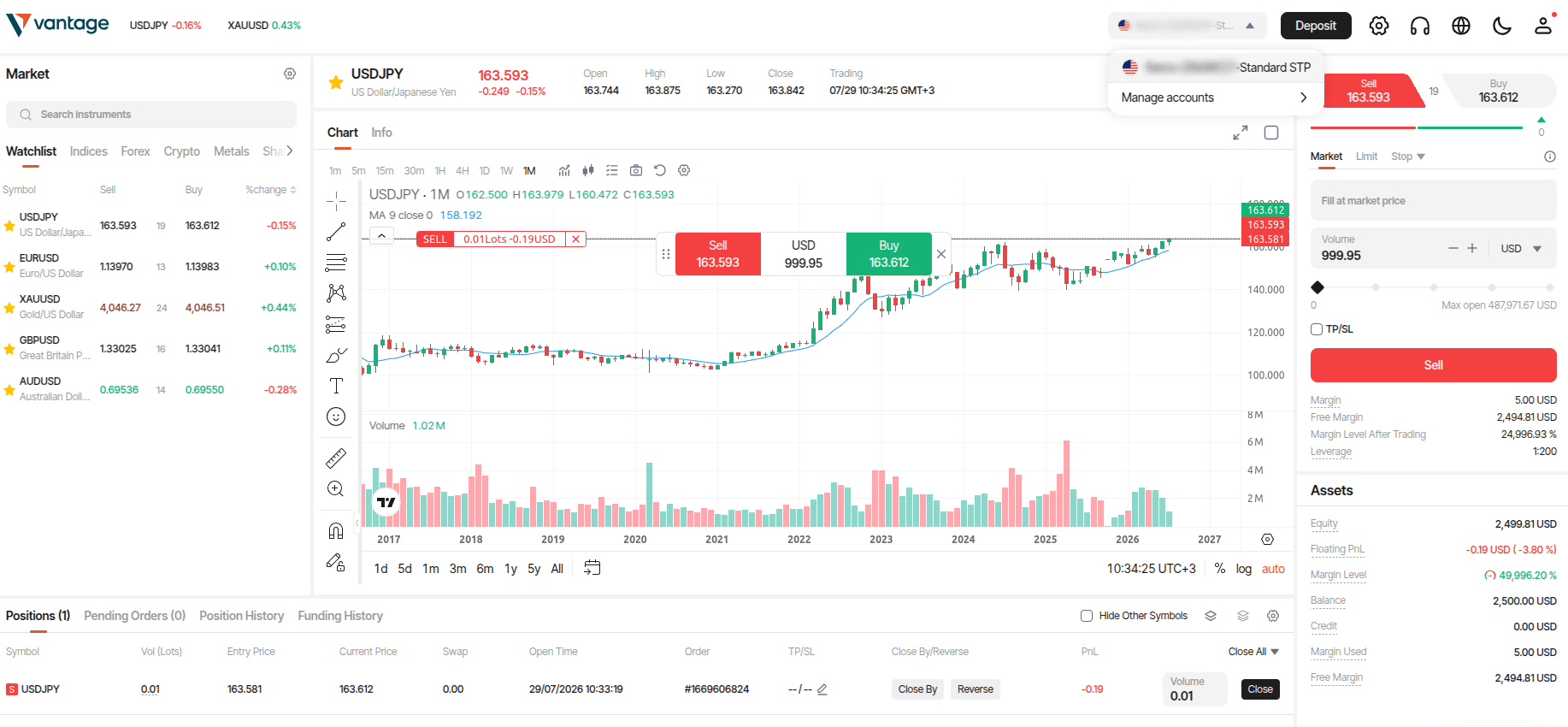
Editorial note: Platform testing on Vantage’s Standard STP account confirmed direct order execution on WebTrader. As shown in our open positions log, USD/JPY traded with a 1.9-pip variable spread (163.593 sell / 163.612 buy) at the time, and no additional commissions.
How STP Execution Works
When you place an order, it is routed to an external liquidity pool and sometimes combined with a small broker markup. While spreads can be as low as 0.2 or 0.3 pips during the London session, they can expand during major news releases. The broker profits from the markup, although commissions are also charged with some STP accounts with a hybrid pricing model.
In practice, you can expect fill rates above 98%, though slippage is still common during high volatility. Testing STP accounts in demo format enables you to monitor for requotes during news, compare spreads during different forex sessions, and see how markups compare against raw interbank rates.
STP Accounts vs ECN Accounts
STP and ECN accounts are often grouped together because both are marketed as alternatives to traditional dealing-desk models. With the STP model, your orders are filled by a single liquidity provider at the best available price they offer, rather than being matched against multiple participants as is the case with ECN.
The ECN model aggregates pricing from a greater pool of interbank market participants and provides order-book transparency with Level II data. It ensures your order is matched against the absolute best bid or ask price across the entire network.
Average Spread Comparison of STP Standard and Raw ECN Accounts at Vantage Markets
| Pair | STP Standard Accounts | Raw ECN Accounts |
|---|---|---|
| EUR/USD | 1.3 pips | 0.1 pips |
| GBP/USD | 1.5 pips | 0.3 pips |
| USD/CAD | 1.2 pips | 0.1 pips |
| USD/JPY | 1.8 pips | 0.3 pips |
| USD/CHF | 1.4 pips | 0.1 pips |
Editorial note: While testing Vantage Markets, we established that Raw ECN accounts offer near-zero spreads averaging 0.1 to 0.3 pips on major pairs like EUR/USD and GBP/USD, whereas STP Standard accounts consistently offer marked-up spreads averaging 1.2 pips to 1.8 pips on some majors.
STP Pricing Models
STP accounts typically use a spread markup model, where the broker adds a small fee to raw market prices. For example, if the interbank spread for EUR/USD currently is 0.2 pips, the broker may add a 0.4-pip markup, which results in an overall spread of 0.6 pips. Some brokers use a hybrid model, charging a commission on top of the spread markup.
Who STP Accounts Are Best For
STP accounts can suit traders who want an execution model marketed around external routing but do not necessarily need depth-of-market tools or a specialized ECN-style setup. They may appeal to discretionary traders who want straightforward access to forex pricing without moving immediately into a more technical account structure.
They are also a reasonable choice for traders who understand that the label itself is only part of the story. If you are willing to compare real-world spread behavior and order quality, an STP account can be a practical option.
Pros and Cons of STP Accounts
STP accounts can be a useful middle ground, but they still require due diligence as there is still a possibility of slippage, widening spreads, or strategy losses.
Key Pros
- Automated routing: Your orders are sent directly to a pool of liquidity providers, which significantly reduces rejections and typically results in high fill rates of 98% or more.
- Ideal for swing traders: STP accounts are a more economical alternative to standard accounts for those placing several orders a week.
- Lower barrier to entry: These accounts often have lower minimum deposit requirements than ECN setups, making it easier for developing traders to access institutional-style routing with a smaller starting balance.
- Reduced conflict of interest: Brokers primarily profit from a small markup added to spreads rather than trading against you.
Key Cons
- Exposure to market thinning: Variable spreads can still widen during the Asian session or the Friday market close.
- Potential for rejections: Some liquidity providers within an STP network reserve the right to reject an order at the last millisecond if the price moves.
- Variable slippage on larger orders: Larger positions may suffer more significant slippage if a specific liquidity provider cannot fill the entire order at once.
Pro and VIP Accounts
What Pro Accounts Are
“Pro” usually refers to higher-tier trading accounts aimed at more active or experienced clients, but the term has two different meanings. In some instances, it refers to lower-cost or more advanced accounts available to regular retail clients. In other cases, it is associated with the professional client categorization in some regulatory jurisdictions. Always inquire whether the account is simply a pricing tier or a specific legal client categorization. Note that this section focuses on higher-tier accounts for active clients.
What VIP Accounts Are
These are generally premium accounts for clients with larger balances, higher monthly trading volumes, or a longer relationship with the broker. In some cases, these accounts require reaching a specific balance threshold, while in others, traders should receive special invitations. VIP accounts may include service upgrades such as:
- Priority customer support
- Commission and spread discounts
- Dedicated account managers
- Preferential overnight financing rates
- Access to exclusive seminars and events

Spread and commission discounts for VIP accounts at FxPro
Higher Deposit Requirements
Pro and VIP accounts often come with higher barriers to entry, but there is no universal threshold. Some brokers base eligibility on account equity, others on monthly trading volume, and a third group may use a combination of factors. Requirements can also differ based on region or trading platform.
Avoid upgrading your account simply for the sake of it. Increasing your deposit only makes sense if the higher balance aligns with your risk tolerance and trading strategy. Overfunding your account can lead to unnecessary physiological pressure, which often amplifies the emotional impact of every loss and leads to irrational decisions.
Lower Trading Costs
While Pro or VIP accounts can offer tighter spreads, lower swap rates on overnight positions, and commission rebates, these benefits are often contingent on maintaining high trading volumes or other broker-specific conditions. You must look beyond the marketing language to account for additional costs like currency conversion charges or inactivity fees, as lower spreads and commissions alone do not guarantee the account is more cost-efficient for your specific strategy.
Priority Support and Extra Services
These accounts may include dedicated support channels, personal account managers, platform training, or access to tools for market research and analysis. Such services can be useful, especially for traders who value faster customer support or need assistance with platform setup. However, it is vital to distinguish these services from investment advice. These additional features can improve your administrative efficiency, but they do not mitigate market risk or ensure good results.
Who Pro and VIP Accounts Are Suitable For
Pro and VIP accounts are best suited for well-capitalized, experienced traders who can objectively evaluate pricing models and can satisfy the higher monthly volume requirements. These accounts offer value only when a trader’s volume is high enough to offset the requirements through lower costs or specialized service features. Conversely, beginners typically benefit more from the simplified pricing, enhanced protections, and smaller position sizes found in standard accounts.
Pros and Cons of Pro and VIP Accounts
These accounts are built for clients who treat trading as a business, offering a more institutional environment where the quality of the fills and the reduction of overhead are the primary drivers of long-term profitability. Here are their main advantages and disadvantages:
Key Pros
- Substantial cost savings for high volume: Active traders can significantly reduce their overhead, often saving hundreds of dollars per month compared to standard retail pricing.
- Operational and technical upgrades: The accounts often include perks like free VPS hosting, priority support, and advanced analytical tools.
- Tailored trading conditions: The VIP status sometimes unlocks lower swap rates and higher interest on unutilized margin.
Key Cons
- High monthly volume requirements: The high minimum deposits and monthly trading volumes can force under-capitalized traders into taking excessive risks to maintain their status.
- Psychological pressure: Maintaining the substantial equity required for these tiers can increase emotional stress.
Islamic Swap-Free Accounts
What Is an Islamic Account?
Islamic accounts, also referred to as swap-free accounts, are designed to facilitate market access for clients whose financial activities must align with the Sharia principles. The most distinctive feature of these accounts is the absence of interest (swaps) on overnight leveraged positions held after the forex market closes for the day.
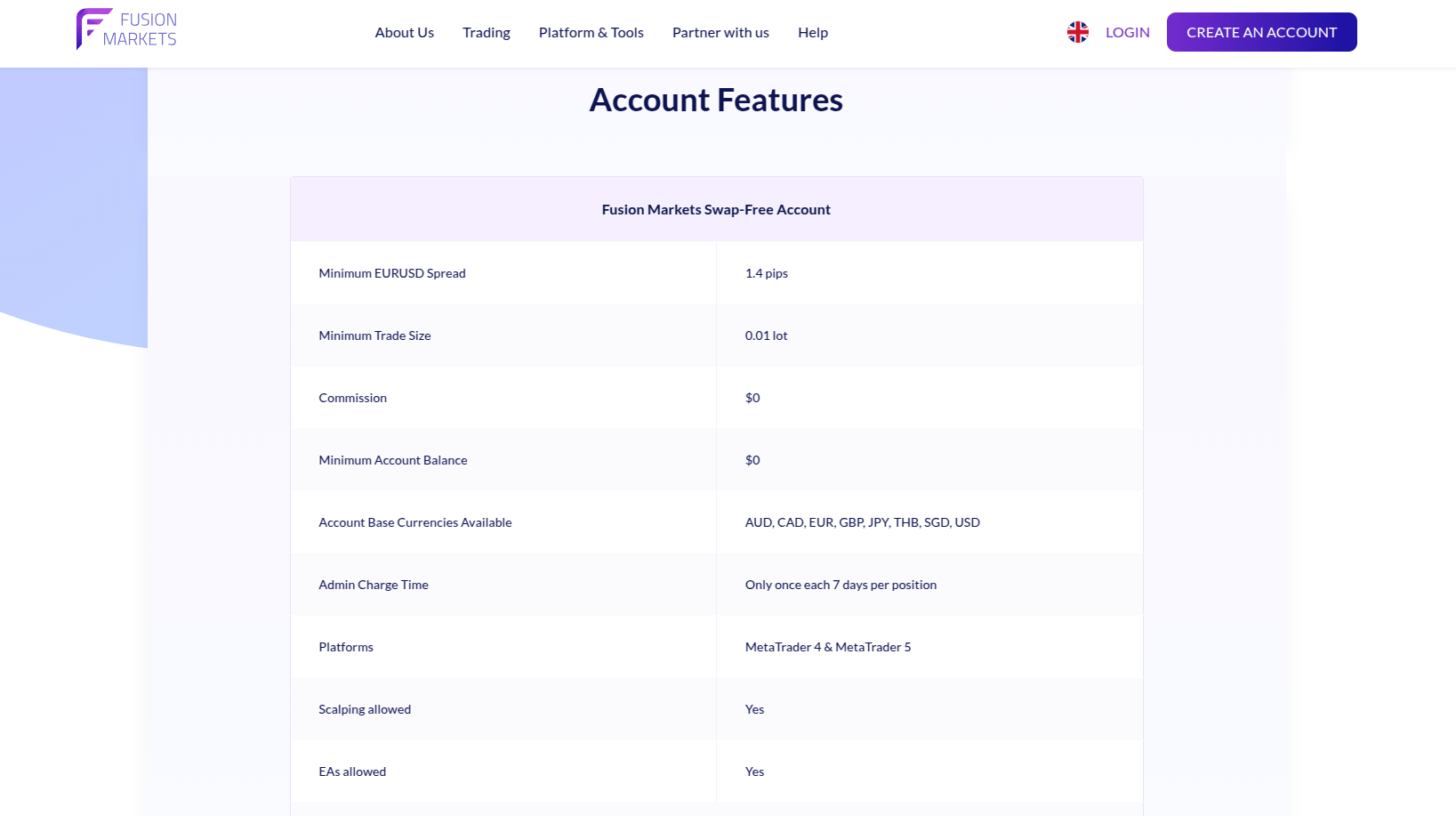
Editorial note: While reviewing Fusion Markets’ swap-free account, we were able to trade with zero commissions and minimum spreads from 1.4 pips on forex majors. There were no minimum balance requirements and we could choose from multiple base currencies but we opted for USD. The broker charged us administrative fees after a 7-day grace period.
How Swap-Free Trading Works
In a standard leveraged account, holding a position past the daily market close triggers a financing adjustment based on the interest rate differential between the two currencies in a pair. A swap-free account eliminates these charges to accommodate Muslim traders who cannot pay or receive interest for religious reasons. Instead, administrative fees are charged after a specific grace period, which varies across forex brokers.
- Administrative fees: A fixed, transparent administrative fee may be charged per lot for positions held past the daily rollover point. The fees are instrument-specific and depend on the specific pair traded. To give you some context, at Fusion Markets we incurred administrative fees of $60 on EUR/USD, $20 on GBP/USD, $50 on USD/CAD, and $120 on USD/JPY and USD/CHF. The fees were significantly higher for positions in precious metals like XAU/USD and amounted to $500.
- Grace periods: Many brokers offer grace periods where no administrative fees are applied for the first 2 to 7 days. In the case of Fusion Markets, we benefited from a 7-day grace period and were charged only once per week.
- Wider spreads: In some cases, the fees are integrated into the bid-ask spread, resulting in slightly higher entry costs compared to regular swap-based accounts. Some brokers like Fusion Markets, for example, charge no commissions on swap-free accounts but widen the minimum spreads to 1.4 pips on major currency pairs.
Eligibility and Other Constraints
The availability and product range for swap-free accounts often depend on a broker’s individual policies. Traders must look beyond the interest-free feature and should familiarize themselves with the constraints associated with this account type:
- Instrument restrictions: While major currency pairs are almost always eligible, exotic pairs, cryptocurrencies, and certain CFDs may be excluded from swap-free trading. Exotic pairs like USD/TRY have massive interest rate differentials. Such was the case at Fusion Markets, where we were unable to trade this pair without swaps. If a broker lets you hold these for free, they are essentially paying a high daily interest rate to their own liquidity provider on your behalf.
- Verification requirements: Most brokers require formal documents (for example, a letter from an imam) or a declaration of faith to open these accounts, as they are intended for those whose religious beliefs mandate them. In some instances, swap-free accounts are available only to customers from Muslim-majority countries like the UAE, Qatar, and Oman.
- Cost reclassification: It is a common misconception that swap-free means free of charge. Beginners should carefully examine the broker’s product schedule to identify where administrative fees might replace traditional swaps, especially for long-term swing trading strategies.
Pros and Cons of Swap-Free Accounts
Swap-free accounts are a specialized solution for traders who need to navigate the market without traditional interest-based financing. While these accounts solve the primary issue of Riba (interest in Arabic), they often come with different trade-offs that impact your long-term profitability.
Key Pros
- Religious and ethical alignment: These accounts allow Muslim traders to participate in the global markets while remaining Sharia-compliant.
- Lower costs for short-term holds: There are no additional fees when holding positions for a few nights due to the brokers’ grace periods.
- Simplified cost calculations: The flat administrative fees make it easier to calculate the exact cost of carrying a leveraged trade over extended periods.
- No negative carry: In standard accounts, holding certain pairs can result in daily negative swaps that gradually eat into your profits. Swap-free accounts neutralize this specific drain on your equity.
Key Cons
- Limited asset range: Brokers often exclude high-yielding exotic pairs from swap-free trading due to their higher swap costs, which make it difficult to administer this pricing model fairly.
- Wider spreads: Some brokers offset the absence of swaps by widening the spreads. For instance, minimum spreads for EUR/USD at Fusion Markets start from 1.4 pips for swap-free traders compared to 0.9 pips for regular accounts.
- Strategy restrictions: Using a swap-free account for carry trading or arbitrage can lead to account reclassification or outright closure.
Managed and Copy Trading Accounts
What Are Managed Accounts?
Managed accounts offer a solution for those who wish to participate in the financial markets without directly executing trades themselves. A professional money manager or algorithm enters and exits positions on your behalf, using capital you have allocated for this purpose.
These accounts are particularly appealing to people who lack the time or expertise required for manual trading. The structure of these accounts can vary significantly depending on the level of control and transparency required. The most prevalent models in the industry include PAMM, LAMM, and MAM, but copy trading is sometimes also grouped into this category.
What Are PAMM Accounts?
A PAMM account, short from Percentage Allocation Management Module, acts as a mini-mutual fund where multiple investors pool their capital into a single master account managed by a professional. The core of the PAMM structure is its proportional distribution of funds. If a person contributes 20% of the total pool’s capital, they are automatically allocated 20% of the profits and 20% of the losses, respectively.
Instead of placing individual trades for every client, the account manager places one bulk order for the total pool. The broker’s software then instantly divides the profits or losses among individual investors based on their contribution to the pool.

PAMM accounts at Vantage
In exchange for their expertise, the account managers typically charge a performance fee (often 10% to 35% of the net profits). The fee is usually protected by a high-water mark, meaning the manager only earns a commission when the account’s value exceeds its previous peak. This ensures that investors are not charged twice for the same growth and that the manager is only rewarded for true performance.
What Are MAM Accounts?
Abbreviated as MAM, the Multi-Account Manager structure also uses a pooled model, designed for managers who require more granular control over capital distribution. Unlike a PAMM, where capital is merged into a single pool, a MAM account keeps each investor’s funds in their own individual sub-account. This allows the manager to apply different allocation methods based on each client’s risk appetite and goal.
For example, a manager can assign larger lot sizes to an investor with high risk tolerance while simultaneously placing smaller, conservative orders for another, all from a single control terminal. There are different distribution models, such as fixed-lot or proportional equity allocation. The manager handles the execution, while the broker’s software instantly calculates and mirrors trades across the connected sub-accounts.
What Are LAMM Accounts?
LAMM (Lot Allocation Management Module) is a more straightforward account management structure where trade distribution is based on fixed lot sizes rather than equity percentages. The account manager assigns a specific number of lots to be traded for each sub-account whenever a position is opened in the master account. For instance, a manager might set the system to always execute 0.1 lots for John and 0.5 lots for Jack, regardless of how the underlying balances of those accounts change over time.
The structure provides a high degree of transparency and simplicity, but it requires investors to be more vigilant about margin management. Since trade size in pure LAMM setups does not automatically scale down if an account balance drops, there is a higher risk of over-leveraging compared to percentage-based models. LAMM accounts are primarily utilized by investors with significant capital who want to maintain strict control over their exact market exposure, ensuring that their risk is defined by a specific contract size rather than a percentage of their total equity.
What Are Copy Trading Accounts?
Copy trading, sometimes referred to as social trading, allows traders to automatically replicate the real-time positions of a professional strategy provider within their own accounts. Unlike pooled funds in managed accounts, the capital remains in the follower’s account. Trades can be copied automatically or manually. Here are the main features and aspects of copy trading accounts to consider, although they may vary from one broker to the next:
- Proportional position sizing: Many copy trading accounts use equity-based multipliers. If you allocate $1,000 to a signal provider with a $10,000 balance, the system will open a 0.01 lot position for every 0.10 lots the provider trades.
- Customizable risk tools: Followers can typically set hard stops, such as a maximum drawdown percentage, which automatically disconnects the account if losses exceed a specific threshold.
- Slippage gap: Your net results may differ from the provider’s due to execution lag, varying spreads between different account types, and the speed of the platform’s copy trading technology.
- Performance fees: Signal providers are usually compensated through a performance fee or a flat monthly subscription. Some copy trading accounts enforce a high-water mark, ensuring fees are only deducted when the account reaches new profit peaks.
While seemingly passive, copy trading still requires active oversight. A signal provider’s historical performance is a snapshot of past results, which do not guarantee future profitability. Regular audits are necessary to ensure a given copy trading strategy has not shifted toward higher levels of risk.
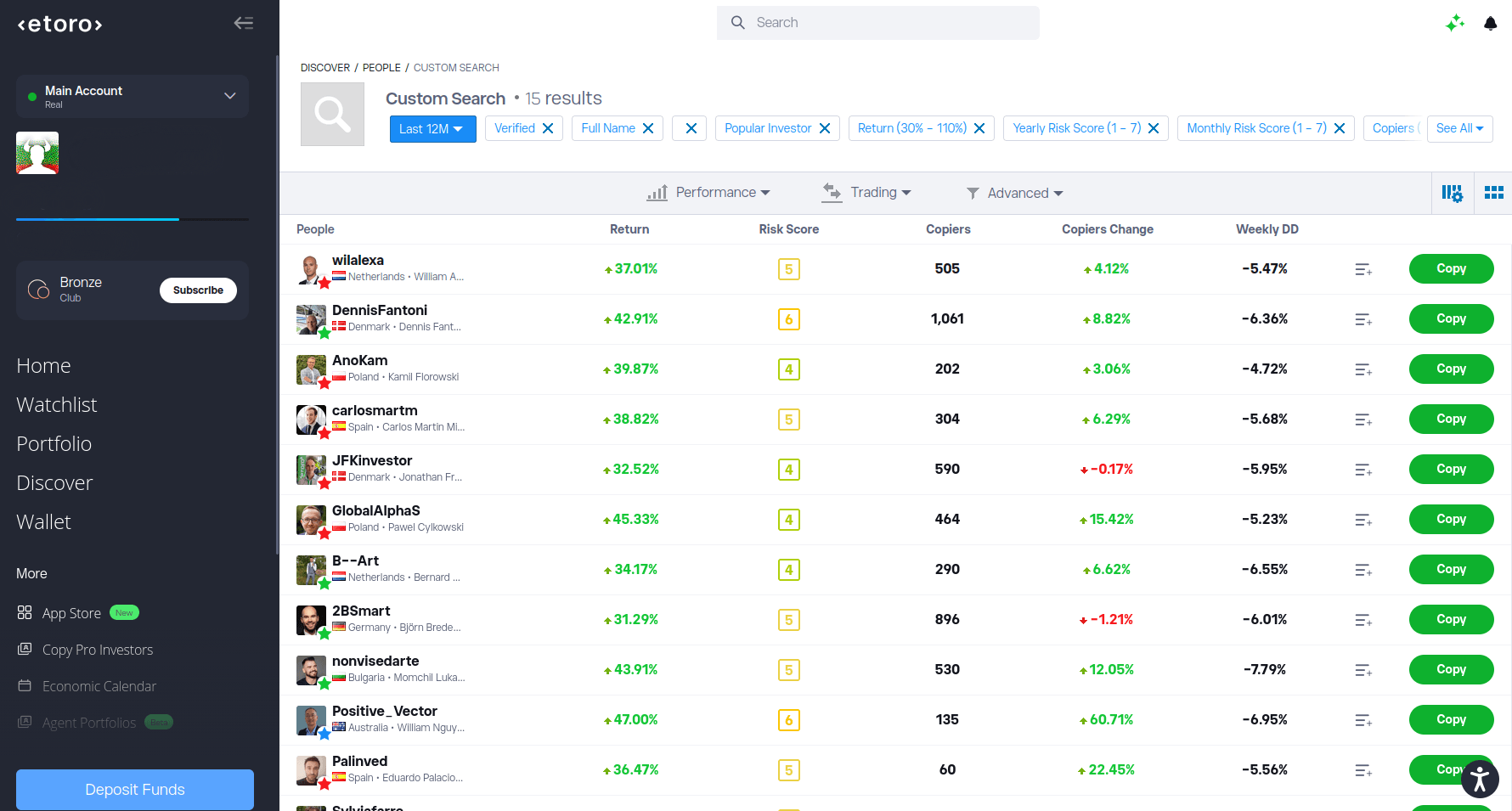
Editorial note: While testing eToro’s CopyTrader, we were able to filter signal providers based on various criteria, including 12-month returns, Popular Investor status, lower risk scores (1 to 7), and more. The platform shows the signal providers’ verified annual performance alongside their weekly drawdown , risk scores, and number of copiers.
Who Could Benefit from Managed and Copy Trading Accounts
Copy trading and managed accounts are primarily beneficial for individuals who want exposure to the forex markets but lack the time to perform detailed technical analysis or actively manage their positions. Such accounts are also suitable for intermediate traders who wish to learn while they earn by observing the entry and exit logic of experienced traders in real-time. Experienced investors looking to diversify their portfolios across different asset classes or strategies without manually executing every trade can also use such account types. However, account holders must be disciplined enough to perform regular due diligence on their chosen signal providers and fund managers.
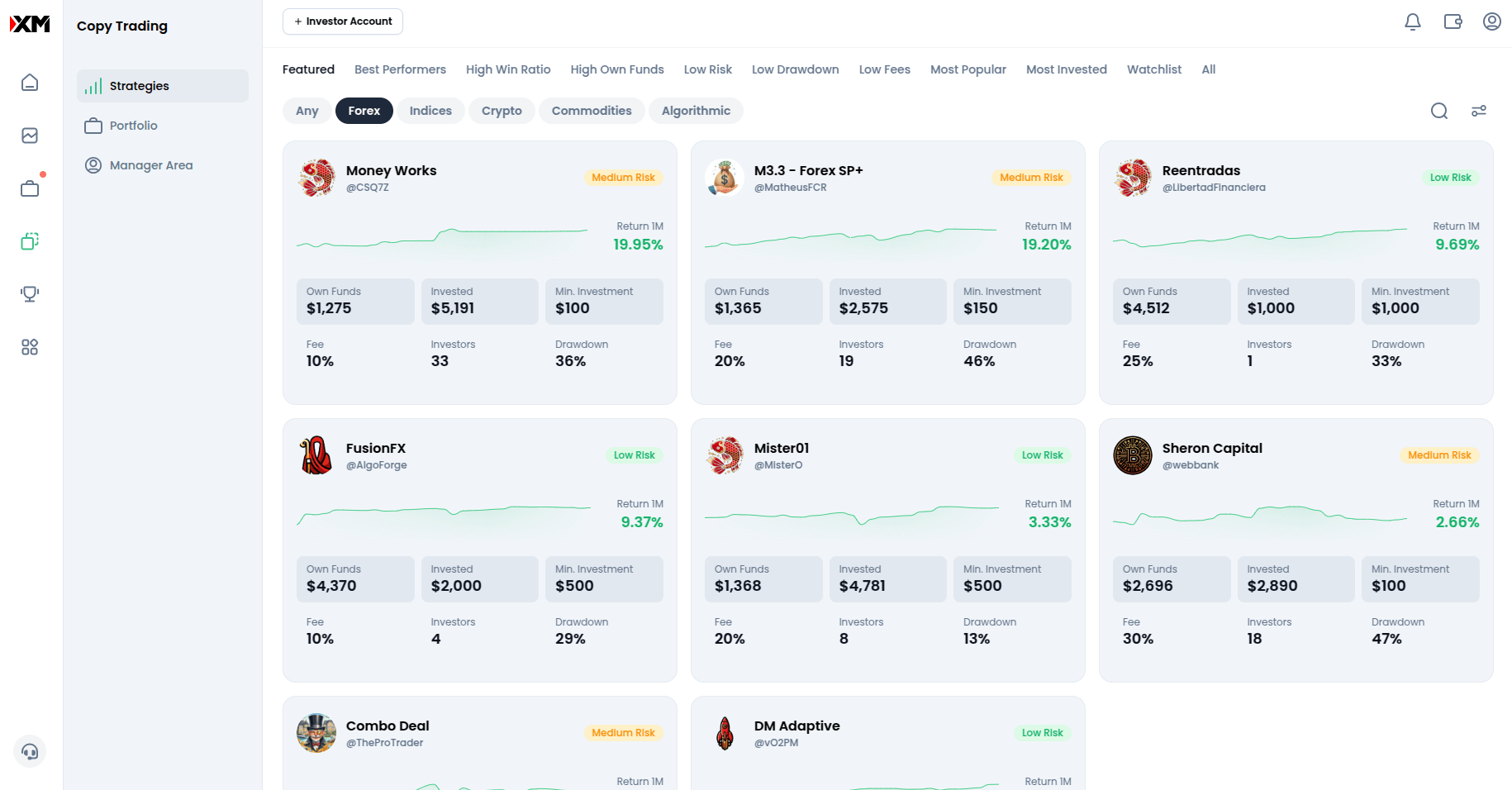
Editorial note: While evaluating XM’s copy trading service, we could filter signal providers by asset class, drawdown, and risk level, among other filtering options. The interface provides key performance metrics, such as 1-month returns, drawdown percentages, and minimum investment amounts, which usually started from $100 for forex copiers.
Pros and Cons of Managed and Copy Trading Accounts
Managed and copy trading accounts allow you to bypass the steep learning curve of manual trading by leveraging the experience of others. However, it is essential to understand the unique benefits and risks of this approach before committing real capital.
Key Pros
- Access to professional expertise: These accounts allow you to leverage the skills, experience, and strategies of seasoned traders that would otherwise take years to develop independently.
- Greater time efficiency: You can participate in the markets without monitoring charts, following economic calendars, or managing your orders manually.
- Diversification potential: You can spread your capital across multiple managers or copy trading strategies simultaneously, creating a diversified portfolio that does not rely on a single asset class or strategy.
Key Cons
- Management and performance fees: The cost of expertise can be high as a significant portion of your net profits may be redirected to the signal provider or account manager.
- Less control: In most managed setups, you cannot intervene in specific trades. If you disagree with a manager’s current direction or a specific open position, your only real lever is to disconnect the account or withdraw your funds entirely.
- Risk of slippage: Especially in copy trading, your results may be worse than those of the signal provider due to slippage. If the provider’s order is filled at a better price than yours, your returns will be lower than what is advertised on their profile.
Professional Forex Trading Accounts
What Is a Professional Account?
Professional accounts are designed for institutional-level or highly experienced traders who require greater operational flexibility than standard retail regulations would allow. By opting for this status, traders bypass the restrictive leverage caps and standardized risk warnings mandated for the general public in certain jurisdictions like the EU and Australia.
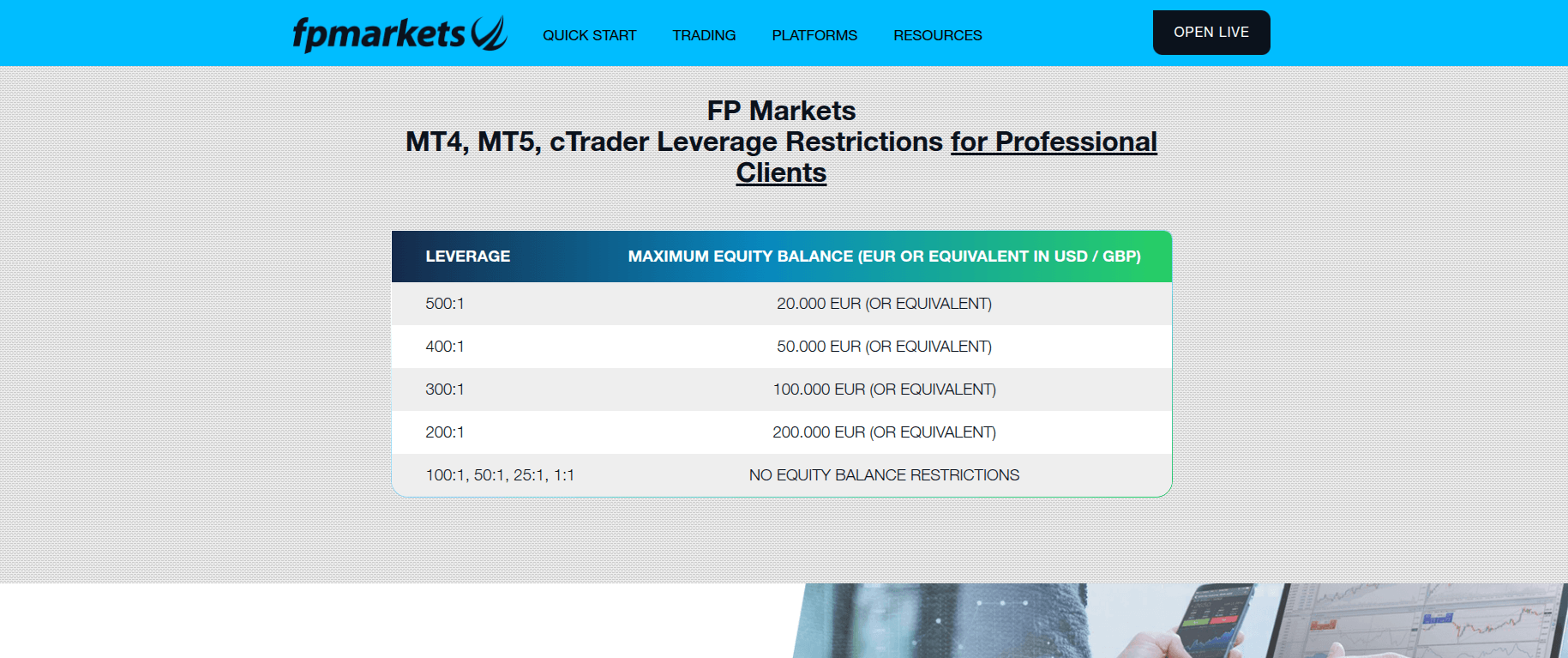
Leverage for professional accounts at FP Markets
This allows for a more aggressive use of capital and provides access to complex financial instruments that are often restricted for retail customers. However, this account type is associated with certain risks and features, which we cover below.
- Substantially higher leverage: Unlike retail accounts, where leverage is capped at 1:30 in the EU and Australia, professional tiers frequently offer leverage as high as 1:500 on major currency pairs, allowing for much larger market exposure relative to the deposited capital. Maximum leverage ratios are largely broker-specific, however. For instance, while trading with a professional account at Plus500, we were able to access leverage of up to 1:300 on major forex pairs and indices but the ratios dropped to 1:5 on options.
- No negative balance protection: Professional clients are not legally entitled to protection against negative balances as is the case for European and Aussie retail traders. If a market gap or extreme volatility pushes your account into the red, you are personally liable to repay the debt to the broker.
- Ineligibility for investor compensation: Professional traders are often excluded from national investor compensation schemes like the ICF in Cyprus or the FSCS in the UK that safeguard retail funds in the event of a broker’s insolvency.
- No risk disclosures: Brokers are not required to provide the standardized, prominent risk warnings or “percentage of losing accounts” statistics that are mandatory for retail clients, as professionals are assumed to already understand these risks.
- Complex language in broker-client communication: Communications from the broker may use advanced technical jargon and sophisticated financial terminology. The appropriateness and suitability tests are significantly less rigorous, assuming the client has the expertise to judge the merits of a trade independently.
- Advanced tools: These accounts often unlock specialized features such as portfolio-based margin models, the ability to use shares as collateral, and direct access to deeper liquidity pools that are unavailable to the retail public.
| Feature | Retail Account | Professional Account | Why It Matters |
|---|---|---|---|
| Leverage Limits | Usually capped at 1:30 on majors to prevent huge losses | Up to 1:500 at some brokers, allowing for massive exposure with minimal margin | Higher leverage amplifies both profits and losses |
| Negative balance protection | Mandatory for retail EU and Aussie clients, the broker absorbs the excess losses | Unavailable in most cases | A professional trader may owe the broker significant sums beyond their initial deposit |
| Compensation scheme access | Mandatory for all EU and Aussie retail clients as per regulatory requirements | May be limited or unavailable at some brokers | If a firm goes bankrupt, the professional client may be treated as a general creditor rather than a protected consumer |
| Other regulatory safeguards | Standardized risk warnings and mandatory margin close-outs at 50% account equity | The assumption of expert knowledge removes the need for risk warnings | Professionals are expected to manage their own risk |
| Best suited to | Beginners and casual traders | Institutional traders, professional scalpers, and high-net-worth individuals | Client categorization should match knowledge and risk tolerance |
Eligibility Criteria for Professional Accounts in the EU
To qualify as a professional client in the EU under MiFID II regulations, traders must demonstrate a specific level of expertise, experience, and financial standing. You generally need to meet at least two of the following three criteria to move from retail to professional status:
- Trading volume and frequency: You must have carried out transactions of a significant size on the relevant market at an average frequency of 10 per quarter over the previous four quarters.
- Portfolio size: The size of your financial instrument portfolio, which includes cash deposits and financial instruments, must exceed €500,000.
- Professional experience: You must work or have worked in the financial sector for at least one year in a professional position requiring knowledge of the transactions or services involved.
Meeting these requirements allows you to waive certain retail protections in exchange for greater flexibility, but the broker must still conduct a rigorous assessment of your capabilities before reclassifying the account.
Eligibility Criteria for Professional Accounts in Australia
In Australia, the classification of a “professional” or “wholesale” client is governed by the Corporations Act. To bypass retail restrictions, traders typically undergo a Wealth Test, which confirms they have the financial capacity to absorb the higher risks associated with increased leverage and the absence of negative balance protection.
Note there is also a Sophisticated Investor Test but the criteria are broker-specific. If you pass the Wealth Test, there is no need to undergo the Sophisticated Investor Test. For the former, you must provide a certificate issued by a qualified accountant within the last six months confirming you meet one of the following two criteria:
- Net asset threshold: You maintain net assets of at least AU$2.5 million. This can include personal assets, such as real estate (excluding your primary residence in some assessment models) and other investments.
- Gross income threshold: You have earned a gross income of at least AU$250,000 per annum for each of the last two financial years.
By meeting these requirements, you are automatically classified as a Sophisticated Investor, allowing you to access professional-grade leverage and execution tools that are otherwise restricted by ASIC for the general retail public.
Pros and Cons of Professional Accounts
Transitioning to a professional account is a significant step that requires sufficient experience. While it unlocks the full potential of institutional-grade trading, it removes the regulatory safeguards designed to protect your capital. Here are the main pros and cons to consider before you submit your application.
Key Pros
- Higher leverage: The professional status bypasses retail leverage caps, allowing you to access ratios up to 1:500 or more. This provides the ability to control large positions with a fraction of the capital required in a retail account.
- Capital efficiency: The lower margin requirements mean you can maintain multiple large positions simultaneously or diversify across more asset classes without spending your entire account balance.
- Institutional execution and tools: Professionals often gain access to deeper liquidity pools, narrower spreads on specific instruments, and advanced trading tools.
- Priority service: Many brokers provide professional clients with dedicated account managers and priority support at no additional cost.
Key Cons
- Loss of negative balance protection: If a market gap causes your balance to drop below zero, you are legally required to pay back the deficit.
- No compensation: If your broker becomes insolvent, you are typically ineligible for government-backed investor compensation schemes. Your capital is treated as that of a general creditor rather than a protected consumer.
- Self-management required: You must monitor your margin and mitigate your risk independently since there are no automatic stop-outs as is the case with retail accounts.
About the Editorial Team