


 Zornitsa Stefanova
 Zornitsa Stefanova is a Financial Research and Platform Testing Analyst at BestBrokers.com, specialising in hands-on reviews of forex, cryptocurrency and stock trading platforms. She evaluates brokerage companies from a user-focused perspective, testing key areas such as account setup, trading conditions, platform usability, available markets and overall reliability.
 | Expert Editor
  Eugene Lee, CFA
 Eugene Lee, CFA, is the Head of Research at BestBrokers.com, where he draws on more than two decades of experience in global markets, portfolio management, derivatives, and fintech to evaluate online brokers. His background in institutional investing and quantitative research helps ensure that broker reviews are based on data, risk assessment, and real-world trading conditions.
  | Updated:
 Introduction to Forex Trading Costs
What This Guide Covers
This BestBrokers guide provides a comprehensive breakdown of the different types of costs associated with forex trading. It covers direct trading costs, such as spreads, commissions, and overnight funding fees, as well as indirect expenses resulting from slippage, requotes, and currency conversion.
Additionally, we have included information about non-trading expenses, related to account funding and maintenance, inactivity, and withdrawals. You will learn to calculate the all-in cost of a trade, comparing spread-only and commission-based pricing models. By mastering these variables, including how volatility and session timing impact your expenses, you can effectively minimize overhead and protect your profit margins.
Who Can Benefit from This Guide
The guide is designed for beginner and intermediate forex traders who recognize that mastering trading costs is just as vital as timing their entries. Whether you are a beginner selecting your first account or an active trader refining a high-frequency strategy, this guide provides the depth required to manage overhead, optimize market entry timing, and maximize long-term profitability.
Importance of Trading Costs
Trading costs matter because every cent you pay in spreads, commissions, or overnight funding fees erodes your net returns in the long term. Charges add up over time no matter how small, especially if you rely on high-frequency strategies like scalping. If you ignore these expenses, a trading strategy that looks good on paper can easily end up costing you a lot of money in reality.
What Readers Will Learn
We provide detailed breakdowns of every type of fee associated with forex trading, from spreads and commissions to overnight charges (swaps) and currency conversion fees. We demonstrate with clear examples how to calculate total costs across different account types and lot sizes. By the end, readers will hopefully be able to compare forex brokers effectively to keep their expenses as low as possible.
What Are Forex Trading Costs?
Forex costs reflect the overall financial impact of executing and holding positions in the currency exchange market. They are not always explicitly listed in a broker’s fee schedule. Some, like spreads, are built into the price quotes, while others, like requotes and slippage, result from abnormal market volatility. Others are not directly related to trading at all, including inactivity, deposit and withdrawal fees. Learning to make a distinction between these categories is essential for identifying how a broker actually makes money and how your bottom line will be affected.
- Direct Trading Costs: These are transparent, predictable charges included in a broker’s fee schedule. They are usually deducted directly from your balance or equity when you open, close, or roll over a position.
- Indirect Trading Costs: These are hidden or variable charges related to market conditions and execution quality, as is the case with slippage and requotes. They often manifest as a difference between the price you see and the price your position is actually filled at.
- Non-Trading Costs: This category includes administrative fees unrelated to active market participation and is often associated with account management, funding, and withdrawals.
| Cost Category | Examples | Characteristics |
|---|---|---|
| Direct Costs | Spreads, commissions, overnight funding charges (swaps) | Deducted immediately upon opening or closing a position, except for swaps, which are deducted at market rollover time |
| Indirect Costs | Negative slippage, requotes, partial fills, gapping, conversion fees, fees for using guaranteed stop losses | Often unpredictable as they depend on market conditions, such as liquidity and volatility, but they still affect your overall profitability |
| Non-Trading Costs | Withdrawal and deposit fees, inactivity fees, VPS hosting fees | Impact overall account ROI over time |
Main Types of Forex Costs
- Spreads: This is the difference between the bid and ask price of a forex pair, representing the immediate cost of entering and exiting a currency position.
- Commissions: Commissions are either flat or volume-based fees charged for executing trades, typically found on raw-spread or ECN accounts. They range from $2.25 to $3.50 per lot per side, resulting in a round-trip cost of $4.50 to $7.00 per standard lot traded.
- Overnight Funding Charges (Swaps): Swap rates represent the interest paid or earned for holding a leveraged forex position past the daily market rollover time, based on the interest rate differential between the two currencies in a pair.
- Currency Conversion Fees: This charge applies when your profits, deposits, and withdrawals are in a currency other than your base account currency.
- Negative Slippage: This occurs when a trade is executed at a worse price than requested due to high volatility or low liquidity, resulting in an immediate increase in trading costs. While negative slippage increases trading costs by executing at a worse price during high volatility, genuine ECN/NDD brokers also pass along positive slippage, filling your order at a better price when market liquidity works in your favor (in compliance with FCA and MiFID II Best Execution standards).
- Requotes: A requote occurs when a broker cannot execute your order at the requested price and offers a different quote, potentially leading to a worse entry.
- Gapping: Gapping takes place when prices jump from one level to another without trading activity in between, often causing stop-loss orders to trigger at a significantly worse price.
- Partial Fills Costs: You incur these expenses when only a portion of your total order is executed at your desired price, with the remainder filled at a worse price.
- Inactivity Fees: This is a recurring monthly charge applied to accounts without any trading or login activity over a specific period. Standard inactivity fees usually kick in after 3 to 12 months and range from $10 to $50 per month.
- Deposit and Withdrawal Fees: These costs are imposed by the broker or payment processor for moving funds into or out of your trading account. While reputable brokers rarely charge internal fee markups for funding or cashouts, third-party processing costs can still apply. During our account testing across major brokers, standard methods like credit cards, e-wallets (PayPal, Skrill), and local bank transfers incurred $0 in broker-side fees, whereas international wire transfers or crypto withdrawals frequently incurred third-party intermediary bank fees or network gas fees.
- GSLO Fee: This is the premium paid for using a Guaranteed Stop Loss Order, common among well-regulated, tier-1 brokers, which ensures your position is closed at an exact price regardless of market gaps. Note that the premium is paid only if the GSLO is triggered.
- Data Subscription Fees: Some brokers impose charges for providing access to real-time market data or premium charting tools, which are not included in their standard platform offering.
What Is a Forex Spread?
The spread is the difference between the bid (the price to sell) and the ask (the price to buy) of a forex pair. It represents the primary cost of transacting in the currency market and effectively functions as a markup paid to the broker for providing liquidity. The spread is typically measured in pips, a unit representing the fourth place after the decimal point in most currency pairs (0.0001), except those involving the Japanese Yen as a quote currency, where a pip corresponds to the second number after the decimal point (0.01).
Forex traders buy at the ask price and sell at the bid price. Conversely, a sell order enters at the bid price and later exits at the ask. If the market does not move, you would normally close the trade at a price below where you bought, or above where you sold, by roughly the size of the spread. This initial gap is why many platforms show a small unrealized loss immediately after entry. The market must move in your favor by a distance at least equal to the spread for you to break even.
- Calculating the Spread: You simply must subtract the bid price from the ask price. For example, if EUR/USD currently has a bid price of 1.1000 and an ask price of 1.1002, the spread will equal 1.1002 – 1.0000 = 0.0002, or 2 pips.
- Converting Spreads into Dollars: Pips value depends on lot size. When trading in standard lots (100,000 base currency units), a price movement of one pip corresponds to $10, so a 2-pip spread will set you back $20.
- Spreads in Pipettes: Many brokers quote their forex prices to the fifth place after the decimal point for greater precision. The fifth place after the decimal point corresponds to a pipette (0.00001) and 10 pipettes equal 1 pip.
- JPY Exception: Forex pairs like USD/JPY where the Yen is the quote currency use the second decimal place for pips (0.01). Consequently, the pipette is represented by the third number after the decimal point (0.001) rather than the fifth.
- Calculating Spread Costs: Traders can convert the spread into a dollar amount by using the following simple formula: Spread in Pips x Pip Value x Number of Lots. So a 1.2-pip spread will cost you 1.2 x $10 x 1 = $12 per standard lot.
Bid and Ask Prices Explained
In the forex market, every currency pair is quoted with two distinct prices, the bid and the ask. This pricing system is the foundation of market liquidity, ensuring there is always a transparent rate for those looking to sell and those looking to buy currencies at any given moment.
What Is a Bid Price?
The bid price represents the maximum price that a buyer, typically a market maker, bank, or a liquidity provider, is willing to pay for a currency pair. From your perspective as a trader, this is the price at which you sell, representing the rate you receive if you choose to exit a long position or initiate a new short position immediately.
The bid reflects the demand in the market and is always the lower of the two quoted prices. It is an important metric for gauging market sentiment. Rising bid prices may indicate increasing demand. When more people want to buy a currency, they start outbidding each other, which pushes the bid price higher and signals that the market is likely to move in an upward, or bullish, direction.
What Is an Ask Price?
The ask price, also called an offer price, is the lowest price a seller is willing to accept for a currency pair. This is your buy price, representing the rate you must pay to enter a long position or close an existing short trade. Since brokers and banks aim to sell at higher prices than they paid, the ask is always higher than the bid. The ask price is often indicative of the current supply in the market. The small difference between the ask and the bid, i.e., the spread, essentially functions as a “service fee” the broker collects for matching your position with the rest of the market.
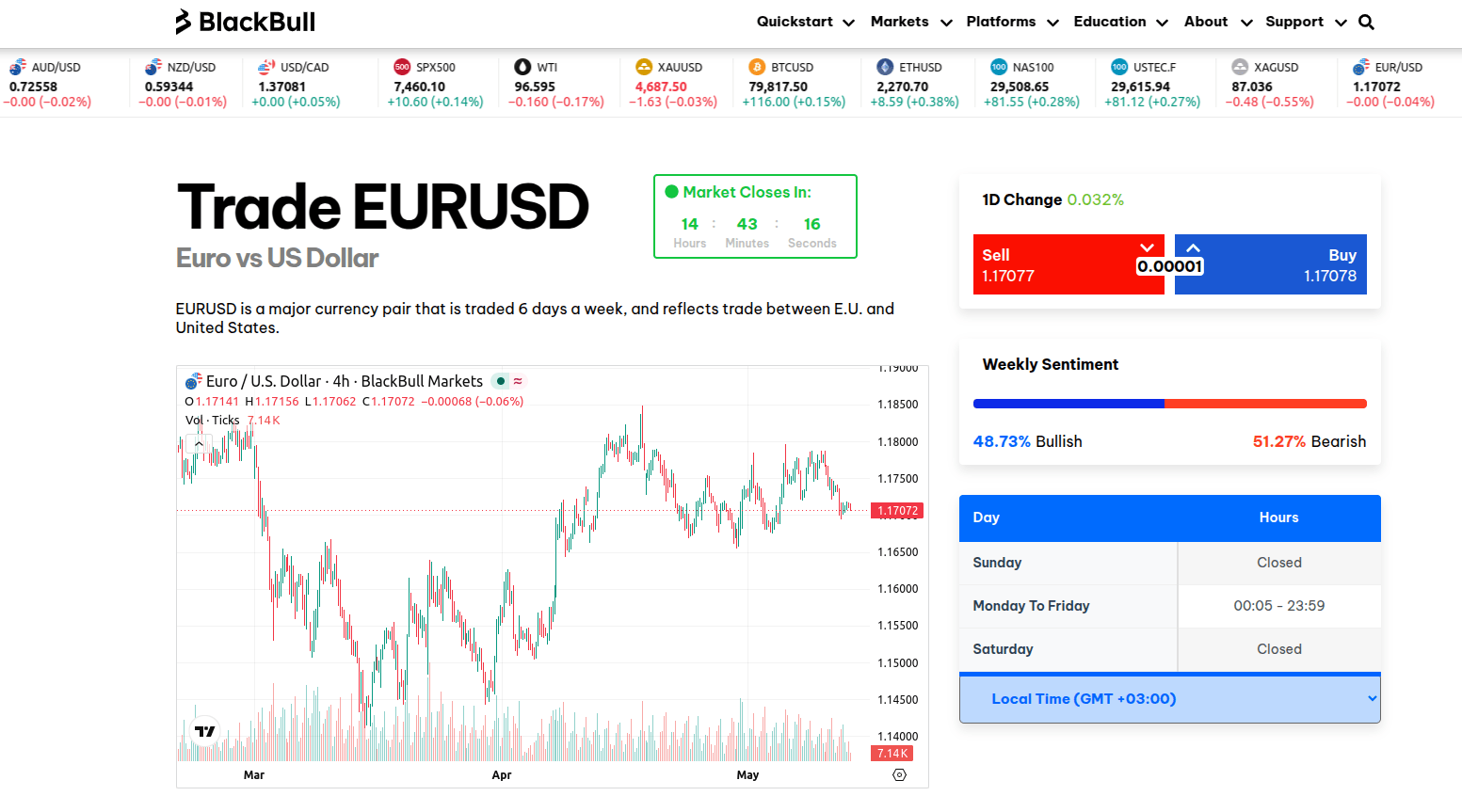
Bid (Buy) and Ask (Sell) price quote for EUR/USD at BlackBull Markets
Opening a Sell Order at the Bid Price
When we open a sell order, or go short, we transact at the bid price because we are selling to a market participant who wants to buy. We do this when we anticipate that the base currency in the pair (the first currency in the quote) will depreciate in value.
For example, during our live testing session, GBP/USD was quoted at 1.32769 / 1.32778. When we opened a short position of 1 standard lot (100,000 base currency units), our trade was executed at 1.32769. The total value of our position was 1.32769 x 100,000 = 132,769 USD. Because open short positions are evaluated against the current ask price, our actual profits or losses are calculated based on what it would cost to buy the currency back. To exit this position later, we must buy it back at the ask price. If the spread remains 0.9 pips, the market price (bid) actually has to drop to 1.32760 just for our trade to reach break-even, as the ask price would then be sitting at our entry of 1.32769.
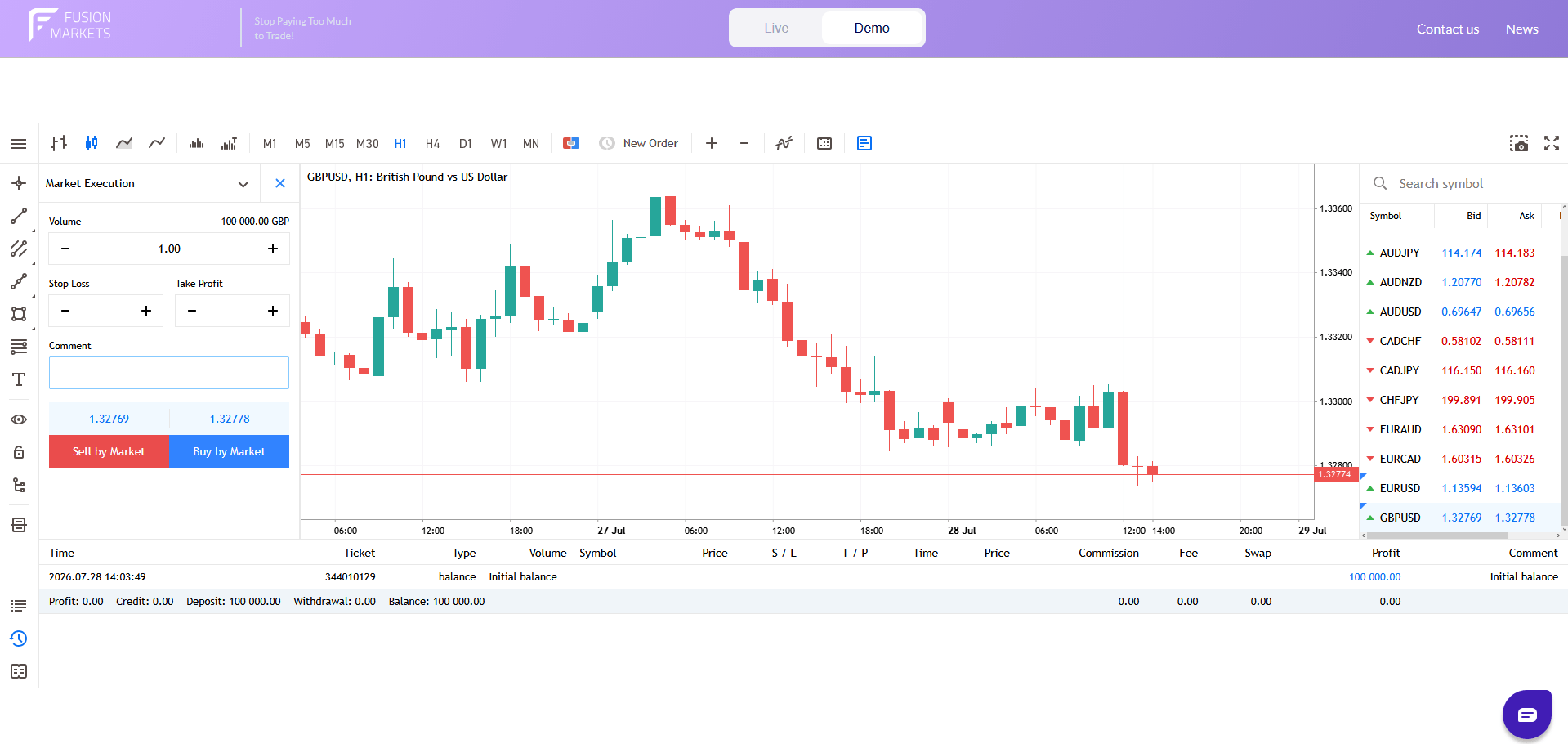
GBP/USD Sell Order
Opening a Buy Order at the Ask Price
To open a buy order, or go long, we must trade at the ask price, as we are buying from a seller who is asking for that amount. We do this when we expect the base currency to appreciate in value. During our trading session, AUD/USD was quoted at 0.69653 / 0.69662. When we bought 1 standard lot of 100,000 base currency units (100,000 AUD), our entry price was 0.69662.
The total value of this trade equaled 0.69653 x 100,000 = 69,662 USD. Respectively, we must sell the currency back to exit the position, whereby our potential profits or losses are determined by the movement of the bid price relative to our original ask entry. Because most trading charts only draw a line for the bid price, you may see your position open slightly above the current chart line. The bid price must climb above the 0.69662 entry for us to turn a profit.
![AUD/USD Buy Order]](https://www.bestbrokers.com/wp-content/uploads/2024/08/AUDUSD-Buy-Order-1.png)
AUD/USD Buy Order
4 Common Beginner Mistakes with Bid and Ask Prices
- Watching the Wrong Line: Most charts only show the bid price by default, so beginners often get confused when a buy order fills above the price they see on the screen.
- Stop Loss Errors: When you are short, your exit is a buy order, which means your stop loss is triggered by the ask price, not the bid you see on the chart.
- Starting in the Red: New traders often panic when they see an immediate loss after clicking buy, forgetting that they must immediately overcome the spread to break even.
- Trading during News: Beginners often trade during major news events when spreads widen sharply, which can trigger stop-outs or poor fills even if the bid chart does not clearly show a breach.
How to Calculate Forex Spread Cost
Calculating your spread costs is a fundamental skill that ensures your strategies remain viable after you account for any associated expenses. The core formula is:
Spread Cost = Spread in Pips x Pip Value x Position Size.
The calculation is at its simplest when the base currency of your trading account coincides with the quote currency of the pair, that is, with the second currency in the price quote, because no exchange rate conversion is required.
- Spread in pips: 0.8
- Pip value: $10 per pip (for 1 standard lot)
- Calculation: 0.8 pips x $10 x 1 lot = $8.00
Example: Trading 1.00 standard lot (100,000 units) of EUR/USD with a live spread of 0.8 pips.
In these instances, the pip value is fixed based on your lot size, allowing you to quickly estimate your immediate overhead. Many people choose USD-based accounts when trading predominantly major pairs like EUR/USD, GBP/USD, and AUD/USD because it simplifies the calculations. Every pip movement reflects directly into their balance without having to deal with fluctuating exchange rates or currency conversion.
Spread Costs with Standard Lots
A standard lot represents 100,000 units of the base currency. The pip value for a standard lot is 10 USD when you are trading pairs like EUR/USD with a USD-denominated account. In other words, every pip movement will cost you $10. If you enter a position with a spread of 1.4 pips, your immediate expenses will amount to $14 (1.4 pips x $10 x 1 lot or 0.00014 x 100,000) per standard lot. Standard lots increase your profit potential but also scale up your transaction expenses. There is less room for error when timing your entries and exits because spread costs are significantly higher.
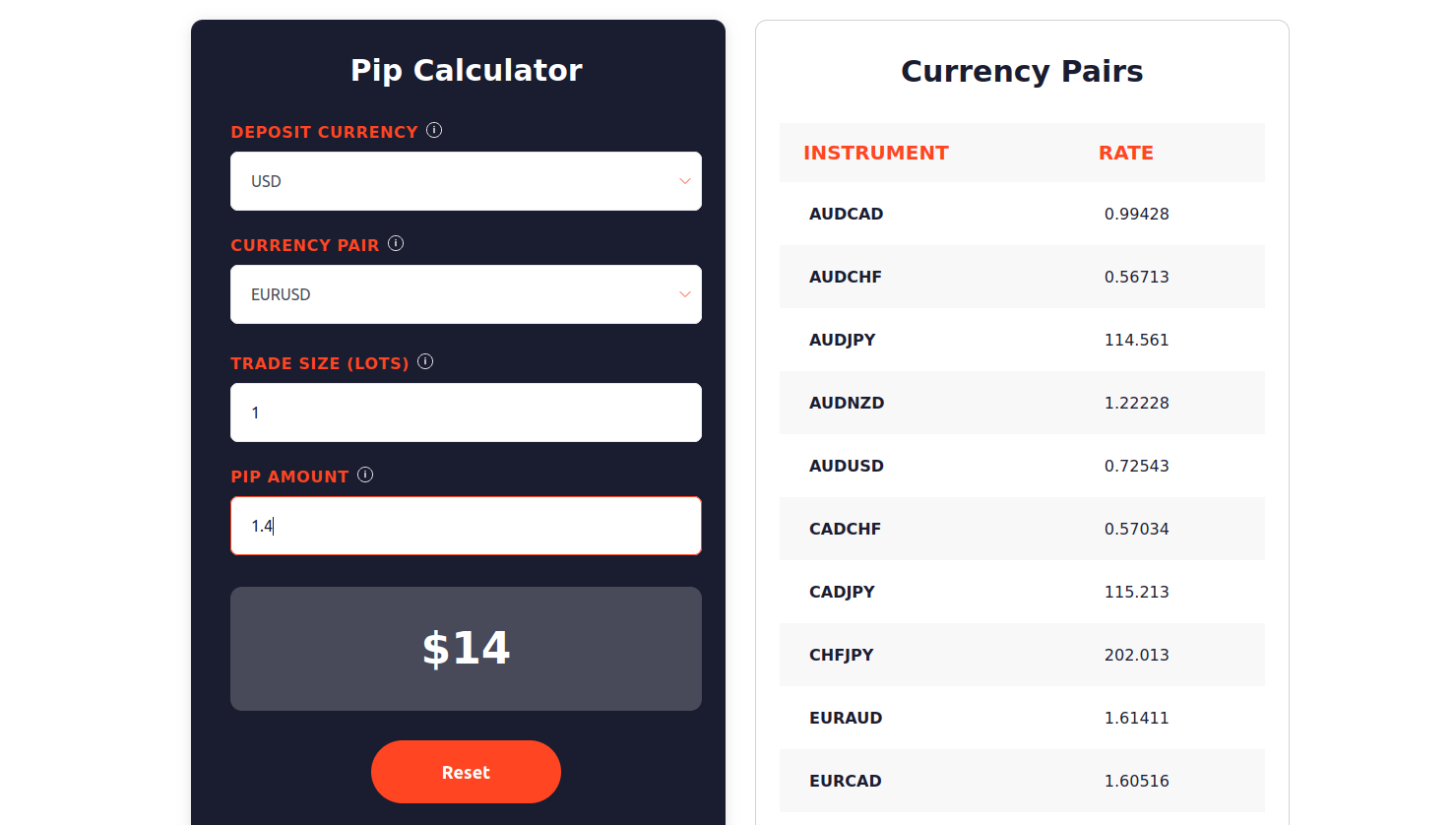
Pip calculator showing the spread costs for one standard lot in EUR/USD with a 1.4-pip spread (courtesy of broker FXTM)
Spread Costs with Mini Lots
A mini lot corresponds to 10,000 base currency units, or 1/10 of a standard lot, so the pip value scales down proportionally. A price fluctuation of a single pip is worth 1 USD when trading EUR/USD in micro lots with a USD-denominated account. Assuming the spread is again 1.4 pips, your transaction cost would amount to $1.40 (1.4 pips x $1.00 x 1 lot or 0.00014 x 10,000) per mini lot. Mini lots offer a scalable solution for intermediate traders, providing the flexibility to fine-tune risk and reduce costs without the heavy financial exposure of standard lots.
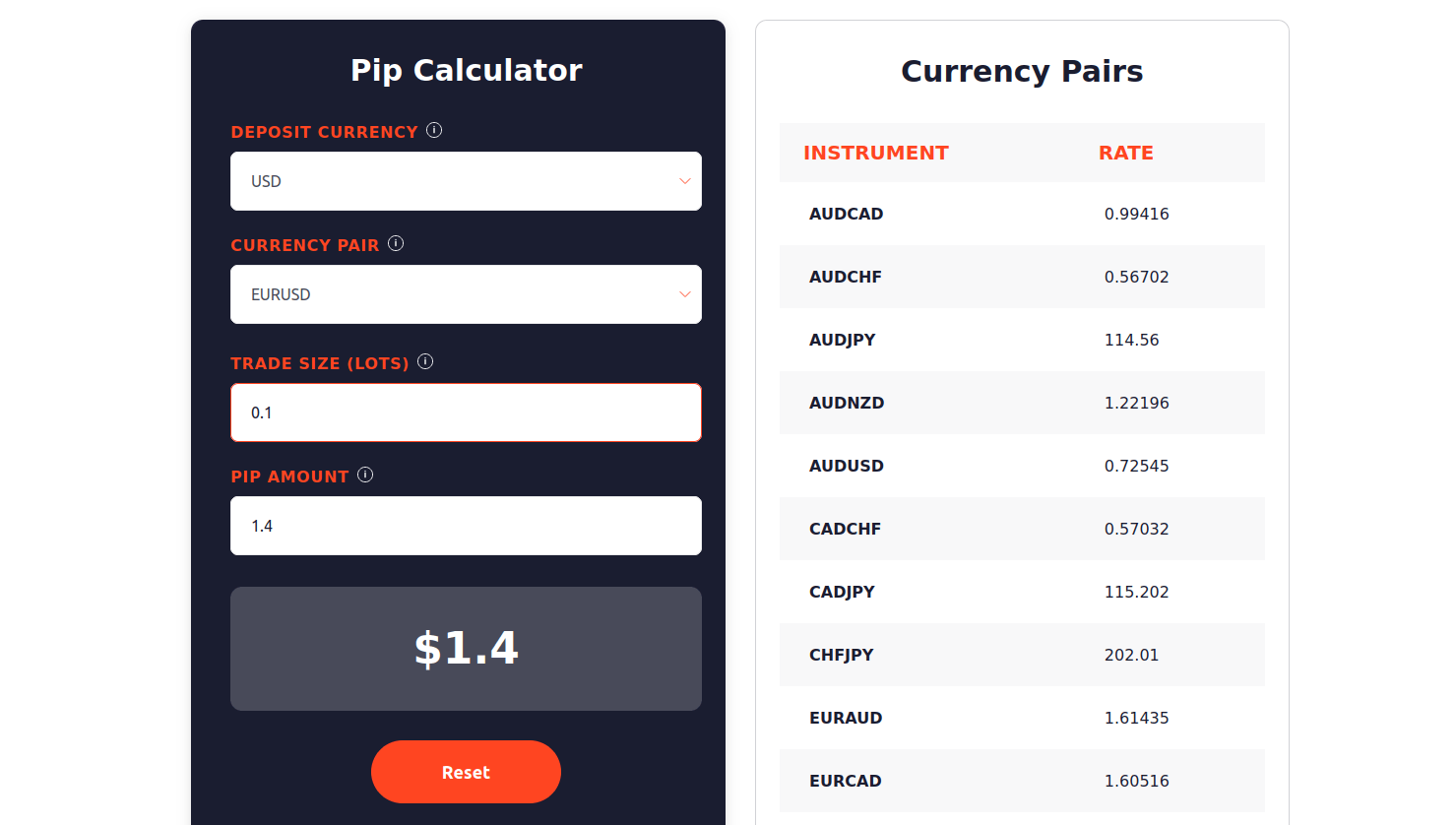
Pip calculator at FXTM showing spread-related costs per 1 mini lot with a 1.4 spread
Spread Costs with Micro Lots
A micro lot contains 1,000 units of the base currency and is the smallest position size typically available at online forex brokers. The pip value for a USD-based account trading EUR/USD in micro lots is only 0.10 USD. If the current spread is 1.4 pips, your cost to open a position would be only $0.14 (1.4 pips x $0.10 x 1 lot or 0.00014 x 1,000) per micro lot. While these costs may seem negligible, they still represent the same percentage of your position size as larger lots. Micro lots are suitable for testing new strategies in a live environment, allowing you to observe how spreads fluctuate without risking significant capital.
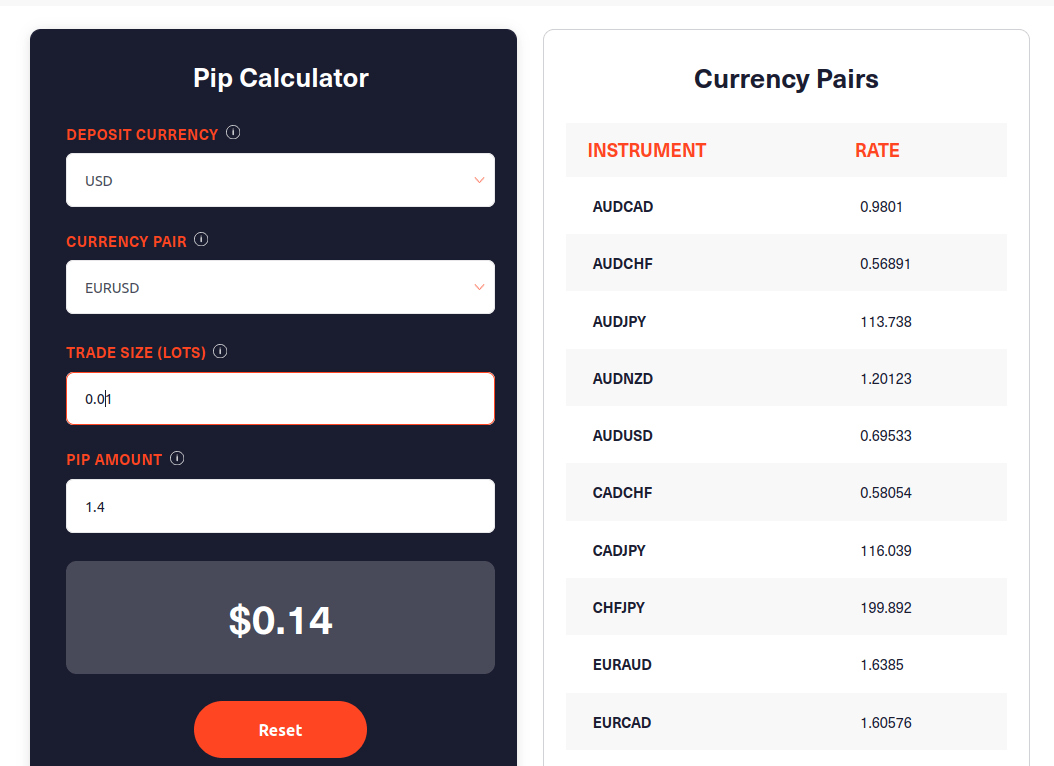
Pip calculator showing the spread costs for one micro lot in EURUSD with a 1.4-pip spread
While the calculations above demonstrate standard (1.00), mini (0.10), and micro (0.01) lot sizes, select brokers also offer nano lot trading (0.001 lot or 100 base currency units), where each pip movement is worth just 0.01 units of the account currency.
| Lot type | Volume in base currency units | Pip value in account currency |
|---|---|---|
| Standard | 100,000 | 10 units per pip |
| Mini | 10,000 | 1 unit per pip |
| Micro | 1,000 | 0.10 units per pip |
| Nano | 100 | 0.01 units per pip |
Spread Costs by Currency Pair
Spreads fluctuate across the forex market, depending on liquidity, volatility, and aggregate trading volume. The constant flow of buy and sell orders in highly liquid currency markets allows liquidity providers to tighten their spreads, which results in lower transaction costs for traders. When market activity thins out or volatility spikes, the spreads widen to offset the higher risk of filling orders. Here are the three main categories of currency pairs and what to expect from them in terms of spreads.
- Major Pairs (EUR/USD, USD/JPY, USD/CHF): These have the highest liquidity and the narrowest spreads, often staying below 1.5 pips, as there is always a massive pool of buyers and sellers.
- Minor Pairs (EUR/AUD, GBP/CAD, EUR/GBP): Pairs in this category typically have lower trading volumes and less liquidity than majors, which can result in wider spreads because liquidity providers usually apply a larger markup to compensate for the higher risk.
- Exotic Pairs (USD/TRY, EUR/HUF): These involve currencies from emerging economies or less liquid markets. Because they tend to have lower liquidity and higher volatility, their spreads can be significantly wider, making them more expensive to trade.
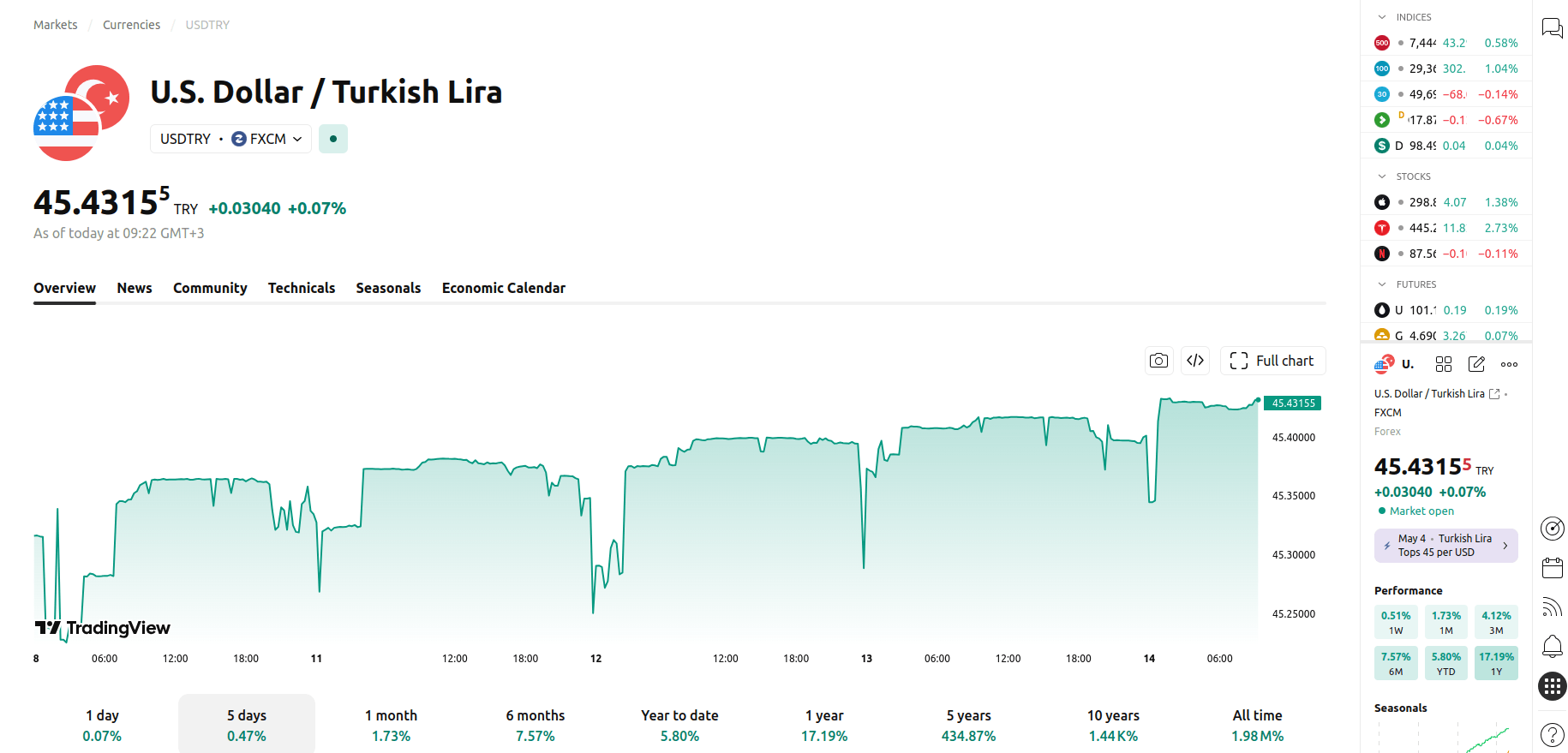
Exotic pairs like USD/TRY often exhibit high volatility and rapid price reversals as seen on this 5-day TradingView chart.
Spread Cost Calculations with Different Account Currencies
When your trading account currency differs from a pair’s quote currency, the broker must convert the pip value into your account currency using current exchange rates. This adds a layer of complexity because your transaction costs will fluctuate proportionately to the exchange rates. Let’s assume you are trading EUR/GBP with an account denominated in USD.
If the pip value for EUR/GBP is £10 and the current GBP/USD exchange rate is 1.2500, the broker must convert the pounds sterling into US dollars. Your pip value becomes $12.50 (£10.00 x 1.2500) per standard lot. A spread of 2 pips on this position would cost you $25 per standard lot with a USD account, rather than the standard $20 you might expect when trading USD-quoted pairs.
Types of Forex Spreads
- Fixed Spreads: As the name suggests, these spreads remain constant regardless of market volatility, which helps with price predictability and decreases the possibility of experiencing negative slippage.
Tested example: easyMarkets offers fixed spread account models, enabling traders to know their costs upfront.
- Variable Spreads: Also known as floating spreads, these fluctuate in real-time based on market depth and offer tighter pricing during peak liquidity but widen significantly during high-impact news events or low-liquidity periods.
Tested example: BlackBull offers variable spreads that change based on market liquidity and trading volume.
- Raw Spreads: Accounts with raw spreads provide direct access to interbank market prices with no broker markup, but typically require paying a fixed commission per lot in either direction of the trade.
Tested example: Pepperstone offers raw execution through its Razor Account, streaming direct interbank spreads starting from 0.0 pips paired with a transparent commission structure from $3.50 USD per lot per side.
- Zero Spreads: These accounts feature spreads that can drop to 0.0 pips on major pairs but also involve paying a fixed commission per side. They are often available at ECN brokers.
Tested Example: Fusion Markets offers direct raw spreads from 0.0 pips on its Zero Account, charging a commission of $2.25 per lot per side.
- Marked-Up Spreads: Common in commission-free accounts, this pricing model integrates the broker’s service fee directly into the spread by adding a small margin above the raw market price.
Tested Example: ActivTrades offers variable, marked-up spreads with zero commissions on standard forex trades.
Which Spread Type Is Best for Beginners?
While the optimal pricing model depends on your specific strategy, most beginners find the accounts with fixed or marked-up spreads to be the most accessible entry point. This is largely due to the simplified cost structure. Broker fees are integrated directly into the spread, so you can see your total transaction cost upfront without having to calculate separate commission expenses for every entry and exit.
As your trading frequency and position size increase, you may find that fixed and marked-up spreads are not always the most cost-effective option. When choosing an account type, you should consider factors like pricing transparency, your trading style, and order execution quality.
| Spread Type | Pricing | Main Advantage | Main Disadvantage |
|---|---|---|---|
| Fixed | Stable spreads under normal market conditions | Predictability | Wider than raw spreads, may freeze during news releases |
| Variable | Changes based on real-time market liquidity | Extremely tight during liquid sessions | Can widen sharply due to market volatility |
| Raw | Interbank market spreads with zero markup and commissions | Deeper liquidity and lower quotes | Total costs include a commission and execution quality |
| Zero | Drops to 0.0 pips under favorable conditions | Clean entry and exit points | Commissions usually apply |
| Marked-up | Market price plus a broker markup | Simplified, all-in cost structure | Higher costs per trade than commission-based pricing |
Fixed Spreads in Further Detail
With the fixed spread pricing model, a broker maintains a fixed difference between the bid and ask price, regardless of minor market fluctuations. By absorbing the micro-volatility of the interbank market, the broker provides consistent entry prices that allow traders to calculate overhead with certainty before placing an order.
How They Work
Market Adjustments
Pros of Fixed Spreads
- Greater predictability as spreads remain largely stable
- Less noise during standard market hours
- Easier for beginners to calculate costs and track profit targets
Cons of Fixed Spreads
- Typically wider than variable spreads during liquid sessions
- Higher likelihood of requotes during fast-moving markets
- May still widen considerably during high-impact news
Variable Spreads in Further Detail
Variable spreads, often referred to as floating spreads, are market-driven prices that fluctuate in real-time based on current market conditions. Unlike fixed spreads, variable spreads directly reflect the current interbank environment, where the difference between bid and ask prices changes based on order volume and market volatility.
How They Work
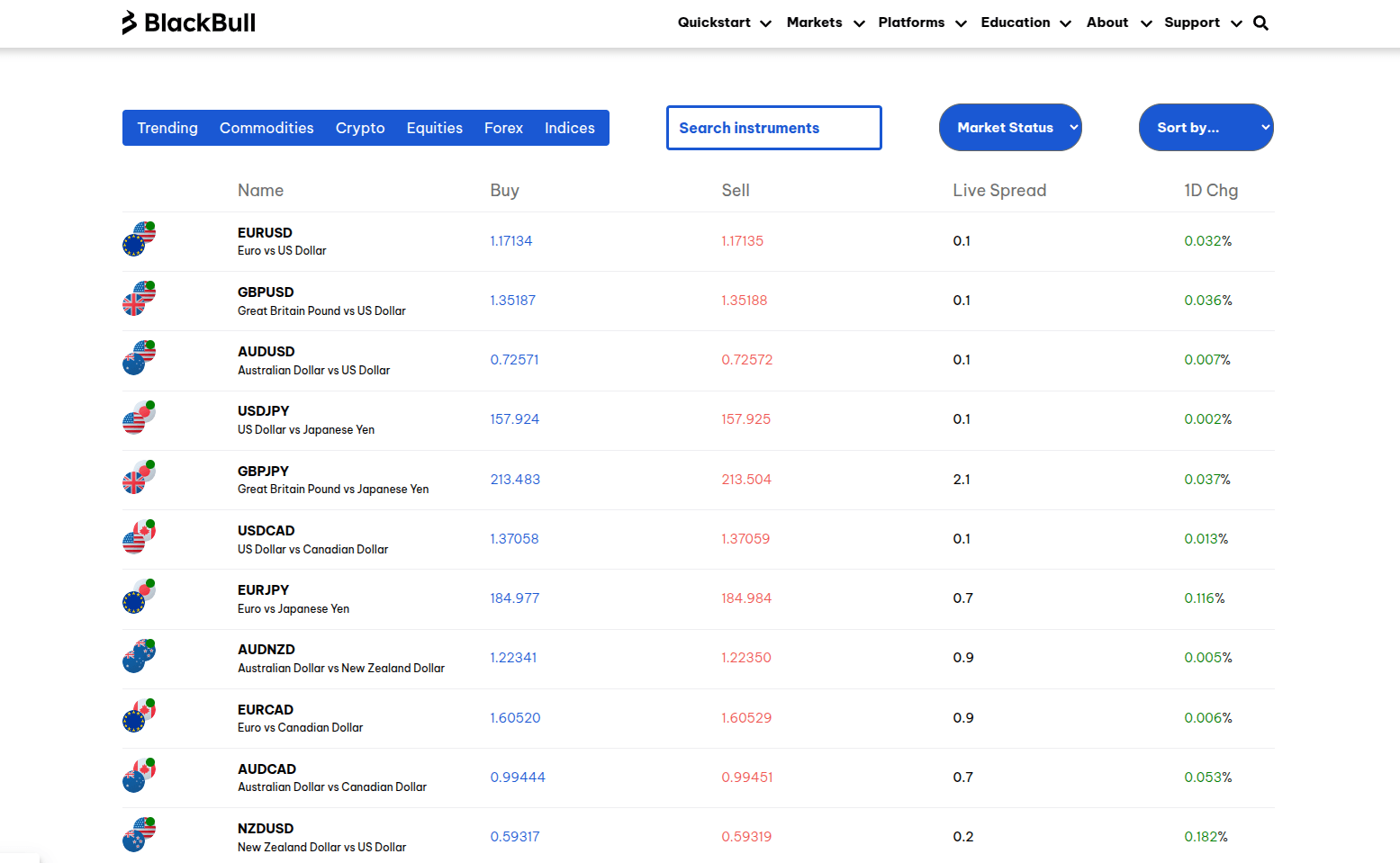
Live variable spreads at BlackBull Markets
What Moves Variable Spreads
The primary drivers of variable spreads are liquidity and volatility. This type of spread tends to tighten significantly during the London and New York session overlap when liquidity is at its peak. The bid-ask spread widens significantly when market activity thins out, and liquidity diminishes during daily rollover periods or major bank holidays. Variable spreads also expand during high-impact economic releases as liquidity providers pull back their orders to mitigate the risk of sudden price gaps.
Pros of Variable Spreads
- Access to the narrowest possible spreads during peak trading hours
- Reflects real-world supply and demand in the interbank market
- Orders are generally executed at the next available price without requotes
Cons of Variable Spreads
- Spreads can spike unexpectedly under unfavorable market conditions
- Negative slippage may occur during high-volatility periods
- Requires careful entry and exit timing to avoid widened spreads
Raw and Zero Spreads in Further Detail
Raw and zero spread accounts are designed for traders who prioritize wholesale pricing. Brokers using this pricing model stream price quotes directly from liquidity providers and other participants in the interbank market without adding any markups. While raw spreads naturally fluctuate based on the interbank market, the so-called Zero accounts are specifically structured to maintain 0.0-pip spreads on major pairs as often as market conditions allow, typically during peak liquidity.
How They Work
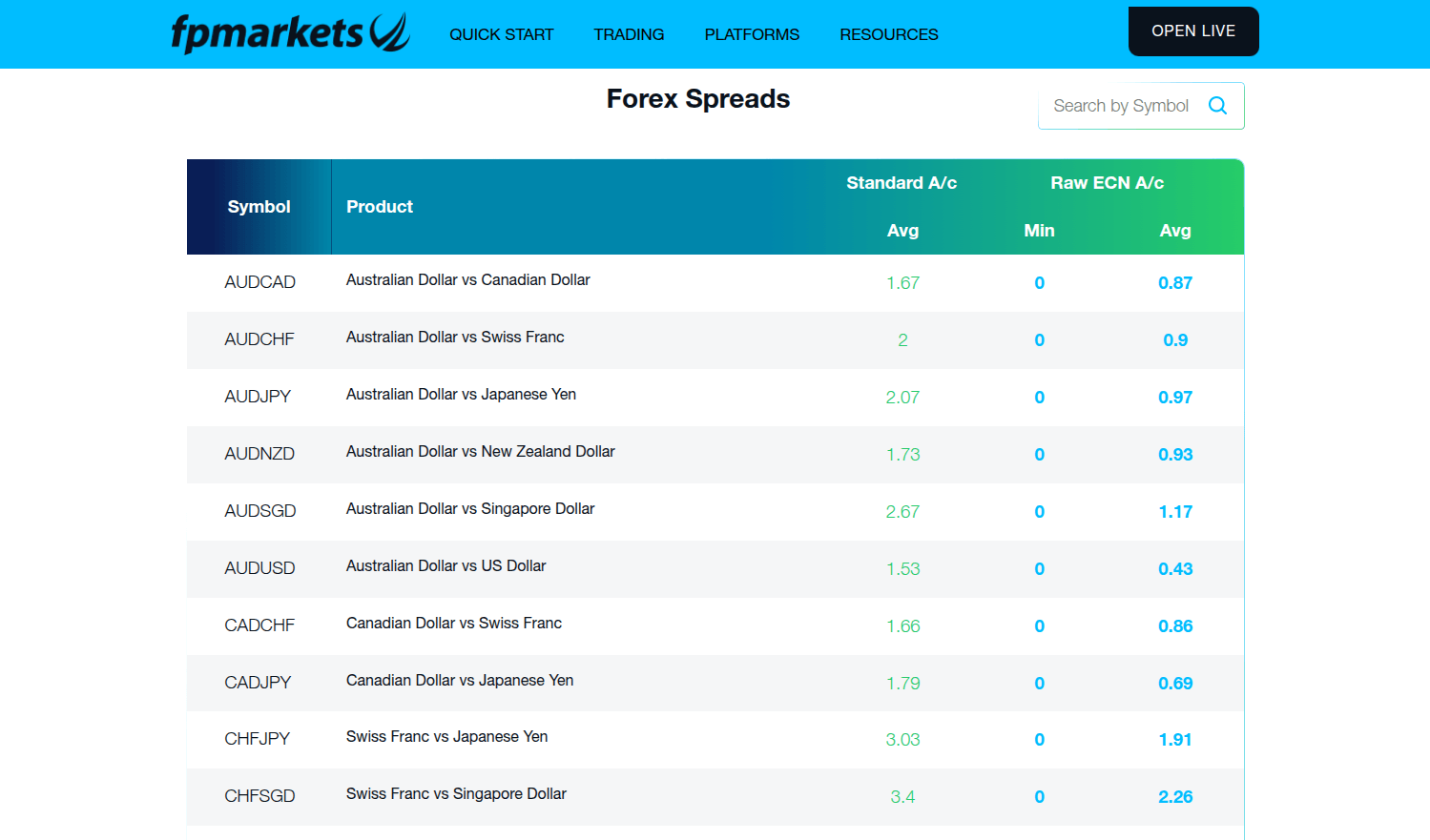
A price schedule at FP Markets, illustrating the differences between the average spreads for Standard and Raw ECN accounts
Who Benefits from Raw and Zero Spreads
Accounts with such spreads mainly benefit scalpers and high-frequency traders who need surgical precision during order execution. This pricing offers greater transparency to beginners but requires more complex cost calculations as traders must account for both the spread and the commission before entering or exiting a position.
Pros of Raw and Zero Spreads
- The tightest possible quotes, frequently starting from 0.0 pips on majors
- Greater transparency in terms of pricing
- Faster and more precise order execution
Cons of Raw and Zero Spreads
- Both commissions and spreads should be factored in when calculating expenses
- Spreads can widen dramatically during low-liquidity periods
- Tight raw spreads do not protect you from slippage, delays, or partial fills
Common Forex Commission Structures
- Commission Per Side vs. Round-Turn Commission: Brokers often quote commissions per side, meaning a fee is applied when you open the position and again when you close it. Round-turn commissions represent the total cost for entry and exit. It is important to check which term is being used, as commissions per side are twice as low as round-turn commissions.
- Commission Per Lot: This is the most common retail structure, where the fee scales proportionately to your position size. If the commission is $3.50 per standard lot, trading a mini and micro lot would cost $0.35 and $0.035, respectively.
- Commission Per Million Units (Notional Volume): This model is favored by institutional brokers because it treats every currency pair with the same mathematical weight. Instead of charging per contract size, the broker charges based on the actual market value of the position you are controlling. In this structure, the base currency of the pair determines the calculation. To calculate a million-based commission, you simply divide the total units in your position by one million to find the notional volume and then multiply that figure by the commission. For example, a position of 100,000 units has a notional volume ratio of 0.1 (100,000 / 1,000,000). A $25 commission per million results in a charge of 0.1 x 25 = $2.50 to open the position and another $2.50 to close it.
- Percentage-Based Commissions: While less common in retail spot forex, percentage-based commissions are standard in many European and institutional trading venues. These are often quoted in basis points (bps), where 1 bps equals 0.01%. This model is unique because the cost is directly tied to the current exchange rate. If the price of the currency goes up, the commission also increases slightly. To determine this cost, you multiply the notional value of your position by the broker’s commission percentage. For example, if you buy 100,000 units of GBP/USD at an exchange rate of 1.2500, your total notional value is $125,000. If the broker charges a 0.003% commission, you multiply the notional value by the commission rate and get $3.75 per side (125,000 x 0.003%).
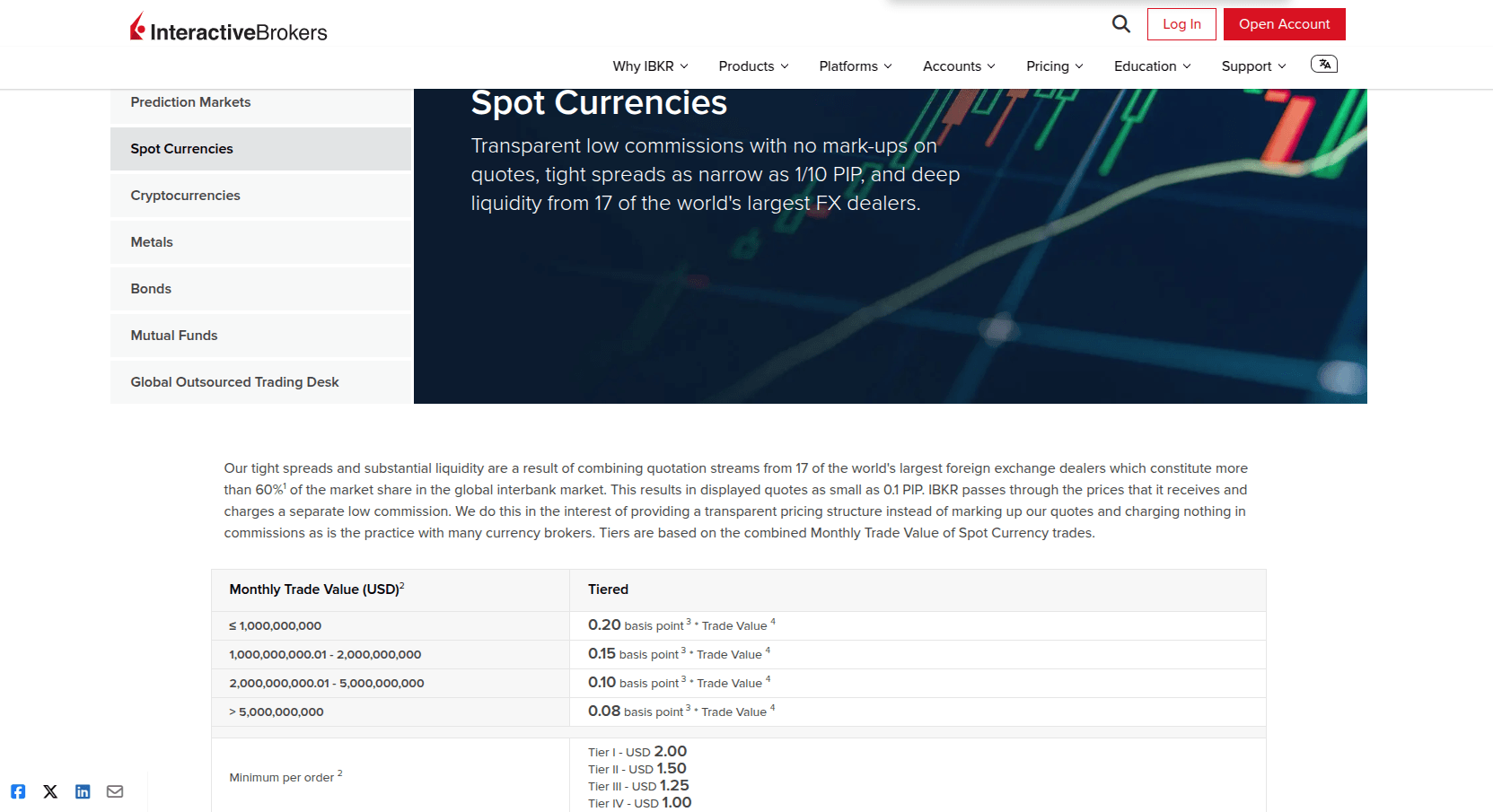
Tiered commission schedule at Interactive Brokers
How to Calculate Forex Commission Costs per Lot
To calculate your total commission expenses, you simply multiply the commission rate by your position size. If a broker quotes a per-side fee, you must multiply by 2 to find the round-turn commission for opening and closing a position. For example, a $3.50 per-side rate equals a $7 round-turn commission. Because forex commissions generally scale linearly, your costs adjust proportionally based on whether you are trading standard, mini, or micro lots. Examples for each are included below.
- Commission per Standard Lot: The commissions in most broker fee schedules are quoted per standard lot, consisting of 100,000 base currency units. With a commission of $3.50 per side as an example, the total cost for a completed trade is 1 x $3.50 x 2 = $7 per standard lot.
- Commission per Mini Lot: A mini lot represents 10,000 base currency units, or 1/10 of a standard lot, and the commission scales down accordingly. If the standard rate is $3.50 per side, the cost for one mini lot will be $3.50 / 10 = $0.35 per side. The round-turn commission per mini lot will be 1 x $0.35 x 2 = $0.70, respectively.
- Commission per Micro Lot: Micro lots consisting of 1,000 base currency units are 1/100 of the size of a standard lot. The commission per side scales down to $3.50 / 100 = $0.035, meaning that your total commission charges will be 1 x $0.035 x 2 = $0.070 per micro lot. While these amounts seem negligible, traders should verify that their broker calculates these fees to the third or fourth decimal place rather than rounding up, which could subtly increase the cost of high-frequency trading in micro lots.
Commission Differences Based on Account Currency
If the broker quotes commission in one currency and your account is in another, the platform usually converts the fee at the applicable rate. This can slightly change the final amount you see on the statement. It also means two traders with identical positions but different account currencies may see slightly different net costs. For example, Pepperstone imposes a $7 round-turn commission on US dollar-denominated accounts, but the rates drop to €5.20 and £4.50 for clients using EUR and GBP as account currencies.
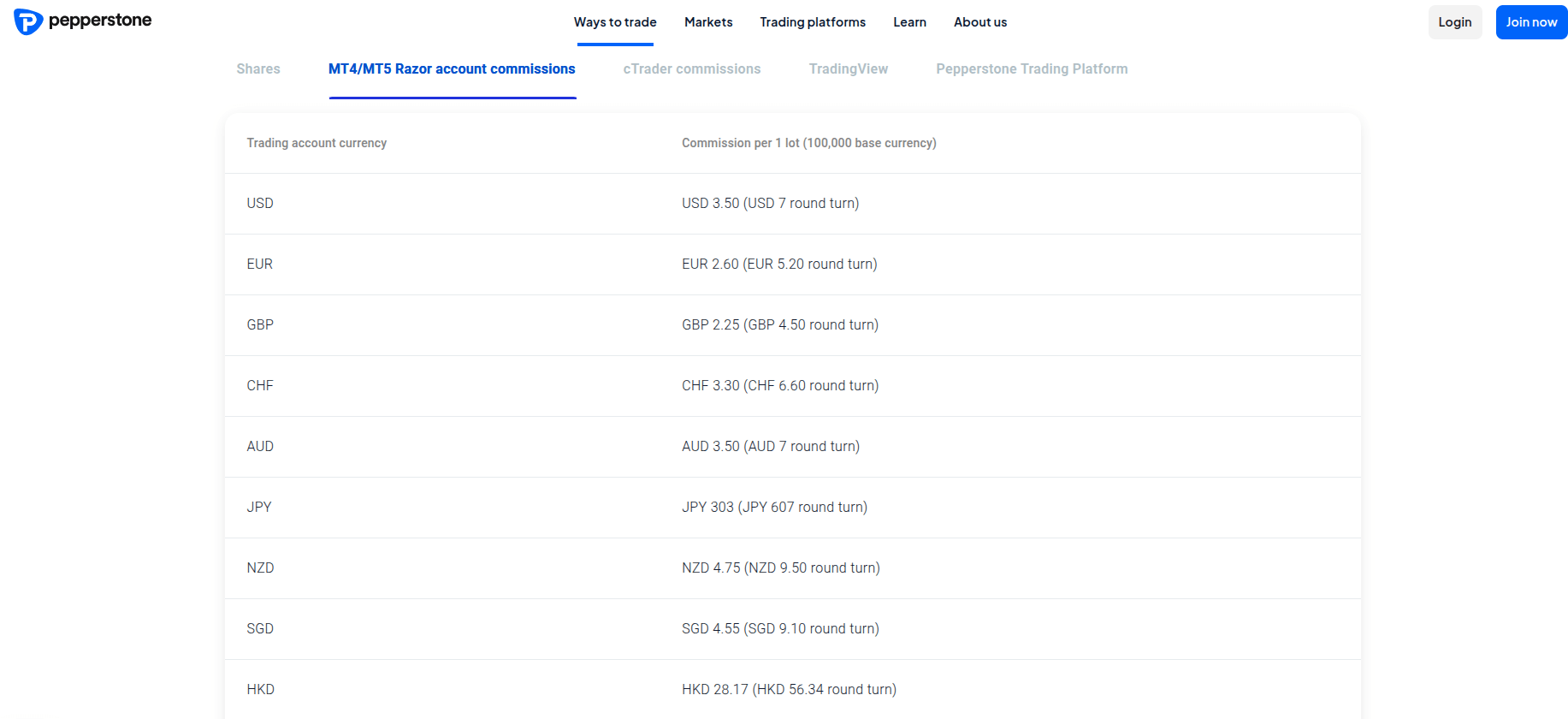
Commission rate differences across supported account currencies at broker Pepperstone
Forex Swap and Overnight Financing Fees
A forex swap, also known as a rollover fee, is the interest rate differential paid or earned for holding (or rolling over) a leveraged currency position overnight. Because spot forex involves trading pairs of currencies with different central bank interest rates, maintaining a position past the daily market cutoff time, which is usually 5:00 pm EST, requires a financial adjustment. Said adjustment reflects the difference between the interest rate of the currency you bought and that of the currency you sold. The exact rollover time can vary by broker and by instrument. Some brokers also adjust for local market conventions or apply rollover slightly differently across forex pairs.
Triple Swap Rates on Wednesdays
Most currency pairs incur a triple swap on Wednesday evenings. Since spot forex settles on a T+2 basis (two business days after the trade), a position held over Wednesday night would technically settle on Saturday. Banks are closed on weekends, so the interest for Saturdays and Sundays is applied on Wednesdays, covering three days of overnight financing.
Notably some pairs like those involving CAD or TRY settle on a T+1 basis at certain brokers. The triple swap rates for such pairs are charged during the Thursday-to-Friday rollover to account for the weekend gap.
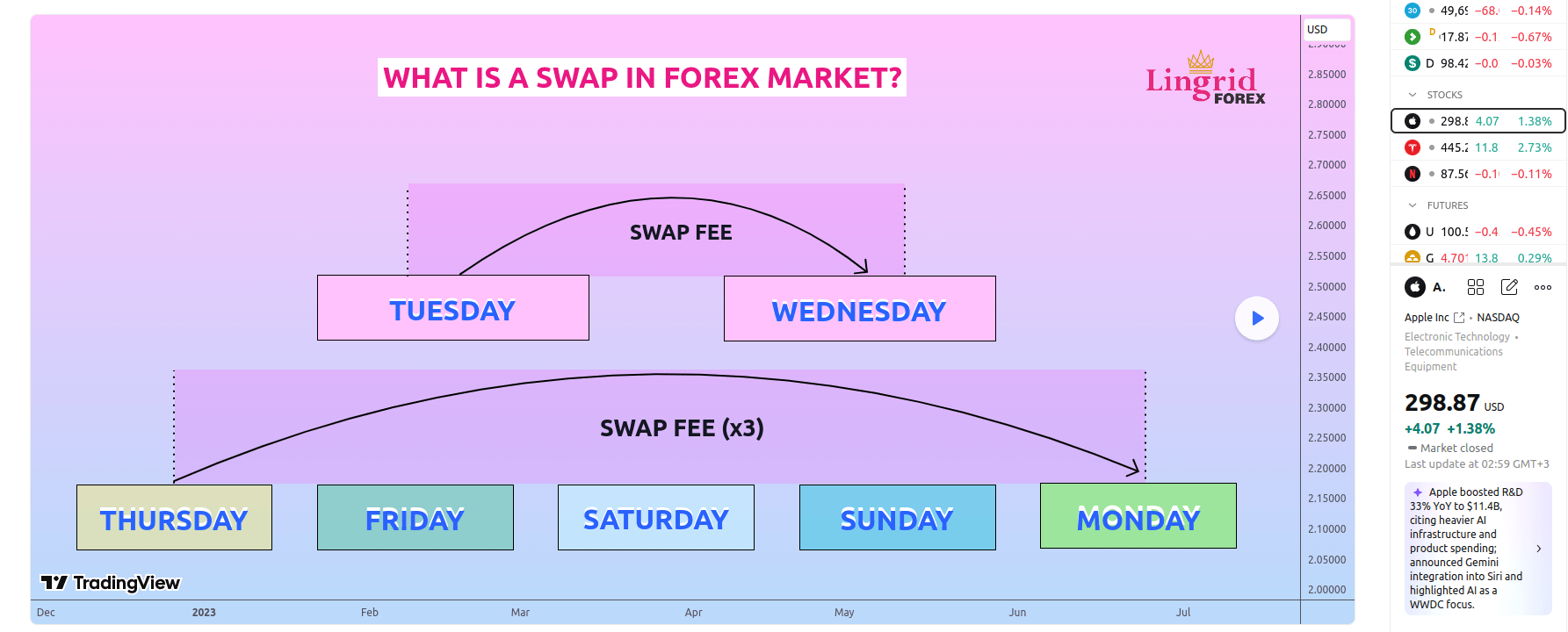
Swap fees triple on Wednesdays to account for the weekend market closure (courtesy of TradingView)
Positive and Negative Swaps
The direction of your trade determines your swap rates. Long swaps apply to long (buy) positions held overnight, while short (sell) positions incur short swaps. Swaps are positive when you buy a currency with a high interest rate and sell one with a lower rate, in which case you earn interest. Carry traders try to use this to their advantage as their primary goal is to collect daily interest by holding higher-yielding currencies against lower-yielding ones.
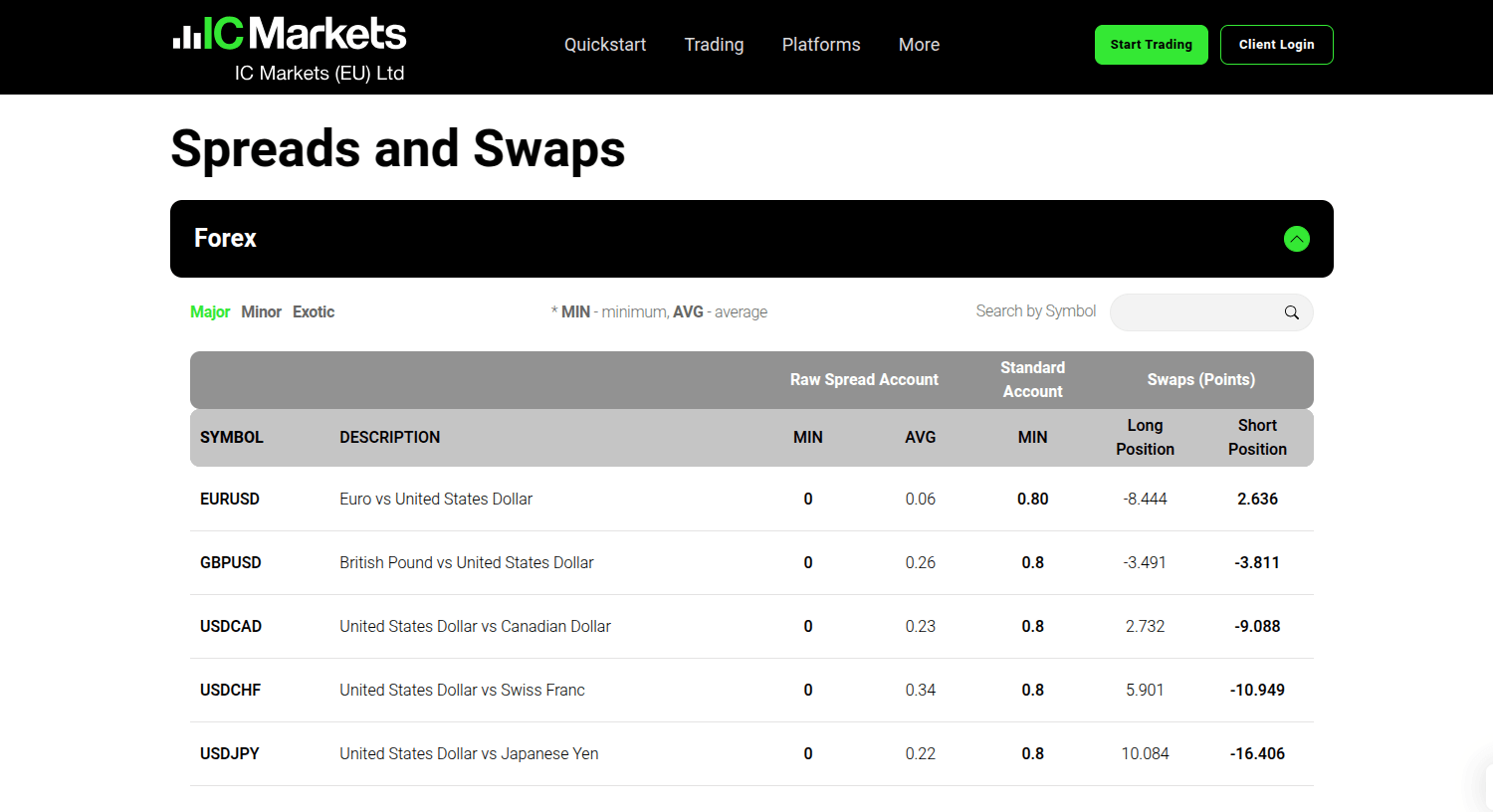
Positive and negative swap rates for major currency pairs at IC Markets
Conversely, swaps are negative when the currency you bought has a lower interest rate than the one you sold, meaning that you essentially pay interest. Keep in mind that swaps depend on the pair, the direction of the trade, and the broker’s policy, so a higher-yielding currency trade is not always guaranteed to produce a positive swap, and vice versa. Here are two examples with calculations to demonstrate how swap rates work in practice.
- Suppose the annual swap rate for EUR/USD is -8.374 points for a long position and +2.566 points for a short position.
- Negative Swaps: If you hold a long position of 1 standard lot (100,000 units) and the swap rate is -8.374 points, you will pay interest equal to 100,000 x 0.00001 x -8.374 = -$8.374 per night.
- Positive Swaps: If you hold 1 standard lot short with a swap of +2.566 points, you will earn interest of 100,000 x 0.00001 x 2.566 = $2.566 per night.
Swap Rates for Different Currency Pairs
Swap fees are critical for strategies like swing trading where positions are held for days or weeks, as these daily costs can significantly erode a trader’s profits or enhance their returns over time. The magnitude of these fees depends largely on the currency type. Majors typically offer the most stable and lower swap costs, while minor pairs have medium swap rates. Exotic pairs often incur the highest charges due to their significant interest rate gaps and lower liquidity.
| Pair Category | Pair Example | Position Type | Swap Rates |
|---|---|---|---|
| Major | EUR/USD | Buy (long) | Typically low |
| Minor | AUD/JPY | Buy (long) | Usually high |
| Exotic | USD/MXN | Sell (short) | Often very high |
Swap-Free Trading with Islamic Accounts
Swap-free accounts, commonly referred to as Islamic accounts, are designed to align with Sharia law, which prohibits charging and paying interest (Riba). Instead of swaps, brokers often charge a fixed administrative fee or widen their spread to cover the cost of maintaining the position overnight. Many brokers limit the availability of these accounts to specific regions or require proof of faith, and some may impose a time limit on how long a position can remain swap-free before standard fees apply.
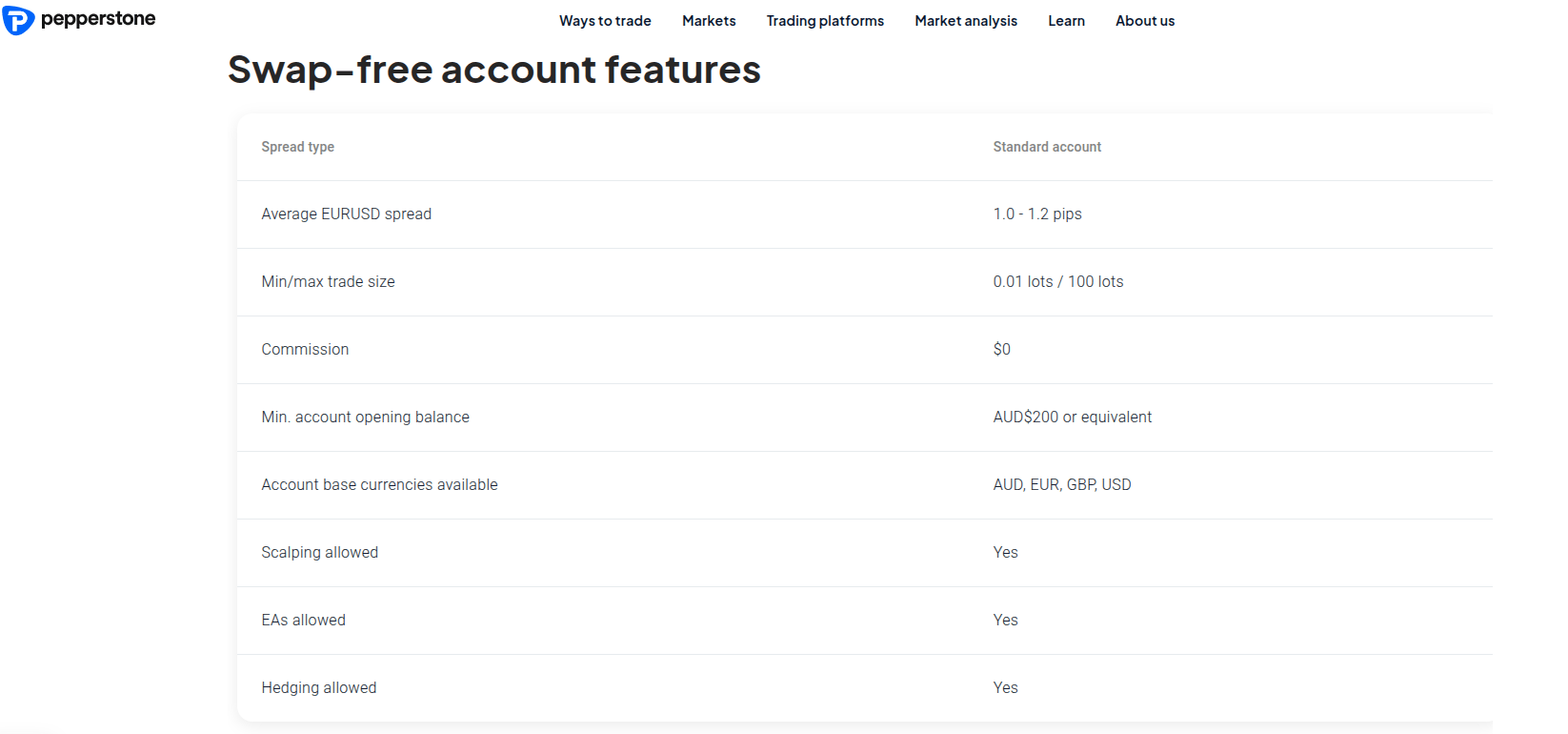
Features of swap-free accounts at broker Pepperstone
Currency Conversion Fees
Currency conversion fees are costs that arise when money must be exchanged from one currency into another. This can happen when you deposit funds to your live balance, withdraw from your trading account, pay commissions, receive swap charges, or realize profits and losses in a currency different from your base account currency. Currency conversion costs may appear as a separate fee or be embedded in less favorable exchange rates.
When Do Currency Conversion Fees Apply?
- The base currency of your trading account differs from the currency used to quote a trade.
- You deposit money in a currency different from your account currency.
- You withdraw funds to a card, bank account, or e-wallet in another currency.
- Trading costs such as commissions or swaps are calculated in a currency other than your base account currency.
In some cases, the conversion is handled by the broker, but in others it may be handled by your bank, card issuer, or payment service provider.
Account Currency and Trade Currency
Your base account currency is the currency in which your balance is held. A trading pair may be quoted in currencies that differ from your account currency. If a profit, loss, commission, or swap fee is first calculated in another currency, it is usually converted before it is added to or deducted from your account balance. Here is an example.
- Suppose your account is denominated in USD and you trade the EUR/GBP pair.
- You generate a profit of £50 from this position.
- The broker must convert that amount into USD.
- If the GBP/USD exchange rate at the time of conversion is 1.3500, your profit will equal £50 x 1.3500 = $67.50.
- If the broker uses a less favorable rate, say 1.3400, the same profit would convert to £50 x 1.3400 = $67.
- In this case, the currency conversion will cost you $0.50.
To help traders model cross-currency exposure and evaluate exchange markups before opening positions, brokers provide interactive tools like the Dukascopy currency converter widget shown below.
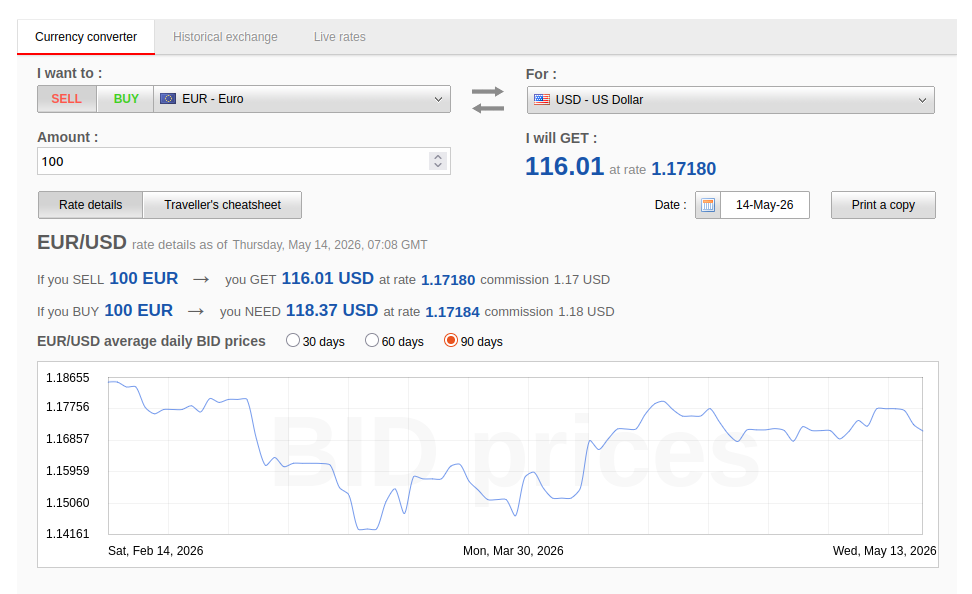
Currency conversion calculator at Dukascopy
How to Reduce Currency Conversion Costs
Conversion costs can gradually diminish your net returns even when a trade is profitable in the original currency. These expenses are easy to overlook because they may not appear as a separate fee. For that reason, traders should check both the broker’s conversion policy and any additional charges from banks or payment providers. Here are a few other ways to reduce your conversion expenses:
- Choose an account currency that matches the currency you use and trade most often.
- Deposit and withdraw in the same currency whenever possible.
- Avoid unnecessary round-trip conversions, such as funding in one currency and withdrawing in another.
- Check whether your broker applies a conversion markup above the market rate.
- Use payment methods that support your base account currency to reduce third-party conversion charges.
- Compare brokers on their conversion policies, not just their spreads and commissions.
- Keep an eye on conversion costs during active trading periods since frequent small conversions can add up over time.
Calculating Your Trading Costs with Spread-Only and Commission-Based Accounts
Traders must consider the all-in trading costs to make an informed decision whether to open a spread-only or a commission-based forex account. While spread-only accounts appear simpler, commission-based accounts are often associated with lower overall expenses, especially for active market participants like scalpers and day traders. Average spreads and commission rates are broker-specific, so we should use a hypothetical broker in our examples.
Spread-Only Account Costs
With this pricing model, the broker’s fees are entirely embedded in the spread. If the EUR/USD spread for account A averages 0.90 pips, you can calculate your average costs by multiplying the pip value by your position size. No commissions are charged, and we shall assume your account is denominated in USD to eliminate the necessity for currency conversion. Your expenses for opening the position will be as follows:
- 0.00009 x 100,000 = $9 per standard lot
- You will get the same result if you multiply your position size by the spread in pips and the pip value per standard lot: 1 lot x 0.9 x $10 = $9.
- Alternatively, if you are trading in mini and micro lots, your expenses will amount to 0.00009 x 10,000 = $0.90 for the mini and 0.00009 x 1,000 = $0.09 for the micro lot.
- Your gross profits must exceed $9 for you to end up with a net gain, assuming you close the position within the same day to avoid swaps.
Commission-Based Account Costs
Commission-based accounts often provide access to raw spreads, which frequently start from 0.0 pips. Let’s assume account B offers average spreads of 0.1 pips for EUR/USD but charges a $3 commission per side and $6 round-turn.
- Upon opening a position, you will pay $3 + (0.0001 x 100,000) = $3 + $1 = $4 per side per standard lot.
- Positions in mini lots will incur expenses of $0.30 + (0.0001 x 10,000) = $0.30 + $0.10 = $0.40 per side.
- Trading in micro lots will cost you $0.03 + (0.0001 x 1,000) = $0.03 + $0.01 = $0.04 per side.
In this example, trading a standard lot in EUR/USD on the spread-only account A is more than twice as expensive as trading the same pair with the commission-based account B. As spreads fluctuate, the gap can narrow or widen. While this is an isolated hypothetical example, trading expenses with spread-only accounts were usually higher than those for commission-based accounts in our comparison across multiple brokers. Which option is best for you largely depends on your trading experience, frequency, and goals.
How Slippage Can Increase Trading Costs
Slippage is the difference between the price you requested and the price at which your order is actually executed. It occurs because forex markets are dynamic. By the time an order reaches the liquidity provider, the requested price may no longer be available due to rapid price movement or insufficient market depth. Positive slippage occurs when you receive a better fill than expected. Negative slippage is a direct trading cost that worsens your entry or exit.
What Causes Slippage
- High-Impact News Releases: Prices can gap or jump several pips in milliseconds during major announcements like the Non-Farm Payrolls (NFP) or central bank interest rate decisions. If you have a stop-loss or market order sitting in that gap, it will execute at the next available price, which could be far from your target.
- Low Market Liquidity: Trading during the daily rollover (the hour between the New York close and the Tokyo open) or during bank holidays means fewer participants are providing prices. With fewer orders in the market, a single large trade can move the price significantly, causing your fill to slip to a deeper, more expensive level in the order book.
- Market Volatility and Gapping: Sudden geopolitical shocks or unexpected market shifts create “fast” markets. The bid-ask spread often widens, and the pace of price change exceeds the technical latency of the broker’s execution, leading to a discrepancy between the quoted and fill price.
Example of Negative Slippage during News
- You place a buy stop order at 1.2510 for one standard lot of GBP/USD, intending to enter the market at exactly that level.
- After a positive news release, the price instantly jumps from 1.2508 to 1.2515, skipping your target price entirely as no trades occur at the 1.2510 level.
- Because your requested price is no longer available, the broker fills your order at 1.2515, which is the first available price in the market after the gap.
- This gap results in 5 pips of negative slippage, representing the difference between the price you wanted and the price you received.
- To determine the monetary impact, you multiply the slippage by your position size and see that it has cost you $50 (100,000 x 0.0005) more per standard lot.
The additional expenses of $50 can easily exceed your combined spread and commission costs and turn what originally seemed like a low-cost trade into an expensive entry.
How Partial Fills and Requotes Impact Costs
Beyond slippage, execution hurdles like partial fills and requotes can also result in unexpected costs for forex traders. A partial fill occurs when you place a large order, but the market lacks the liquidity to fill the entire position at your requested price. Should this happen, the broker will execute only a fraction of your order, either cancelling the remainder or filling it at a different, usually worse, price level.
Example of Increased Costs due to a Partial Fill
- You attempt to buy 10 standard lots of EUR/GBP at a price of 0.8540.
- The market only has enough depth to fill 4 lots at your requested price of 0.8540.
- The broker fills the first 4 lots at 0.8540, but the remaining 6 lots are pushed to the next available price of 0.8543.
- The 3-pip difference on the remaining 600,000 units results in an additional £180 (600,000 x 0.0003) in execution costs.
How Requotes Affect Trading Costs
Requotes primarily occur with instant (price‑guarantee) execution. When you click “Buy” or “Sell,” the market may move so quickly that the price is no longer available. Instead of filling you at the new market rate, the broker stops the execution and asks if you accept the new, adjusted price.
- If you reject a requote on a fast-moving pair like GBP/JPY, you may miss a profitable entry entirely, which represents a significant loss in potential gains.
- If you accept a requote at a worse price, your overall cost increases immediately. For instance, accepting a requote that is 1.5 pips higher on a standard lot of USD/CAD adds $15 to your entry cost before the spread or commission is even considered.
Impact of Order Execution on Trading Costs
The method a broker uses to process your trades directly impacts the transparency and reliability of your transaction expenses. While spreads and commissions are the most visible costs, the execution model determines how much friction in the form of slippage or requotes you will experience in live market conditions.
- Instant Execution: The broker tries to fill the order at the quoted price. If that price is no longer available, the trader may receive a requote, especially during fast or volatile markets. This can delay entry or cause the trade to be filled at a less favorable price if the requote is accepted.
- Market Execution: Prioritizing speed over a specific price, market execution fills orders at the best available market rate, which eliminates requotes almost entirely but exposes you to slippage.
- STP (Straight-Through Processing): By routing orders directly to external liquidity providers without dealer intervention, this model reduces the conflict of interest associated with markups. Costs can vary depending on the quality and depth of the broker’s liquidity pool.
- ECN (Electronic Communication Network): ECN acts as a digital hub connecting various market participants, typically offering the tightest raw spreads in exchange for a fixed commission. However, total costs are influenced by the currently available liquidity at different price levels.
- Market Maker Execution: Market makers act as counterparties and internalize trades using in-house dealing desks. This can provide stable spreads and reliable execution during quiet periods but may involve wider spreads or price smoothing when volatility is high.
How Execution Quality Affects Costs
Execution quality affects how close your actual fills are to the price you intended to trade. Strong execution can offset a slightly wider quoted spread, while weak execution can erase the benefit of a low spread. This is especially important for scalpers, news traders, algorithmic systems, and anyone trading around volatile conditions.
| Execution model | Pricing Mechanism | Common Risk |
|---|---|---|
| Instant execution | Attempts to match the specific quoted price on your terminal | High frequency of requotes, leading to missed entries during volatility |
| Market execution | Fills orders at the best prevailing market price | Exposure to negative slippage if the market moves before fill |
| ECN-style | Direct access to a pool of diverse liquidity providers | Liquidity can vary by pair, and there are commissions |
| STP-style | Routes orders to external counterparties and liquidity providers | Total costs depend on the markups and fills from the liquidity pool |
| Market maker | Brokers act as counterparties and manage the pricing | Potential for wider spreads or price smoothing during fast markets |
How Forex Sessions Can Impact Trading Costs
Liquidity in the forex market fluctuates throughout the 24-hour cycle and directly impacts bid-ask spreads. According to the 2025 BIS Triennial Bank Survey, average daily global OTC FX turnover reached $9.5 trillion, yet this immense liquidity is concentrated primarily during overlapping financial center hours. Consequently, trading during peak hours ensures optimal market depth and lower spread-related costs, whereas off-peak windows or illiquid market sessions can significantly increase execution overhead.
- Asian Session: Spreads are typically competitive for AUD, NZD, and JPY pairs, but liquidity is generally lighter than in Western sessions. European and American pairs may see wider spreads during these hours as their primary markets are closed.
- London Session: As the most liquid period in the global forex market, this session offers the most competitive spreads on majors like EUR/USD and GBP/USD. Active traders prefer these hours for high-volume entries due to increased price efficiency and narrower spreads.
- New York Session: Strong liquidity continues, particularly for USD-related pairs. While spreads remain tight, they can begin to widen once the London market closes and New York enters its final afternoon hours.
- Session Overlaps: The London-New York overlap provides the highest concentration of liquidity. This period often yields the tightest spreads and best execution quality, but traders should still expect volatility-induced widening during US data releases.
- Market Open and Weekends: Spreads are often at their widest during the Sunday market open. Thin liquidity and potential price gaps from weekend news can make early-week execution unpredictably expensive.
- Holiday Trading: The lack of market participants creates thin conditions during bank holidays. Even if prices appear stable, spreads often expand to compensate for the increased risk taken by liquidity providers.
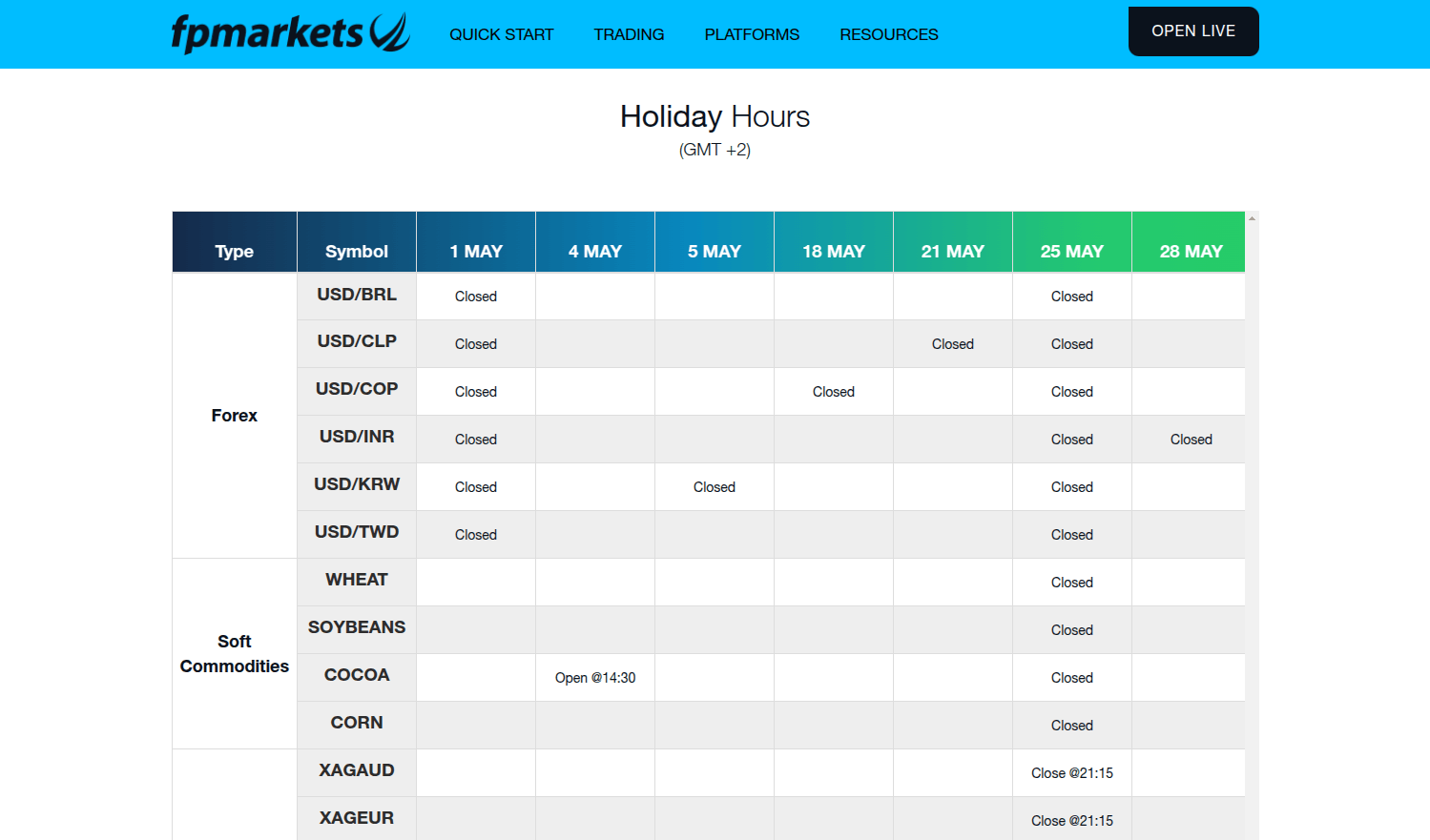
Holiday hours published at FP Markets
Best Times for Lower Spreads
Forex liquidity is not constant, and spreads tend to be the tightest when the largest financial centers are most active. For traders focused on cost control, the objective is to execute orders during high-volume periods while avoiding thin market conditions that lead to spread widening.
| Trading Session | Session Hours (UTC) | How Spreads Behave | Primary Risks |
|---|---|---|---|
| Asian-Pacific session | 22:00-08:00 | Moderate on majors and tight on AUD, NZD, and JPY pairs | Lower liquidity for EUR and GBP pairs leads to wider spreads |
| London session | 08:00-16:00 | Deepest liquidity and tightest spreads on all major pairs | High volatility and sudden spread jumps during European data news |
| New York session | 13:00-21:00 | Very competitive spreads, especially for USD pairs | Liquidity drops sharply after the London close at 16:00 UTC |
| London/New York overlap | 13:00-16:00 | The most efficient pricing and tightest spreads of the day | Slippage risk during high-impact US economic releases |
| Daily rollover | 21:00-22:00, depending on the broker and DST | Spread widening as liquidity providers roll over open positions | High execution costs and significant risk for stop-loss triggers |
| Weekend open | Sunday 22:00 | Unpredictable spread widening and potential price gaps | Thin liquidity can lead to severe slippage on market orders |
The Dukascopy Forex Market Hours Widget is an interactive trading clock that tracks active global forex sessions (Asian, European, and North American) in real time while converting schedules to local time zones. It also displays historical 24-hour liquidity data for major currency pairs, including hourly average spreads, tick volumes, and volatility levels. We find the tool particularly useful for traders aiming to optimize execution timing, secure tighter bid-ask spreads, and avoid trading during illiquid market opens and closes.
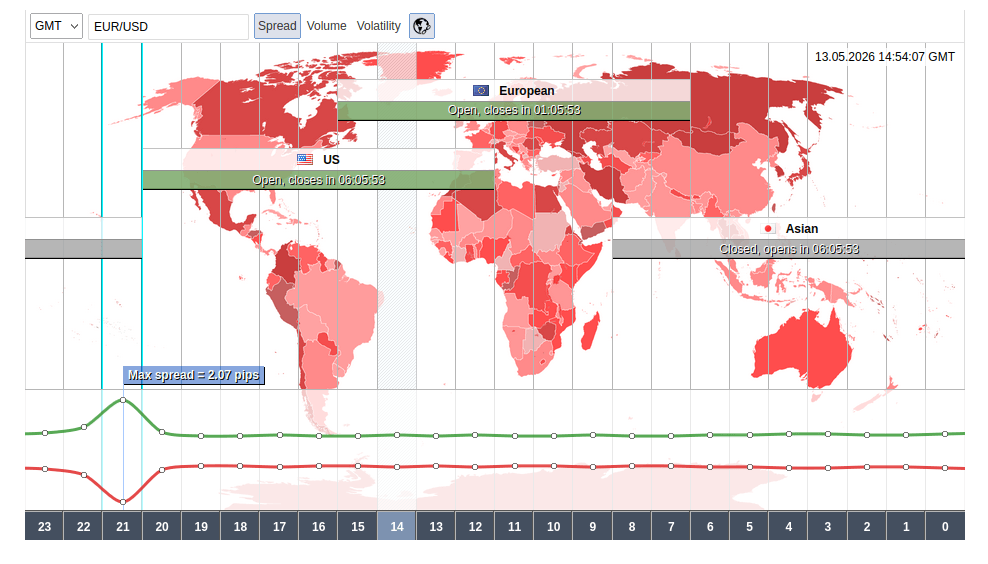
Correlation between global trading sessions and costs, courtesy of Ducascopy Bank
Impact of News Releases on Spreads and Trading Costs
High-impact news events create a liquidity vacuum where market participants pull their quotes to avoid being caught on the wrong side of a sudden price gap. This lack of liquidity causes the bid-ask spreads to expand instantly, effectively increasing the cost of entries and exits until the market stabilizes.
- Central Bank Announcements: They impact interest rate expectations and policy outlooks, causing rapid repricing that results in extreme spread widening and significant slippage for market orders.
- Inflation and Employment Data: Releases like CPI or Non-Farm Payrolls (NFP) trigger sharp volatility as traders adjust to new economic realities, often causing spreads to widen rapidly for several minutes.
- Interest Rate Decisions: Beyond immediate price action, these decisions directly influence the interest rate differentials, which may increase overnight swap costs and widen forex spreads.
- Geopolitical Shocks: Political events like armed conflicts create unpredictable volatility across multiple pairs, often leading to prolonged spread widening and reduced market depth.
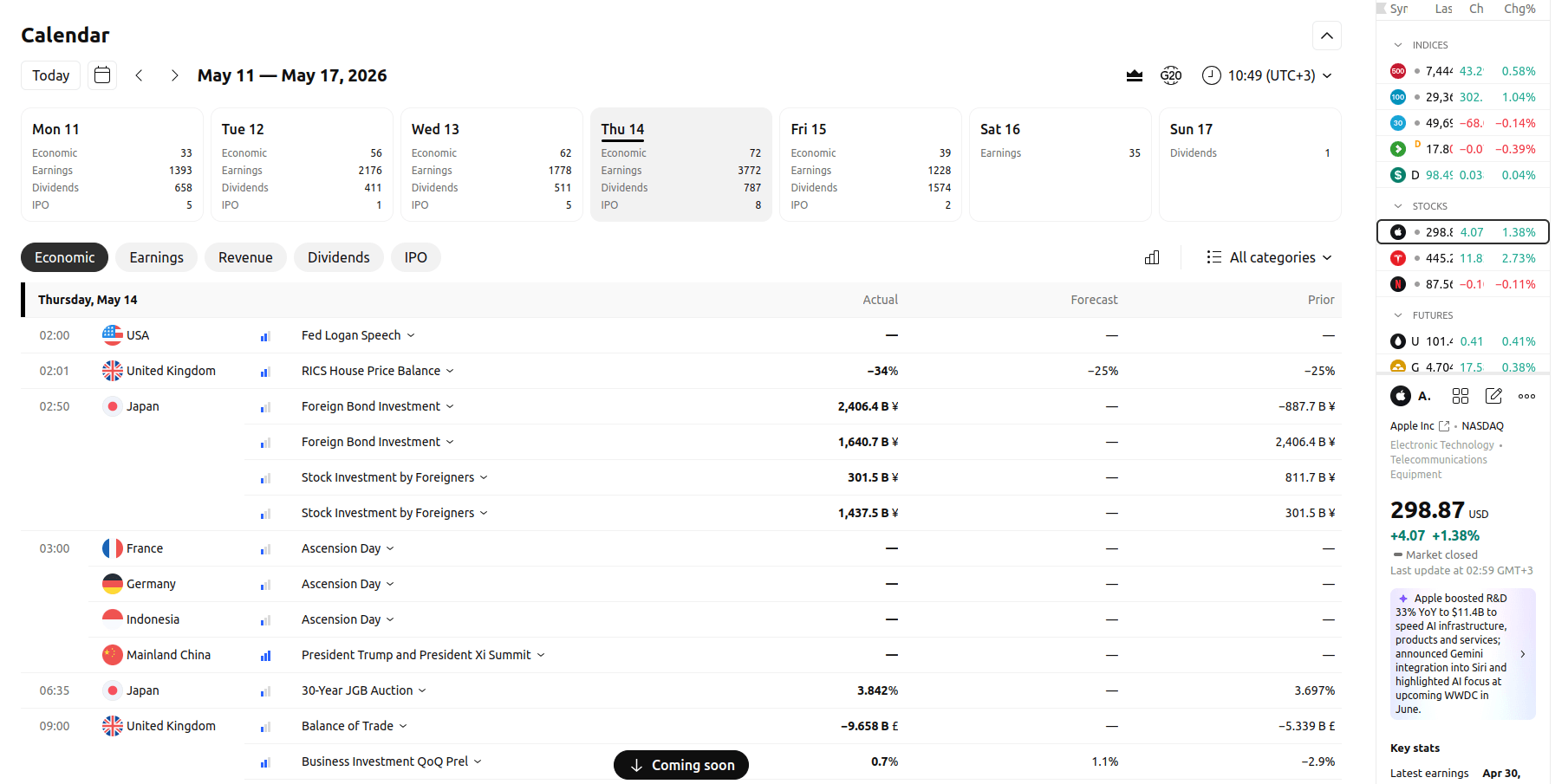
An economic calendar with upcoming events at TradingView
To mitigate the impact of news releases, traders often reduce their position size, avoid market orders during and after news, and utilize limit orders to prevent entries at unfavorable, inflated prices.
How Traders Can Manage News-Related Costs
Practical ways to manage news-related costs include reducing position size, avoiding new entries just before major releases, checking the economic calendar, using limit orders where appropriate, and understanding that stop orders can still slip in fast markets. News trading is not just about forecasting direction but also about managing execution risk.
How Trading Strategies Impact Overall Costs
- Scalpers are highly sensitive to spreads, commissions, and slippage, as their profit targets are often only a few pips. A minor execution delay or a slightly wider spread can instantly erase the statistical advantage of such high-frequency traders.
- Day traders often focus on intraday spreads and commissions, but they must also account for cumulative execution costs across multiple positions. Because they rarely hold positions past the daily market close, they avoid overnight swaps but remain vulnerable to slippage during volatile sessions.
- Swing traders who hold positions for several days are primarily concerned with overnight swap fees, as they can significantly diminish their net returns.
- Position traders typically prioritize swap rates and currency conversion fees over intraday spreads. Their positions remain open for weeks or months, so changes in central bank interest rates can significantly impact their carrying costs.
- Algorithmic traders use automated strategies that rely on consistent execution quality, low latency, and relatively stable spreads. Such traders must also factor in infrastructure costs for VPS services and data feeds to maintain an advantage.
- Copy traders sometimes experience slippage of their copied positions due to execution delays between their account and that of their signal provider. They must account for external platform fees or performance-based commissions paid to the strategy providers.
- High-volume traders sometimes qualify for tiered commission discounts, but their massive turnover can cause their losses from unsuccessful trades to gradually add up. Slippage and conversion fees can translate into substantial monetary losses when scaled across large position sizes.
| Trading Style | Time Horizon and Frequency | Main Costs | Main Risks |
|---|---|---|---|
| Scalping | Short-term as trades are held for seconds or minutes, high-frequency | Spreads, commissions, and slippage | Narrow profit targets leave virtually no margin for execution friction |
| Day trading | Short-term intraday; High frequency | Spreads, commissions, and intraday slippage | High turnover compounds transaction costs, which can erode daily profits |
| Swing trading | Medium-term as trades are held for several days or weeks; moderate frequency | Overnight swaps and bid-ask spreads | Cumulative swap fees can significantly offset net profits |
| Position trading | Long-term as trades are held for months or years; low frequency | Swap rates, carry costs, and currency conversion fees | Extended holding periods magnify the impact of interest rate differentials |
| Algorithmic trading | Variable | Fill quality, slippage, and infrastructure costs for VPS services | Live execution friction often exceeds simulated costs during backtesting |
| Copy trading | Depends on signal providers | Performance fees, spread markups, and slippage of copied positions | Discrepancies in execution timing can lead to results that differ from those of the signal provider |
| High-volume trading | Typically short-term | Cumulative commissions, spreads, and slippage | Small pricing discrepancies scale into larger losses over time |
How Leverage Impacts Trading Costs
When using leverage, traders borrow capital from their brokers to control larger positions than their account balance would normally allow, effectively magnifying both their position size and risk exposure. Margin is the amount required to open and maintain a leveraged position, acting as collateral for the borrowed capital. Since leverage can inflate both potential profits and losses, some financial regulators like ASIC, CySEC, and FCA cap the maximum leverage ratios available to retail forex traders at 1:30. Professional clients from these jurisdictions can access higher ratios, reaching 1:500 in some cases.
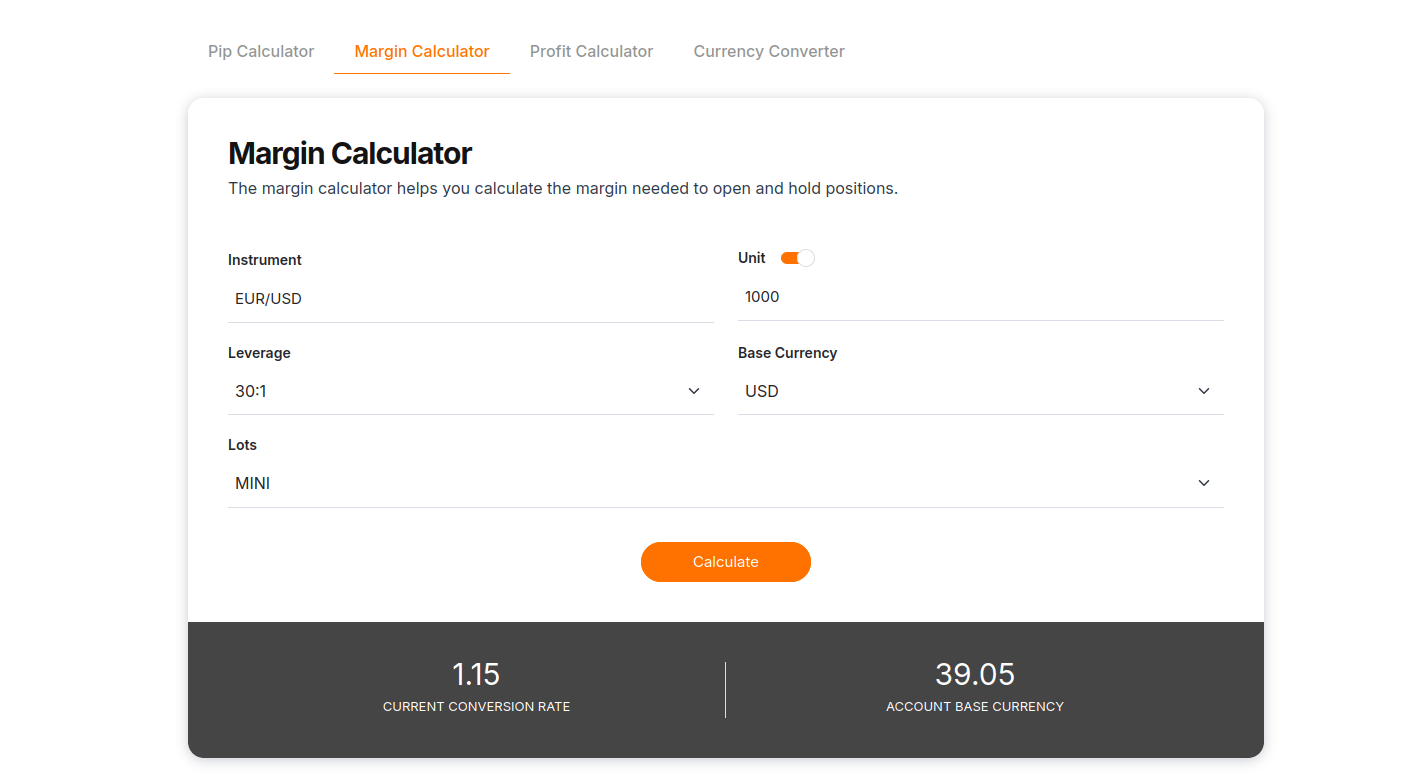
A margin calculator showing $39.05 is required as collateral for a EUR/USD position with a 1:30 leverage
Leverage Can Increase Trading Costs, Here is How
While leverage can multiply both your potential profits and losses, it can also increase your long-term trading expenses as your costs grow proportionately to your position size. There are several ways for this to happen, including the following:
- Notional Exposure: Spreads and commissions are calculated based on the full value of the position, so a larger leveraged order results in a higher cash outflow for every entry and exit.
- Financing and Swaps: Overnight interest is charged on the total amount borrowed from the broker, not the deposited margin. Consequently, highly leveraged positions accumulate carrying costs much faster relative to the account balance.
- Compounding Slippage: When trading with high leverage and thin margin, even the smallest price fluctuations or spread widening can trigger liquidations or forced re-entries. This leads to a cycle of repeated transaction fees that can rapidly deplete your equity.
- Margin Erosion: Higher leverage reduces the buffer between your account balance and your stop-out level, meaning that market volatility can deplete your available capital at an accelerated rate.
Examples of How Leverage Impacts Trading Costs
Leverage allows traders to control larger nominal positions relative to their deposited equity. However, while higher leverage lowers the initial required margin needed to open a trade, it drastically narrows the account’s capital buffer against market moves and execution friction.
The examples below illustrate how identical trade volumes ($10,000 nominal exposure) impact two accounts with different leverage profiles:
Example 1: Using 1:100 Leverage
- You deposit $100 to control a position of $10,000, or 1 mini lot
- A price fluctuation of 1 pip costs $1 and consumes 1% of your available margin before the market even moves.
- Your account has a very thin buffer, making you highly vulnerable to minor price fluctuations.
Example 2: Using 1:10 Leverage
- You deposit $1,000 to open a position of $10,000.
- A 1-pip price movement will still cost you $1, but this amount corresponds to only 0.1% of your available margin.
- Your account has a much larger cushion, allowing you to absorb the costs without triggering a stop-out.
Important Take: Even with safeguards like negative balance protection, excessive leverage increases the speed at which trading expenses erode your account equity. To preserve your balance for longer, you must align your notional exposure with both your risk tolerance and the expected cost of trading.
Non-Trading Fees
Apart from direct trading and execution costs, participants in the forex market may also incur non-trading expenses that result from various administrative and service charges associated with maintaining their accounts. While these expenses are not directly related to market price fluctuations, they can significantly impact your total return on investment if unmonitored, especially for active and algorithmic traders.
- Deposit fees may apply when you fund your account, although many brokers absorb these costs to encourage participation and remain competitive. Traders are most commonly charged when using wire transfers, but the exact amount is broker-specific. E-wallet and card deposits are largely processed free of charge.
- Withdrawal fees may apply when you cash out funds from your balance and can be fixed or variable based on the payment method and location, making frequent small withdrawals inefficient. Some brokers waive their withdrawal fees for transactions exceeding certain amounts, for example, $50, $100, or $500.
- Inactivity fees are recurring charges imposed on accounts without any trading or login activity for extended periods that usually range from 3 to 12 months. They usually range from $10 to $50 per month depending on the specific broker’s policies. You can avoid them by accessing your account and placing orders occasionally.
- Account maintenance fees are imposed by some brokers to cover the costs of regulatory reporting and general account management. These charges, which are separate from inactivity penalties, are most often applied on a quarterly or annual basis and may be waived for traders who maintain a minimum balance or meet specific volume thresholds. For example, AvaTrade charges a $100 annual administration fee in addition to a $50 quarterly inactivity fee for dormant accounts.
- Platform and data fees may result from accessing premium market analysis and research tools, specific platform features, and real-time depth-of-market (DOM). Such tools sometimes require a monthly subscription or meeting specific volume thresholds.
- VPS hosting fees may apply to traders who require Virtual Private Servers to execute automated strategies with minimum latency and round-the-clock uptime. Some brokers offer complimentary VPS hosting to customers with higher monthly trading volumes.
- In copy trading, copiers often pay a profit-sharing or performance fee that typically ranges from 10% to 30% to the signal provider they follow. Most platforms use a high-water mark to ensure fees are only charged on new net profits rather than on the recovery of previous losses.
- Guaranteed Stop-Loss Orders (GSLOs) ensure positions are closed at your exact specified price regardless of market gapping or slippage. Brokers typically charge a premium for this protection, which is often applied as a wider spread or a separate fee if the order is triggered.
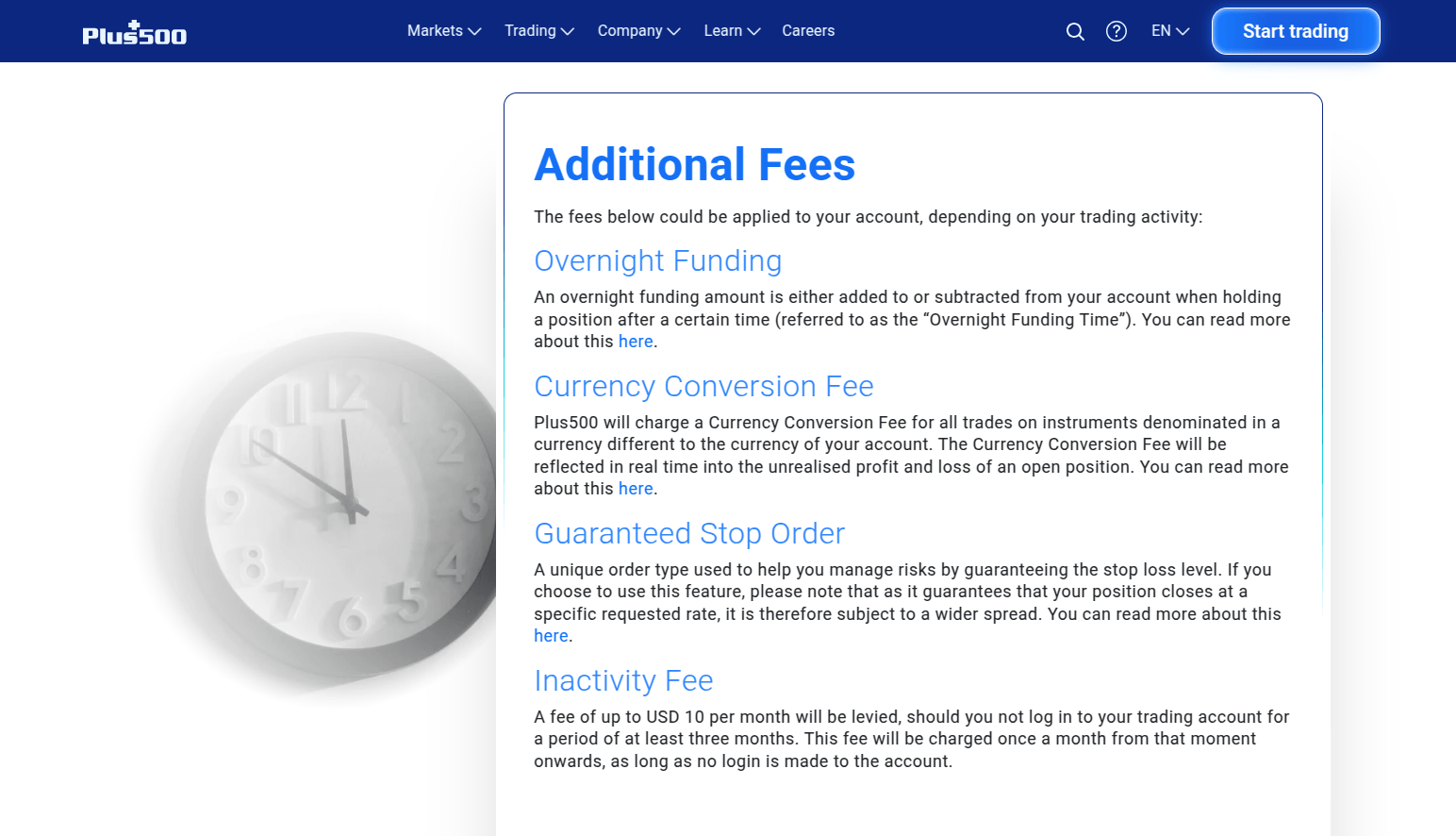
GSLO and Inactivity fees at broker Plus500
10 Smart Ways to Reduce Forex Trading Costs
Managing your expenses smartly is as vital to long-term profitability as trading strategies and risk control. By understanding how market timing, order types, and account structures interact, traders can significantly reduce the negative impact of transaction fees and market friction on their equity. Here are several ways to achieve this.
- Prioritize Highly Liquid Currency Pairs: Major pairs like EUR/USD, USD/JPY, GBP/USD, and AUD/USD generally have tighter spreads and more reliable execution due to their substantial trading volumes compared to exotics like USD/TRY or USD/MXN.
- Trade During Peak Liquidity: Aligning your trades with peak market hours like the London and New York overlap ensures deeper liquidity, narrower spreads, and less slippage.
- Sidestep High-Impact News Releases: Avoid placing orders during major economic announcements to protect your account from extreme spread widening and slippage that often result from sudden volatility.
- Evaluate All-In Costs Holistically: Analyzing spreads, commissions, swaps, and potential conversion fees gives you a more accurate view of the true cost per trade for your specific position size.
- Use Limit Orders: Setting specific entry or exit prices with limit orders helps eliminate negative slippage, although there is still a risk of the order not being filled in fast-moving markets.
- Avoid Overtrading: If you reduce the frequency of your entries and exits, you can minimize risk exposure and prevent recurring transaction costs that can quickly diminish your returns.
- Examine Swap Rates Before Position Rollover: Check the swap rates and triple-swap days for your preferred pairs before rolling over your positions to ensure your carrying costs do not exceed your potential gains.
- Select Accounts with Cost-Efficient Pricing: Opting in for ECN, STP, or Raw Spread accounts can lower your overall expenses, but make sure the pricing structure matches your trading style and frequency.
- Look for Smart Order Routing (SOR): Choose a broker that uses SOR or aggregates liquidity, as this technology enables better order fills, fewer requotes, and less slippage. SOR improves execution because it scans multiple liquidity sources in real time and sends your order to the venue offering the best available prices for your position size without delays and requotes.
- Use Netting and Hedging: Use netting to consolidate opposing positions into a single net exposure, which eliminates redundant carrying costs. You can also use hedging to manage risk during volatility without closing key positions.
8 Common Pitfalls in Forex Trading Cost Management
While many people focus primarily on spreads, trading costs are an aggregate of execution quality, financing charges, and account-specific fees that can erode your balance if not meticulously managed. Here are several common beginner mistakes to avoid when it comes to cost management.
- Focusing Solely on Spreads: Relying solely on advertised spreads is a common error, as commissions, slippage, and non-trading fees can often entirely eliminate the benefits resulting from narrower spreads.
- Neglecting Commissions: Many traders understate their actual break-even point by overlooking explicit commission charges. This is especially common with Raw and Zero accounts where primary costs result from commissions rather than spreads.
- Confusing Minimum with Average Spreads: Minimum spreads often reflect ideal, low-volatility conditions that are not always available during active trading, whereas average spreads offer a more accurate representation of the typical costs you will encounter across various market sessions.
- Disregarding Swap Fees: Traders who hold positions overnight may be caught off guard by swap charges, which can significantly impact the performance of an otherwise profitable intraday strategy.
- Overlooking Currency Conversion Fees: Conversion fees embedded in deposits, withdrawals, profits, and losses can diminish your net returns if the account currency differs from the quote currencies of your preferred forex pairs.
- Underestimating the Volatility of Exotic Pairs: While exotic pairs offer high volatility, they also carry wider spreads and increased risk of slippage, often making them substantially more expensive to trade than major pairs. It would be best to avoid them altogether if you are new to forex trading.
- Using Excessive Leverage: High leverage amplifies the monetary effect of each pip, causing spreads and commissions to consume a much larger percentage of your collateral.
- Overtrading Within Lower Timeframes: Trading on lower timeframes ranging from 1 to 15 minutes increases your transaction costs, as spreads and commissions make up a much larger portion of your position’s expected profit. For example, scalping 5‑minute charts can transform a nominal fee into a significant expense that effectively neutralizes any competitive advantage you may have.
Forex Cost Comparison Checklist
Spread Checklist
A good spread checklist helps you see through a broker’s marketing language and uncover the actual costs of your specific trading strategy.
- Check average spreads, not only minimum spreads.
- Examine spread behavior during the sessions you actually trade.
- Check how spreads behave around rollover, holidays, and news releases.
- Confirm whether the account uses marked-up, fixed, variable, or raw spreads.
Commission Checklist
By looking into these specific details, you can familiarize yourself with different fee structures and compare the true value of different broker offerings.
- Confirm whether the advertised commission applies per side or round-turn.
- Verify whether it is quoted per lot, per million, or as a percentage.
- Check for commission rounding.
- See what currency the commission is charged in.
Swap Checklist
By systematically evaluating overnight financing costs, you can better gauge the financial impact of holding trades across multiple sessions.
- Check both long and short swap rates for the pair.
- Check the rollover time and when triple swaps apply.
- Examine whether swap values change frequently.
- Look for alternative overnight charges when using a swap-free account.
Slippage Checklist
Review the difference between the expected entry price and the final execution price to identify slippage.
- Check order execution quality during fast-moving markets.
- Review whether positive or negative slippage is more prevalent.
- Consider market, stop, and limit order behavior separately.
- Track actual fills on a small live sample if possible.
Conversion Fee Checklist
By pinpointing how and when currency exchange occurs, you can identify where hidden fees are most likely to impact your bottom line.
- Check account currency versus deposit currency.
- Examine how profits and losses are converted.
- Confirm whether commissions and swap fees are charged in another currency.
- Check the exchange-rate markup used for conversions.
Non-Trading Fee Checklist
Review non‑trading expenses to keep your capital working in the market rather than being eroded by maintenance and account fees.
- Look for inactivity, maintenance, platform, and data fees.
- Check for complimentary VPS hosting for specific monthly volumes.
- Check for additional deposit and withdrawal fees.
- Examine performance fees if you plan to engage in copy trading.
Execution Quality Checklist
Analyze how your orders are executed so the quoted price matches the price that actually posts to your account.
- Examine the execution model and whether requotes are common with this specific broker.
- Track slippage behavior during volatile periods.
- Prioritize live market data over demo results.
- Check whether the broker provides transparent execution and fill reports.
Know Your Terms: Glossary of Forex Trading Costs
- A
- Ask Price: The price at which you can buy a currency pair immediately. It is always higher than the bid price.
- B
- Bid Price: The price at which you can sell a currency pair immediately. It is also the price used to close a long position.
- C
- Commission: A fee charged per trade, typically found on raw spread, zero-spread, and ECN accounts, and often calculated per side based on lot size.
- D
- Dealing Desk: A pricing model where the broker may take the opposite side of a client’s trade, potentially affecting the spread and execution quality.
- F
- Fixed Spread: A spread that remains constant under normal market conditions, providing predictable costs regardless of minor volatility.
- Floating Spread: A spread that fluctuates based on market conditions, typically narrowing during high liquidity and widening during low liquidity.
- H
- High-Water Mark: A performance‑fee mechanism used in copy‑trading or managed accounts where incentive fees are charged only on net gains above the account’s prior highest value, ensuring managers are not paid for recovery of past losses.
- L
- Latency: The delay between an order’s transmission and its execution. High latency can lead to unfavorable price changes and increased slippage.
- Liquidity Provider Markup: A small premium added by a broker to the wholesale prices they receive from banks or other liquidity sources.
- Lot Size: The standardized volume of a forex position, commonly categorized as standard, mini, micro, or nano lots.
- M
- Margin Call: A notification that account equity has fallen below the required maintenance level for current leveraged positions, often leading to liquidation at current market prices.
- Market Execution: An order type that fills at the best available current price, prioritizing the speed of the fill over price certainty.
- Market Impact: The extent to which a large order moves the market price against the trader during the execution process.
- P
- Pip (Percentage in Point): A standard unit of price movement in forex trading, usually representing 0.0001 for most pairs and 0.01 for JPY-based pairs.
- Pip Value: The specific monetary value of a one-pip price move, determined by the lot size, currency pair, and your account’s base currency.
- Pipette: A fractional pip, representing the fifth decimal digit (0.00001) in most currency pairs (or the third in JPY pairs), allowing for more precise pricing and tighter spreads.
- Positive Slippage: Occurs when an order is filled at a price better than requested, effectively lowering the trade’s cost.
- R
- Raw Spread: A spread passed directly from liquidity providers with minimal markup, usually requiring the trader to pay a separate commission.
- Requote: A notification that the requested price is no longer available, requiring the trader to accept a new quote to execute the order.
- Rollover: The process of extending the settlement date of an open position to the next trading day.
- Round-Turn: A completed trade cycle consisting of both opening and closing a position.
- S
- Slippage: The difference between the expected price of a trade and the actual price at which it is executed.
- Spread: The difference between the bid and ask prices, representing the primary cost of entering a trade.
- Stop-Out Level: The specific equity percentage at which a broker automatically closes open positions to protect against a negative balance.
- Swap: The daily interest adjustment, either a debit or credit, applied to leveraged positions held past the market’s daily rollover time.
- T
- Tom-Next Rate: Short for “Tomorrow-Next,” this is the interest rate differential used to calculate the swap cost for carrying a position overnight.
About the Editorial Team