


 Zornitsa Stefanova
 Zornitsa Stefanova is a Financial Research and Platform Testing Analyst at BestBrokers.com, specialising in hands-on reviews of forex, cryptocurrency and stock trading platforms. She evaluates brokerage companies from a user-focused perspective, testing key areas such as account setup, trading conditions, platform usability, available markets and overall reliability.
 | Expert Editor
  Eugene Lee, CFA
 Eugene Lee, CFA, is the Head of Research at BestBrokers.com, where he draws on more than two decades of experience in global markets, portfolio management, derivatives, and fintech to evaluate online brokers. His background in institutional investing and quantitative research helps ensure that broker reviews are based on data, risk assessment, and real-world trading conditions.
  | Updated:
 If you are interested in trading CFDs on forex or other instruments, it is necessary that you become familiar with the margin mechanics of leveraged trading. In this guide, we break down the different types of margin used in online trading, along with key concepts like margin calls and how stop-out levels work. Additionally, we cover demo accounts and their importance for both practice and strategy testing.
This guide is written for beginners who are new to leveraged trading, and it also serves as a risk-management framework for active traders. By the end, you should be able to read the main margin figures on a trading platform, understand how floating losses reduce equity, recognize the difference between a warning and forced closure, and build a basic margin-risk routine before entering a trade.
All numerical examples provided in this guide are strictly illustrative. Actual margin call thresholds, stop-out percentages, available leverage, platform warnings, and forced-closure protocols are highly variable and determined by your broker, jurisdiction, and other factors. The same applies to the availability of negative balance protection.
Introduction to Margin Trading and Key Terminology
Leveraged trading involves the use of borrowed funds to open large positions with more capital than you have at hand. Margin is the collateral, i.e., the portion of your balance that is set aside to support an open position, and the exact amount equals a percentage of the total position size.
There are several types of margin:
Used Margin
 Used margin is the total amount of margin currently tied up by all your open trades. If one position requires $300 of margin and another requires $700, your used margin would be $1,000. Used margin is not the same as a loss. It is collateral being reserved while trades remain open, and it is released when positions are closed, assuming losses have not already reduced your account equity.
Free Margin
 Free margin is the part of your equity that is not currently being used to support open trades. In simple terms, it is the cushion you still have available for market movement and, if broker rules allow, for opening new positions. When your free margin becomes very low, the account has less room to absorb losses. If it falls to zero or below, the account may be near a margin call or stop-out, depending on the broker’s policy.
Margin is also separated into initial and maintenance margin. The former is the funds required to open the position, while the latter is the margin you need to maintain for the said position to stay open.
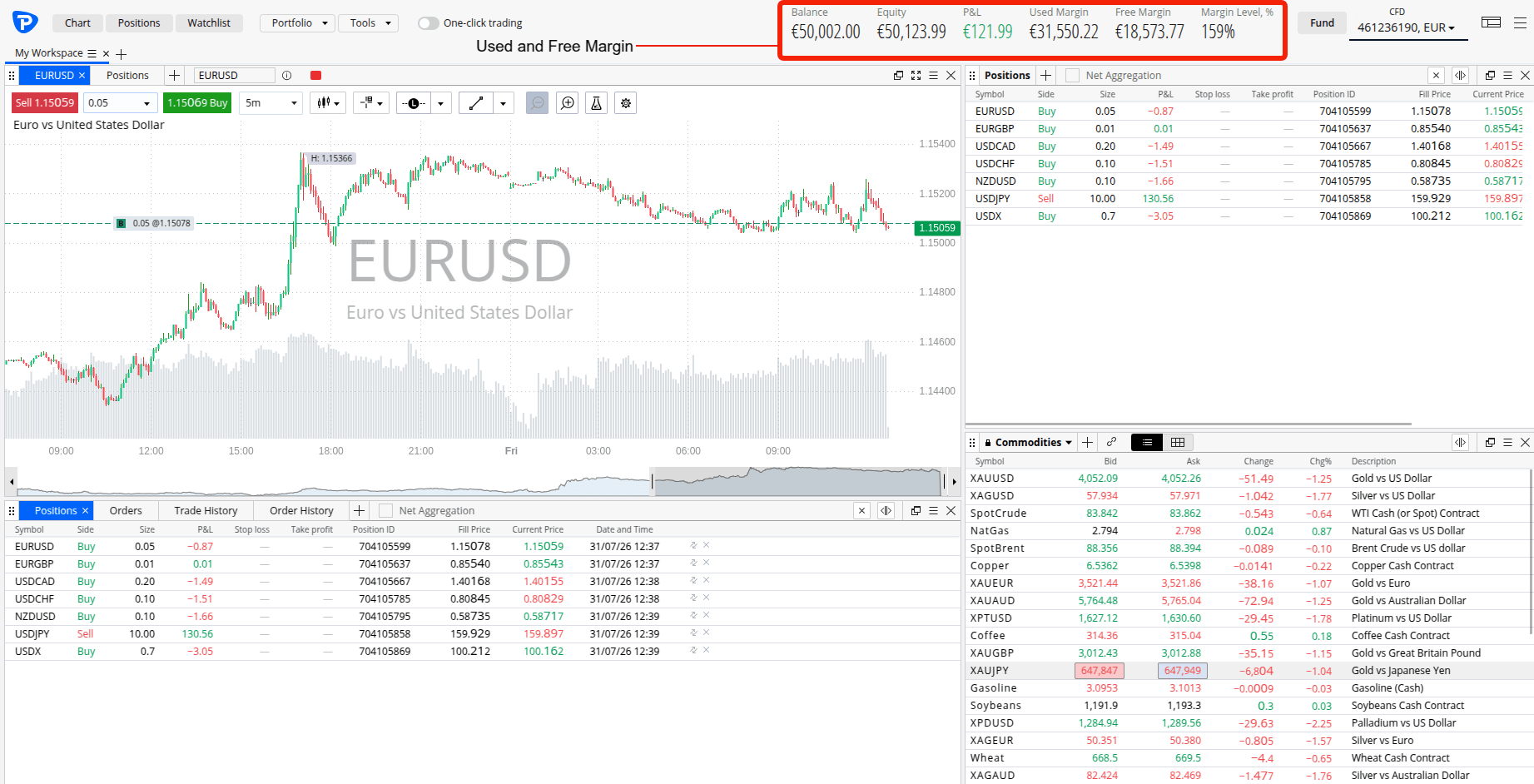
Editorial note: Pictured above is our account at broker Pepperstone with several open positions that pushed our used margin to €31,550.22, leaving only €18,573.77 in free margin out of €50,123.99 in total equity. This translates to a 159% margin level and demonstrates how active leveraged positions impact collateral and narrow traders’ buffer against adverse price moves.
How Leverage Affects Margin
Margin is also dependent on the leverage ratio: the higher the leverage, the lower the margin requirement. If you use leverage of 1:100, for example, this means that an amount equivalent to 1% of the position will serve as the margin. If you utilize leverage of just 1:2, on the other hand, that percentage jumps to 50%.
| Leverage | Margin Requirement |
|---|---|
| 1:1 | 100% (client funds make up the entire position) |
| 1:2 | 50% |
| 1:5 | 20% |
| 1:10 | 10% |
| 1:20 | 5% |
| 1:30 | 3.33% |
| 1:50 | 2% |
| 1:100 | 1% |
| 1:200 | 0.5% |
| 1:500 | 0.2% |
| 1:1000 | 0.1% |
While leverage lowers the amount of margin needed to open a position, it also increases how much market exposure you take on relative to your account size. That is why higher leverage can make both profits and losses grow faster.
A trade that looks affordable from a margin point of view may still be far too large when you take risk into account. This is especially important for professional accounts or other high-leverage setups, where the ability to use more leverage may come with faster drawdowns and, depending on the jurisdiction, reduced or unavailable leverage protections.
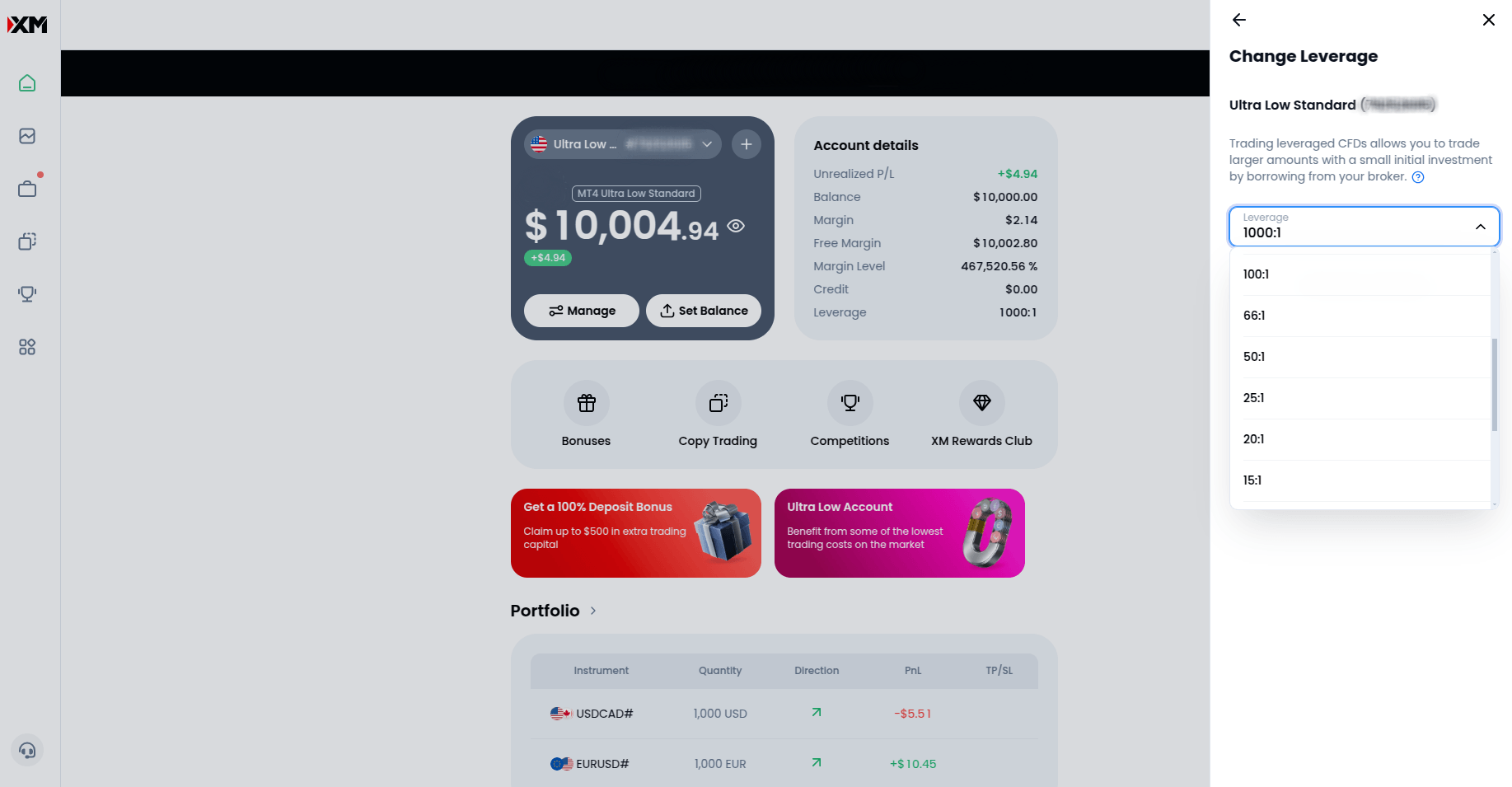
Editorial note: Our Ultra Low Standard account at XM enabled us to adjust our leverage ratios by clicking on “Manage” and then selecting “Change Leverage” from the settings, with ratios ranging from 1:1 to 1:1000. Note that the account was opened under XM Global Limited, the international entity regulated by the FSC in Belize under license 8557558. This gave us access to higher leverage ratios with significantly lower margin requirements compared to those offered by CySEC and ASIC-regulated brokers. For instance, the highest available leverage of 1:1000 allowed us to trade forex with a margin of 0.1% at XM.
Margin Level
Margin level is a percentage that compares your equity to your used margin. It is one of the most important account-health indicators on a leveraged trading platform because many brokers base warnings and forced closures on it. The standard formula for calculating margin level is:
margin level % = (equity / used margin) × 100
If there are no open positions and the used margin is zero, the margin level may appear blank, very high, or not meaningful at all, depending on the platform and broker.
Equity vs Balance
Balance is what your account is worth after closed trades, deposits, withdrawals, and other realized adjustments. Equity, meanwhile, is the real-time value of the account after adding or subtracting the floating profit or loss on open positions. This means your balance can stay unchanged while equity moves up and down with the market. If spreads widen, commissions apply, or overnight financing charges are booked, equity and balance can diverge even more.
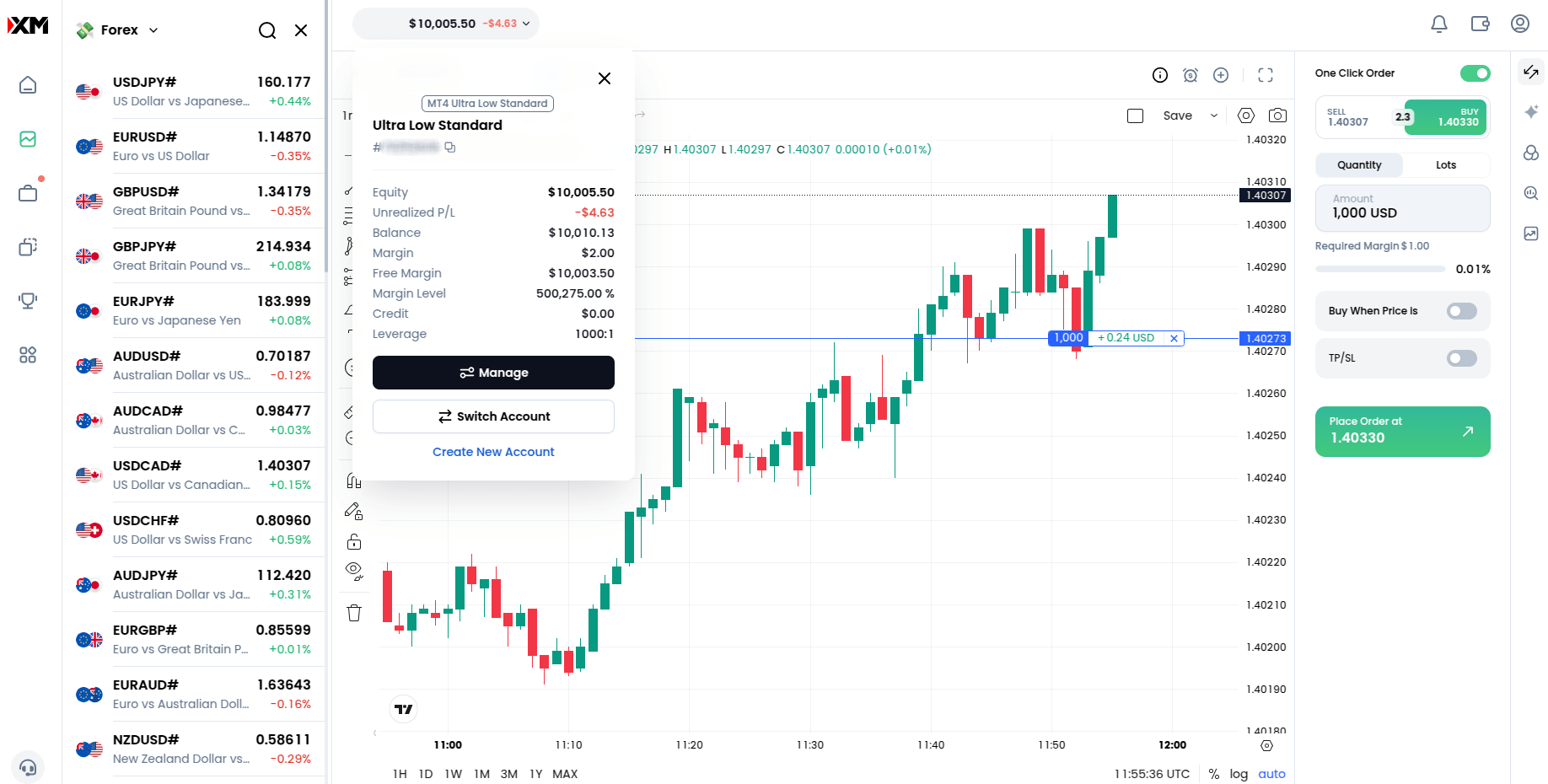
Editorial note: As you can see from the screenshot above, the balance of our XM Ultra Low Standard account stood at $10,010.13 while our equity dropped to $10,005.50 as live prices fluctuated. The resulting difference of $4.63 corresponds to the unrealized losses from our open leveraged positions. This illustrates how equity dynamically reflects real-time market movements when one engages in margin trading.
| Key Terminology Summary | ||||
|---|---|---|---|---|
| Term | Meaning | Formula or Note | ||
| Balance | Account value after closed results | Balance = Equity – open profit or loss | ||
| Equity | Equity is the value of the account and it includes floating profit/loss, adjusted by applicable costs | Equity = Balance + floating profit or loss (adjusted by applicable costs) | ||
| Required Margin | Margin needed for one trade | Percentage of the total sum of the position | ||
| Used Margin | Total margin tied to open trades | Sum of margin in use across all of your open positions | ||
| Free Margin | Available cushion | Free margin = equity − used margin | ||
| Leverage | The usage of borrowed funds to open positions | Higher margin equals lower leverage | ||
| Margin Level | Account health ratio | Margin level = (Equity / used margin) × 100 | Floating PnL | Unrealized profit or loss | Floating PnL = (entry price – current market price) x position size x pip value |
What Is a Margin Call?
A margin call is a warning that is triggered when losses reduce your equity, and your margin level falls below the broker-defined maintenance threshold. The way margin calls are issued depends on your broker and your own notification and communication settings. Most brokers send margin calls via email, SMS, in-platform alerts, and push notifications.
To address a margin call, you need to restore your account’s equity by depositing or closing losing positions. Failing to meet the margin call will result in the automatic liquidation of all of your positions at the current market price, which is known as a stop-out.
Common Causes of Margin Calls
The health of your account is determined by how much equity remains compared with how much margin is already being used. As margin calls are caused by a drop in equity that falls below the maintenance threshold, anything that can result in excessive loss of equity can lead to a margin call.
Common causes include:
- Using excessive leverage: As leverage enables you to control a large position with smaller capital, it amplifies potential profits and losses. Thus, you expose yourself to significant risk in the event that a highly leveraged position goes south.
- Keeping losing trades open without a stop-loss order: Stop-loss orders are risk management tools that automatically close positions once losses reach a certain threshold.
- Holding several positively correlated trades that suffer simultaneous losses: Positive correlation involves assets that tend to rise and fall in parallel, and opening multiple such positions without recognizing this dynamic can result in significant losses. For example, if you trade the EUR/USD, NZD/USD, and GBP/USD, you will become overexposed to sentiment surrounding the greenback as all of these positions will suffer price drops if the US dollar appreciates.
- Withdrawing funds from your account when numerous positions are open: Before you cash out, you should check your open positions and ensure that withdrawals would not reduce your equity too much.
- Trading through volatile news or Gap risk without enough free margin: Major volatility can result in sharp and unexpected price drops, and a lack of sufficient free margin can lead to these price movements lowering your equity.
- Ignoring spreads, overnight charges, and other costs: Trading costs can easily eat into your equity, and failing to take them into consideration can contribute toward margin calls.
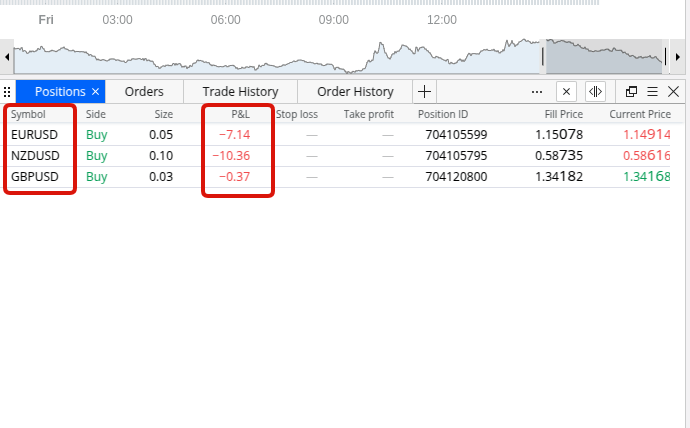
Editorial note: This snapshot from our Pepperstone account illustrates how positive correlation accelerates drawdown. Holding long EUR/USD, NZD/USD, and GBP/USD positions left us with simultaneous floating losses of -$7.14, -$10.36, and -$0.37 as the US dollar picked up momentum, which resulted in pressure on our account equity.
Margin Call Level Explained
The margin call level is the threshold at which the broker may warn you, restrict certain actions, or mark the account as underfunded according to its rules. Many brokers express this level through margin level, but the exact calculation, display, and response can vary.
Once your account has reached this level and a margin call has been issued, you will be blocked from opening new positions and urged to remedy your equity by depositing into your balance or closing losing positions. As established, failure to do so will result in the triggering of a stop-out.
While working with Pepperstone’s supported platforms, we found that margin calls work slightly differently, depending on which software we used. On MT4, MT5, and the proprietary WebTrader, Pepperstone’s EU entity starts issuing margin calls when equity falls below 90% of the used margin, and then enforces a hard stop-out at 50% by fully closing the largest losing positions.
On cTrader, we were able to configure the warning levels in the platform settings at 150%, 100%, or the default 80%. At the 50% threshold, cTrader switched to its Smart Stop-Out logic, and started trimming our positions rather than closing them outright. This way, more of our exposure stayed in the market while we still benefited from reduced risk.
Margin Call vs Account Warning
A margin call is more specific than a generic account warning. A general warning might tell you that the free margin is low or that an order cannot be opened. A margin call usually means a broker-defined threshold has already been reached.
That said, brokers and platforms do not always label these events in the same way. Some use broader risk wording, while others use the term loosely. Make sure to browse your broker of choice’s FAQ page and terms and conditions to see how exactly margin calls are issued. If you cannot find this information, you could turn to the broker’s customer support team.
What Is Stop-Out?
Stop-out is the point at which the broker may automatically close some or all open positions because account equity has fallen too far relative to used margin. It initiates the forced liquidation of positions, and it is triggered when you do not manage to meet the margin call within a certain time threshold.
Beginners may confuse stop-out levels with stop-loss orders, but they are different. A stop-loss is a trader’s order to limit a position’s loss, and it serves as a risk management tool for the trader themselves. A stop-out, on the other hand, is a broker risk-control action applied at the account level.
In fast or illiquid conditions, the move from warning to forced closure can be much faster than beginners expect. Often, they may be given several days to meet the margin, but in many cases, one may be required to remedy their equity as soon as possible before the stop-out is triggered.
Brokers use stop-out levels to limit the risk of an account continuing to lose money after it no longer has enough equity to support open exposure. In simple terms, it is designed to reduce unsecured losses. However, we should stress that stop-out is a broker risk-control mechanism as opposed to a personalized risk-management tool for the trader.
Stop-out does not guarantee favorable exits, full capital protection, or freedom from negative balances. Where negative balance protection exists, its availability and scope still depend on your jurisdiction, account classification, product type, and broker policy.
Stop-Out Level Explained
The stop-out level is the threshold that can trigger forced position closure, and it is dependent on the margin level of your account. If your broker has set the stop-out level to 50%, for example, then a stop-out will be triggered once your margin level hits 50%. This is usually the case at brokers overseen in Australia, the EU, and the UK as regulators in these regions mandate this stop-out level for retail accounts.
The exact margin level threshold and trigger method can vary by broker. Because policies differ, traders should never assume the same stop-out behavior applies everywhere.
How Forced Position Closure Works
When a stop-out is triggered, the broker’s system will start closing positions automatically to reduce used margin and limit further account deterioration. This can happen very quickly, especially in fast markets. The trader does not control the timing or the exact execution price of these forced exits. As prices may be affected by slippage, gaps, spreads, available liquidity, and market speed, the realized loss can be worse than a trader expected.
There is no universal rule for which trade gets closed first during stop-out. Depending on broker and platform rules, the system may close the largest losing position first, the trade using the most margin, the oldest position, the newest position, or multiple positions in sequence. In most cases, the positions involving the steepest losses tend to be prioritized.
Margin Level Explained
As established, the term margin level refers to the percentage difference between your equity and the used margin. Here is a concrete, real-life example to better illustrate how it works. While trading on Pepperstone’s proprietary WebTrader, our account showed €50,160.66 in equity against €3,446.30 in used margin. When we implement the formula mentioned earlier and divide equity by used margin and multiply by 100, we get a margin level of 1,455%, which indicates that the overall risk on our account is very low.
(€50,160.66 / €3,446.30) x 100 = 1,455%

Brokers may calculate, display, or act on margin figures according to their own rules, so the formula is a useful baseline but not a substitute for reading the broker’s terms. If the used margin is zero because no leveraged positions are open, the margin level may be undefined or shown differently on the platform.
The same account can look healthy or stressed depending on which figure a trader focuses on, which is why beginners should look at the full account summary instead of their balance alone.
In summary:
- Check current equity in the platform. This figure is typically located in the trade watch menu of your respective platform.
- Check total used margin. Some platforms simply list it as margin
- Use the following formula: (equity / used margin) × 100 = margin%
- Compare the result with the broker’s margin call and stop-out rules.
What Happens When Margin Level Falls
As margin level falls, free margin shrinks, and the account has less room for adverse price movement. At some point, traders may be unable to open new positions because there is not enough margin available.
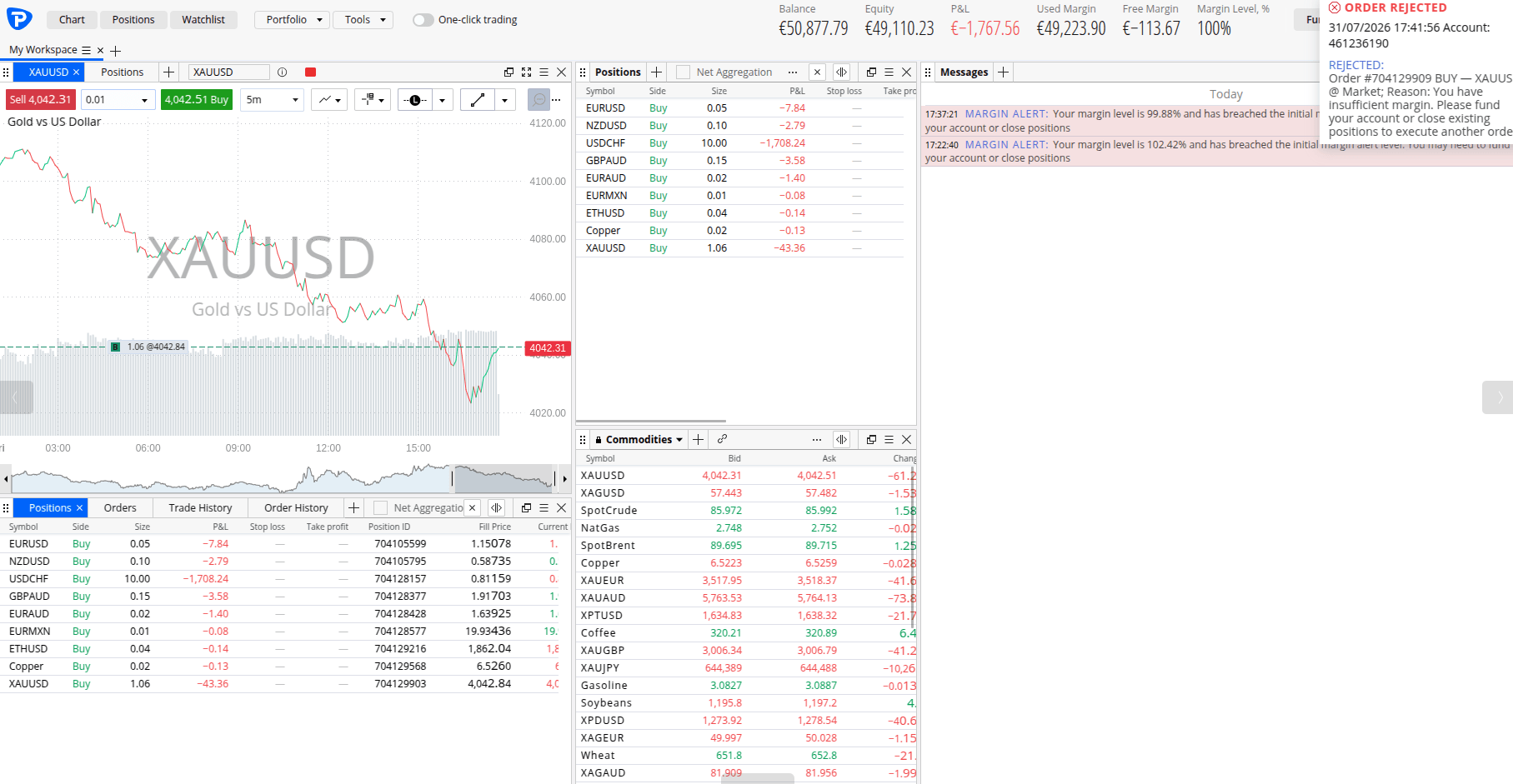
Editorial note: This snapshot of our account at Pepperstone shows the broker sending us margin alerts rather than margin calls. When our free margin dropped to -€113.67, the system started generating margin alerts as our equity fell below our used margin of €49,223.90. As you can see, when we attempted to go long on XAU/USD, the platform rejected our order and prevented us from opening any new positions until we restore our equity or close some of our trades.
If the account keeps deteriorating, the broker may trigger a margin call warning, and if the trade is unable to restore the margin level to a reasonable percentage, a stop-out can follow. The exact sequence varies. In fast markets, spreads and slippage can make these changes happen more quickly than the chart alone suggests.
In general, a higher margin level gives the account more room to absorb volatility, while a margin level close to the broker’s warning or stop-out thresholds leaves little margin for error. However, there is no universal percentage that is safe for every trader, strategy, broker, or instrument. Some brokers set a stop-out of 50%, for instance, while others may opt for a stop-out triggered when the margin level drops to 30%. Additionally, a margin level that feels comfortable in a quiet market may be dangerous during times of heightened volatility as a result of geopolitical events or inflation reports.
Margin Call and Stop-Out Example
Starting Account Balance
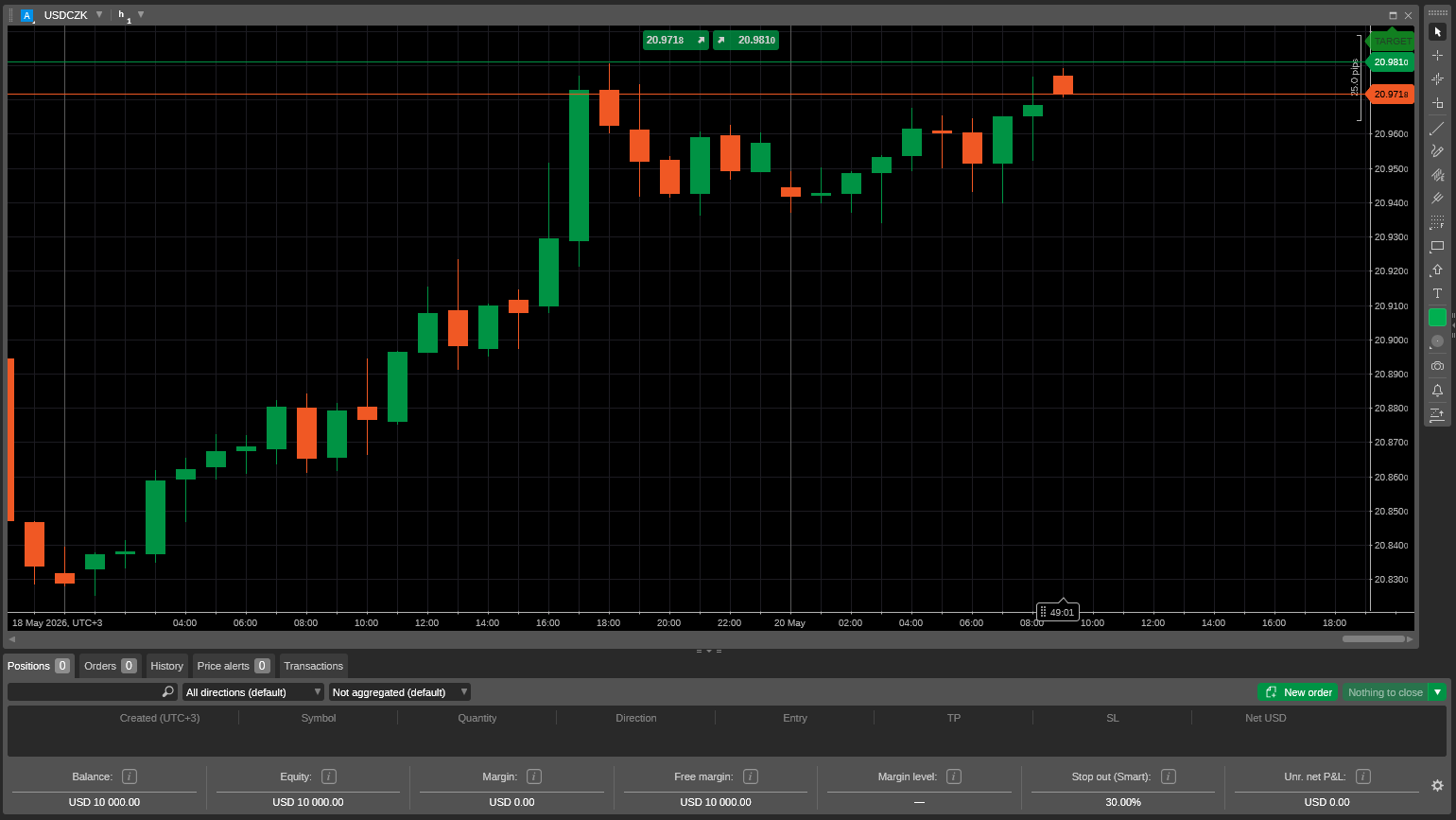
Suppose a trader has an account balance of $10,000 and no open positions. At that moment, balance and equity are both $10,000, used margin is $0, and free margin is effectively the full account equity. Because there are no leveraged positions open, margin level may not be displayed on your platform.

Data Source: cTrader
Opening Leveraged Positions
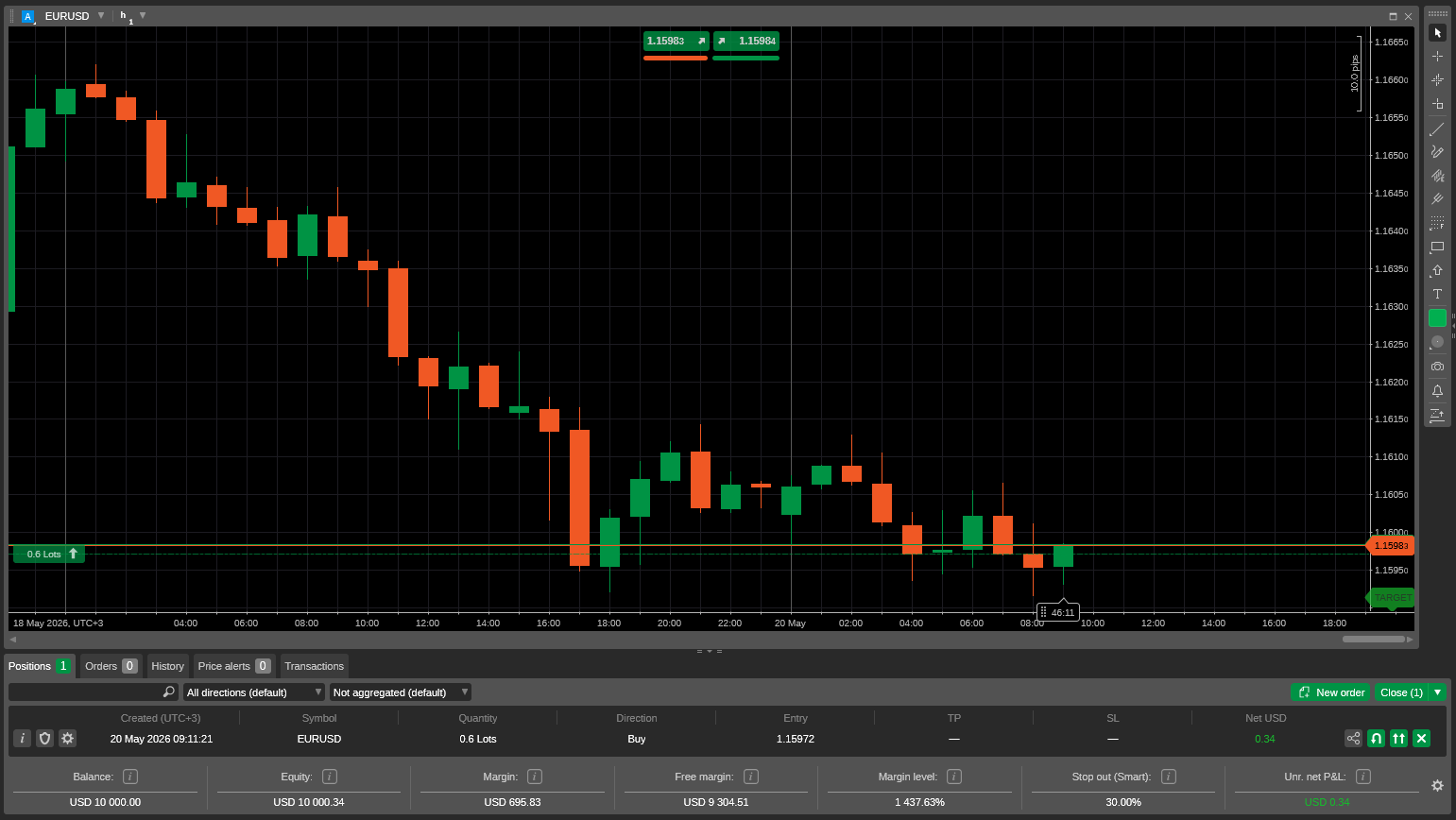
The trader opens a leveraged position that requires $695.83 of margin, and as a result, used margin becomes $695.83. If there were no floating profit or loss yet, equity would remain $10,000.
On a live or demo account, the initial spread and any immediate costs may reduce equity slightly right after entry, so real figures can start a little lower. In this case, a slight variance increased equity to $10,000.34, and free margin dropped to $9,304.51. The margin level is:
(10,000.34 / 695.83) x 100 = 1,437.63%
Data Source: cTrader
Equity Starts Falling
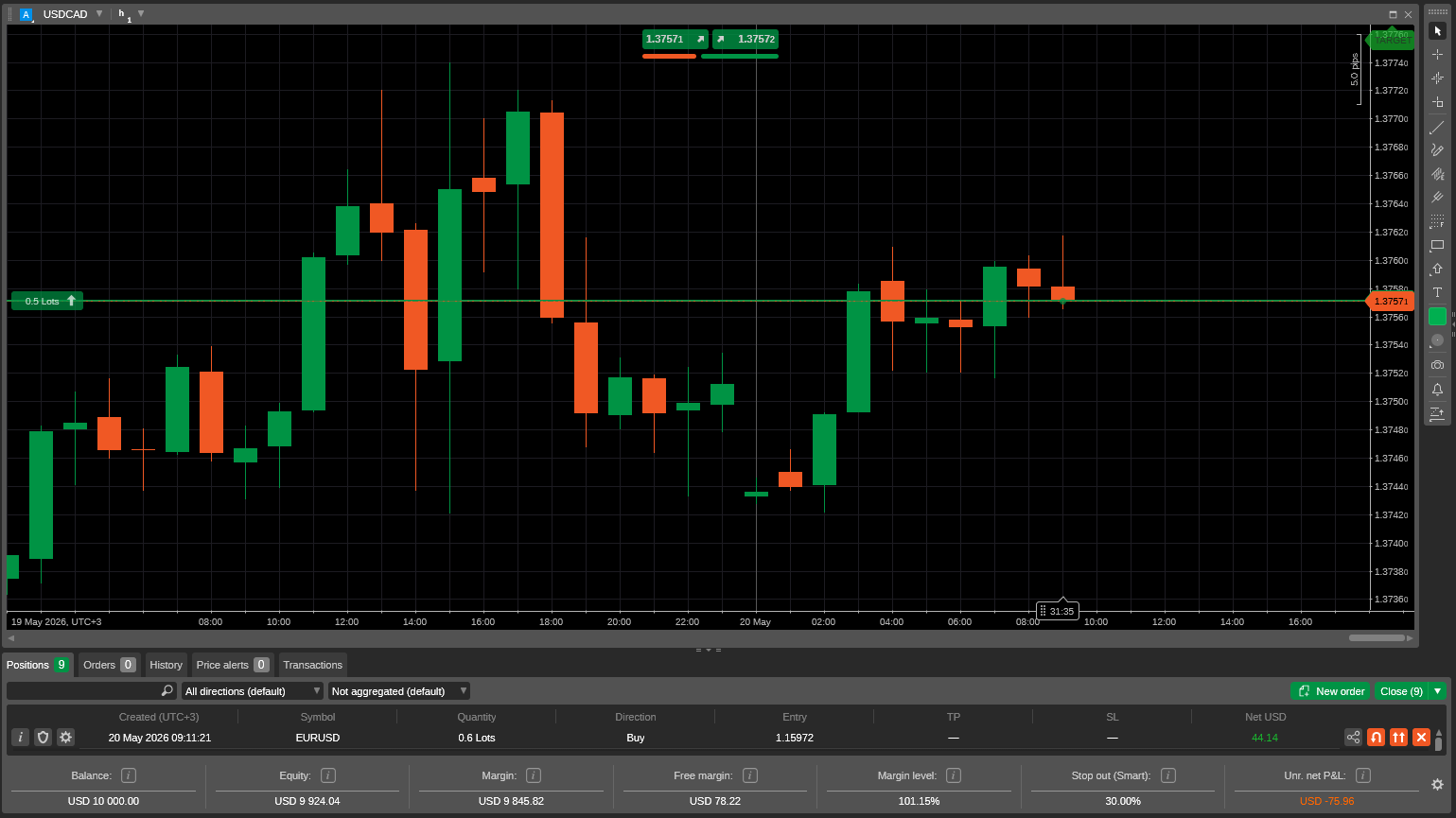
If the market then moves against the position or you open additional positions, your equity will start to drop. In the example below, we can see that equity has fallen to $9,924.04, while used margin has reached $9.845.82, and free margin is $78.22. As a result, the margin level has fallen significantly to 101.15%:
Data Source: cTrader
You may notice that the balance has stayed at the $10,000 mark. This is a key point many beginners miss: The account can start getting weaker even though the balance line has not changed due to the fact that margin stress is driven by equity. A relatively modest additional adverse move could trigger a broker warning or stop-out depending on the broker’s own thresholds.
Margin Call Is Triggered
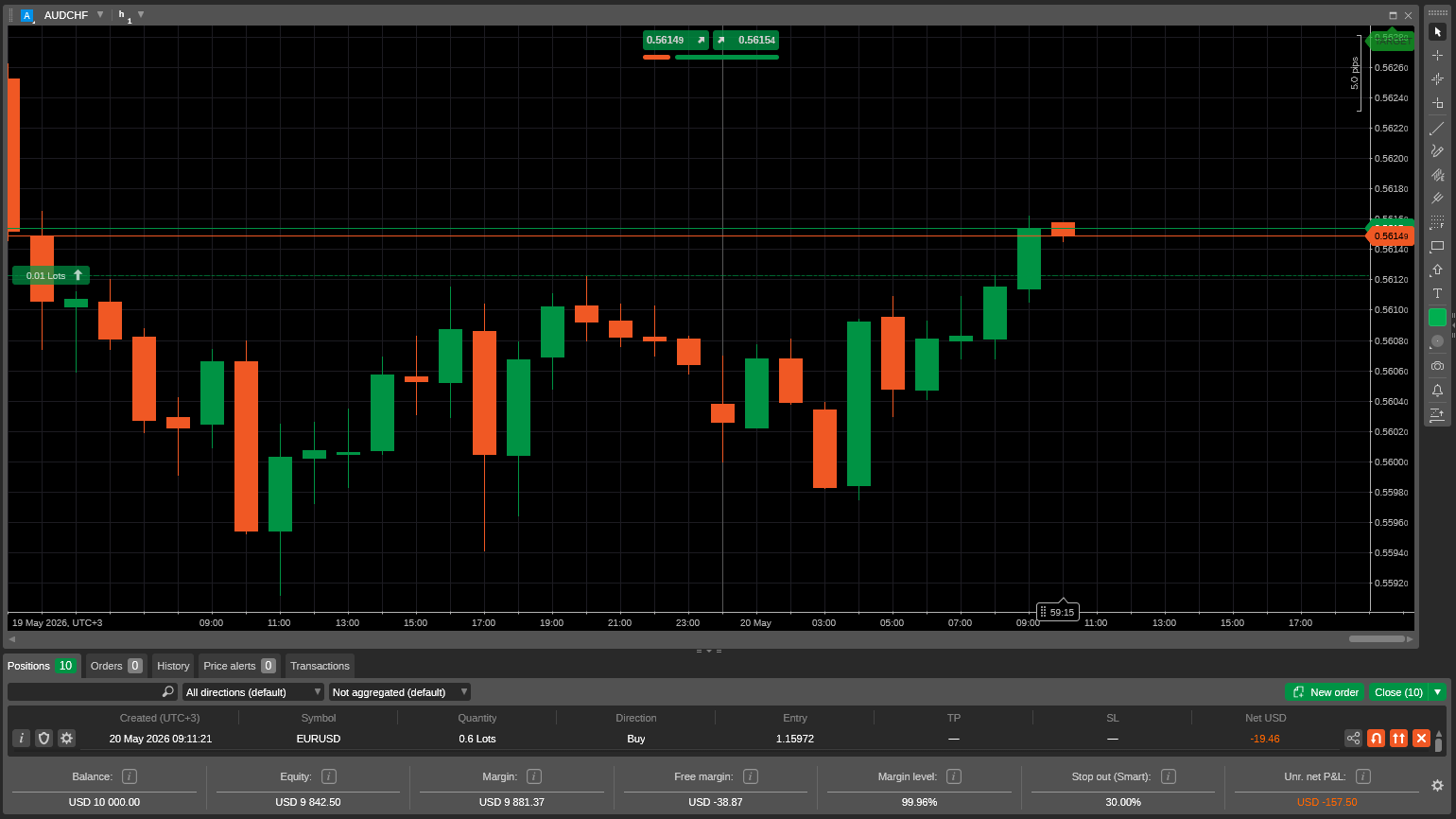
In this hypothetical scenario, the margin call level is 100%. If we suppose that a series of losses has resulted in the equity dropping to $9,842.50, while used margin has reached $9,881.37, and the free margin is in the negatives. Crucially, the used margin now exceeds the trader’s equity. As a result, the margin level has dropped below 100%:
(9,842.50 / 9,881.37) x 100 = 99.96%
Data Source: cTrader
At that point, a margin call warning or account-status event could be triggered under this hypothetical policy. We should reiterate that thresholds, labels, restrictions, and notification methods will vary based on your broker of choice.
If you would like to avoid reaching the stop-out level, this is the point at which you should make a deposit or start closing losing positions.
Stop-Out Is Triggered
The account of this example’s trader has a stop-out level of 30%. If we suppose that a series of losses has resulted in the equity sinking to $2,000, while used margin has jumped to $8,000, then the margin level has breached this critical threshold:
(2,000 / 8000) x 100 = 25%
The broker may now begin closing positions automatically, and stop-out execution may occur with slippage, wider spreads, or price gaps. Multiple trades may be closed in sequence depending on the broker’s rules.
Key Takeaways
- Oversized leveraged trades or an excessive number of positions can push an account from comfortable to critical surprisingly fast.
- Free margin can disappear before the position is closed, leaving little room to recover.
- Used margin can exceed your equity.
- A trader can undertake certain actions once they have been issued a margin call, but stop-out can remove those choices.
Overall, the example should also illustrate why demo practice is useful for novices. Positions can move rapidly, and overexposure and usage of excessive leverage can both have a negative impact on accounts. Thus, beginners should learn the ropes through demo trading first, without risking real losses, before they are knowledgeable enough to start trading live.
It also bears repeating that demo trading can differ from live trading due to a range of factors, including how the potential loss of real money will affect your decision-making. Therefore, once you switch to a live account, it can be better to start out with conservative position sizes before you slowly start expanding the amount of capital you use for trading.
Margin Call vs Stop-Out
Margin calls tell you the account is at risk, while stop-outs will act on that risk. Traders who treat them as the same thing often react too late.
| Feature | Margin Call | Stop-Out |
|---|---|---|
| Nature | Warning or risk-status event | Automatic broker action may begin |
| Main Trigger | Account reaches a broker-defined warning threshold | Account reaches a broker-defined liquidation threshold |
| Typical Effect | Alert, restriction, or warning | Positions may be closed automatically |
| Trader Control | Traders can choose to close positions, make a deposit, or both | Exit timing and price can no longer be controlled by the trader |
| Important Note | Policies vary by broker and platform | Policies and execution behavior differ across brokers |
Essentially, a margin call is a sign that your current exposure may already be too large for the available equity, and that you should take action to increase your equity as soon as possible. You may be given several days to close positions manually, reduce trade size, or add funds, though the exact timeframe is dependent on the broker. Many broking firms also block new trades at this stage.
Stop-out, on the other hand, is more severe because it results in the automatic closure of positions. Once the account breaches the stop-out threshold, the broker will start liquidating trades to free margin and reduce risk. In this phase, the trader loses control over which trade closes first, at what price it closes, and whether only one position or several positions are affected.
When testing and reviewing different trading platforms, we have come across brokers that treat margin calls as stop-outs, which is to say they start liquidating our positions immediately after issuing a margin call. That is why, we always read the brokers’ execution policies and terms before we commit real money and open live accounts.
Why Traders Should Act Before Stop-Out
Acting before stop-out usually means more control over trade selection, timing, and exit logic. If you close or reduce risk while the account is still above forced-liquidation levels, you may avoid the worst effects of slippage, multiple unplanned closures, and emotional decision-making under pressure. Waiting for a stop-out is risky because the account may be liquidated at unfavorable prices.
Platform and Broker Differences
Two traders holding the same market view can experience different margin outcomes because platforms and brokers do not all handle margin in the same way. Each of the following factors can differ from broker to broker:
- Margin call levels
- Stop-out levels
- Closure sequence
- Partial close behavior
- Leverage availability
- Instrument margin requirements
- Hedging treatment
- Platform alerts
Your account type and the jurisdiction you reside in will also play a role. Leverage ratios, for example, are capped at 1:30 for major pairs if you are a retail trader residing in the UK, while professionals can use leverage of 1:500 as per FCA rules. The same goes for brokers licensed in the EU, as ESMA also caps retail leverage ratios at 1:30 in line with the provisions of the Markets in Financial Instruments Directive II (MiFID II). The instrument you are trading and the market conditions are important as well.
What Causes Margin Calls and How to Avoid Them
Margin calls primarily happen due to a reduction in your equity versus your used margin, which in turn exerts pressure on the margin level. There are various factors that can contribute to such a disparity, and in this section, we explore each one in detail. We also offer tips on how to avoid or mitigate each margin call risk factor.
Using Too Much Leverage
High leverage lets you control a large position with a relatively small amount of margin, but that same feature makes the account more sensitive to market movement. A small adverse move on a large leveraged position can cause equity to fall rapidly.
Beginners often focus on how little margin is required to open a trade and overlook how large the actual exposure is. As a result, their account may look efficient at entry, but it may quickly become fragile as price swings begin to take effect.
Overall, it is recommended that you stick to lower leverage when you begin trading. This leads to taking less exposure relative to your account size, giving it more room to handle normal market movement and reducing the speed at which losses eat into equity and margin. This approach does not completely remove risk, but it does mitigate it.
Opening Positions That Are Too Large
Depending on your trading strategy and experience level, it can be possible for you to open a position that ìs far too large, even if the platform allows it. When trade size is too large relative to account equity, free margin disappears faster, and normal market noise can become a serious problem. This is one of the most common beginner errors because the margin requirement may look manageable while the potential loss remains far too big.
Using a smaller position size is one of the most direct ways to lower margin pressure. A smaller position reduces the impact of each point, pip, or tick move on equity. It also makes it easier to place a stop-loss at a sensible distance without turning that stop into an account-threatening loss.
Holding Losing Trades Too Long
Traders sometimes avoid closing a losing trade because they do not want to realize the loss and hope that market movement may switch course. However, leaving a losing trade open results in a floating loss, and that floating loss is exactly what pushes the margin level lower.
The longer a losing trade stays open, the less free margin remains. Moreover, if you add to the losing position, the account can deteriorate even faster.
Trading During High Volatility
High-volatility periods can move prices quickly, widen spreads, and reduce the time available to react. Even if your analysis is sound, the path of price can still become turbulent around major reserve bank announcements, GDP data releases, geopolitical headlines, or market openings.
In these conditions, a margin call can arrive faster than expected, and stop-out can happen with slippage or gaps. This is especially risky for traders using high leverage or tight margin buffers.
To avoid high volatility within reason, you may want to limit the number of positions you open just before or in the midst of major economic releases, central bank decisions, earnings reports, market opens, and weekend closures, since all can increase gap risk and widen spreads. This does not mean you should refrain from news trading and volatility entirely, but being careful and paying close attention to your margin buffer is important during such periods.
Traders with thin free margin are especially vulnerable because a fast move can turn a manageable loss into a margin call or stop-out before there is time to react. Additionally, beginners should be extra cautious about holding oversized leveraged positions through known risk events.
Neglecting to Monitor Margin Level Regularly
Your account’s margin level is one of the most important metrics of online trading. It should be checked before entry, after entry, and whenever market conditions change.
It is especially important to monitor it after adding positions, as well as when you are holding trades overnight or trading during volatile sessions. Many beginners look at their margin only when something has already gone wrong. A better habit is to treat margin level like a dashboard gauge: If it is trending down toward broker thresholds, risk should be reviewed before the broker makes the decision for you.
Ignoring Free Margin
Free margin is the account’s breathing room, but many beginners watch only profit and loss. If free margin is low or drops below $0, even a small increase in floating loss can create a serious account-level problem.
Traders sometimes open a new position because they still see some available funds, without realizing they are leaving no buffer for spread widening, overnight charges, or ordinary adverse movement. Ignoring free margin is one of the fastest ways to drift toward a margin call.
Essentially, free margin should not be treated as a target to use up completely, since leaving a healthy buffer can help absorb spread widening, volatility spikes, overnight charges, and adverse movements that happen before you can respond. However, do note that there is no universal ideal amount because a suitable buffer depends on the instrument, strategy, holding period, and broker rules.
Keeping Too Many Open Positions and not Avoiding Overexposure
Multiple positions can create margin pressure even when each trade seems reasonable on its own, since used margin adds up across positions. Moreover, losses can arrive together if the trades are correlated because several positions linked to the same base currency, stock sector, commodity theme, or market direction may behave like one oversized trade. Beginners often underestimate this clustering effect and assume they are diversified when they are actually overexposed to certain markets.
If you trade EUR/USD and EUR/GBP, for instance, both pairs will be affected by changes in market sentiment towards the euro. Another example is shorting crude oil prices and trading USD/CAD, seeing as the Canadian dollar is a commodity currency and falling oil prices can exert pressure on the CAD. Crude oil price hikes, on the other hand, will support the CAD, which would result in both the crude oil short position and the USD/CAD position going south.
To reduce margin-call risk, think in terms of total portfolio exposure when you plan out your positions. Fundamental analysis and technical analysis can both aid you in gauging whether your account is trading too many positively correlated instruments.
Withdrawing Funds While Positions Are Open
This is a factor that many novices may overlook. Withdrawing from your account will lead to another drop in equity, which in turn will push your account closer to a margin call. Therefore, you must carefully consider your equity, used margin, free margin, margin level, and the stop-out level set by your broker before you cash out funds from your account.
Not Using Stop-Loss Orders
A stop-loss order can help define trade risk before the trade is opened, which can keep one losing position from growing into an account-level margin problem. They are an important risk management tool, and neither novices nor experienced traders should neglect to use them when necessary.
It is important to keep in mind, however, that stop-loss orders are not perfect and do not guarantee an exact exit price in all conditions. Gaps, slippage, low liquidity, and fast markets can still lead to worse fills than expected. A stop-loss also does not override broker stop-out rules, so it should be a part of a broader risk management strategy rather than your only way of mitigating losses.
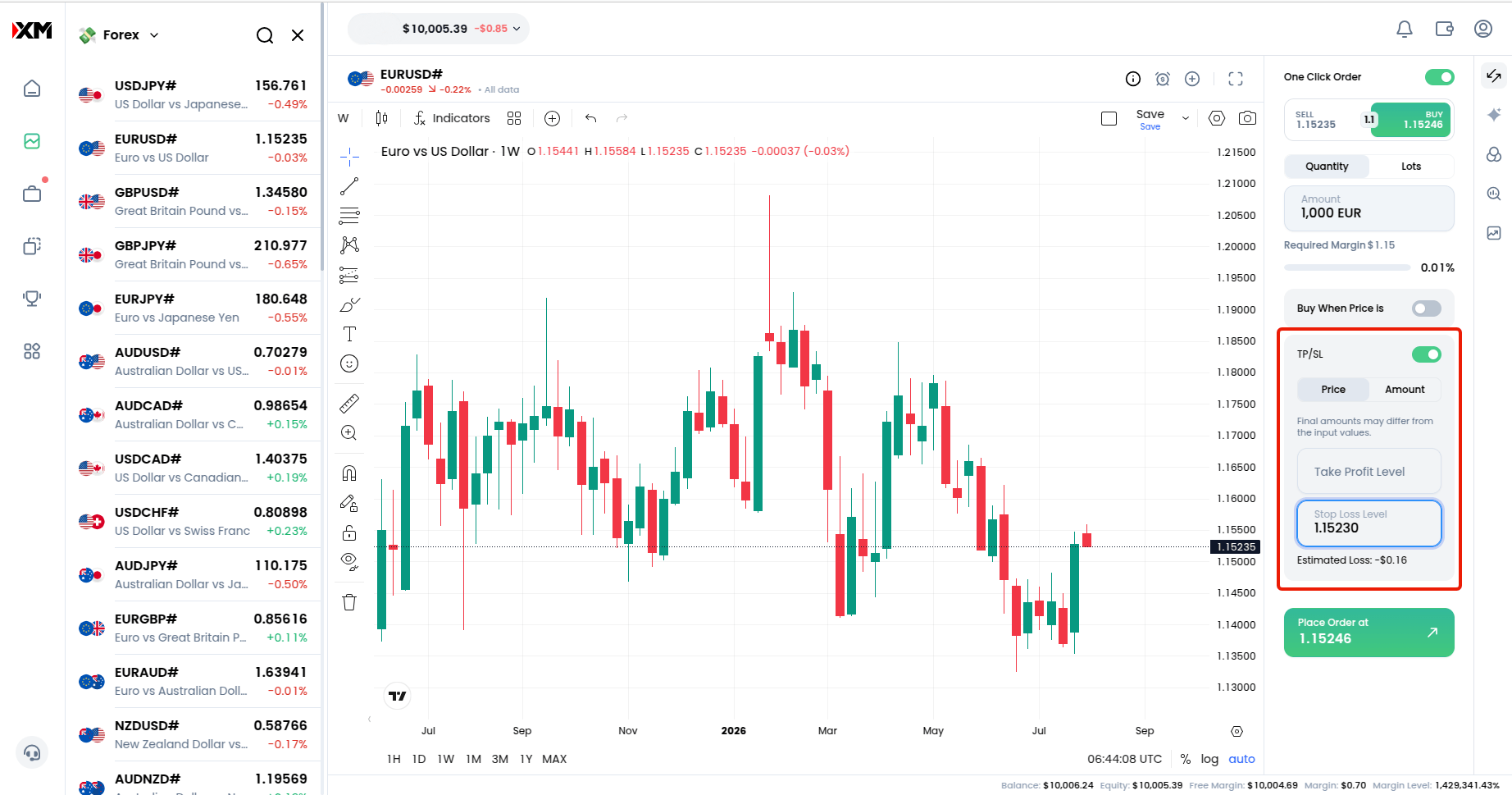
Editorial note: We always use stop-loss orders to protect ourselves from excessive losses, helping to ensure that a single position is unlikely to trigger margin calls or stop-outs. As you can see in the example above, our buy order at XM is around 1.15246 and the stop-loss is set at 1.15230, a few pips below, capping potential losses at approximately $0.16. In practice, your stop-loss should be placed at a level below the current market price where your trade idea is invalidated, rather than right on the market price itself.
How Stop-Out Affects Open Trades
The most direct effect of stop-out is that open trades may be closed automatically without a manual exit decision from the trader. Essentially, the account owner cannot control the exact exit price of their positions.
Because the broker system is responding to margin stress, it is not trying to optimize the trader’s chart setup or preferred exit level. It is reducing exposure based on account risk rules and the available market prices at that moment. Slippage is another potential issue in this scenario and involves trades being executed at a worse or simply different price than expected. Traders with many open positions are often surprised by how quickly one stop-out can turn into several forced closures, especially when trades are correlated or affected by slippage, and all lose at once.
Some brokers or platforms also support partial position closure during stop-out, while others may close full positions only. Partial liquidation can sometimes restore margin level without wiping out every trade, but it still removes trader control and can leave the account with a different risk profile than intended. Whether a partial close is possible depends on the instrument, platform design, trade size rules, and broker policy, so traders should not assume it will always happen.
Once positions are closed, floating losses become realized losses and the account balance drops. That means the account may have less capital available for future trading even if margin pressure improves after liquidation.
In extreme cases, large gaps or poor liquidity can create losses larger than the account’s initial balance. Negative balance protection may apply in some cases, but its availability and scope depend on your jurisdiction and whether you are classified as a retail or professional trader.
Margin Calls on Trading Platforms
The way margin calls are displayed is dependent on a range of factors. One such factor is the type of platform you utilize when you trade online. In this section, we cover three of the most well-established online trading platforms that are used among FX enthusiasts.
Margin Calls on MT4
 Developed by MetaQuotes, MetaTrader 4 is one of the oldest trading platforms that sees use in the online trading sphere. It caters to traders interested in forex and CFDs, and it is known for its intuitive interface, Expert Advisors for algorithmic trading, and broad availability across brokers.
Available for a free download, MT4 enables traders to monitor their margin in the trade area where account summary fields such as balance, equity, margin, free margin, and margin level are shown. The exact layout can vary by broker branding and depend on whether you are using the desktop, web, or mobile version. Your broker also dictates whether a margin call appears as a warning, rejected order, or a message.
Margin Calls on MT5
 MetaTrader 5 is another MetaQuotes-branded software that is used by a plethora of online FX traders. It is supported by a wide range of brokerages, and its catalog encompasses forex, CFDs, physical shares, ETFs, and more.
The platform typically displays similar account metrics in its trade or toolbox areas, again with differences across broker setups and devices. Because MT5 is used for a wider range of instrument types, traders should be especially careful with symbol-specific margin requirements and account settings. A margin warning on MT5 may still look like a generic platform message or a restriction on new orders. Push notifications are also issued on mobile, and your broker may send an SMS or email.
Margin Calls on cTrader
 If you are not interested in MT4 or MT5, cTrader is a popular option. It was launched in 2010, and traders praise it for its sleek interface, roster of markets (forex, metals, energies, indices, crypto, etc.), cBots for algo trading, and copy trading capabilities.
On cTrader, account and margin information are usually visible in the trading panel, where you can view your positions, though there may be variations between desktop, web, and mobile interfaces depending on the broker. Traders can generally monitor used margin, free margin, and margin level in real time.
Where to Check Margin Level and Free Margin
Margin level is usually shown in the platform’s account summary area alongside equity and free margin. On desktop platforms, this often appears near the trade list or terminal panel. On mobile, it may be inside the account tab or trade tab rather than visible at all times. Because display locations differ, beginners should locate this field during calm market conditions.
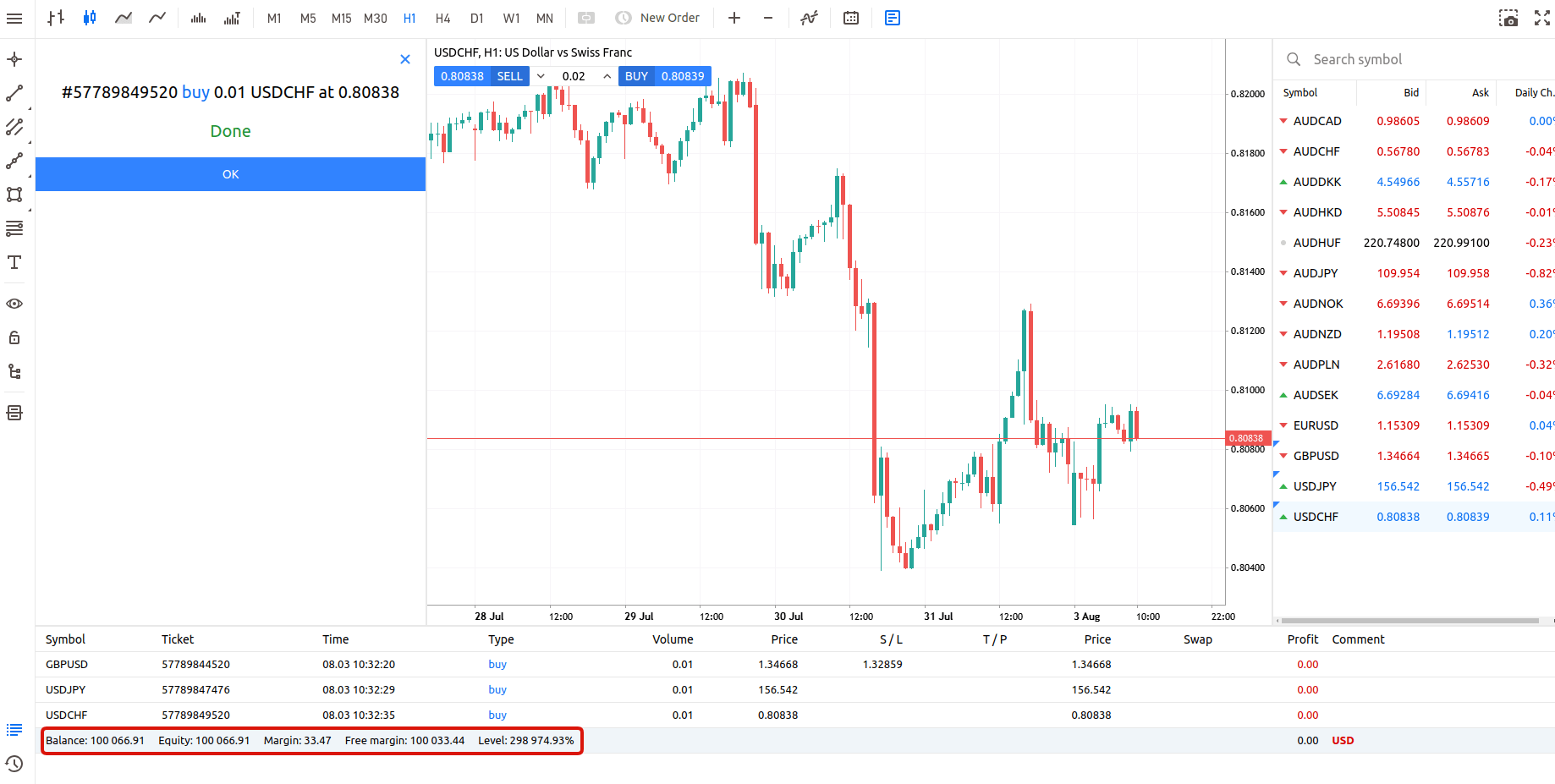
Editorial note: The MetaTrader 4 web terminal neatly displays all key account metrics in the lower left corner of the screen, right below our open orders. This makes it easy for us to track our available free margin, equity, and margin level without leaving the chart view.
Free margin, meanwhile, is usually displayed in the same account summary area as balance, equity, and used margin. It is one of the most practical fields to watch because it shows how much room the account still has. In live trading, free margin may change quickly not only from price movement but also from spreads, commissions, financing charges, and additional positions being opened.
Platform Alerts and Warnings
Some platforms and brokers send pop-ups, emails, text messages, push notifications, or account-color warnings when margin pressure rises. Others may simply reject new orders or display an “insufficient margin” message.
Keep in mind that connectivity issues, device settings, email delays, or broker policy differences can all affect what you receive and when you receive it. Demo alerts may also differ from live behavior because live execution, liquidity, spreads, and broker risk handling are not always identical.
Broker Rules and Margin Levels
Margin call levels vary because brokers operate under different risk models and regulatory environments. Platform setups, types of markets, and client classification also matter.
One broker may define margin call as a visible warning, while another may basically treat it as a stop-out and use it as a threshold for restricting new trades. Even within the same broker, levels may differ by jurisdiction, platform type, account type, instrument, and whether the client is classified as retail or professional.
As brokers do not all use the same liquidation logic, stop-out levels also vary based on the trading firm you use for online trading. Some may start closing positions at one threshold, while others may use a different threshold or liquidation sequence. For instance, while trading at the Vanuatu-licensed entity of Fusion Markets, we observed margin call and stop-out levels of 90% and 20%, as clearly stipulated in the broker’s trading conditions under the Margin and Leverage section. Partial automatic closing of positions is also possible at certain brokers.
Market conditions matter as well. Liquidity, volatility, spreads, and execution quality can all play a role in how stop-out is experienced in practice.
Retail vs Professional Accounts
Your trading experience will differ significantly depending on whether you are a retail or professional trader, particularly when it comes to leverage. Retail traders are often subject to significant leverage restrictions based on the financial authorities that regulate their respective jurisdictions, meaning their margin requirements will also differ.
ASIC and CySEC, for instance, mandate that CFD brokers offer leverage no higher than 1:30 to their retail clients, and that said users are entitled to negative balance protection. The exact ratio is dependent on the instrument, and CySEC imposes the following limits based on the regulatory rules of the European Securities and Markets Authority:
- Forex Majors: 1:30 (3.33% margin requirement)
- Gold, Major Indices, Forex Minors, Forex Exotics: 1:20 (5% margin requirement)
- Commodities (Excluding Gold), Non-Major Indices: 1:10 (10% margin requirement)
- Individual Equities: 1:5 (20% margin requirement)
- Crypto: 1:2 (50% margin requirement)
The above limits are not universal across jurisdictions. Japan’s Financial Services Agency and Financial Futures Association enforce an even stricter cap of 1:25 on major FX pairs, with a 4% margin of the notional position amount. The Monetary Authority of Singapore (MAS) goes even further, restricting retail leverage to 1:20. The CFTC in the US is a bit more lenient in this respect, allowing ratios as high as 1:50 on forex majors with a 2% margin. In Poland, on the other hand, experienced retail traders can access leverage of 1:100.
Professional classification at jurisdictions with stringent leverage regulations tends to come with far higher leverage, often 1:500. However, pros typically waive their rights to negative balance protection as financial watchdogs consider them experienced enough to fully understand the benefits and risks of large leverage ratios.
We should also note that not all financial supervisors take this approach toward leverage. The FSA (Seychelles) is one such regulator, seeing as it does not explicitly restrict leverage. Thus, you may be able to trade at FSA-licensed broking firms with leverage of up to 1:200, 1:500, 1:1000, or even higher.
Margin Requirements by Instrument
 Given the relationship between leverage and margin, margin requirements can also vary widely by jurisdiction. If you plan to use the maximum leverage allowed in Germany, for instance, your margin requirement will be 3.33%. Instrument type is also key because not all markets carry the same volatility, liquidity, contract structure, or gap risk, and leverage restrictions may also be different.
We should also stress that the margin of an open position is not necessarily fixed. Brokers offering dynamic leverage may temporarily introduce Higher Margin Requirements (HMR) during earnings reports, weekend trading conditions, and market volatility. Traders should check the exact symbol specifications for the instruments they actually trade instead of assuming one rule applies to the whole account.
Does Account Type Impact Margin Requirements?
 As we noted earlier, margin requirements are primarily determined by the client classification (retail or professional) and the regulatory jurisdiction governing the broker. Special account types like the Islamic account do not impact these statutory leverage limits. Instead, an Islamic account uses a different overnight fee structure that eliminates interest and swaps to comply with the Sharia law, while keeping the same margin and leverage rules as standard retail or professional accounts. The same goes for commission-based and spread-only accounts, which typically share the same margin requirements.
Reading Broker Margin Rules and Terms
Broking firms are not identical in terms of how they treat margin. Margin call levels and stop-out levels will vary, as will the very definition of margin call. Most brokers define margin calls as a warning, but some treat them as stop-outs and take automatic action to restore the client’s equity. Traders should check which positions may be closed first, whether margin requirements can change during volatile periods, and how negative balance protection is described if it is available. Funding speed matters too, because a deposit that has not yet been credited may not prevent a stop-out.
Typically, these specifics are outlined in the broker’s terms and conditions. From what we have seen while testing and reviewing different brokers, margin details can sometimes be listed on their FAQ pages. Alternatively, support representatives or chatbots have occasionally directed us to the margin requirements and contract specifications.
If you struggle to find the margin and stop-out specifics, it may be best to reach out to a representative of the broker’s support team. Usually, you will be able to do so via live chat, email, or phone.
Here is a summary of the type of information you should ask about in your query or look up on the broker’s website:
| Item to Review | Why It Matters |
|---|---|
| Margin call definition | Shows whether it is a warning, a restriction, or both |
| Stop-out rules | Explains when forced closure may begin |
| Closure sequence | Shows which trades may be closed first during liquidation |
| Instrument-specific margin | Prevents wrong assumptions across symbols |
| Event or weekend margin changes | Highlights times when buffer may shrink faster |
| Funding and credit timing | Important if adding funds during account stress |
| Negative balance protection scope | Shows whether coverage exists and under what limits |
| Platform alert policy | Clarifies whether warnings are sent and how reliable they may be |
What to Do During a Margin Call
Once a margin call has been issued, you are typically given time to address the issue. The series of steps you can take to restore your equity can include:
Close or Reduce Losing Positions
The fastest way to reduce margin pressure is often to close or reduce positions that are causing the account stress. This can free up used margin and stop further deterioration from those trades.
It may feel painful to realize a loss, but refusing to act can leave the broker to close positions automatically later, often at worse prices or in a less favorable sequence. If several trades are open, focus on the total account risk and how each position affects it.
Add Funds Only with Caution
Adding funds can improve margin if the deposit is credited in time. However, you should remember that a deposit does not fix an oversized position or a weak trading plan. It can also encourage a trader to keep a bad trade open.
Funding delays matter as well, especially since deposit times can vary based on the method used. In our observations, card deposits and wallet transfers are often instant, but topping up via bank transfers can take hours to 5 business days, depending on the broker. If you experience deposit delays, a stop-out may be triggered before the money reaches your account.
Avoid Opening New Trades
Some brokers may permit opening new trades during a margin call. However, doing so usually makes the problem worse because new positions use additional margin and can create immediate floating loss from spread and costs. Even if the new trade is intended as a hedge or quick recovery idea, its performance is not guaranteed. During a margin call, the priority should be stabilizing the account, not introducing additional variables.
Review Free Margin
Check how much free margin remains, and how fast it is changing. If free margin is near zero, even a small additional loss or spread change can push the account into stop-out territory. Review whether the current exposure leaves any realistic room for ordinary volatility. This is also a good time to look at the total used margin across all positions.
Check Upcoming News Events
If a major announcement or market event is approaching, account pressure can worsen very quickly. Traders in a margin call should know whether central bank decisions, employment data, earnings releases, or other high-impact events are near. Thin free margin plus a scheduled volatility spike is a dangerous combination and is likely to worsen your account’s condition as opposed to fixing it.
Reassess Risk Per Trade
A margin call is a sign that your existing risk structure may be too aggressive for your account. After the immediate issue is handled, review how much risk you are taking per trade and across all open positions. Your risk model should leave enough room for losses, volatility, and execution imperfections. One instance of losing trading positions should not put the whole account near forced liquidation.
Common Margin Call Mistakes
Like most aspects of trading, it is entirely possible to make mistakes when it comes to how you treat margin calls or margin call prevention. This is particularly true for beginners who lack general trading experience and may not have experienced a margin call yet. Below, we offer an overview of some common mistakes tied to margin calls and using margin in general, and why you should avoid them.
- Treating Margin as Available Cash: A common beginner mistake is assuming that because margin is lower than the full trade value, the rest of the account is freely available in the same way as unused cash. Margin is collateral, and once it is tied up in open trades, the account has less flexibility. The real question is how much equity is left after the trade is opened and how much that equity can withstand if the market moves against you.
- Using Maximum Leverage: If a broker offers high leverage, beginners may assume it is reasonable to use it fully. However, maximum leverage often leaves very little room for error. It can make ordinary market fluctuations feel like emergencies and turn manageable drawdowns into margin calls. Thus, it is best to stick to low leverage ratios if you are a novice.
- Ignoring Stop-Losses: Trading without a stop-loss can allow a losing trade to keep consuming equity with no predefined exit plan. Some traders avoid stops because they fear being stopped out and then seeing the market recover. However, the alternative of a floating loss that grows until the broker steps in at the account level is much worse. A stop-loss is not perfect, but ignoring this risk-management tool can have a negative impact on your account and profitability.
- Adding to Losing Positions: Adding to a losing position can increase both the potential reward and the risk factor, but beginners often focus only on the chance of a rebound. Averaging down or scaling into a loser uses more margin, increases total exposure, and can accelerate the drop in equity if the market continues against you. Adding funds or adding size to a losing trade should never be treated as an easy recovery method. In many cases, it simply magnifies the potential losses.
- Holding Too Many Correlated Trades: Traders sometimes open several positions that look different on the surface but are, in reality, closely linked. If you trade USD/JPY and AUD/JPY, for example, both positions will be reliant on the yen depreciating and essentially behave like one large trade. When those positions move against you together, the account can suffer a broad equity drop, and margin call risk rises sharply.
- Assuming You Have a Lot of Time to Meet Margin Calls: While some brokers allow traders to recover from margin calls within days, others require immediate action on behalf of the trader. Many brokers reserve the right to liquidate your positions whenever they see fit, so it is advised that you address margin calls as soon as possible.
Margin Call and Stop-Out Checklist
Checks you can perform during trading to ensure that you are fully informed about your account’s health, specifically how likely it is for your margin level to reach liquidation territory. These include:
Account Equity Checklist
Start with the account’s current condition. The goal is to understand how much real-time support your account still has.
- Am I looking at equity rather than just balance?
- Do I already have floating losses reducing my usable buffer?
- Have commissions, swaps, or other costs changed equity?
- Would a normal adverse move create immediate stress?
Position Size Checklist
Position size should match the account’s ability to absorb loss, not the maximum trade size the platform allows. Check size before every trade, especially after a losing streak.
- Is this trade size reasonable for my account equity?
- What dollar loss would occur if my stop is hit?
- Am I sizing the trade based on risk, not on excitement or urgency?
- Would I still be comfortable if spreads widen or price slips?
Leverage Checklist
Ensure that you are using the appropriate leverage for your trading strategy and instruments.
- Do I understand the leverage available for this specific instrument?
- Am I using a leverage ratio because it fits the plan, or solely because it is the highest available option?
- Would lower leverage leave me with better staying power?
- Am I eligible for negative balance protection?
Free Margin Checklist
Free margin is the buffer that helps the account survive normal market movement. Thin free margin can make even a small mistake significant.
- How much free margin will remain after I open this trade?
- Would that buffer survive routine volatility?
- Am I leaving room for spread widening, slippage, or overnight charges?
- What happens to free margin if another open trade also moves against me?
Stop-Loss Checklist
A stop-loss does not remove risk, but it helps limit the potential losses you may suffer if the market moves against you.
- Do I have a stop-loss plan before entering?
- Is the stop placed where the trade idea is invalidated?
- Is the position size small enough that the stop-loss loss is acceptable?
- Have I considered the possibility of slippage or gaps?
Broker Margin Rule Checklist
Before trading live, confirm how your broker handles margin calls.
- What is the broker’s margin call definition?
- What is the stop-out rule and how is it triggered?
- Which positions are closed first during forced liquidation?
- Do margin requirements change by instrument, account type, or market conditions?
- How are alerts delivered, and are they guaranteed?
- What does the broker say about negative balance protection, and under what scope?
Beginner Workflow: Assessing Margin Risk
- Check Account Equity: Before entering a new trade, look at current equity rather than only your deposit history or balance. Equity tells you what the account is worth right now after open profits and losses are included. If you already have losing positions open, your usable risk capacity may be much smaller than the balance suggests. Also, remember that commissions, swap charges, and other adjustments can affect the relationship between balance and equity over time.
- Check Available Leverage: Next, confirm the leverage available for the specific instrument you want to trade. Leverage may vary by symbol, account type, jurisdiction, client classification, and market conditions. In general, it is recommended that beginners avoid high leverage ratios.
- Calculate Required Margin: Estimate how much margin the trade will require before placing it. The typical formula is “required margin = position value/leverage”, but real calculations may involve contract size, quote-currency conversion, tiered schedules, and symbol-specific broker rules. If your account currency differs from the instrument’s pricing currency, the platform may convert margin and profit/loss values in real time. If available, use the broker’s specification page or margin calculator to confirm the estimate.
- Estimate Potential Loss: Required margin tells you how much collateral is needed to open the trade, but it does not tell you how much money the trade can lose. That is why you should estimate potential loss separately based on position size and the distance to your planned exit level. You should ask yourself how much you would lose if the price reaches a stop-loss. A trade can have a low margin requirement and still carry a loss that is too large for the account.
- Set Stop-Loss: Place a stop-loss based on your trading plan before or at the time you open the trade, rather than deciding later under pressure. The stop should define where the trade idea no longer makes sense or where the account-level risk becomes unacceptable. Keep in mind that stop-loss orders can be filled at worse prices during gaps or fast markets, so they reduce risk but do not guarantee a perfect outcome.
- Check Free Margin After Entry: After estimating the trade, ask what free margin will remain if the order is opened. This step is often skipped, but it is crucial. If the trade leaves very little free margin, the account may be vulnerable to ordinary volatility, spread widening, or temporary drawdown. On a live account, initial spread and any commission may reduce equity immediately, so the actual free margin after entry can be slightly tighter than the pre-trade estimate.
- Monitor Margin Level After Opening the Trade: Once the trade is live, keep watching the margin level as the market moves. A trade that looks comfortable at entry can become uncomfortable if volatility increases, if you open additional positions, or if several correlated trades begin losing together. Monitoring should be even stricter when holding overnight or through the news. Practicing this workflow on demo can help, but remember that live trading may differ in execution, spreads, slippage, liquidity, and how quickly margin pressure builds.
Margin Calls and Stop-Out Glossary
Margin
Margin is the amount of account funds set aside to support a leveraged position. It is collateral, not a fee, and not the full value of the trade. The amount required can vary by instrument, leverage, account type, jurisdiction, and broker policy.
Used Margin
Used margin is the total margin currently tied up by all open trades. It shows how much of your equity is already committed to maintaining existing exposure. When trades close, used margin is released, subject to any realized profit or loss remaining in the account.
Free Margin
Free margin is the portion of equity not currently being used as margin. Essentially, it is the account buffer available to absorb losses and, if allowed, support new trades.
Margin Level
Margin level is the ratio of equity to used margin, expressed as a percentage. It is calculated as follows: margin level = (equity / used margin) × 100.
Equity
Equity is the real-time value of the account after opening, and profit and loss are included. It changes as market prices move and can also be affected by costs such as commissions or financing charges. Equity is one of the most important figures for understanding margin risk.
Balance
Balance is the account value after closed trades and other realized adjustments, such as deposits and withdrawals. It does not include the unrealized profit or loss on open positions. That is why balance can stay unchanged while equity changes rapidly during live trading.
Margin Call
A margin call is usually a warning or account-status event showing that the account has reached a broker-defined risk threshold.
Stop-Out
Stop-out is the stage at which the broker may automatically close positions because the account no longer has enough equity relative to its used margin. It is a forced-closure mechanism, and the threshold and liquidation method vary by broker, account, instrument, platform, and market conditions.
Forced Closure
Forced closure means positions are closed by the broker’s system rather than by the trader’s own exit decision. This typically happens during stop-out. The execution price may be affected by slippage, gaps, spread changes, liquidity, and market speed, so the result may differ from what the trader expected.
Leverage
Leverage allows a trader to control a larger market exposure with a smaller amount of margin. It can increase both potential gains and potential losses. High leverage makes an account more sensitive to price changes, which is why it can accelerate both profits and losses.
About the Editorial Team