


 Zornitsa Stefanova
 Zornitsa Stefanova is a Financial Research and Platform Testing Analyst at BestBrokers.com, specialising in hands-on reviews of forex, cryptocurrency and stock trading platforms. She evaluates brokerage companies from a user-focused perspective, testing key areas such as account setup, trading conditions, platform usability, available markets and overall reliability.
 | Expert Editor
  Eugene Lee, CFA
 Eugene Lee, CFA, is the Head of Research at BestBrokers.com, where he draws on more than two decades of experience in global markets, portfolio management, derivatives, and fintech to evaluate online brokers. His background in institutional investing and quantitative research helps ensure that broker reviews are based on data, risk assessment, and real-world trading conditions.
  | Updated:
 Our Methodology in Compiling This Guide:
This guide was prepared using hands-on testing of live and demo forex accounts across multiple brokers, including BlackBull Markets and Fusion Markets. We primarily analyzed pricing data, spread behavior, and order execution across trading platforms such as MetaTrader 5, cTrader, and TradingView. Special focus was given to real-time bid/ask spreads, the correlation dynamics of FX pairs, regulatory leverage constraints, and pair-specific liquidity dynamics. Market turnover figures were cross-referenced with institutional primary sources, including the Bank for International Settlements (BIS), TFEMC, and FXJSC. Platform screenshots are provided to illustrate live trading mechanics, currency strength shifts, and order entry layouts. Further information on our review structure is available in our full methodology.
Currency pairs are at the core of online forex trading, with some of the top currency pairs generating billions and even trillions in trading volume on a daily basis. The EUR/USD, for example, achieved a daily turnover of $1.97 trillion in April 2025, according to the Bank for International Settlements.
Each pair depicts the spread, i.e., the price difference between a base currency and a quoted currency. This is the main factor that dictates the trading costs and potential opportunity to profit from trading a given symbol. Two traders can use the same strategy and get very different results if one picks a liquid major pair while the other goes with a high-volatility exotic pair.
In this guide, we explain how forex pairs work from the ground up. We cover the main categories of currency symbols, how liquidity and volatility affect them, how fundamental and technical analysis can aid you in trading, and how your choice of broker will impact your trading costs and other nuances. We will also walk you through the core principles of risk management.
If you have seen tickers like EUR/USD or USD/JPY and want to understand what they mean and how they move, this guide is for you. Moreover, both beginners and traders who would like to brush up on the basics will find the information presented below useful.
By the end, readers should understand the base and quote currency, compare pair categories, estimate trading costs, recognize pair-specific risks, and build a simple trade plan. Additionally, they will learn that no currency pair is universally “best.” Suitability depends on experience, strategy, costs, volatility, available trading hours, and overall risk management.
What Are Forex Currency Pairs?
A forex currency pair shows the value of one currency relative to another. Instead of trading a single currency on its own, you are always comparing one currency against another.
Every forex pair has two parts. The first currency is called the base currency, and the second is the quote currency. The pair price tells you how much of the quoted currency is needed to buy one unit of the base currency. If you trade EUR/USD, for instance, you are trading the euro against the US dollar, and the exchange rate tells you how many dollars are needed to purchase one euro.
How Currency Pair Prices Work
If a pair is quoted at an illustrative price of 1.1000, it means that one unit of the base currency costs 1.1000 units of the quoted currency. A forex trade is always a relative view between two currencies, and forex markets are built around these relative value changes.
Price changes are reflected in the spread, which is the difference between the base and quoted currency. When using a Blackbull Markets cTrader account, our testers were quoted a EUR/USD sell price of 1.15150 and a buy price of 1.15162. In this case, the spread is 0.00012, which translates to 1.2 pips.
After the order was placed, the spread fell to 1.1 pips as seen below. This marked a price movement of 0.1 pips.
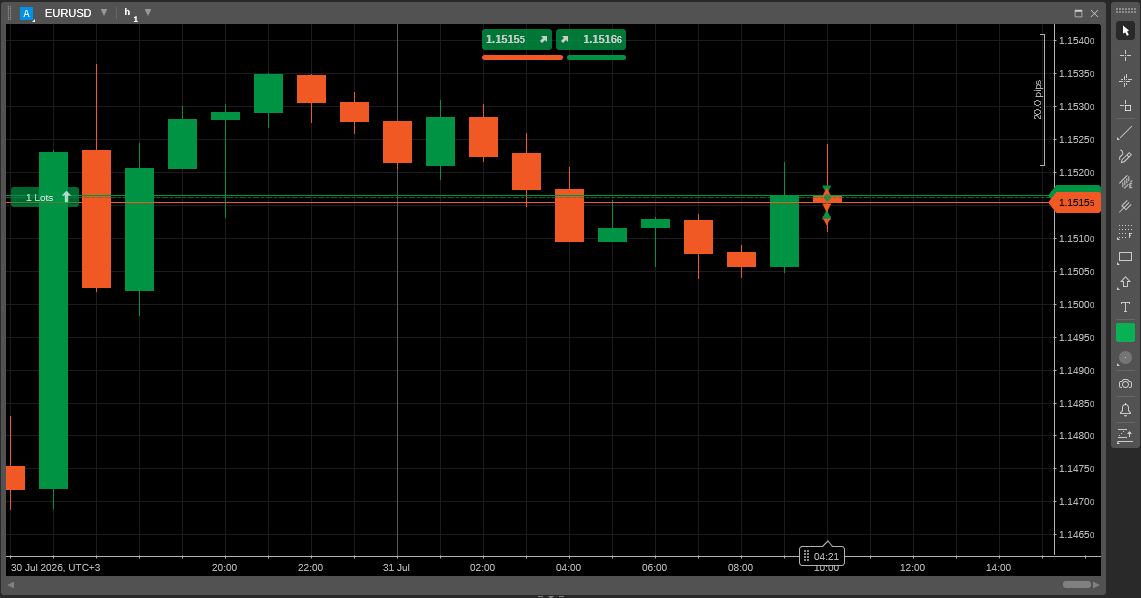
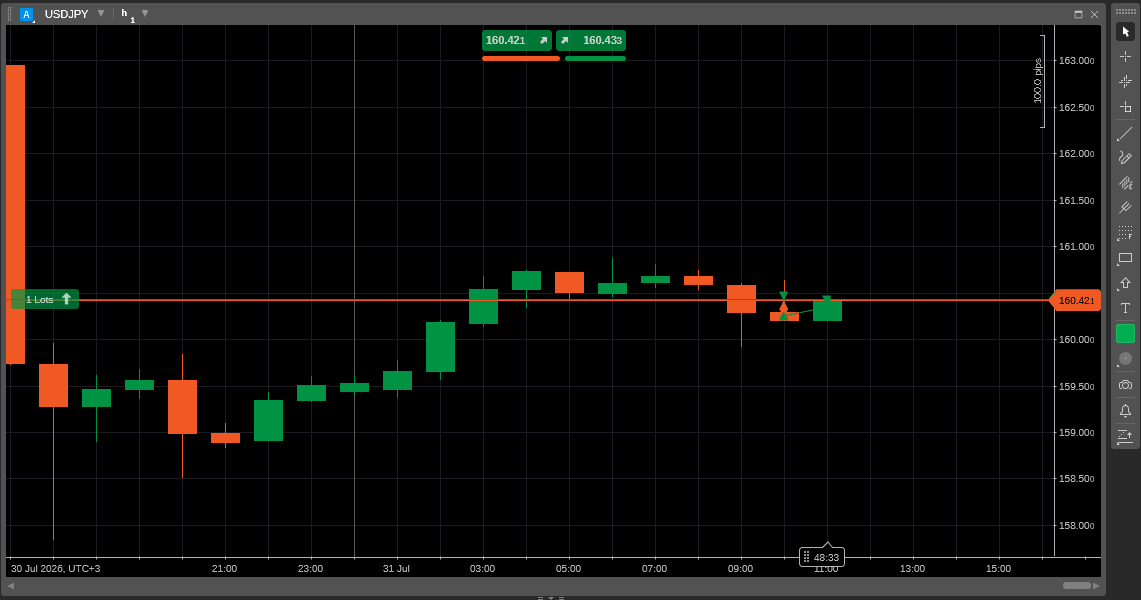
Most non-JPY pairs are quoted to four decimal places, with many platforms also showing a fifth decimal called a pipette. JPY pairs, meanwhile, are quoted to two decimal places, with platforms typically displaying a third decimal. After we opened a USD/JPY position with an initial buy price of 160.430 yen, the said price moved to 160.433 yen. This represents a 3-pip movement.
As for what drives these changes, interest rate outlooks, inflation trends, jobs data, central bank guidance, geopolitical risks, and broad market sentiment all affect demand for one currency relative to another. A pair can rise because the base currency gets stronger, because the quoted currency gets weaker, or because both forces happen at once.
Detailed Look Into Base Currencies and Quoted Currencies
Forex pairs are usually written using standard three-letter currency codes, such as EUR/USD, GBP/USD, or USD/JPY. The slash separates the base currency from the quote currency.
What the Base Currency Is
The base currency is the first currency listed in the pair: if you are trading the EUR/USD, the base currency is the euro. It is the reference unit for the quote, and it is the currency you are effectively buying or selling when you trade the pair. Essentially, trading platforms show you how much the base currency is worth in terms of the quoted currency, and every buy or sell decision starts with whether you expect the base to strengthen or weaken relative to the quote.
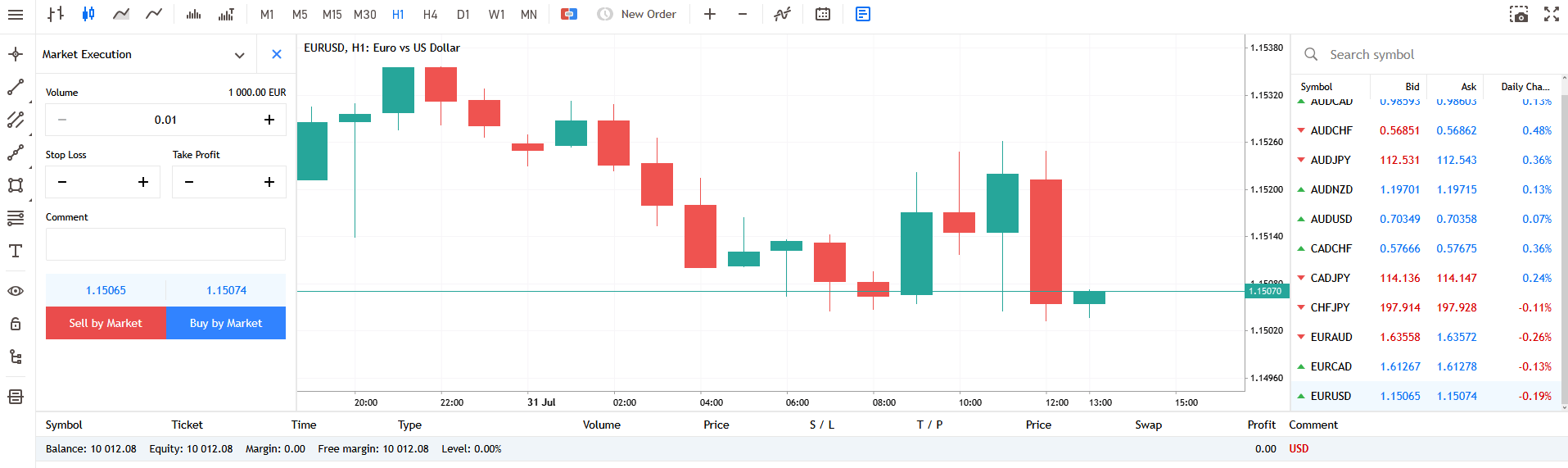
The following screenshot demonstrates the EUR/USD pair’s bid and ask prices as shown in Fusion Markets’ MT5 web client. If you long the EUR/USD, you are paying 1.15074 in USD to buy one euro. If you short EUR/USD, you are selling one euro to buy 1.15065 in USD.
What the Quoted Currency Is
The quote currency is the second currency listed in the pair. It tells you the price of one unit of the base currency, and you give up the quoted currency when you buy the pair or receive it when you sell the pair. This pricing role is why understanding the quote currency is essential when you calculate spreads, pip values, and pair direction.
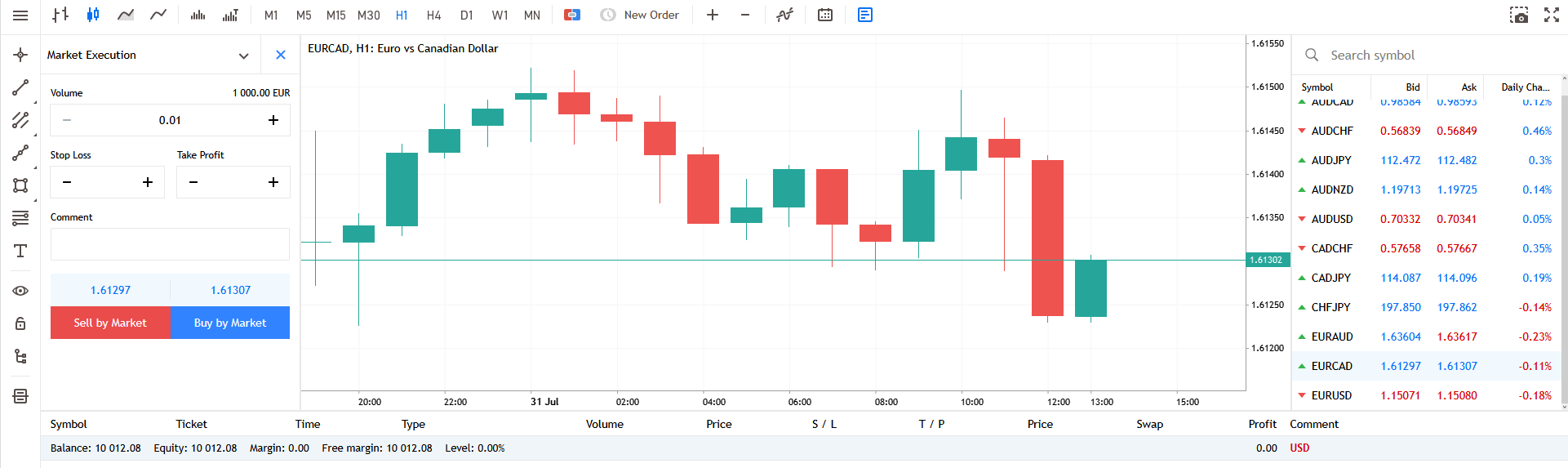
For example, EUR/CAD below is quoted at 1.15074 (buy). The quote currency, CAD, tells you that one euro is priced at 1.15074 Canadian dollars. Most trading platforms use this format, although some brokers may add symbol suffixes or prefixes depending on platform setup.
How Currency Strength Affects the Pair
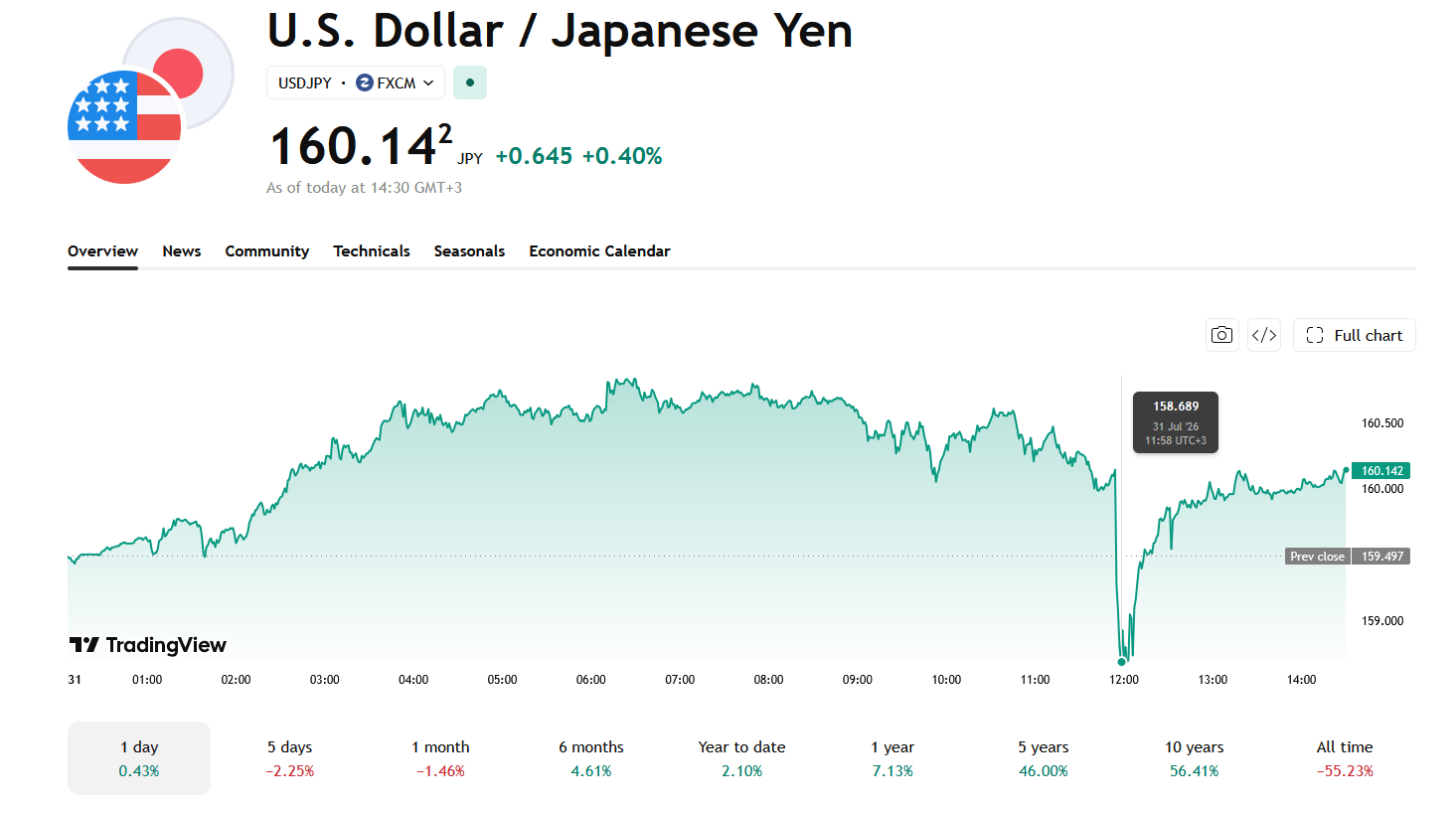
If the base currency becomes stronger while the quote currency stays unchanged or is put under pressure, the pair rises. For example, on July 31, 2026, our team observed that the USD/JPY rebounded from 158.689 yen to 160.142 yen in the span of several hours, as per price data from TradingView. The base currency (USD) gained value relative to the quoted currency (JPY) amid bolstered expectations of a Fed rate hike, which were triggered by a jump in energy prices tied to tensions in the Middle East.
The opposite scenario, i.e., when the quote currency becomes stronger while the base currency stays unchanged, will result in a price drop. Looking at the EUR/USD’s price movements as shown on TradingView, the US dollar strengthened while the outlook on the euro did not improve, resulting in the EUR/USD’s price slipping from 1.5249 USD to 1.14918 USD.
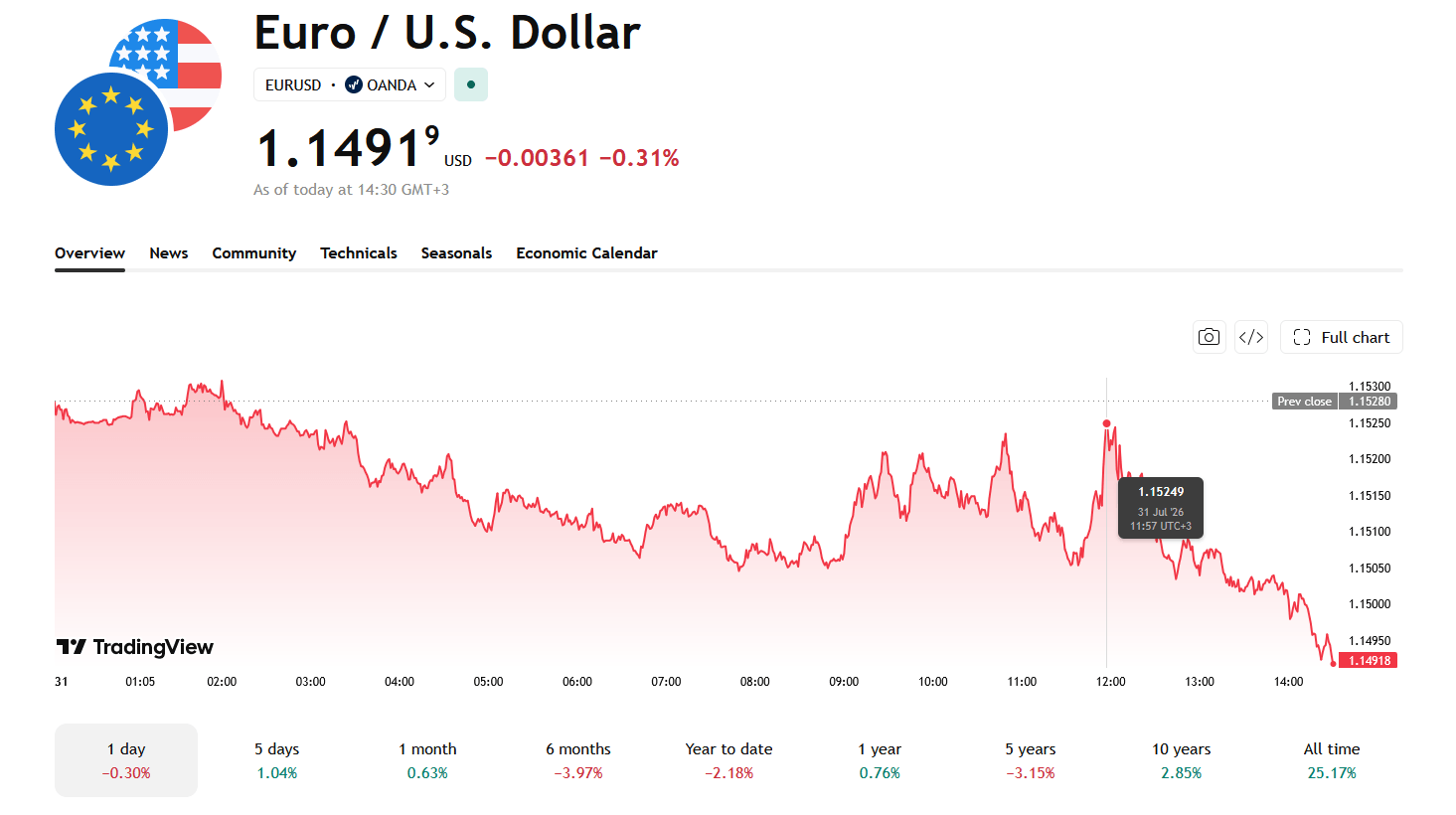
Essentially, a stronger quote currency means fewer units of it are needed to buy one unit of the base currency.
Hyper-focusing on just one of the currencies that make up a pair is a common beginner mistake. Make sure to remember that both affect the price of the symbol in question, and that analysis should include the economies of each currency’s respective jurisdiction and other such factors.
Major Currency Pairs
Major currency pairs include the US dollar and another one of the most heavily traded global currencies, such as the euro, pound, yen, Swiss franc, Australian dollar, Canadian dollar, or New Zealand dollar. These pairs are known for their liquidity and are generally less volatile than the other categories of currency symbols.
EUR/USD
The EUR/USD is widely followed because it is tied to the Eurozone and the United States, two of the largest economic regions globally. It is favored by beginners, seasoned traders, and institutions because it tends to have deep liquidity and clear market coverage, especially during the London and New York sessions.
Data from the BIS Triennial Survey has consistently shown the EUR/USD rank above all other currency pairs in terms of turnover. This remained the case in April 2025, when its daily trading volume of $1.97 trillion represented 20.7% of the total daily forex turnover of $9.5 trillion.
Thanks to the above factors, pretty much any broking firm that welcomes forex traders includes the EUR/USD in its roster of symbols. The EUR/USD spreads are also often lower than those of other currency pairs, and can drop to zero when using commission-based accounts.
However, none of this makes the EUR/USD ticker low risk. Like all trading instruments, the pair is subject to price swings during major data releases, central bank events, and other key factors that affect price movements.
GBP/USD
The GBP/USD is another highly liquid currency pair that sees widespread availability across online brokers, and its April 2025 turnover reached $715.489 billion per day (7.25% share) based on the BIS’ triennial survey results. In addition to events affecting the US dollar, it can also react strongly to Bank of England policy, UK inflation figures, jobs data, and political headlines.
As the pair’s price rises when the GBP is strong and the USD experiences headwinds, the symbol has a positive correlation with the EUR/USD. However, GBP/USD does tend to be more volatile than the EUR/USD. Many traders like its intraday movement, but that same movement can lead to faster losses if stops are too tight or one’s position size is too large.
USD/JPY
US interest rate expectations, treasury yields, Bank of Japan policy, and broader risk sentiment all exert influence on the USD/JPY. It is one of the most traded yen pairs and major pairs in general, and it can move quickly when bond markets or risk conditions shift.
The USD/JPY is also the only other FX symbol that has achieved a daily turnover measured in the trillions in April 2025, with its volume reaching $1.37 trillion per day, as per BIS survey estimates. It represented 14.41% of the total daily FX turnover.
Unsurprisingly, it also tends to be the most heavily traded forex symbol in Japan, with its October 2024 turnover totaling $257.4 billion, as shown in the Turnover Survey of the Tokyo FX Market conducted by the Tokyo Foreign Exchange Market Committee (TFEMC).
JPY pairs use a different quote structure than other forex symbols. Therefore, new traders should make sure they understand JPY pip conventions, namely that the pip is located in the second decimal place instead of the fourth, before they start trading.
USD/CHF
Often referred to as the “Swissie,” the USD/CHF tends to be discussed in the context of safe-haven flows because the Swiss franc and USD are both widely seen as defensive currencies in periods of market stress. The symbol enjoys relatively high liquidity, and its popularity translated to a daily turnover of $455.180 billion in April 2025, making for a share of 4.79%. This placed it among the top 10 traded currencies worldwide, and its spreads can often drop below 1 pip when it comes to retail trading.
The pair reacts to US data, Swiss National Bank communication, and broader European risk sentiment. It is characterized by its strong liquidity, but while it may look calmer than other major FX pairs or crosses, event-driven moves can still be sharp.
AUD/USD
The AUD/USD represents the Australian dollar traded against the greenback, and it is commonly linked to Australian rates, commodity sentiment, and global risk appetite. Moreover, as Australia’s economy is highly reliant on commodities shipped to China, Chinese growth expectations can significantly affect Aussie trading instruments like the AUD/USD.
In terms of trading volume, AUD/USD’s average turnover in April 2025 reached $467.113 billion, as revealed in BIS estimates. Its share of the trading volume sat at 4.91%.
The pair can trade actively in the Asian session and remain relevant later in the day because of the US dollar side of the symbol. Traders often watch it when evaluating broader “risk-on” or “risk-off” themes.
USD/CAD
The USD/CAD is shaped by both US and Canadian economic data, along with oil prices, because of the Canadian economy’s heavy commodity exposure. The symbol, known as the “loonie,” may become particularly active during North American trading hours.
As a major currency pair, the USD/CAD is highly liquid. According to the BIS, April 2025 saw the USD/CAD’s daily trading volume stand at an average of $491.602 billion, representing 5.17% of the total turnover.
New traders should remember that USD/CAD can react not only to central bank expectations but also to sudden changes in energy markets. As always, it is best that you pay close attention to both fundamental and technical analysis indicators when you trade currencies, and this applies to USD/CAD.
NZD/USD
The NZD/USD usually receives less global attention than the EUR/USD or the GBP/USD, and its trading activity reflects this, with its daily turnover reaching $118.687 billion in April 2025(1.25% share). However, it is still one of the recognized major USD pairs at many brokers.
The NZD/USD can respond to Reserve Bank of New Zealand policy, dairy and commodity sentiment due to the NZD’s heavy correlation with agriculture, and broad risk trends. Liquidity may be lower than in the largest majors, especially outside active sessions.
Minor Currency Pairs
Minor currency pairs are tickers that do not include the US dollar but still involve widely traded currencies, such as the euro, pound, yen, Australian dollar, or Swiss franc. Minor pairs are often called cross pairs.
EUR/GBP
The EUR/GBP directly compares the euro with the British pound, which makes it useful for traders who want a view on the Eurozone versus the United Kingdom without taking a direct US dollar position. Its daily trading volume stood at $169.347 in April 2025, and it made up 1.78% of FX transactions. The pair tends to react to European Central Bank and Bank of England expectations.
EUR/JPY
The EUR/JPY is sensitive to both European developments and shifts in risk sentiment. The ticker is known for being relatively volatile, providing opportunities for profit that saw interest in the EUR/JPY result in daily trading volume of $99.220 billion in April 2025 (1.04% share), according to the triennial forex trading volume survey by BIS. Volatility can also be dangerous, however, so beginners should be careful with position size if the pair is moving rapidly.
EUR/CHF
The EUR/CHF is widely known for having relatively low volatility despite being a minor pair. That can make it attractive to beginners, but experienced intraday traders may look elsewhere if they are looking for pairs characterized by large price swings. Its April 2025 daily turnover stood at $97.630 billion, and it is strongly correlated with the USD/CHF and the EUR/USD.
AUD/JPY
The AUD/JPY is often watched as a risk sentiment barometer because it combines a commodity-linked currency (AUD) with a widely perceived safe-haven currency (JPY). In April 2025, it had a trading volume of $35.267 billion per day, translating to a share of 0.37%. When global sentiment is strong, the ticker may rise, while unstable economic conditions may cause it to fall. This relationship is not fixed, but it is a common framework many traders use.
EUR/AUD
This cross compares a large European currency with a commodity-sensitive Asia-Pacific currency, and its trading activity amounted to a daily turnover of $31.080 billion, 0.33% of the trading activity recorded for April 2025. It can move when there is a divergence between European and Australian growth expectations, inflation, or central bank policy. Traders should also remember that China-related news can affect the Australian dollar side, even when European headlines are quiet.
GBP/CAD
The GBP/CAD can be influenced by UK data, Bank of England policy, Canadian data, and oil-linked CAD dynamics. Because both sterling and the Canadian dollar can have their own strong drivers, the ticker may produce uneven swings and occasional bursts of volatility. It is usually less beginner-friendly than the most liquid major pairs and doesn’t see much trading activity, and it was not included in the BIS survey.
Exotic Currency Pairs
Exotic currency pairs usually combine one heavily traded currency with a currency from a smaller or emerging-market economy. Examples often include the Turkish lira, South African rand, or Mexican peso.
Exotic classifications are also broad conventions, and availability, leverage, margin rules, and trading hours may differ significantly across brokers and jurisdictions. Exotics tend to have significantly lower liquidity and trading activity compared to major and minor pairs, but there are some outliers.
USD/TRY
USD/TRY compares the US dollar with the Turkish lira, and it had a daily turnover of $49.496 billion in April 2025, 0.52% of the overall trading volume. It can be highly sensitive to inflation, central bank credibility, domestic policy, and political risk. Traders should approach it with caution because the pair can be susceptible to gaps, slippage, and overnight costs, resulting in spreads that can be much larger than on major pairs, especially during unstable conditions.
USD/CNY
The USD/CNY, known as USD/CNH at international brokers, is one of the major exceptions when it comes to the expected behavior and trading volumes of exotic currency pairs. Despite its exotic classification, the USD/CNY ranked third in the BIS Triennial Survey thanks to its daily trading volume of $781.309 billion, and this figure made up 8.22% of all traded funds.
Its key drivers include policies undertaken by the People’s Bank of China (particularly its daily fixing of rates), trade policies of US and Chinese officials, and the Federal Reserve (Fed)’s interest rate policies.
USD/ZAR
USD/ZAR combines the US dollar and the South African rand. It can react to US dollar strength, commodity sentiment, local political developments, and risk appetite toward emerging markets. In April 2025, its turnover on a daily basis reached $74.940 billion per day. Liquidity conditions may change sharply throughout the trading day, which can affect spread width and execution quality.
USD/MXN
USD/MXN is one of the more widely discussed emerging-market pairs, but it is still an exotic pair and should be treated carefully. In terms of trading volume, the symbol performed relatively well considering its status as an exotic pair and reached $133.919 billion per day in April 2025. It can respond to US policy, Mexican central bank expectations, trade developments, and global risk sentiment. Some traders watch it for carry and macro themes, but its risk profile is still very different from a major pair.
EUR/TRY
EUR/TRY removes the US dollar from the comparison and focuses on the euro versus the Turkish lira. This ticker’s turnover reached $1.697 billion in April 2025, representing a mere 0.02% of daily transactions. It can create very strong trend behavior when policy divergence is large, but it can also produce sudden spikes and large overnight moves. Availability and costs can vary substantially by broker and market conditions.
EUR/ZAR
EUR/ZAR reflects the euro against the South African rand and can be influenced by European developments, commodity sentiment, and local South African risk factors. Like many exotics, it may have wider spreads and less stable liquidity than traders are used to on major pairs. Beginners are usually better served by learning on more liquid instruments first. Due to its low trading volume, it was not named in the April 2025 BIS survey.
Comparing Major, Minor, and Exotic Pairs
Major pairs usually have lower trading costs because they tend to attract the most market participation and the deepest liquidity. More liquidity often means tighter spreads and more consistent execution, especially in active sessions.
In comparison, minor pairs often have lower liquidity, somewhat wider spreads, and sharper swings outside their most active sessions. Minor currency pair markets can still be highly profitable, but cost and volatility profiles make these symbols less forgiving for novice traders. A strategy that works well on the EUR/USD may need different stop distances, session timing, and expectations on a minor pair.
Exotic pairs also tend to have wider spreads than majors because, barring a few exceptions, there is often thinner continuous liquidity, fewer active participants, and greater uncertainty around pricing and hedging. Wide spreads make it harder for short-term strategies to overcome costs.
In the chart below, you can see the difference in trading activity when comparing major symbols with minor pairs and exotics.
* The aggregate turnover of certain minor and exotic pairs was too low to be included in the data as individual pairs
Data Source: BIS
In terms of risks, exotic tickers typically take the lead. Due to the higher costs, traders of exotics stand to lose more funds from a single trade, and these symbols can generally be prone to slippage. As wide spreads make it harder for short-term strategies to overcome costs, exotic pairs are not the first place for a beginner who’s trying to trade for the first time.
On the other hand, leverage restrictions are usually tighter when it comes to exotic and minor pairs, reducing the risk of losses that may be accumulated through substantial leverage. However, leverage limits do depend on your broker, jurisdiction, and account type. The Financial Conduct Authority (FCA) caps leverage on non-majors to 1:20, and this is the same limit applied by the Cyprus Securities and Exchange Commission (CySEC) and other European Securities and Markets Authority (ESMA) members who impose leverage restrictions. Offshore regulators, such as the Financial Services Authority of Seychelles (FSA), on the other hand, do not mandate specific leverage limits on exotic or minor symbols.
We should also stress that major pair costs are not uniform across trading platforms, nor is trading majors risk-free. The types of trading costs (spreads, commissions, swaps) and execution quality will be reliant on your broker of choice. Performance will also differ depending on the session, market conditions, and the trader’s own experience level.
| Pair category | Typical structure | Typical liquidity | Typical spread tendency | Suitability for beginners |
|---|---|---|---|---|
| Major Pairs | USD paired with a heavily traded currency (e.g. EUR/USD, USD/CAD) | Usually highest | Often lower in active sessions | Generally the best option for beginner forex traders |
| Minor Pairs | Two widely traded currencies without the USD (e.g. EUR/CHF, AUD/JPY) | Usually moderate | Often wider than majors | Higher spreads and lower liquidity than majors make these pairs better for traders who are already familiar with forex markets |
| Exotic Pairs | One major currency and one emerging or smaller-market currency (e.g. USD/CNY, USD/TRY) | Often lower and more variable | Usually widest | Out of the three, this is the least suitable category for beginners due to wide spreads and significantly higher volatility |
Cross Currency Pairs
Cross pairs do not include the US dollar. Pretty much all minor pairs are crosses, while exotics can include the USD depending on the symbol.
Crosses can be useful when a trader wants a more direct comparison between two non-USD economies. For example, an individual who is seeking an instrument affected by both the European and UK economies may consider trading the EUR/GBP.
Euro Crosses
Euro crosses include pairs such as EUR/GBP, EUR/JPY, and EUR/AUD. These pairs let traders focus on euro strength or weakness relative to another non-USD currency. They are often shaped by European Central Bank expectations and whichever second economy is in the pair. In April 2025, the EUR/GBP stood as the most traded European cross with a daily turnover of $169.347 billion, as shown in BIS data. The trading volume of the most popular EUR cross pairs made up 27.40% ($743.743 billion) of the euro’s total turnover.
Yen Crosses
Yen crosses include EUR/JPY, GBP/JPY, and AUD/JPY. They can be especially sensitive to changes in risk sentiment because the yen often strengthens when markets turn defensive. As a result, yen tickers can be volatile, with faster reversals than some traders may expect. On a global scale, yen crosses see far less trading activity than the USD/JPY or even EUR cross pairs, with the AUD/JPY managing to reach a daily trading volume of just $35 billion in April 2025. Against the euro, turnover averaged $99.22 billion globally. In Japan, the pair ranked third in terms of trading volume in October 2025, with transactions reaching $25.0 billion.
Pound Crosses
Pound crosses include EUR/GBP, GBP/JPY, and GBP/CAD. Based on survey data gathered by the Foreign Exchange Joint Standing Committee (FXJSC), EUR/GBP was the most heavily traded GBP cross in the UK in October 2025, with a turnover of $84.8 billion. It represented 2.1% of transactions, which strongly contrasts the EUR/USD’s 25% share.
The sterling can react sharply to domestic inflation, labor data, unexpected GBP figures, and Bank of England communication, so GBP crosses often need more room than traders would use on calmer currency symbols. Careful stop placement is important.
Commodity Currency Crosses
Commodity currency crosses include pairs such as AUD/JPY, AUD/NZD, and CAD/JPY. These pairs are often watched when traders are looking to capitalize on the price movements triggered by global events concerning exports and imports of commodities, crude oil, and the like, without using the US dollar.
Cross Pairs vs Major Pairs
As crosses include both minor and exotic pairs, these symbols often have wider spreads and different active hours than those of majors. Their high volatility can be beneficial for traders who manage to use the sharp swings to achieve gains, but they are also far less forgiving when the market moves against the trader. As such, crosses are best utilized by experienced traders who have a deep understanding of forex markets and what drives forex prices.
Commodity Currency Pairs
Commodity currencies are currencies commonly associated with economies that have strong links to exports of raw materials or agricultural goods. The Australian dollar, Canadian dollar, and New Zealand dollar are typically placed in this group.
Global Risk Sentiment and Commodity Currencies
Commodity-linked currencies often strengthen when markets are optimistic about growth and weaken when market sentiment turns bearish. This is why traders often describe AUD, NZD, and sometimes CAD as “risk-sensitive.” However, these relationships can change, especially when domestic central bank policy becomes the dominant driver.
Australian Dollar Pairs
AUD pairs typically respond to Reserve Bank of Australia expectations, global risk sentiment, commodity demand, and broader market risk appetite. The Australian dollar is often associated with metals and industrial commodity demand in particular because Australia is a major exporter of such resources. Iron ore, the health of China’s economy, and broader Chinese demand trends can be relevant.
AUD/USD is the most widely traded currency pair, with its global turnover reaching $467.113 billion in April 2025. In Australia, it typically ranks first, as shown by data published by the Australian Foreign Exchange Committee: In October 2025, it represented 42% of the local turnover with a trading volume of $74,358 billion. This pair, along with crosses like AUD/JPY and AUD/NZD, is typically available to trade at most brokers. However, traders should remember that major Australian dollar moves can start during the Asian session.
Canadian Dollar Pairs
CAD symbols are influenced by Bank of Canada policy, North American data, and energy prices, especially oil. When oil prices rise, CAD may strengthen in some environments, though the relationship is not perfect and can weaken when interest rates or broader market stress take over. Traders should treat the oil-CAD link as a tendency, not a guarantee of price directions.
USD/CAD is the most widely traded CAD pair both globally and in Canada. Data published by the Canadian Foreign Exchange Committee (CFEC) shows that in October 2025, its turnover amounted to $3.073 trillion, 55.7% of the total trading volume of $5.512 trillion.
Crosses like the GBP/CAD and the CAD/JPY are other options traders can explore. However, we should stress that US releases can affect CAD pairs directly and indirectly because Canada is closely tied to the US economy.
New Zealand Dollar Pairs
NZD tickers often reflect Reserve Bank of New Zealand policy, commodity sentiment, and risk appetite. The NZD/USD and the AUD/NZD are widely followed examples, and NZD pairs’ total daily turnover stood at $14.887 billion in July 2026, as seen in the Reserve Bank of New Zealand’s latest foreign exchange turnover dataset. Liquidity can be lower than in the largest majors and crosses, so traders should pay attention to session timing and the possibility of changing spreads outside active hours.
Safe-Haven Currency Pairs
The term “safe-haven” in the context of forex refers to currencies that investors often favor during periods of uncertainty or market stress. The Japanese yen, Swiss franc, and the US dollar are commonly placed in this category.
Symbols involving safe-haven currencies can be heavily affected by risk-on and risk-off sentiments:
- Risk-on means that investors are more willing to buy volatile growth-sensitive assets.
- Risk-off refers to traders’ tendency to sell high-risk assets in favor of safe-haven markets during times of economic distress.
Commodity currencies often perform better in risk-on environments, while safe-haven currencies can become more volatile under the same conditions. For example, the greenback may depreciate when traders turn to riskier assets, which would in turn lower the appeal of a pair like the USD/HKD, and lead to a spike in EUR/USD and AUD/USD prices.
In contrast, yen, USD, or franc demand may increase in risk-off conditions, while interest in commodity currencies may drop.
Japanese Yen Pairs
JPY pairs are widely traded domestically and on a global scale. BIS survey results placed USD/JPY second with a turnover of $1.370 trillion in April 2025, while EUR/JPY and AUD/JPY generated $99.220 billion and $35.267 billion, respectively. As for Japan, October 2025 saw USD/JPY stay at the top and reach a turnover of $250.6 billion, whereas EUR/JPY placed second ($27.7 billion). AUD/JPY figures hit $9.97 billion, GBP/JPY turnover stood at $8.91 billion, while MXN/JPY and CHF/JPY both had a daily turnover of under $5 billion.
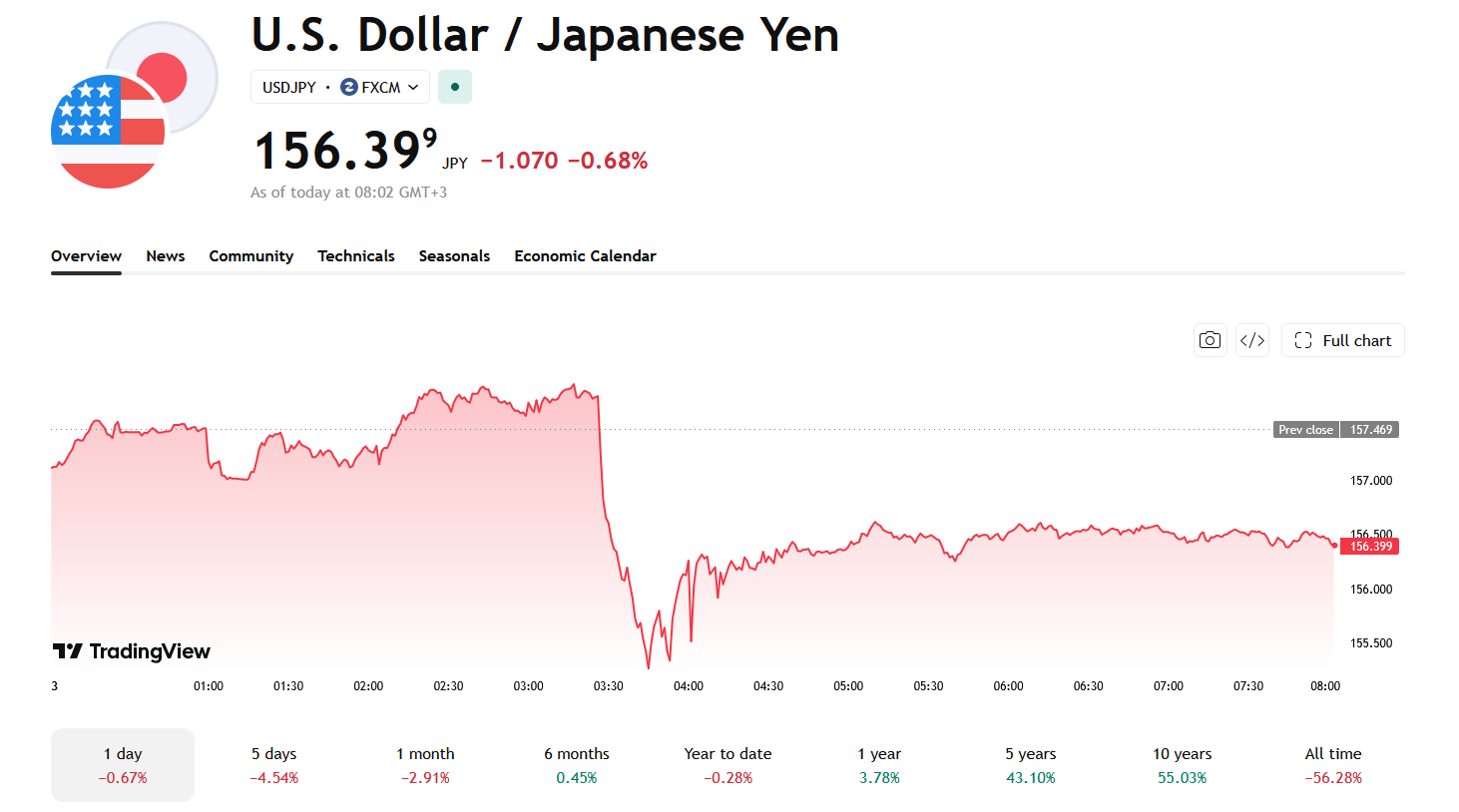
These pairs can react strongly when global risk sentiment changes. In risk-off conditions, the yen may strengthen and push pairs like USD/JPY, EUR/JPY, or GBP/JPY lower. For example, our team observed that soft USD economic data and geopolitical tensions resulted in the USD/JPY dropping below the 157 yen mark on August 3, 2026. Because these moves can happen quickly, traders should be careful about entering yen pairs just before major risk events.

Swiss Franc Pairs
CHF tickers are often influenced by safe-haven flows and Swiss National Bank policy. USD/CHF and EUR/CHF are closely watched examples, with the former having a daily turnover of $455.18 billion in April 2025 as per BIS data, while the latter had a trading volume of $97.63 billion. Although the franc is often seen as defensive, it can still move sharply based on central bank comments, inflation surprises, and broader European developments.
US Dollar Safe-Haven Demand
As established, USD pairs are the most traded currency pairs on a global scale, with both EUR/USD and USD/JPY achieving daily turnovers measured in the trillions. The US dollar often benefits during global stress because of its reserve currency role, the size of US financial markets, and broad demand for liquidity. That can push pairs like EUR/USD or GBP/USD lower in risk-off periods.
The dollar does not strengthen in every crisis. If the stress is centered on the United States, the opposite may happen, and EUR/USD, for example, could see a sudden jump, while pairs like USD/CAD might drop.
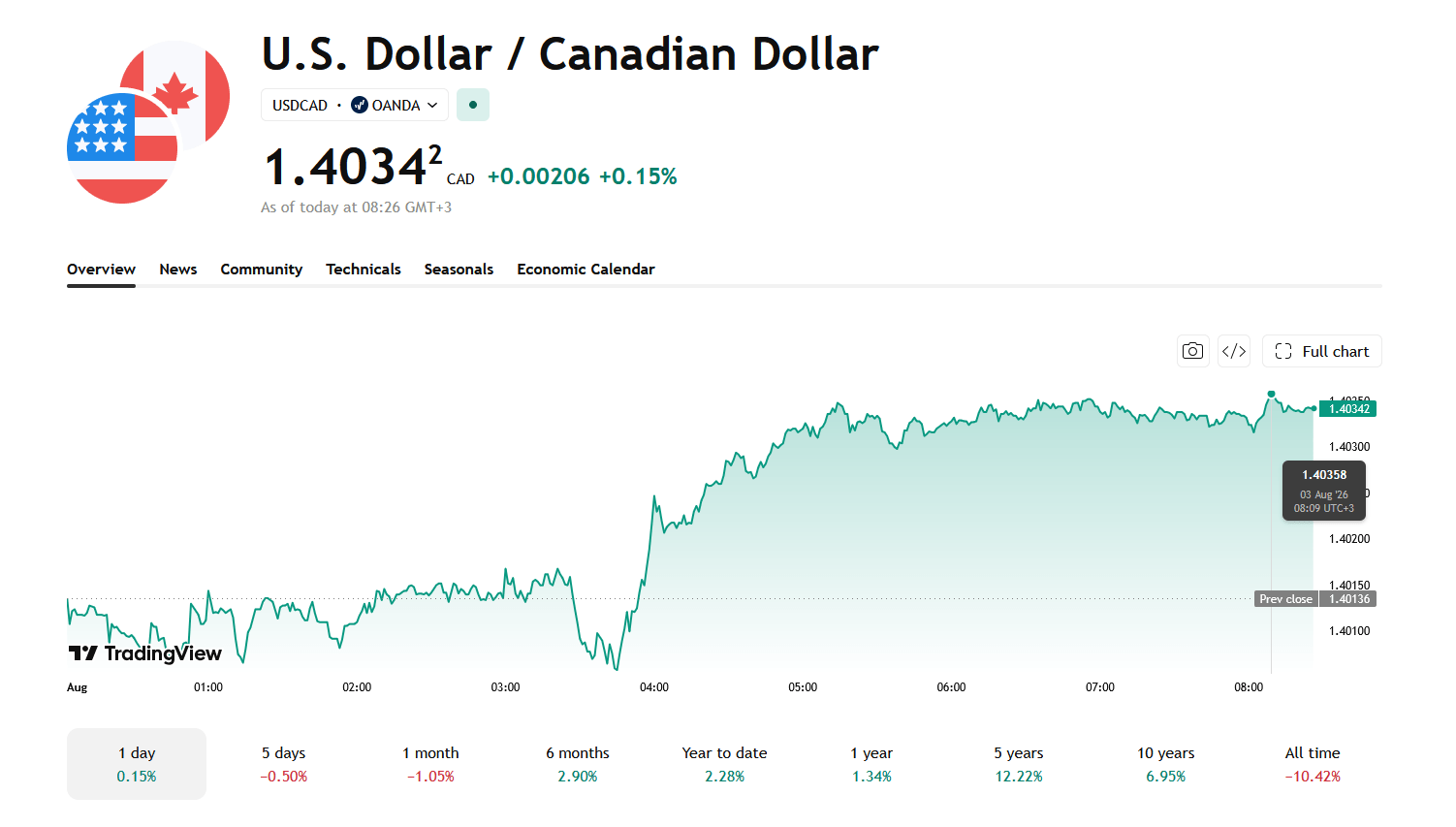
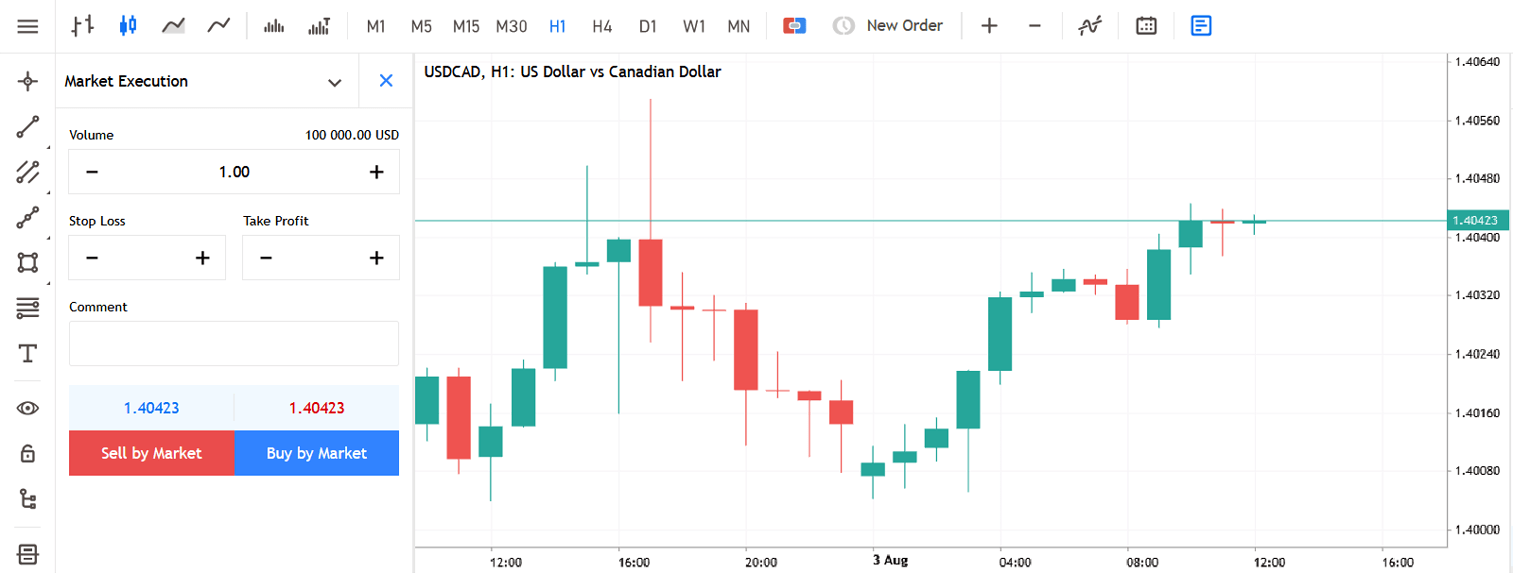
Other data can also have an effect depending on the pair. On August 3, 2026, USD/CAD surged to 1.40358 USD despite weak US economic data as falling oil prices exerted pressure on the CAD, and tensions in the Middle East propped up the greenback:
Risks Associated With Safe-Haven Pairs
Safe-haven tickers can be relatively volatile, which means there is a range of risks involved that novices should be familiar with. Based on our observations, spreads may widen, liquidity may thin out, and prices can gap through stop levels. Thus, it is best to remember that safe-haven currencies do not always move slowly or predictably.
Most Traded Forex Pairs
The popularity of individual forex pairs is tied to a range of factors. Many pairs see higher trading activity because they represent large economies, major reserve currencies, and the deepest pools of institutional activity. They are widely used by corporations, banks, asset managers, and speculators. This tends to translate into lower trading costs and more analyst coverage in comparison to less liquid FX tickers, which can further boost interest in popular pairs.
In terms of measuring interest in forex pairs, the OTC Triennial Survey conducted by the BIS gives a clear idea of which forex pairs consistently see the most trading activity. Below, you can see the figures of the top 20 most traded currencies from April 2019 to April 2025:
*Figures presented in billions of USD
Data Source: BIS
Popular Currency Pairs Insights
- EUR/USD as the Most Traded Pair
The EUR/USD pretty much dwarfs other currency pairs, both in terms of its performance per survey and its combined trading volume from the surveys conducted from 2019 to 2025 ($5.259 trillion). This interest can be explained by the fact that it combines the euro and the US dollar, the two most important currencies in global trade and finance. It is widely available at online trading brokers, highly liquid, and heavily covered in news and analysis. - Popular Dollar Pairs
The most widely traded dollar pairs include EUR/USD, USD/JPY, USD/JPY, GBP/USD, USD/CAD, USD/CHF, and USD/HKD. Their combined daily turnover stood at $6.131 trillion in April 2025, or 64.46% of the total FX turnover globally. These pairs enjoy major trading activity because the US dollar sits at the center of global finance. Traders often start with one or two of them rather than trying to monitor the entire forex market at once. - Popular Yen Pairs
The most popular yen pairs are generally USD/JPY and EUR/JPY, with GBP/JPY and AUD/JPY often being on the radar of FX enthusiasts as well. These pairs’ total turnover (excluding the GPB/JPY) reached $1.505 in April 2025, or 15.82% of the global turnover.Yen symbols are favored by many traders because of their active movement and strong response to risk sentiment, yields, and central bank expectations. Some yen crosses can be fast-moving, so beginners should not assume popularity equals low risk.
- Popular Pound Pairs
GBP/USD, EUR/GBP, and GBP/JPY pairs are all examples of GBP tickers that traders often gravitate towards. EUR/GBP and GBP/USD trading activity accounted for 9.30% ($884.836 billion) of the global turnover in April, 2025. The pound can react strongly to UK data and Bank of England guidance, and traders often find that pound pairs require a different volatility tolerance and stop placement.
- Popular Commodity Currency Pairs
Popular commodity currency pairs include AUD/USD, NZD/USD, USD/CAD, AUD/JPY, and AUD/NZD. USD commodity pairs alone represented 11.33% of the April 2025 turnover, with their trading volume reaching $1.077 trillion.These pairs attract traders who want exposure to commodity-linked or growth-sensitive currencies. Their behavior can be influenced by central bank policies, commodity trends, and broad market mood all at once.
Why Liquidity Matters
Liquidity is important because it affects how easily you can enter and exit a trade, how tight the spread is likely to be, and how much slippage you might face. A pair can look attractive on a chart but still be difficult to trade efficiently if liquidity is poor. This is one reason beginners usually start with the most liquid pairs, and in the following section, we will take an in-depth look at liquidity and its significance in trading.
Liquidity and Its Importance in Forex Trading
Liquidity refers to how easily a currency pair can be bought or sold without causing a large change in price. High liquidity often means more buyers and sellers, smoother price flow, and better odds of getting filled close to the price you expect. Low liquidity can mean wider spreads and more erratic movement.
High-liquidity pairs usually include the most traded majors, especially EUR/USD, USD/JPY, and GBP/USD during their active sessions. These pairs tend to have more stable pricing and a stronger depth of market. High liquidity does not eliminate risk, but it often reduces trading friction compared with thinner symbols, and it makes it easier to learn how to read charts and practice risk management. These factors make majors and highly liquid minor pairs a reasonable option for beginners.
Low-liquidity tickers, meanwhile, tend to be exotics and some less active crosses, particularly outside their core regional hours. In these conditions, prices can jump more between ticks, spreads may be inconsistent, and stop-loss orders can be filled at less favorable prices than expected. This can be a difficult environment for novice traders, which is why they are typically advised to stick to highly liquid majors until they are more experienced.
How Liquidity Affects Spreads and Execution
When many market participants are active, the difference between bid and ask prices is often smaller due to strong competition among liquidity providers. When liquidity drops, spreads can widen quickly. This is why the same pair may have a different spread during the London-New York overlap than late in a quiet session or during a holiday.
Liquidity also affects execution quality, including whether your order fills where you expect, whether partial fills occur, and how much slippage you experience. This is important given the fast-paced nature of forex trading and how major events can cause sharp price swings.
Liquidity During Different Trading Sessions
Liquidity tends to follow regional market activity. Pairs often trade most actively when the markets of countries tied to those currencies are open or when major sessions overlap. Broker trading hours, server time, daylight saving shifts, holidays, and liquidity provider conditions can all change what “active” looks like on a given day for a specific pair.
| Session | Most active pairs | Typical conditions | Beginner note |
|---|---|---|---|
| Asian | JPY, AUD, NZD pairs | Generally known for being less volatile than other sessions, though activity varies by event risk | Watch out for lower liquidity, particularly when trading pairs outside the regional focus |
| London | EUR, GBP, CHF pairs and many majors | Often characterized by high liquidity, low spreads, and frequent price movements | Good for learning active market structure |
| New York | USD pairs, USD/CAD, majors | High activity, especially based on US data | News can sharply increase volatility |
| London-New York Overlap | Most major pairs | Often features the deepest liquidity of the day | Spreads can be favorable, but volatility is also very high |
Volatility in Forex
Volatility describes how much and how quickly a currency pair’s price swings in different directions. A pair with high volatility may cover a large number of pips in a short time, while a lower-volatility pair may exhibit more gradual price movements.
Whether high volatility is suitable for you depends on what type of trader you are. A scalper, for example, may prefer a liquid pair with consistent intraday movement and low costs, while a swing trader may gravitate towards volatile pairs to capitalize on their movements. There is no universally correct volatility level. The key is matching the pair’s behavior to your strategy, available hours, and psychological tolerance for fluctuation.
While volatility can present traders with a lot of opportunities to close positions at a profit, you should keep in mind that it also increases the risk of fast losses and makes wider stop-loss distances a necessity if one wishes to avoid being knocked out by normal price noise. If the stop distance grows, the position size usually needs to shrink to keep the risk constant. There is also the risk of stop-loss slippage. Thus, volatility is something you should tread carefully.
High-Volatility vs Low-Volatility Currency Pairs
High-volatility pairs often include GBP/CAD, GBP/JPY and some other yen crosses, and many exotic pairs. They can offer larger intraday swings, but they also demand wider stops, smaller position sizes, and more emotional discipline. Traders who use the same lot size on a volatile pair that they use on a calmer pair often take more risk than they realize.
In contrast, relatively lower-volatility pairs often include some of the most liquid majors or steadier European crosses, depending on the market environment. As always, it is important to remember that lower volatility does not automatically mean that a given currency ticker is risk-free or stable at all times. A pair that has been quiet for days can suddenly accelerate on central bank news and unexpected macro data.
Timing and Volatility
Volatility usually rises around important releases such as inflation reports, jobs data, and central bank decisions. It is common to see wider spreads and larger slippage around these events. Beginners should be especially careful because a setup that looks good before a release can behave very differently once the data is out.
Session overlaps also provide a favorable environment for volatility, especially when London and New York are active at the same time. This section of the day is known for deep liquidity due to massive market participation, but the said activity can also create faster price discovery and sharper intraday moves. Individuals who prefer a slower pace may not automatically find overlap periods easier for trading.
Pip Values in Currency Pairs
As established, a pip is a standard unit of price movement in forex. For non-JPY pairs, one pip is 0.0001. For JPY pairs, one pip is 0.01. Understanding the pip is essential because traders often measure spreads, stop-loss distances, and profit or loss in pips.
Another important component of currency pair trading is the pipette. This is a fractional pip, and on trading platforms, it represents the fifth decimal place for non-JPY pairs and the third decimal place for JPY pairs.
Pip value is key in determining your trading costs and risk management strategy. If your stop-loss is 30 pips away, your money risk is 30 × pip value × position size. Without pip value, you cannot size a trade properly, compare risk across pairs, or understand how the same stop distance can mean very different dollar outcomes.
Pip Value Explained
Pip value tells you how much one pip is worth in money terms for your position size. When it comes to standard lots, the pip value tends to be $10 if your account currency matches the quote currency. If your account currency is different, you must convert the pip value into your account currency, so the exact number will vary with exchange rates.
When USD is the quoted currency, the pip value in a USD account is straightforward. For example, a 10,000-unit EUR/USD position has a pip value of about $1 per pip because:
- 10,000 × 0.0001 = 1 USD
As for standard lots, 1 pip typically equals a pip value of 10 currency units. If the EUR/USD pair has a spread of 1.1 pips, and you use standard lots (100,000 units), the spread cost would be $11.
When USD is the base currency, i.e., USD/CAD, the pip value in a USD account changes with the exchange rate and requires conversion. Some online trading platforms will automatically convert the figures:
For JPY pairs, one pip is 0.01 rather than 0.0001. Thus, a 10,000-unit USD/JPY position moves by 100 JPY per pip because:
- 10,000 × 0.01 = 100 JPY
Meanwhile, a position involving 100,000 units would move 1,000 per pip:
- 100,000 × 0.01 = 1,000 JPY
If an account is in USD, that yen amount must then be converted back into dollars to find the actual pip value. A spread of 1.2 pips, for instance, would translate to a pip value of $6.38.
Lot Sizes and Currency Pairs
Lots are a unit of measurement that dictates the size of your trade. There are several types of lots depending on how many units of the base currency they contain:
| Lot type | Common unit size | Illustrative pip value when quote currency = USD | Typical use |
|---|---|---|---|
| Standard Lot | 100,000 units | About $10 per pip | Larger accounts or institutional-style examples |
| Mini Lot | 10,000 units | About $1 per pip | Smaller active positions |
| Micro Lot | 1,000 units | About $0.10 per pip | Beginner learning and tighter risk control |
| Nano Lot | 100 units | About $0.01 per pip | Very small sizing where available |
Larger lot size means larger pip value. If all else is equal, doubling position size doubles the money gained or lost per pip, and this makes lot sizing one of the most important risk variables in forex. Since price movement does not need to be large for losses to grow if the lot size is too big, many beginners tend to favor mini and micro lots over standard lots.
Position risk also depends on stop-loss distance. A small stop with a large lot can carry the same risk as a wide stop with a smaller lot.
Beyond your experience level and stop-loss distance, lot size should be chosen based on the pair’s volatility, your account size, and your maximum acceptable loss. Potential gains should also be taken into consideration, but proper risk management typically takes precedence. A highly volatile pair usually requires a smaller lot than a calmer pair if you want to keep risk consistent.
Spreads and Other Trading Costs
Trading currency pairs will involve a range of costs. Each plays a key role in your overall profitability as well as the overall risk factor of your trading strategy, so it is best that you familiarize yourself with your broker’s cost structure well. The costs you will encounter include the spread, commissions, and swap fees, and this section is dedicated to examining each of them in detail.
The Spread
The spread is the fundamental cost of trading currency pairs, and it is one of the major factors that can affect your earnings from forex. As established, the spread is the gap between the ask price and the bid price of a given currency pair, and it is measured in pips.
To illustrate the impact of spreads on trading costs, we will calculate the EUR/USD costs at Fusion Markets and BlackBull Markets. In this example, we are using standard lots, and one pip equals $10. The formula used requires multiplying the spread in pips by the pip value:
- Fusion Markets’ EUR/USD Spread: 1.15274 – 1.15265 = 0.9 pips
Total Cost: 0.9 x 10 = $9 per side, or $18 round-turn
- BlackBull Markets’ EUR/USD Spread: 1.15676 – 1.15265 = 1.1 pips
Total Cost: 1.1 x 10 = $11 per side, or $22 round-turn
As you can see, our Fusion test account offered a round-turn cost of $18, which is lower than Blackbull’s $22 cost, thanks to the lower spread.
Beyond individual broker pricing, liquidity, trading activity, session timing, and market uncertainty all affect the spread. Additionally, your account type is relevant, seeing as brokers offer commission-based accounts with far lower spreads than zero-commission accounts. The type of broker is also crucial: Electronic Communication Network (ECN) brokers offer commission-based accounts with raw prices sourced directly from liquidity providers, while market maker brokers operate their own dealing desks and introduce wider, fixed spreads but charge no commissions. Typical price movers like news, interest rate policies, and market conditions will play a role as well.
Another key factor is the type of pair you have chosen. Major pairs often have the tightest spreads, especially during active trading hours, because they usually have the deepest liquidity. This can make them more efficient for shorter-term trading, and they are also the pair category that’s typically recommended to beginners.
Minor pairs, on the other hand, often carry wider spreads than major pairs because trading volume is typically lower and pricing may be less competitive. That does not make them untradable, but the cost difference can be significant for scalpers and day traders. Before trading a minor pair, compare its average active-session spread to the pair’s usual movement.
The widest spreads are typically found in exotic pairs due to their thin liquidity and highly volatile nature. This combination makes slippage, which results in orders being executed at a price different from what was expected, a notable risk. Moreover, on very short-term trades, the spread alone can take a meaningful portion of the expected move, which can make for higher losses if a position goes south. These risks are why most novices avoid exotics until they have more experience.
Commission Costs by Account Type
Some accounts incorporate most trading costs into the spread, while others may offer lower displayed spreads and charge a separate commission. The exact cost structure and spread reduction vary per broker.
To demonstrate the difference, our team used the broker Fusion Markets and opened Classic and Zero accounts. During testing, the spread of USD/CAD stood at 0.9 pips with the Classic account, which is Fusion’s offering for traders looking to use a standard account.
In contrast, the Zero account offered a USD/CAD spread of 0.0 pips, and we were also charged a commission of $2.25 per side.
In our experience, many brokers name their zero-spread accounts Raw accounts since they offer raw pricing without spread markups.
Using the formula shown in the previous section and adding the commission led to the following results:
- Classic Account Spread: 0.9 pips
Commission: $0
Total Cost: (0.9 x 10) + 0 = $9 per side, or $18 round-turn
- Zero Account Spread: 0.0 pips
Commission: $2.25
Total Cost: (0.0 x 10) + 2.25 = $2.25 per side, or $4.50 round-turn
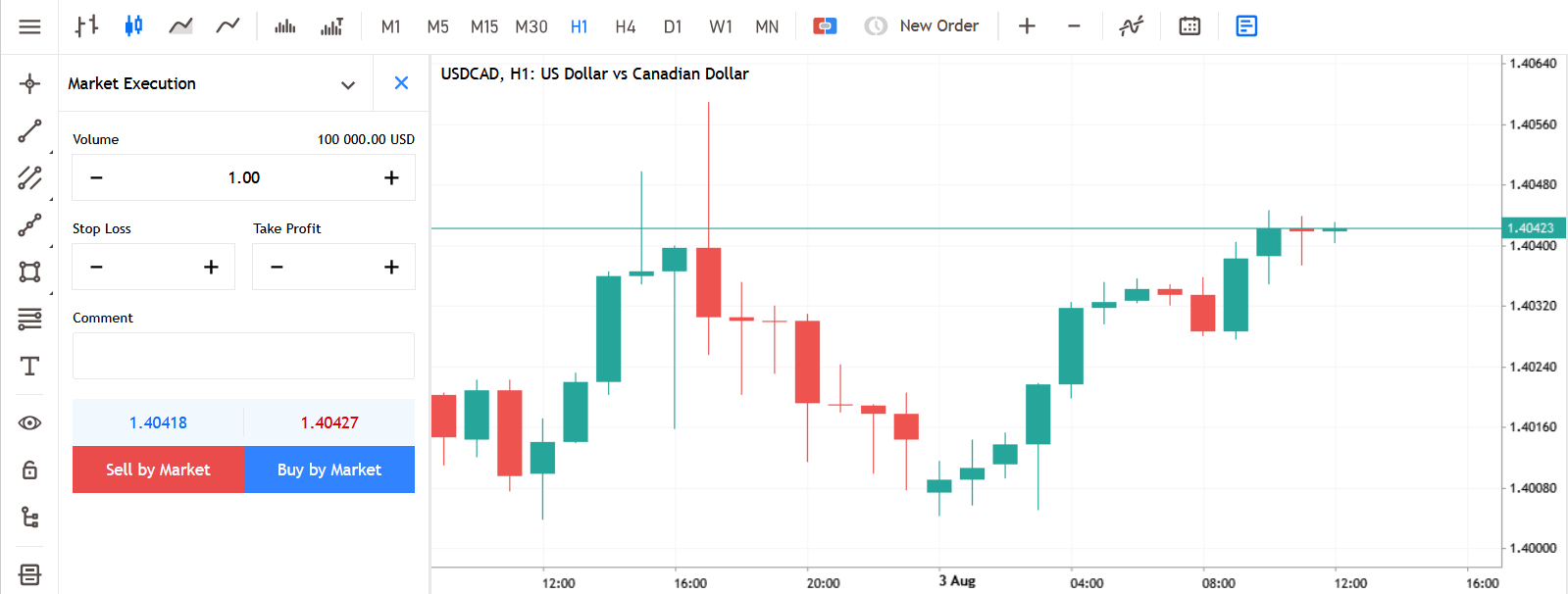
As you can see, even with the addition of a commission, our costs while using the raw-pricing account were substantially lower than those of the Classic account. This is the case in many brokerages, and it is the main factor behind commission-based trading accounts’ popularity in the online forex sphere.
However, do remember that the exact structure will vary by broker, jurisdiction, and instrument. There are brokers whose spreads are not substantially lower, even if a given account type also comes with a commission, and this can make their zero-commission accounts more appealing.
Swap Costs and Administrative Charges
Swap rates are the overnight financing adjustments applied when a forex position is held past the broker’s rollover time. Interest rate differentials are a core reason swaps exist. If one currency in the pair has a higher interest rate than the other, the overnight adjustment may differ depending on which side of the pair you hold.
Long swap applies when you hold a buy position overnight, while short swap applies when you hold a sell position overnight. The two values are often different because they depend on how the broker prices the interest rate differential and funding adjustment for each side. A pair may be relatively cheap to hold one way and expensive the other way.
Depending on the pair and direction, there are two main types of swap fees:
- Negative Swap: This is the fee you pay to your broker if you keep a position open past market hours, and the sold currency’s interest rate is higher than that of the bought currency.
- Positive Swap: This is the interest the broker pays you should a leveraged position move in your favor when held overnight.
As seen on Fusion Markets’ MT5 web client below, you will typically find these swaps listed in the symbol specifications menu of your platform of choice.
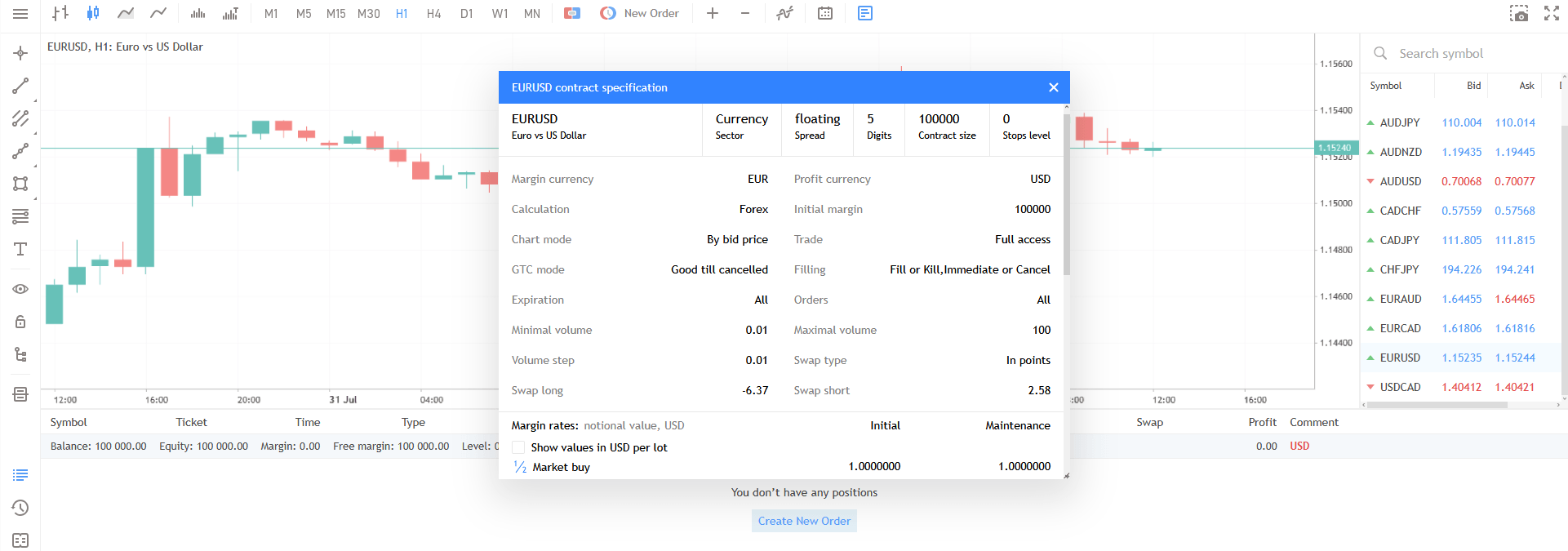
Rollover values differ by direction, broker methodology and markups, market conditions, and, as established, interest rate differentials. Furthermore, swap values are broker-specific and can change over time, so they should be checked directly in the platform or instrument specification.
We should also stress that the specific pair you trade is another factor:
- Majors: Swap costs on major pairs may be more moderate than on some exotics, but they can still matter if the trade is held for days or weeks. A position can become less attractive if the overnight cost is persistently high. Checking both long and short swaps before entering is advised.
- Minors: As minor pairs are often less liquid than majors, they may be subject to higher rollover fees. These costs can materially affect long-term trade performance, so always weigh the pros and cons if you are considering keeping a position open.
- Exotics: Exotic pairs can carry especially large and variable swap charges because of higher rate differentials, lower liquidity, and broker funding considerations. Beginners should be careful about holding exotic positions overnight without understanding the full cost profile.
Your broker will also specify when exactly it applies, and the same goes for when triple swaps come into effect. Swaps are typically tripled on Wednesdays due to the fact that the currency trading market is closed Saturday through Sunday. However, some brokers choose to charge triple swaps on other days of the week, so traders who hold positions overnight should check their broking firm’s rollover terms and conditions and learn exactly when this larger adjustment will apply to their accounts.
Administrative Fees
For Muslim traders who adhere to Sharia law and can neither receive nor pay interest, many brokers offer swap-free accounts. These account types replace rollover fees with fixed administrative charges.
When examining Blackbull Markets’ swap-free trading conditions, we noted that the brokerage offers a grace period of 1-4 days. If a position is kept open for five days, an admin fee is applied on the fifth day. After that, the trader continues being granted 4-day grace periods, and charges will apply every five days.
Like Blackbull, most brokers that enable swap-free trading offer grace periods. However, the exact conditions can differ. Many firms offer a one-time grace period per position, and holding positions beyond this limit means being charged admin fees for each subsequent day the position remains open.
We should also note that not all brokers offer Islamic accounts. Moreover, those that do often require that traders provide proof of faith documentation from their local mosque, imam, or Islamic authority, or that their religion is stated in their ID. At some brokers, eligibility requirements often include the trader being a resident of countries like Saudi Arabia or Qatar.
Non-Trading Costs
Beyond the charges that may be directly attached to your trading activity, owning a trading account can come with other fees that may still play a role in your profitability as a currency trader. These may include deposit fees, withdrawal fees, and monthly subscription fees for using a virtual private server (VPS). Conversion fees are also possible when you deposit and cash out, depending on your account’s currency.
If you prefer a hands-off approach and take advantage of copy trading, you will additionally be required to pay performance fees based on the profits your strategy provider generates. Individuals who take breaks from trading may also be charged an inactivity fee, but these fees are usually relevant only if you stop using your account for 6 months or 12 months.
Comparing Trading Costs
As each cost type can be reliant on a plethora of aspects, including the account type you plan to use, where you reside, the broker’s liquidity providers, and more, the trading costs can vary significantly from platform to platform, so trading costs should be one of the factors you examine thoroughly.
| Cost component | How it appears | Why it changes | What to check |
|---|---|---|---|
| Spread | Difference between bid and ask | Liquidity, session, volatility, pair type | Average spreads during your trading hours, the minimum spread of given account types |
| Commission | Separate fee attached to trades | Account model and broker structure | Per-side and round-turn cost |
| Swap | Overnight debit or credit | Interest differentials, broker methodology, direction | Long and short swap before holding overnight |
| Administrative Fee | Fixed fee for overnight trading | Account model and broker structure | Fee amount, grace period terms and conditions, eligibility requirements |
| VPS | Charged monthly for using a VPS | VPS service provider’s cost structure and potential partnerships with the broker | Discounts or complimentary VPS on behalf of the broker, the requirements for discount eligibility |
| Slippage | Fill away from requested price | News, low liquidity, fast movement | The broker’s execution speed and model |
| Conversion or Other Account-related Charges | Account-currency, service-related fees, transaction fees, inactivity fees | Broker and account setup | Fee schedule, deposit and cashout method, broker’s funding policies, account inactivity terms and conditions, and base account currency |
Central Banks and Currency Pairs
Central banks move forex markets because they influence interest rates, liquidity conditions, and expectations about future policy. Since a currency pair compares two currencies, any shift in one central bank’s outlook can change the pair’s relative value.
Federal Reserve and USD Pairs
The Federal Reserve affects USD pairs through rate decisions, economic projections, speeches, and balance sheet policy. Because the US dollar appears in so many forex pairs, Fed communication can move a broad part of the market at once. A single Fed event may influence EUR/USD, GBP/USD, USD/JPY, USD/CAD, and pretty much any major and exotic tickers.
European Central Bank and EUR Pairs
The European Central Bank has a major influence on EUR pairs through rate policy, inflation outlook, growth projections, and guidance. EUR/USD is especially sensitive, but euro crosses such as EUR/GBP and EUR/JPY can also respond strongly. Traders should pay attention to whether the ECB sounds more hawkish or dovish than the market expected.
Bank of England and GBP Pairs
The Bank of England often has a strong impact on GBP pairs because sterling can react quickly to changes in inflation outlook and policy guidance. GBP/USD and EUR/GBP are especially sensitive, but the impact can extend to GBP/JPY and other pound crosses. BOE announcement days can be volatile even when the actual rate decision is unchanged.
Bank of Japan and JPY Pairs
The Bank of Japan affects JPY pairs through its interest rate policies, guidance, and the broader framework it uses to manage monetary conditions. USD/JPY often reacts not only to BOJ signals but also to the gap between Japanese and US rate expectations. Because the yen is also a risk-sensitive safe-haven currency, policy reactions can be layered and complex.
Swiss National Bank and CHF Pairs
The Swiss National Bank influences CHF pairs through rate policy, inflation commentary, and communication about currency strength. The franc can be sensitive because a strong CHF affects Swiss economic conditions and export competitiveness. Traders in USD/CHF and EUR/CHF should watch SNB events carefully because price reactions can be sudden.
Reserve Bank Decisions and Commodity Currencies
Decisions from central banks such as the Reserve Bank of Australia and Reserve Bank of New Zealand, along with the Bank of Canada, can have a major effect on commodity-linked currencies. These decisions are especially important when inflation and growth conditions are changing quickly. Commodity currencies may also react strongly to forward guidance, not just the headline rate decision.
Trading Sessions and Currency Pairs
Because the global forex markets operate 24 hours a day across different time zones, the liquidity and volatility of currency symbols fluctuate depending on which major financial hubs are active. Generally, most trading is concentrated during the following sessions:
- Asian Trading Session: The Asian session often sees the most natural activity in JPY, AUD, and NZD pairs, although important global news can move any symbol at any time. Price action may be more orderly on some pairs, but liquidity can also be thinner on many European crosses. Broker server times and daylight saving changes can affect exact session labeling on platforms.
- London Trading Session: The London session is often one of the busiest periods in forex because it overlaps with many globally important currencies and financial centers. EUR, CHF, and GBP pairs (particularly EUR/USD and GBP/USD) often become more active, and spreads on major pairs may be more competitive. This session can produce strong breakouts after the quieter parts of the day. For traders based outside Europe, it is worth deciding in advance whether those hours fit their routine well enough to trade consistently.
- New York Trading Session: The New York session is important for USD pairs and North American data. Pairs such as EUR/USD, GBP/USD, USD/CAD, and USD/JPY often respond to US influences, especially when US data or interest rate releases are scheduled. Price action can be fast during this period, so traders should not assume that a liquid market will also be a calm market.
- London-New York Overlap and Other Session Overlaps: Session overlaps, especially the London-New York overlap, often bring the highest combined liquidity and active price movement. This can be favorable for spreads and execution in many major pairs, but it can also increase volatility and the speed of reversals.
Currency Pair Correlation
Correlation describes how two currency pairs tend to move in relation to each other. It changes over time and can weaken or reverse in different market environments. There are two main types of correlation:
- Positive Correlation: Positive correlation means two pairs often move in the same direction, i.e., they rise and fall together to some degree. Traders sometimes measure this on a scale from +1 to -1, where numbers closer to +1 indicate a stronger positive relationship. In practice, traders should take note of positive correlation because opening two similar trades can double exposure. The cTrader charts of AUD/USD and NZD/CAD price movements below offer a visual illustration of the positive correlation between the AUD/USD and NZD/USD pairs. Myfxbook data suggests that on August 3, 2026, their correlation stood at 82.8%.
- Negative Correlation: Negative correlation means two pairs tend to move in opposite directions. If one rises, the other may fall. For example, EUR/USD and USD/JPY have a strong negative correlation, and Myfxbook data shows the pairs’ correlation stands at -77.5% at the time of writing.
Negative correlation can be taken into account when you are aiming for diversification. However, traders should be careful not to assume the relationship will hold during every period. Correlation can break down when a strong local story or another event dominates one of the currencies.
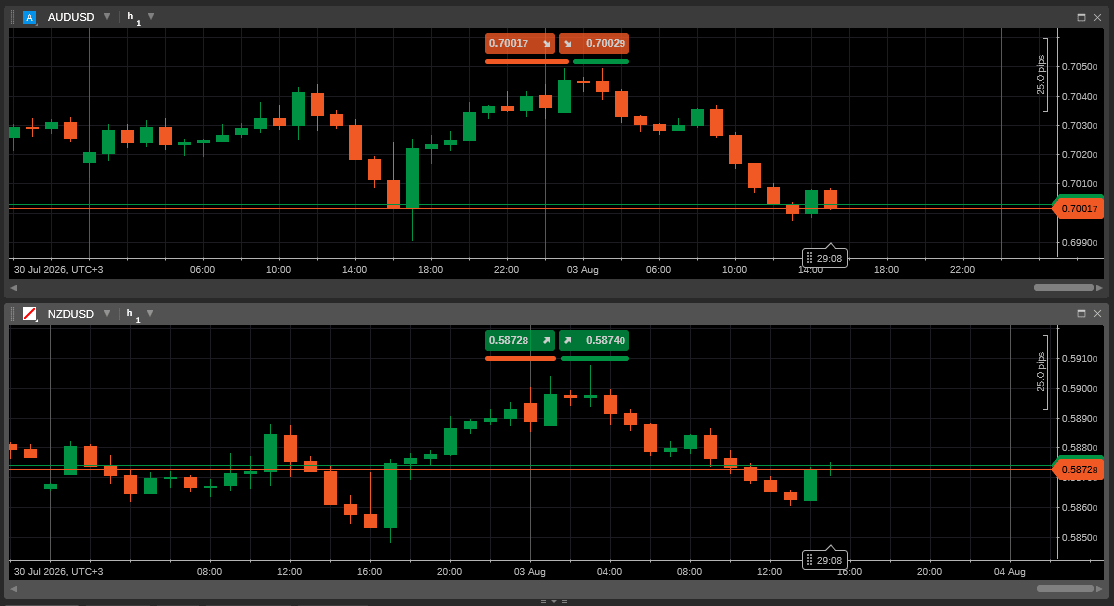
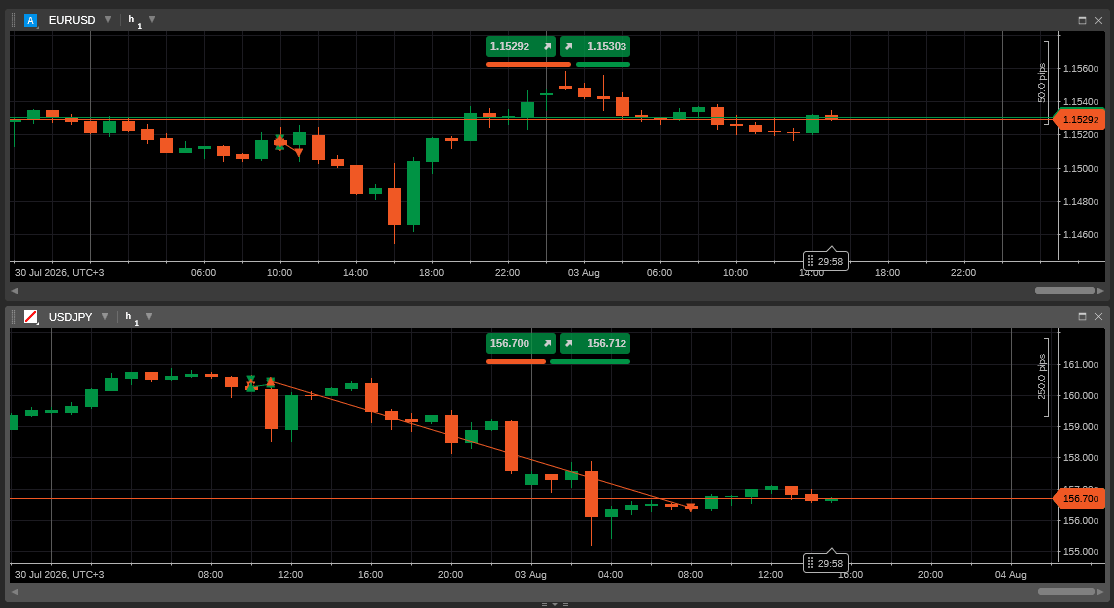
Correlation’s importance lies in the fact that multiple trades can quietly create one large macro bet. Long EUR/USD and short USD/CAD may look like three separate positions at a glance, but they may both rely on broad USD weakness. Thus, failing to take correlation into account when assessing risk can lead to unexpected results.
EUR/USD and GBP/USD Correlation
However, this positive correlation is often overshadowed by UK-specific news that can make GBP/USD move very differently from EUR/USD, especially around Bank of England or UK political developments.
USD/CHF and EUR/USD Correlation
On the other hand, Swiss-specific policy, safe-haven demand, or changes in broad risk sentiment can alter how these two pairs move against each other. As always, it is best that you consider multiple fundamental analysis factors before you proceed with a trade.
Commodity Currency Correlations
Commodity-linked currencies such as AUD, NZD, and CAD may show correlation with each other at times because they can respond to growth expectations, commodity demand, and market sentiment. But each has its own drivers as well, and this is particularly relevant when examining commodity currency price movements.
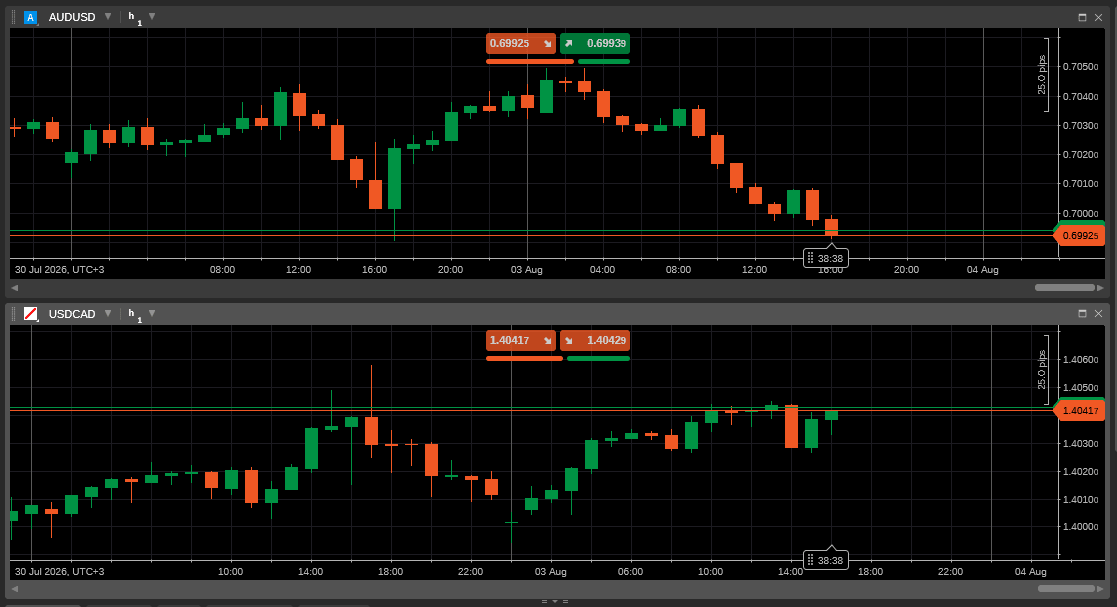
AUD/USD and USD/CAD are negatively correlated (-84.1% according to Myfxbook) since they rely on contrasting dollar sentiments. However, this dynamic can be shaken up by oil price movements, which CAD is heavily influenced by, and China-related demand, which can impact AUD prices.
Currency Pairs by Trading Style
Currency pairs are often suited for different strategies and experience levels. Some can be excellent options for beginners, while others should mainly be explored by individuals who are well-versed in forex trading. Below, we have outlined the suitability of a range of forex pairs in terms of how they perform for beginners, scalpers, swing traders, and more.
Best Currency Pairs for Beginners
There is no universally best pair for all beginners, but many new traders start with liquid major pairs such as EUR/USD or USD/JPY because they are widely covered across online brokers and often have relatively efficient pricing in active sessions. Majors also tend to have high liquidity and be less volatile than minor and exotic symbols, which is important for novices who are still learning the ropes of risk management and trading as a whole.
Best Currency Pairs for Scalping
Scalping is a technique where you make a large number of trades in quick succession with the goal of profiting from short-term price swings. Scalpers often prefer pairs with high liquidity, low trading friction, and active movement during the specific session they trade. Major pairs like EUR/USD and GBP/USD are commonly considered because the spread cost matters heavily for very short trades. Minors and exotics like EUR/AUD and USD/TRY, on the other hand, are typically avoided despite their volatility since their wide spreads can make profiting difficult.
Best Currency Pairs for Day Trading
Day traders usually look for a balance between movement intensity and cost. Popular choices often include actively traded majors like EUR/USD and some well-known crosses (EUR/GBP, EUR/JPY, etc.) during their busiest hours. The right pair for day trading is one that offers enough movement to reach targets, but not so much that ordinary intraday noise repeatedly hits stop-losses.
Best Currency Pairs for Swing Trading
Swing traders often care more about medium-term trend structure, clean technical levels, and macro themes than about the tightest possible spread. Majors, yen crosses, and commodity-linked pairs can all be good options for this strategy, depending on the market environment. Because trades may be held overnight, swap costs and event exposure become more important.
Best Currency Pairs for Position Trading
Position trading is the practice of holding a specific position for weeks, months, or longer. It often focuses on pairs with strong macro narratives, such as widening policy divergence, long-lasting inflation differences, or a durable risk sentiment trend. Majors like EUR/USD and USD/JPY are a popular choice. This style of trading typically requires strong patience and awareness of overnight swaps and headline risk.
Best Currency Pairs for News Trading
Generally, the most widely traded currency pairs are considered by news traders, particularly those symbols of regions that have global news coverage. Examples include EUR/USD for major Eurozone or US data, GBP/USD for UK events, or USD/JPY for key US and Japanese policy developments. However, news trading can carry substantial risk because spreads can widen sharply and slippage can be severe.
Best Currency Pairs for Algorithmic Trading
Algorithmic traders typically prefer pairs with strong historical data quality, steady trading hours, and relatively consistent liquidity and costs. Major pairs are common candidates because backtesting tends to be cleaner when spreads and execution are more stable.
Technical Analysis for Currency Pairs
There are two main ways of examining forex markets: technical analysis and fundamental analysis. The former operates on the premise that the market’s collective knowledge is already embedded within its current price. Thus, it focuses on chart data, momentum indicators, and other technical factors that reflect identifiable trends and recurring market reactions to economic stimuli. In this section, we focus on the key concepts of technical analysis and how you can use them to enhance your trading strategy.
Trend Analysis
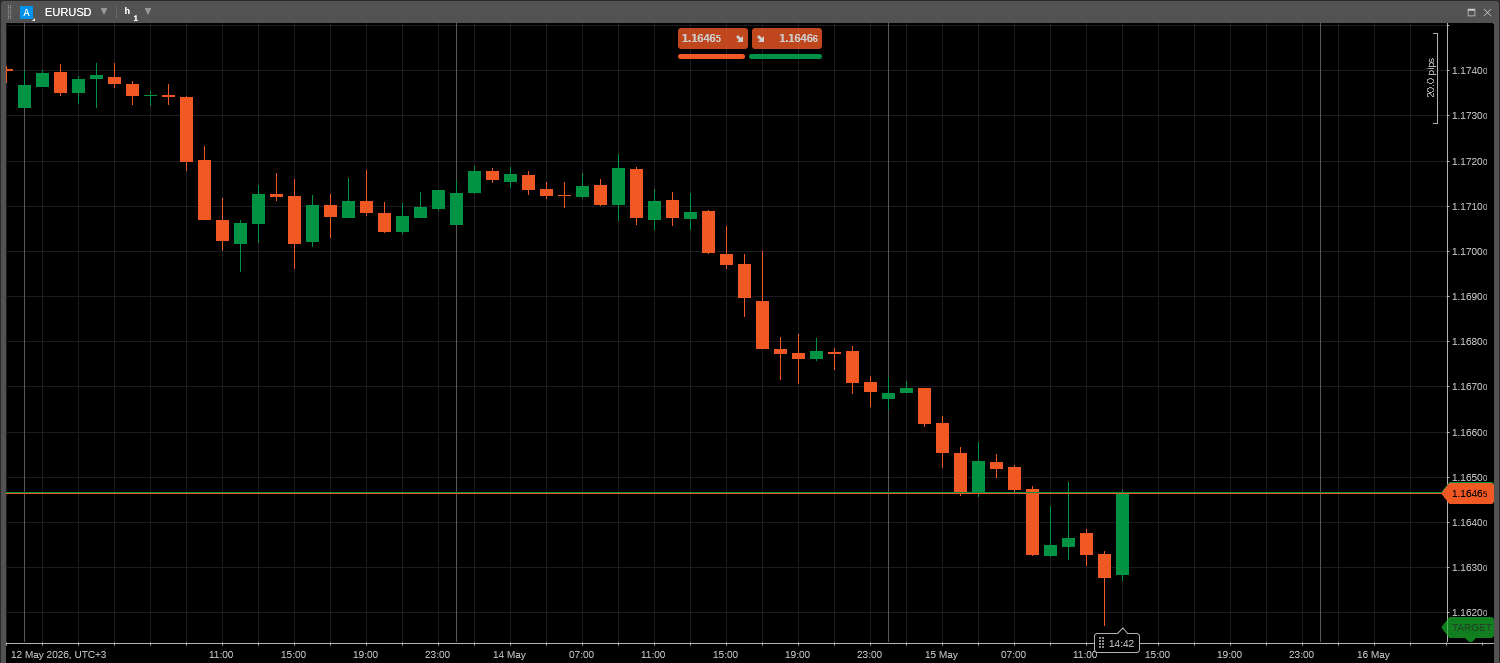
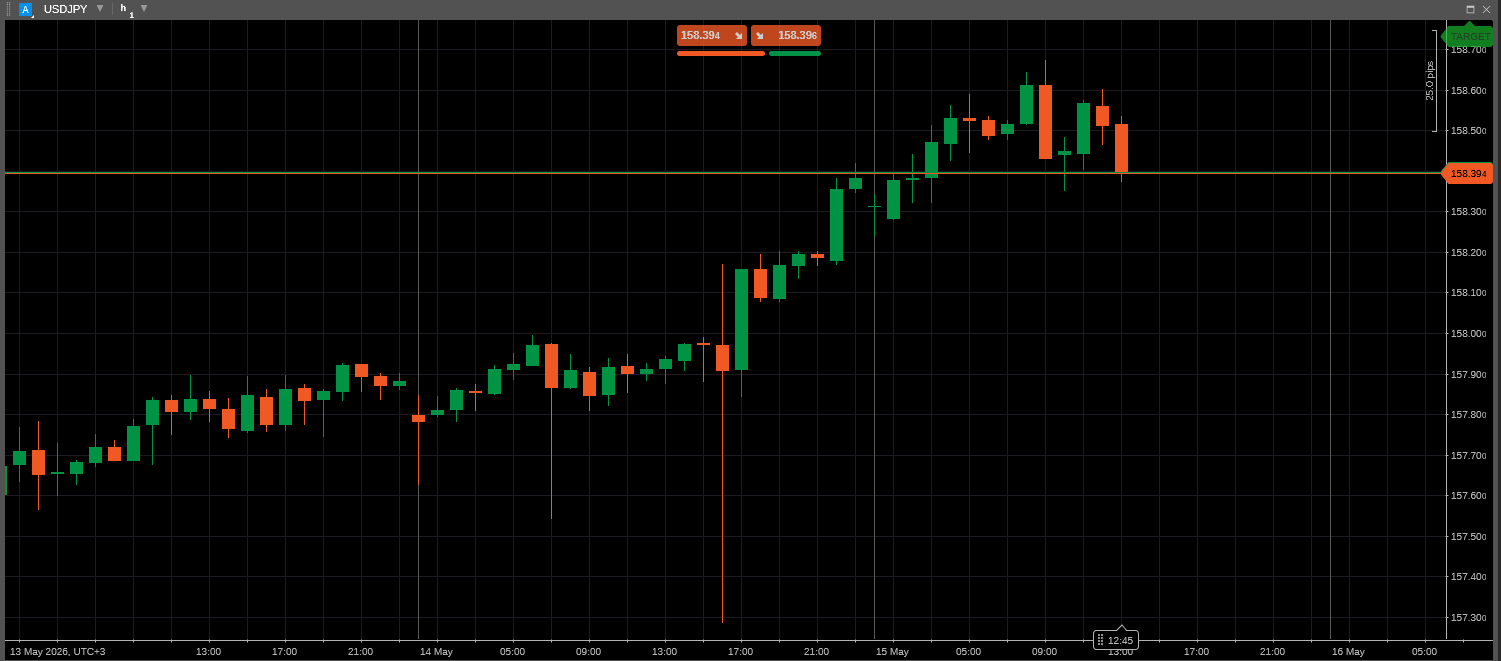
Trend analysis aims to identify whether a pair is generally moving up, down, or sideways. Traders often look at higher highs and higher lows in an uptrend or lower highs and lower lows in a downtrend.
In the chart below, we can observe a short-term downtrend of the EUR/USD pair.
Data Source: cTrader
With the USD/JPY, on the other hand, we have an example of an uptrend:
Data Source: cTrader
In forex, trend strength can vary by pair and session, so it helps to define the trend on a specific timeframe before entering.
Support and Resistance
Support is a price area where buying has tended to appear, while resistance is an area where selling has tended to appear. These levels can form around prior highs, lows, consolidation zones, or psychological round numbers.
- The support price is typically the lowest price a given pair will reach before traders begin purchasing with the intention to “buy the dip,” i.e., buying at a low price with the expectation that it will rise in the future.
- Resistance occurs in the opposite scenario; when the price of a given pair has gone on an upward trend, many traders may start closing their positions to cash out profits in case the price starts to drop.
Moving Averages
Moving averages serve as technical indicators that smooth price data and can help traders identify trend direction or dynamic support and resistance. A shorter moving average reacts faster, while a longer one reacts more slowly. The blue line in the screenshot below represents a simple moving average indicator:
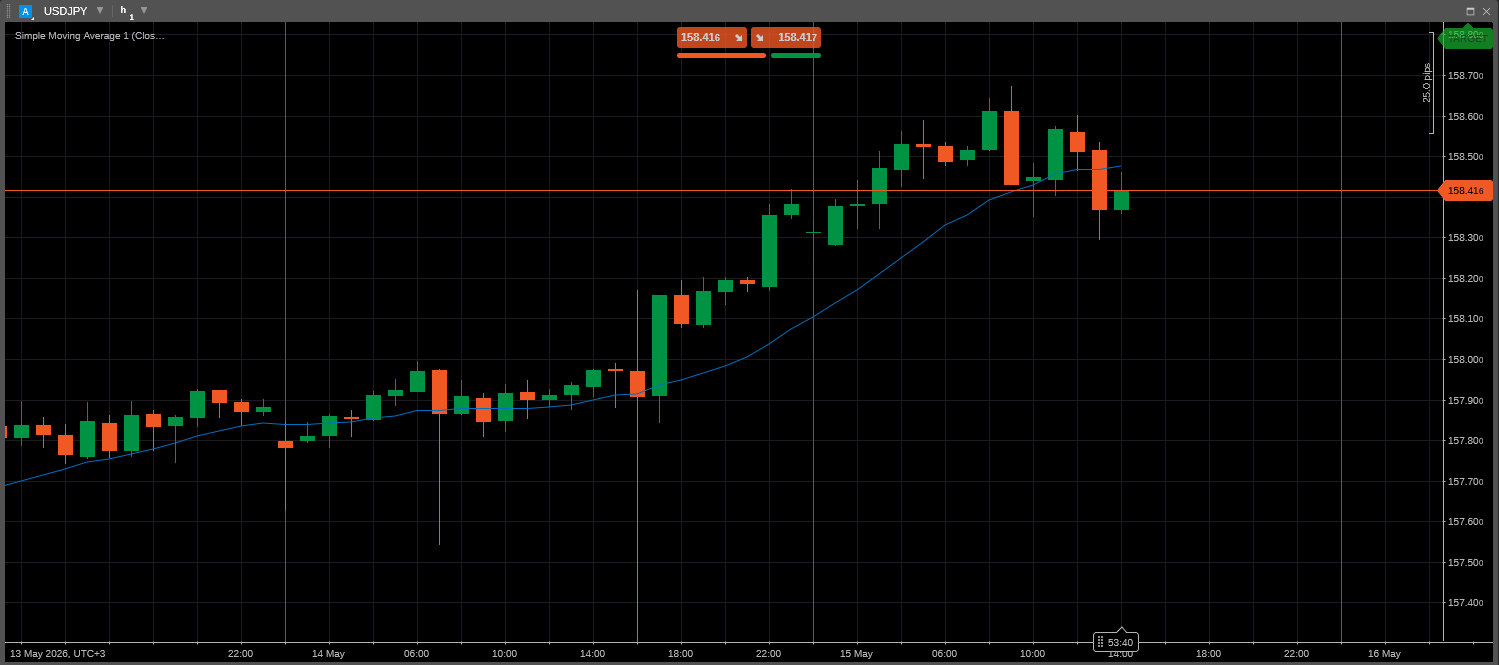
* SMA, Data Source: cTrader
There are several types of moving averages:
- Simple (SMA): This indicator calculates the average price of an asset over a chosen timeframe.
- Exponential (EMA): This indicator focuses more on recent price trends by assigning exponentially decreasing importance to past price data.
- Weighted (WMA): WMA is similar to EMA in that its calculations emphasize recent pricing, but importance is assigned on a linear basis.
- Volume-Weighted (VWMA): VWMA resembles WMA, but it focuses specifically on high-volume changes.
Momentum Indicators
Momentum indicators, also referred to as oscillators, aim to show the speed and strength of a price move. They can help traders spot weakening momentum or divergence.
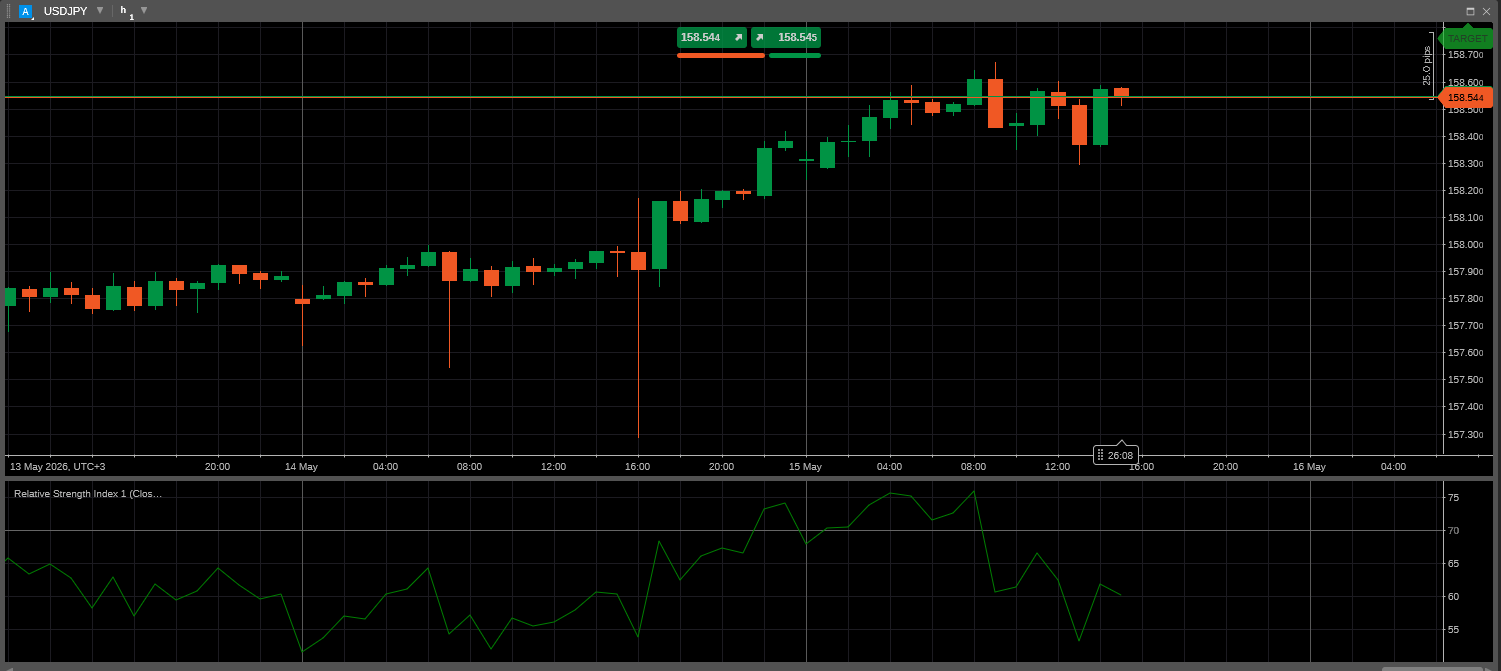
* RSI, Data Source: cTrader
Momentum tools work best when used with trend context, because overbought or oversold conditions can persist longer than many beginners expect.
- Relative Strength Index (RSI): The RSI gauges the momentum of a given pair by focusing on gains and losses in order to identify overbought and oversold trends.
- Stochastic Oscillator: Stochastic oscillators are similar to the RSI, but they focus on the closing prices and what they indicate about a given price trend.
- Moving Average Convergence Divergence (MACD): This indicator showcases the gap between the closing prices of a 12-period EMA and a 26-period EMA to highlight potential turning points.
- Rate of Change (ROC): This indicator compares the current price of an instrument with a previous price. It expresses this difference in percentages and aims to determine the velocity of price movements.
- Money Flow Index (MFI): The Money Flow Index (MFI) tracks price action in combination with the actual amount of capital that is being traded. It helps determine whether a trend is supported by genuine market participation.
- Average Directional Index (ADX): The ADX displays the intensity of market momentum. It tracks how fast the market is moving toward a specific destination, without specifying if that destination is north or south.
Volatility Indicators
Volatility indicators such as ATR or Bollinger Bands help traders estimate how much a pair is moving. Since these metrics focus on the degree of market turbulence, they help distinguish between stable markets and movements characterized by sharp swings, which is useful when assessing risk levels.
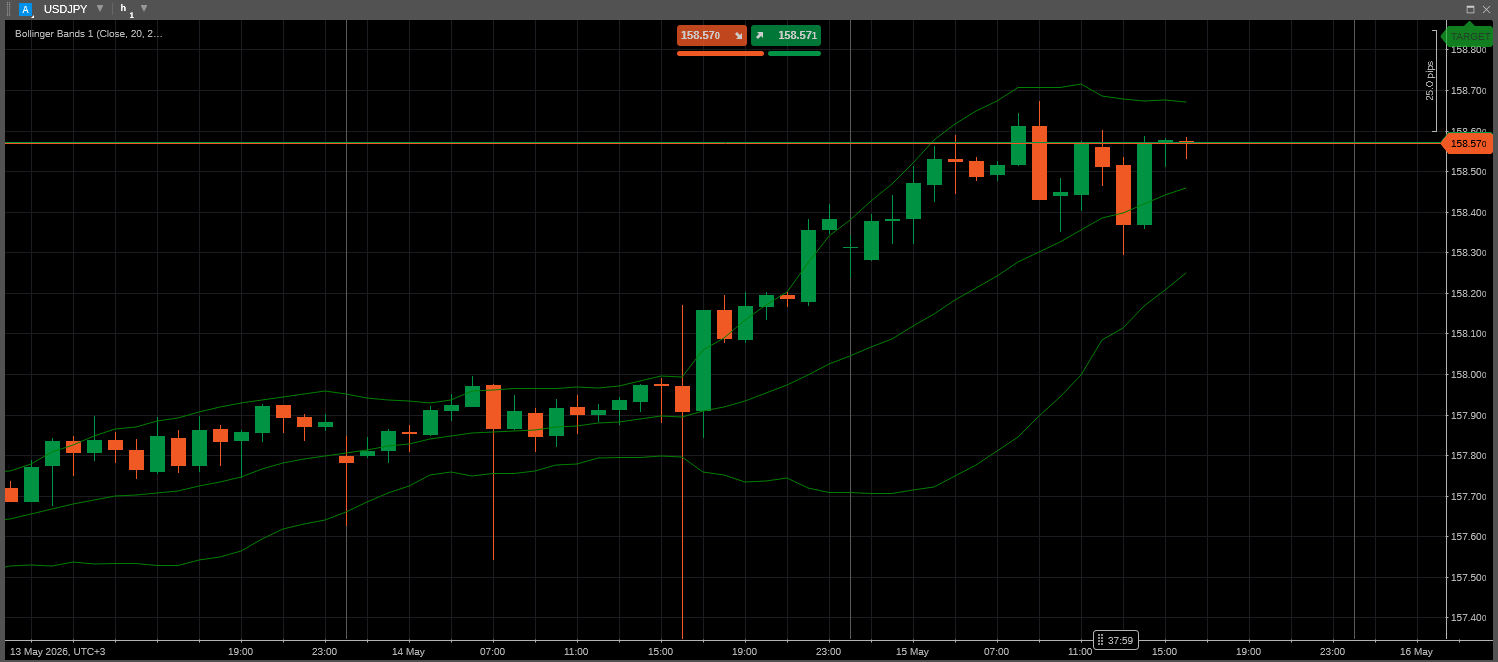
* Bollinger Bands, Data Source: cTrader
Most platforms offer a wide range of volatility indicators, but some of the most popular ones are:
- Bollinger Bands: Bollinger Bands visualize market tension to assist in identifying whether a currency pair has been overbought and oversold. They contain three lines: a 20-period SMA (located in the middle), an upper band showing a standard deviation above the MA, and a lower band showing a standard deviation below the MA.
- Average True Range Indicator (ATR): The ATR is useful for stop-loss planning because it gives a sense of whether your stop is realistic relative to the pair’s normal range. A stop that is too tight for the current volatility may fail even if the trade idea is sound.
- Volatility Index (VIX): This indicator uses trading data tied to the S&P 500 to gauge volatility over the upcoming 30 days. As the S&P 500 is a leading economic indicator for the state of the US economy, the VIX is often used by individuals who trade majors and exotics involving the USD.
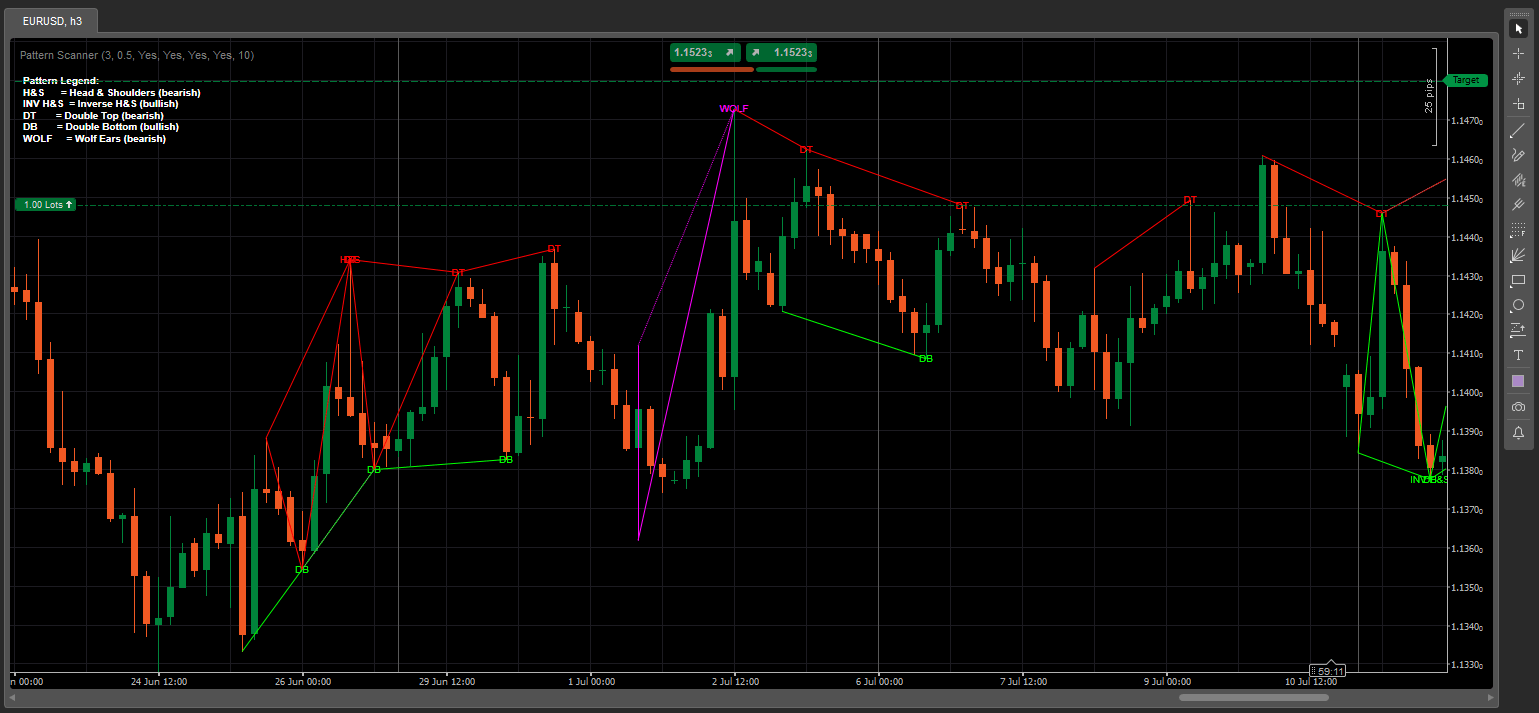
Chart Patterns
 Chart patterns such as triangles, ranges, breakouts, flags, double tops, wolfe waves, or head-and-shoulders formations can help organize price action. You can view examples of Wolfe wave, Double Top, and Double Bottom patterns in the screenshot below, as visualized by the cTrader Pattern Scanner.
Multi-Timeframe Analysis
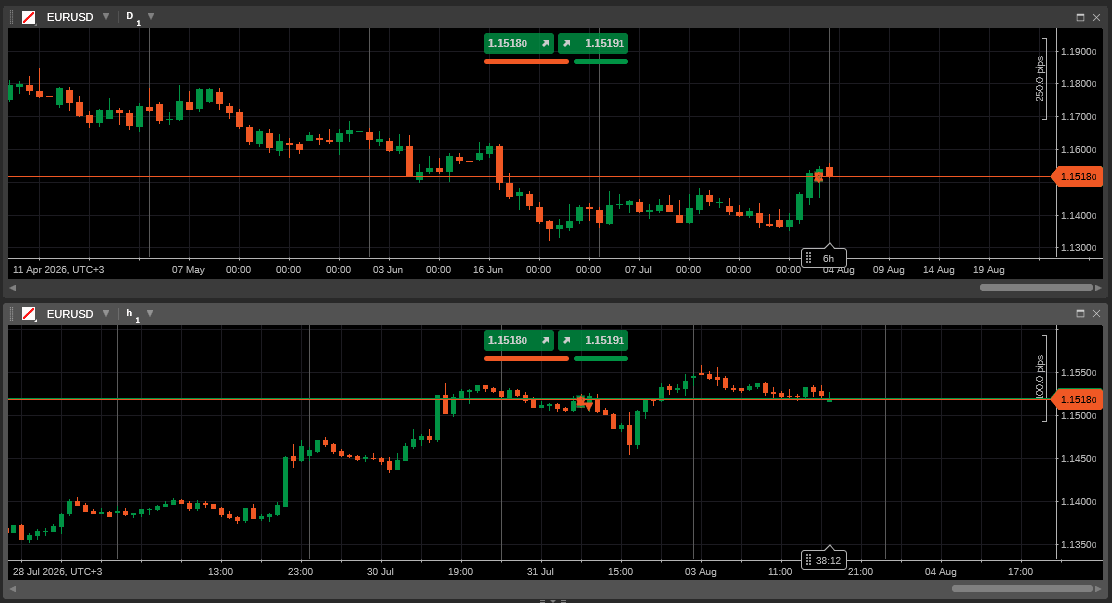
 Multi-timeframe analysis means checking a higher timeframe for trend and structure, then using a lower timeframe for entry and risk control. For example, the daily chart pictured below can be used to identify direction, and the hourly chart can be used to time an entry. This can reduce noise and help keep short-term decisions aligned with the bigger picture.
Fundamental Analysis for Currency Pairs
Fundamental analysis essentially focuses on the key drivers of the foreign exchange market. Forex pricing is a reflection of the relative economic conditions of at least two countries, and it can be affected by factors like central bank policies, macroeconomic indicators, geopolitical events, and more. Each of these aspects is a part of fundamental analysis, which focuses on determining the intrinsic value of a given currency and how that plays a role in its respective forex pairs.
We should also stress that fundamental analysis in forex is always comparative. A trader is not just asking whether one economy of a certain currency is strong, but whether it is stronger or weaker than the economy on the other side of the pair.
Interest Rate Expectations
 Interest rate expectations are one of the strongest long-term drivers in forex. Interest rate differentials, in particular, compare the expected return environment between the two currencies in a pair. If one central bank is expected to maintain higher rates than the other, that currency may attract support. Markets often move on expectations before the actual decision arrives.
Inflation Data
 Inflation reports, such as Consumer Price Index (CPI) or Personal Consumption Expenditures (PCE), depending on the country, can have a large effect on rate expectations. Markets often react to core measures, month-over-month details, and revisions as much as the annual rate.
You will typically find this data on official government websites. In the US, for example, CPI data is published by the Bureau of Labor Statistics, while PCE figures can be found in the Department of Commerce’s Personal Income and Outlays report.
Higher-than-expected inflation may increase the chance of tighter policy, while lower inflation may reduce it. The market reaction depends not only on the headline number but also on the prior forecast, underlying details, and current sentiment.
Employment Reports
 Reports such as US nonfarm payrolls or other national employment data can change views on growth, consumer spending, and central bank policy. In turn, this may lead to sharp swings of the related currency pairs. Slippage and spread widening are common around these releases, especially if the result is far from the consensus.
Essentially, strong labor data may support a currency if it suggests economic strength or persistent inflation pressure. Weak data may have the opposite effect, but context matters because markets may react more to wages, participation, or revisions than to the headline job count alone.
GDP Growth
 Gross domestic product (GDP) measures economic output. In the UK, for instance, this data can be found on the official website of the Office for National Statistics, while in the US, this information is available in the FRED database.
GDP figures can influence how traders compare one economy to another. Stronger growth may support a currency if it implies better returns or a more resilient economy.
Analysts typically interpret GDP in the context of inflation, employment, and other key factors to get a clearer picture of how it may affect forex markets. Of course, it is not recommended to measure growth on its own; markets may discount strong growth if it was already fully expected, so focusing on other points of interest in addition to economic growth figures is crucial.
Central Bank Policy
 Central bank policy includes interest rates, asset purchases, balance sheet guidance, and communication about future policy. As a result, central bank meetings like those of the US Federal Reserve are often among the most important scheduled events for a currency pair, with traders and analysts typically focusing on the rate decision, policy statement, voting pattern, where applicable, and forecasts.
The tone of the press conference is also important. In fact, sometimes the way the statement was delivered will move the market more than the rate decision itself. A pair may fall even after a rate hike if the central bank sounds more cautious than expected. Since volatility can rise before, during, and after the meeting, beginners should be cautious about holding large positions during those events.
Geopolitical Events
 Elections, budget disputes, trade tensions, sanctions, military conflict, and political instability can all move currency pairs. These events can increase uncertainty, widen spreads, and cause price gaps.
Political risk is especially important in exotic pairs, but it can also affect major currencies when the issue is large enough. Coalition instability, policy uncertainty, and regulatory changes may all influence a currency pair, particularly if they affect capital flows or central bank credibility.
Market Sentiment and Risk Appetite
 Market sentiment influences whether traders prefer growth-sensitive currencies or defensive currencies. In optimistic conditions, currencies tied to global growth may perform better. In defensive conditions, the yen, franc, or US dollar may attract demand. Sentiment can shift quickly, especially when markets are already nervous.
Economic Data
 Forex markets constantly reprice expectations about two economies at once, and economic data can change assumptions about rates, growth, inflation, and relative strength. A release can move a pair not only because the number is strong or weak, but because it differs from what traders were already expecting. The types of reports you can look forward to when conducting analysis include:
- Retail Sales: Retail sales data, such as the figures outlined in the US FRED, provide insight into consumer demand, which is a major part of economic activity in most countries. Strong retail numbers may support a currency if they suggest resilient spending, while weak results may raise concerns about growth. As always, the reaction depends on expectations and the broader macro backdrop.
- Manufacturing and Services Data: Manufacturing and services surveys, including PMI-style indicators as shown in the S&P Global Flash UK PMI, can affect currencies because they offer timely clues about business activity. Traders often watch whether these reports are improving or deteriorating relative to forecasts. Services data can be especially important in economies where services make up a large share of output.
- Trade Balance Data: Trade balance data shows the difference between exports and imports. Persistent trade surpluses or deficits can influence market sentiment surrounding currencies over time, especially in export-driven economies. In some pairs, trade data is a secondary factor, but it can still matter when combined with commodity prices, external demand, and political developments.
Fiscal Policy
 Fiscal policy includes government spending, taxation, deficits, and borrowing plans. Large fiscal shifts can change growth expectations, inflation outlook, and bond market behavior, all of which can affect a currency. Traders should pay attention when budgets, stimulus plans, or debt concerns become major market themes.
Risk Management When Trading Currency Pairs
Forex trading has the potential to be very profitable in the hands of a skilled trader, but recklessness and inexperience can result in substantial losses, particularly when trading with leverage. Thus, effective risk management is typically the most important aspect of any trading strategy. In this section, we offer insight into the risk management strategies our reviewers employ when testing online broking firms.
Risk Per Trade
Risk per trade is the maximum amount you are willing to lose on one position. Some traders use a fixed dollar amount, while others use a small percentage of account equity that can often range from 0.25% to 1%. There is no single correct number for everyone, but keeping risk consistent helps prevent one bad trade from significantly affecting your entire capital.
Stop-Loss and Take-Profit Placement
We place a stop-loss where the trade idea becomes void. That might be beyond a swing high or resistance, below a support zone, or outside normal volatility. Very tight stops can reduce nominal risk but may increase the chance of being stopped out by ordinary price movement.
Take-profit orders, meanwhile, are typically placed below the resistance level and above the support level, depending on whether we go long or short. The goal of these orders is to ensure you close a position if you make a profit, without the risk of markets turning against you and the position ending at a loss.
Position Sizing
Position sizing refers to the units of currency we trade, and it connects stop distance to account risk. If an account currency differs from the pair’s quote currency, conversion is needed to assess the exact amount. This step is one of the most important habits a forex trader can learn.
Leverage Risk
Trading with leverage involves borrowing money from one’s broker to control large positions with a smaller capital. It can result in substantial profits even from small price movements, but it may also lead to losses exceeding the initial capital of the trade or even the account balance. Thus, going with a leverage ratio that is not excessive is crucial. If possible, stick to brokers that offer their retail clients negative balance protection, which will prevent your balance from dropping below zero due to leverage.
Brokers operating under the purview of strict financial watchdogs are usually mandated to make explicit risk disclosures if they offer leveraged trading. For example, Pepperstone includes the following warning on its Europe-facing website at the time of writing:
CFDs are complex instruments and come with a high risk of losing money rapidly due to leverage. 72.9% of retail investor accounts lose money when trading CFDs with this provider. You should consider whether you understand how CFDs work and whether you can afford to take the high risk of losing your money.
Currency Correlation Risk and Exposure to a Single Currency
Correlation risk appears when several positions depend on the same underlying theme, such as broad US dollar weakness or global risk-on sentiment. A trader may think they hold diversified positions, but if each involves the USD as the base currency (for example, USD/JPY, USD/TRY, USD/CAD), then all of them would be affected by US data reports and the country’s economic health. Checking overall currency exposure can prevent over-leveraging in a single area.
It is also possible to become overexposed to one currency by opening several seemingly different trades that all depend on the same currency. Long EUR/USD, long GBP/USD, and long AUD/USD all increase exposure to a weaker US dollar scenario.
News Event Risk
In our experience, major data and central bank events can cause price spikes, spread widening, slippage, and sudden reversals. Even if your stop-loss is in place, the fill may be worse than expected in a fast market. Beginners should be especially careful about holding oversized positions into scheduled releases without understanding the risk.
Overnight Risk
Holding a trade overnight introduces swap costs or credits, changes liquidity, and increases the chance of headlines while you are away from the screen. Weekend gaps add another layer of risk. Carefully consider these factors before you decide to keep a position open past market hours.
Leverage and Currency Pairs
Leverage essentially lets a trader control a larger position with a smaller amount of margin. When examining the broker IC Markets, we set up a demo account with $100,000 in virtual funds and 1:30 leverage, and traded the EUR/USD by making a 1-lot buy order. Despite our available margin being exactly $100,000, we were able to open a buy position of $115,069 with a required margin of $3,835.67 because we were using 1:30 leverage.
In forex, small price moves can create large percentage changes in account equity if the trader in question is using substantial leverage. This can amplify returns, but it also increases the amount of funds you stand to lose if markets move against your position. This is why many jurisdictions, including the FCA, CySEC (as per ESMA rules), and ASIC, impose strict leverage restrictions on brokers offering retail trading. When we use non-professional accounts during our testing of online broking brands, we are limited to 1:30 leverage if we are registered with the broker’s European branch, for example.
Margin Requirements by Pair
Margin is the amount of account equity set aside to support a leveraged position. They affect the leverage you can utilize, as for example, a margin of 3.33% equates to leverage of 1:30, while 5% margin translates to 1:20 leverage. If the leverage is 1:1 and the margin is 100%, this means that you are actually trading without leverage.
Here is an overview of notable leverage ratios you may come across at online brokers and the equivalent required margin:
| Leverage Ratio | Margin | Notes |
|---|---|---|
| 1:1 | 100% | Unleveraged position; the trader is using their own capital |
| 1:2 | 50% | Retail crypto limit (ESMA, ASIC) |
| 1:5 | 20% | Retail equity/stock limit (ESMA, FCA, ASIC) |
| 1:10 | 10% | Retail commodity limit (ESMA, FCA, ASIC) |
| 1:20 | 5% | Retail cap on non-major pair, gold, and major index leverage (ESMA, FCA, and ASIC) |
| 1:30 | 3.33% | Retail major forex limit (ESMA, FCA, ASIC) |
| 1:50 | 2% | Retail major forex limit (US / NFA, CFTC) |
| 1:500 | 0.20% | Offered by brokers licensed by the FSA (Seychelles) and other offshore regulators |
Margin requirements and leverage ratios can vary significantly depending on where you reside and your account status, as some regulatory entities impose strict limits on what leverage brokers can offer retail traders, while others are more lenient. As shown above, European regulators like BaFin, as well as the financial watchdog of Australia, both impose a maximum retail leverage of 1:30, for example. Professionals can access higher ratios, but that typically comes with significant restrictions. Brokers themselves may also choose to restrict leverage further, although this is very rarely the case.
Another factor that affects leverage availability is the type of pair you wish to trade:
Leverage on Major Pairs
We have observed that in many brokers, major pairs may have more favorable leverage or margin treatment than less liquid pairs. This is due to their high liquidity and the perception that they are less risky than the alternatives.
Brokers operating in strict financial environments in regions like the UK, Europe, and Australia impose a cap of 1:30. In Japan, the limit is even lower at 1:25, but Poland has taken the opposite approach and exceeds the European cap by permitting retail leverage of 1:100. Locations with even more lenient restrictions can enable traders to utilize leverage of 1:200, 1:500, or even higher.
In summary, leverage limits on forex majors can vary significantly, so make sure to always check current instrument specifications before you start trading.
Leverage on Minor and Major Pairs
Minors and majors both tend to be subject to stricter leverage limits than majors. Low liquidity and less predictable volatility are the typical reasons strict regulators see minor and exotic pairs as far more risky for retail traders, and these pairs can make the usage of leverage even more risky. Thus, it is often believed that such pairs warrant even more significant safety precautions.
If you are a resident of the UK, Germany, Australia, or another region with notable leverage restrictions, and you plan on trading minor and exotic tickers, you will most likely have access to leverage no higher than 1:20. In contrast, offshore financial supervisors may impose the same limits as those they apply to major pairs, or just keep leverage limits at the full discretion of brokers. Thus, it may be possible for you to trade EUR/JPY and USD/TRY with leverage of 1:500 or even higher, depending on the authority that supervises forex trading in your region.
Why Higher Volatility Requires More Caution
Managing Free Margin When Trading Multiple Pairs
Free margin is the equity available to support additional trades or absorb open losses. When multiple positions are open, especially correlated ones, free margin can shrink faster than expected. Traders should monitor total margin usage and keep a buffer, because margin stress can force poor decisions at exactly the wrong time.
Trading Currency Pairs on Platforms
If you plan to trade currencies online, you will need to use a trading platform. Some brokers have developed their own software, while others rely on third-party platforms that see widespread popularity among forex devotees. This section will introduce you to several of the most popular platforms you may come across during your currency trading journey.
MetaTrader 4
 MetaTrader 4 (MT4) is a staple of the online forex trading scene, with the vast majority of brokers supporting this platform in the form of downloadable software, a webtrader web app, or mobile applications. We find the platform’s overall interface is relatively easy to navigate.
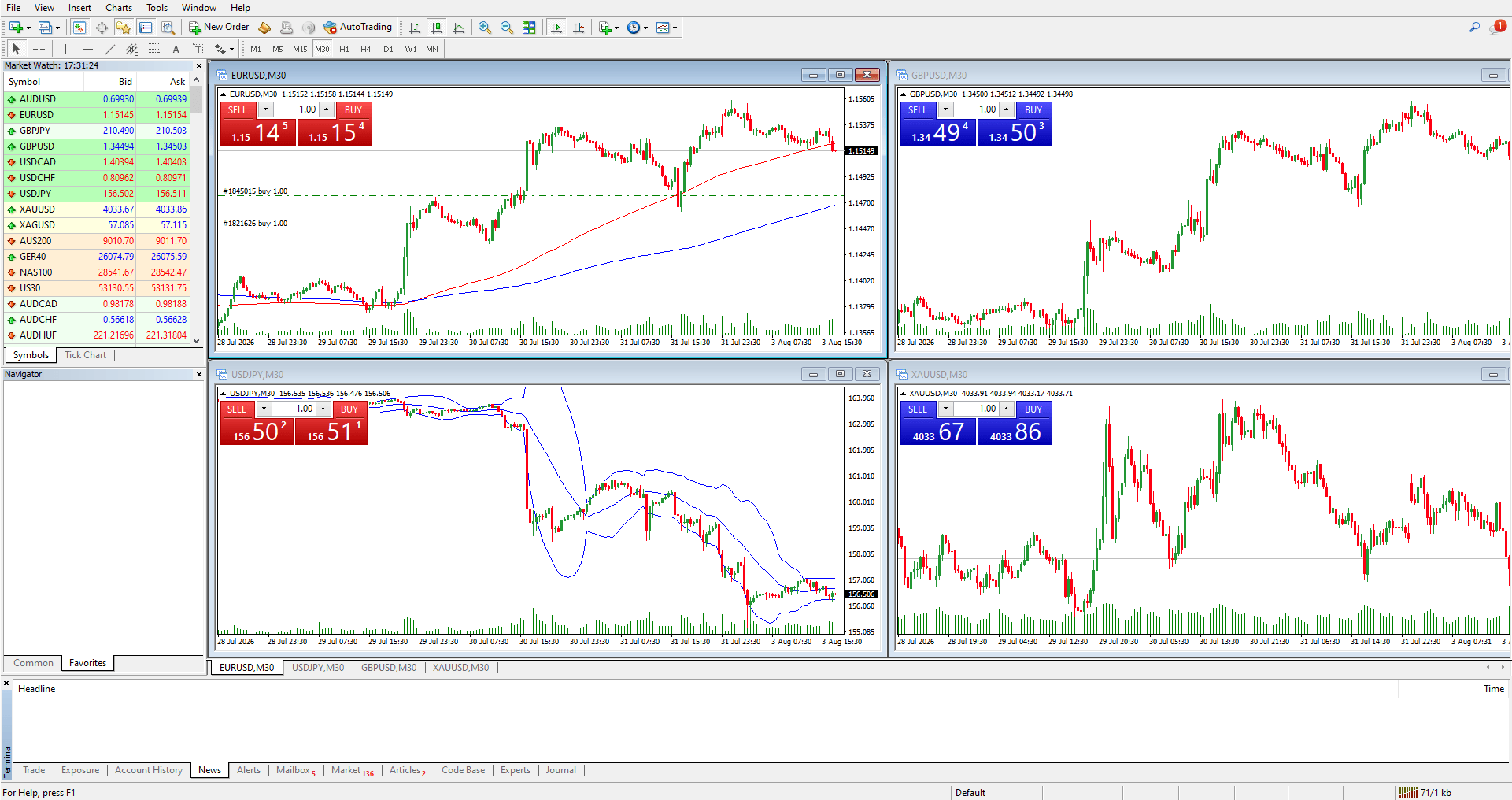
Currency pairs are usually found in the Market Watch window. If a pair is not visible, it may need to be enabled through the symbols list, depending on broker setup. Some brokers use suffixes or custom naming, so EUR/USD may appear with extra characters rather than the plain standard symbol. In terms of additional features, one of MT4’s characteristic perks is its Expert Advisors (EA), which enable algorithmic trading.
The platform does lag behind in terms of visual design, however, and we should also note that MT4 is primarily a forex and CFD trading platform that lacks certain asset classes. Its chart type selection is basic as well, with only bar, line, and candlesticks being available. If either of these factors is a concern, it may be worth it to consider other options.
MetaTrader 5
 MetaTrader 5 (MT5) was launched by MetaQuotes in 2010, five years after the release of its predecessor MT4. It also enjoys widespread availability, with many traders preferring MT5’s more modern interface and the fact that its library of instruments features a larger roster of instruments, including physical stocks and ETFs.
MT5 includes symbols in the Market Watch area, and forex pairs are usually grouped by categories like majors, minors, or exotics, although in our experience, the layout can differ based on the broker. You will be able to place market orders, pending orders like buy limit, stop limit, and the like, stop-loss orders, and more. Like MT4, MT5 is also suitable for FX enthusiasts interested in algorithmic trading.
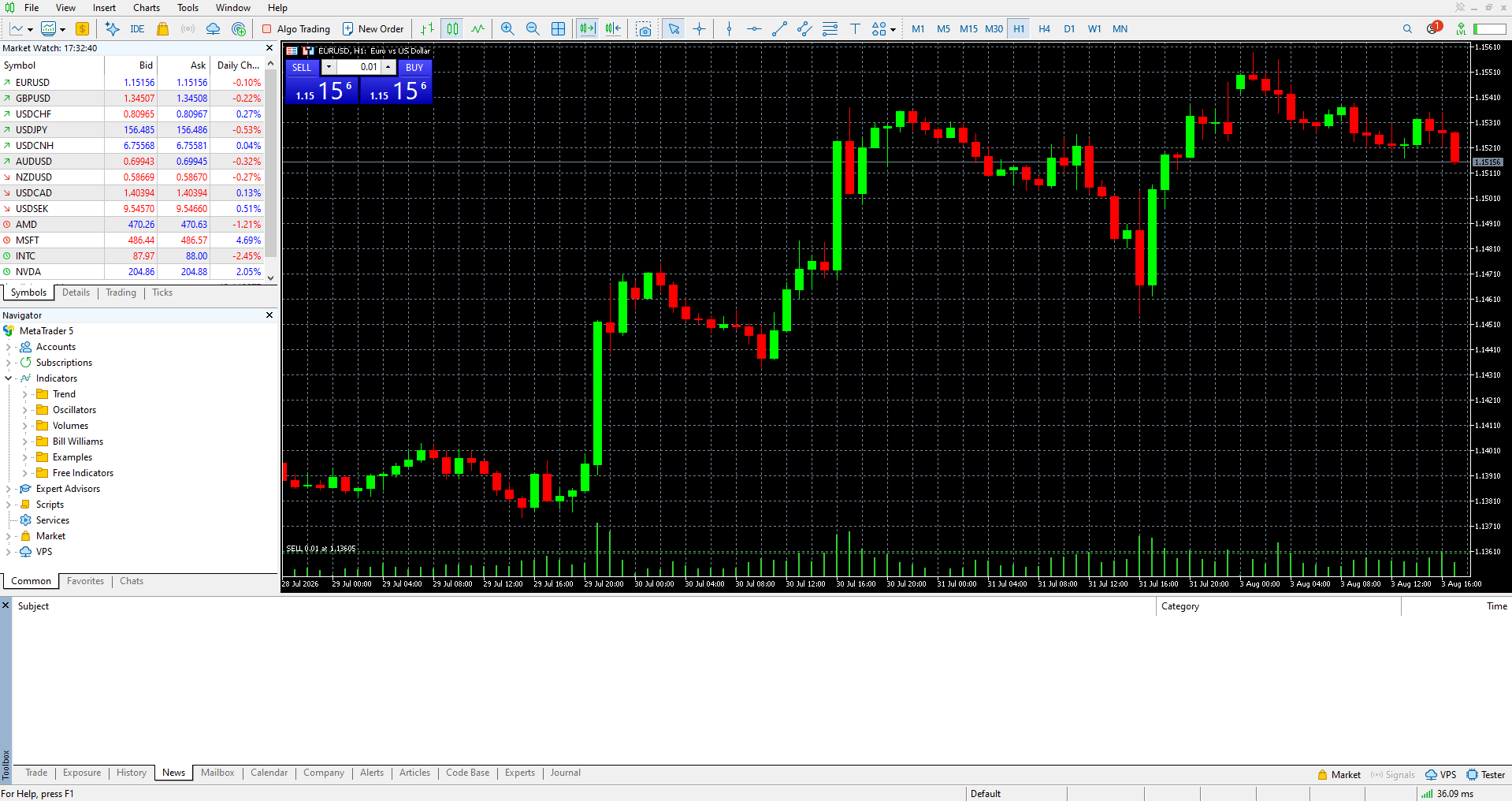
cTrader
 cTrader stands as a popular alternative to MetaTrader. While not quite as widespread as MT4 and MT5, it is still supported by various reputable broking firms. We have used cTrader to trade pretty much all popular types of instruments, including but not limited to commodities, crypto, and of course, forex, though the exact roster of symbols is dependent on the broker.
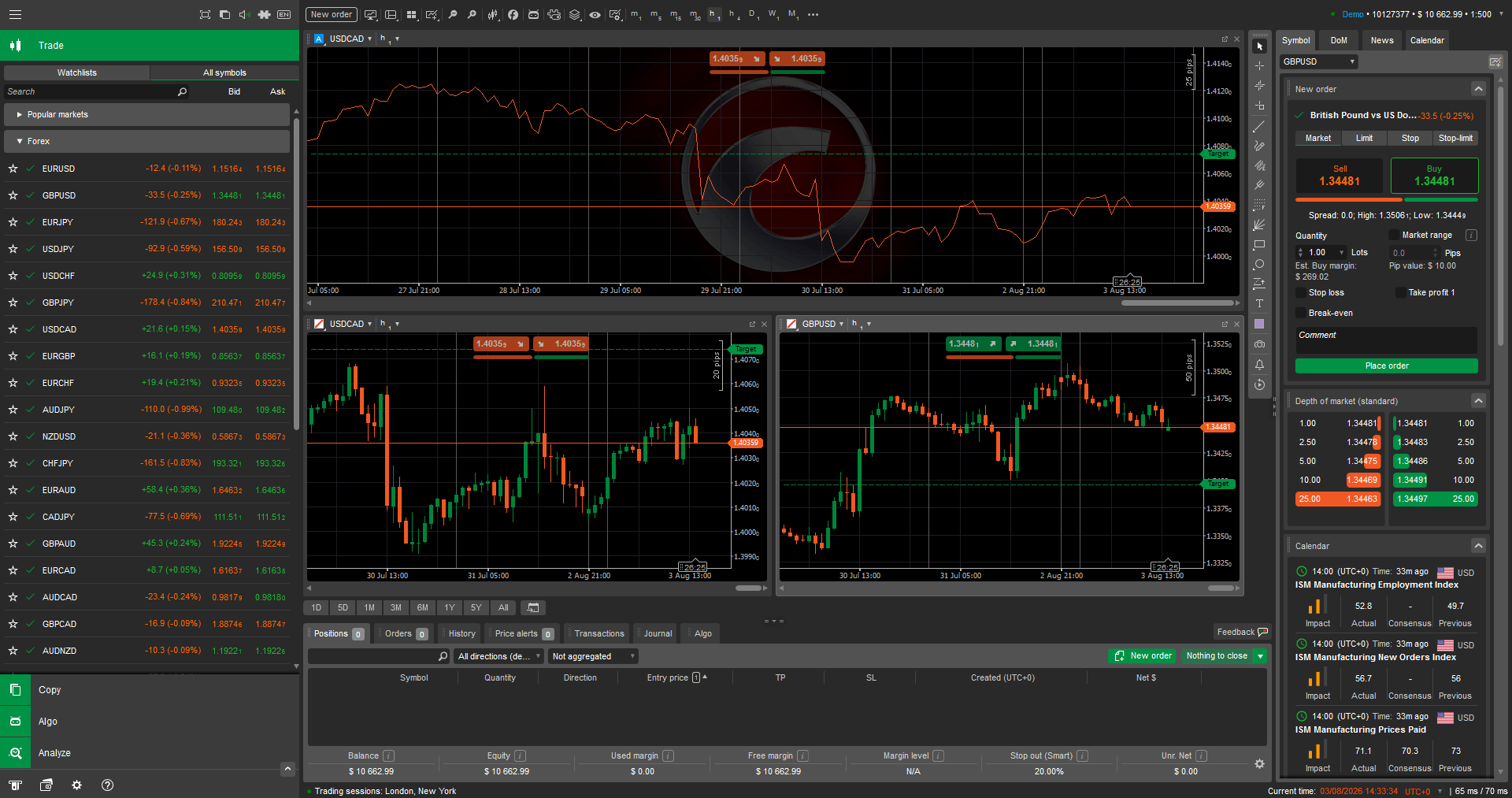
One of cTrader’s key highlights is its clean and easy-to-use interface. Pairs can be organized in watchlists, algo tools can be accessed easily, and traders can choose from various technical indicators like SMAs, Bollinger Bands, Average True Range, and more. In terms of charts, bars, candlesticks, line charts, dot charts, area charts, and HLC charts are all available.
On cTrader, pairs are typically listed in the watchlist or symbol finder. The platform makes it easy to search by currency code and open charts quickly. As with other platforms, naming conventions and trading hours depend on the broker and account type.
Trading Currency Pairs on Mobile Platforms
 FX devotees who plan on trading on the go can do so by using mobile applications. We have verified that all of the platforms outlined in this publication have created apps that can be installed through Google Play, the App Store, or official APK files. Brokers with proprietary platforms also tend to make them mobile-friendly.
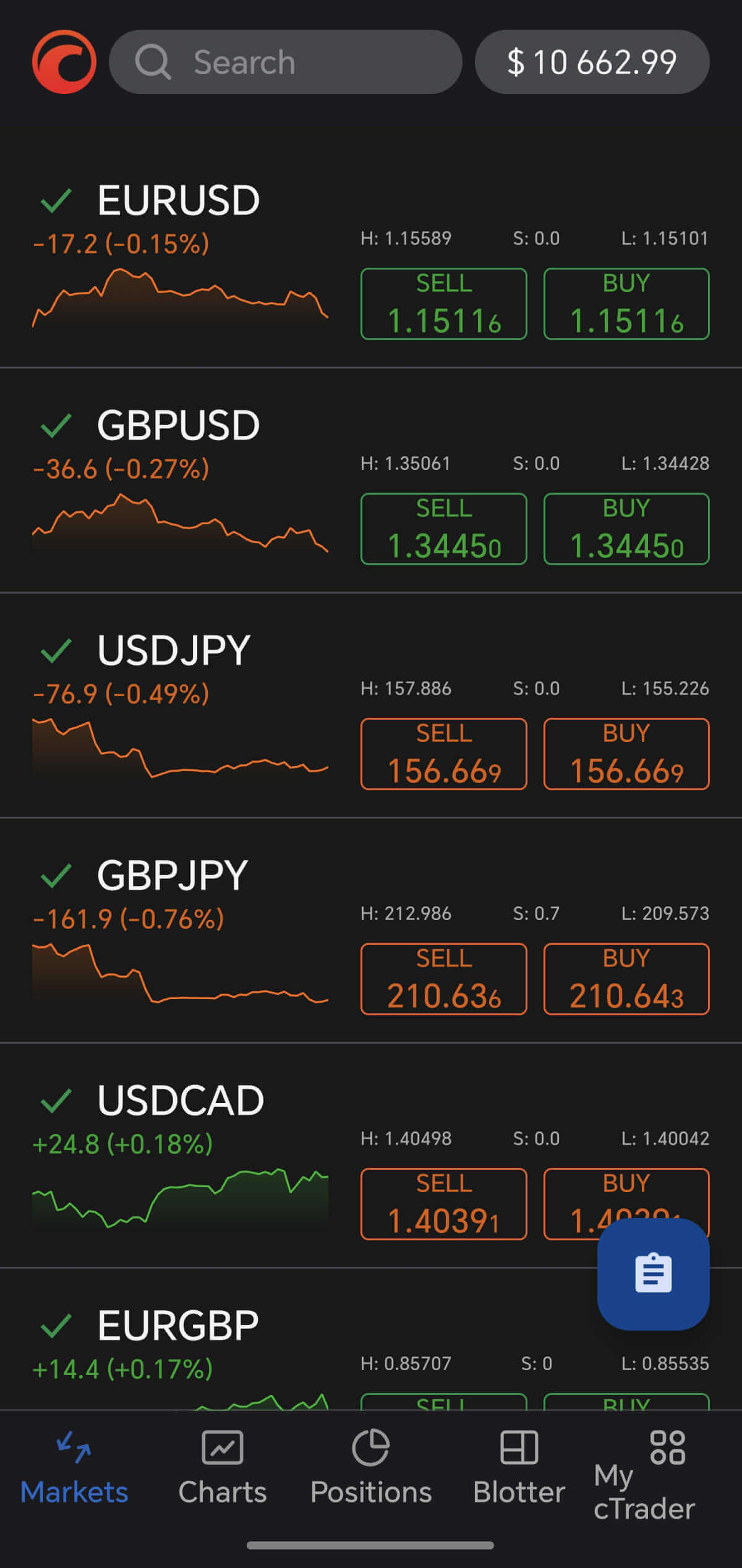
Trading on the go has its pros and cons, and typically, a notable perk is push notifications for price alerts, orders being filled, margin call thresholds, and the like. They typically feature one-click trading and enable account management. In terms of downsides, the mobile interface is far more limited in terms of charting, and features like backtesting or algo trading can be either absent or limited in their capabilities.
Using Platforms to Trade Currency Pairs
 Platforms allow you to open charts in order to see the performance of a given trade. To open a chart, select the pair and choose a timeframe that matches your analysis style, such as one minute, one hour, or daily. Candlestick charts are the preferred chart type of many traders because they show open, high, low, and close prices clearly.
Pair specifications are also key and often include contract size, minimum trade size, step size, decimal format, swap rates, margin requirements, and trading hours. These details are essential because they affect risk, cost, and order placement.
Once you are ready to place an order, you will have the opportunity to place buy and sell orders on most platforms. You will also be able to set up the stop-loss and take-profit parameters, market range, quantity, and the like. A common beginner error is entering the wrong direction or using a volume that is much larger than intended, so you must pay close attention when placing an order.
Choosing Currency Pairs to Trade
Picking your first currency pairs can be very difficult for a complete novice, and even seasoned traders may also struggle with FX choices. Below, we offer a set of tips on how to approach currency pair choice.
- Start with Major Currency Pairs: Most beginners start with major pairs because they are usually easier to follow, more heavily analyzed, and often more liquid than minors or exotics. Many traders start with one pair, such as EUR/USD, before expanding. Do remember that even majors are not low risk, so an effective risk strategy should be utilized.
- Compare Spreads and Volatility: Compare how much a pair usually moves with how much it costs to trade. A pair with moderate movement and lower costs may fit your strategy better than a pair with huge swings and wide spreads. The right balance also depends on whether you scalp, day trade, or swing trade.
- Match Pairs to Your Trading Session: It is usually easier to trade a pair during the hours when that pair is naturally active. If you can only trade during Asian hours, yen, Australian dollar, or New Zealand dollar pairs may be easier to monitor than pound or euro pairs. Matching the pair to your schedule helps you avoid forcing trades in thin conditions.
- Consider Economic Calendar Events: Before choosing a pair for the day or week, review the economic calendar for the countries involved. Central bank meetings, inflation releases, and jobs reports can transform a quiet setup into a high-risk event trade. If you are a beginner, avoiding major releases until you fully understand when trading in the midst of event-driven volatility can be a sensible choice.
- Avoid Too Many Pairs at Once: Watching too many pairs at the start often leads to confusion, duplicate exposure, and negligence in terms of noticing important details. It is usually more effective to learn how to trade one or two pairs well than to scan ten pairs superficially. Fewer pairs make it easier to notice how session timing, volatility, and news affect price behavior. As you gain more experience, you can choose to slowly expand the roster of currency pairs you focus on.
- Choose Pairs That Fit Your Strategy: A breakout trader, a range trader, and a long-term macro trader do not need the same type of pair. Some strategies work better on highly liquid majors, while others may prefer trending crosses, macro-driven commodity pairs, or exotics. There is no pair that is universally considered the best; the right choice depends on your style, risk tolerance, and when exactly your trading sessions take place.
- Test Pairs on a Demo Account: Demo trading can help you learn how currency pair prices move, how spreads change, and whether your strategy fits the symbol in question. However, demo results do not perfectly translate to live trading sessions due to factors such as emotional trading, slippage, and more, and you should keep this in mind when evaluating your demo performance.
Currency Pair Comparison Checklist
Below, you will find a comprehensive overview of the type of checks you should perform before you settle on a given pair and what questions you should ask yourself before proceeding with opening a position.
Liquidity Checklist
Use liquidity checks before adding a pair to your watchlist. Good liquidity often makes trading simpler, but it should be confirmed during the hours you actually trade. Make sure you know the answers to each of the following questions before proceeding:
- Is the pair usually active during your available trading session?
- Does the spread stay reasonably stable outside major news?
- Is execution typically smooth on your platform and account type?
- Are there known periods of thin liquidity you should avoid?
Spread Checklist
Spread should be reviewed in context, not in isolation. A low spread is helpful only if the pair’s movement and your strategy can still justify the trade:
- What is the spread during your normal trading hours, not just at the market open?
- Is the spread proportionate to your target size and stop distance?
- Does the spread widen significantly during the times you plan to trade?
- Are you comparing full cost, including commissions, where applicable?
Volatility Checklist
Volatility must fit your strategy and risk tolerance. Too little movement may not suit short-term trades, while too much movement can overwhelm your stop-loss plan:
- Does the pair’s average movement match your timeframe?
- Can your stop-loss handle normal volatility without being too wide for your account?
- Does volatility spike regularly around scheduled data you may hold through?
- Have you adjusted the lot size to the pair’s current pace?
Session Checklist
Session timing matters because the same pair behaves differently across the day. The best pair on paper may be a poor choice if you trade it in its quietest hours:
- Which session is most relevant for this pair?
- Do you trade during that session consistently?
- Does your strategy work better in active or quieter conditions?
- Have daylight savings or holidays affected current trading hours?
News Event Checklist
Before entering a trade, check whether upcoming events could change the pair’s behavior. Scheduled news often creates more risk than beginners expect:
- Are major releases due for either currency soon?
- Will you hold through the event, reduce size, or avoid the trade?
- Does your strategy include rules for spread widening and slippage?
- Have you taken unscheduled headline risk into account?
Correlation Checklist
Correlation review helps prevent accidental overexposure. Always look at the bigger currency picture, not only the individual trade ticket:
- Do you already hold another trade with similar USD, JPY, or EUR exposure?
- Are two planned trades likely to move together?
- Has the correlation changed recently due to a local macro story?
- Would a single market theme hurt several positions at once?
Swap Cost Checklist
Swaps are a major trading cost for trading enthusiasts who hold positions past market hours. Many traders remember the swap only after it starts affecting results.
- What are the current long and short swap values on your platform?
- Are you likely to hold the trade beyond the rollover?
- Is there a triple swap day during your planned holding period?
- Could the swap materially change the attractiveness of the setup?
Risk Management Checklist
Every pair should pass a risk test before you decide to trade. A setup is not good if the account-level risk is wrong.
- Have you defined the maximum loss for the trade?
- Is position size calculated from stop distance, not from profit hope?
- Will total open exposure remain within your account rules?
- Have you planned for news, overnight risk, and possible slippage?
About the Editorial Team